
 Worksheets
Genetics Review
Total questions: 36
Worksheet time: 24mins
Name
Class
Date
1.
The passing of traits from parent to offspring
a)
Heredity
b)
Genetics
c)
Hybrid
d)
Probability
2.
which is heterozygous ?
a)
Tt
b)
TT
3.
Which is homozygous ?
a)
Zz
b)
SS
4.
the genetic makeup of an organism
a)
heterozygous
b)
punnet square
c)
genotype
5.
A homozygous dominant dog with brown fur is crossed with a heterozygous dog with brown fur. What are the percentages of the possible genotypes?
a)
100% BB
b)
75% BB and 25%Bb
c)
50 % BB and 50% Bb
d)
50% Bb and 50% bb
6.

An offspring will receive how many alleles from each parent to determine a specific trait?
a)
one
b)
two
c)
three
d)
five
7.
Which of the following is a phenotype?
a)
BB
b)
Bb
c)
bb
d)
Blue eyes
8.
having two of the same genes for the trait (sometimes called purebred).
a)
homozygous
b)
hetrozygous
c)
protein
d)
chromosome
9.
having two different genes for a trait (sometimes called hybrid).
a)
protein
b)
homozygous
c)
heterozygous
d)
genotype
10.

In the second generation-how many people are carriers of the trait?
a)
2
b)
3
c)
5
d)
6
11.

How many individuals are there in the 3rd generation?
a)
2
b)
3
c)
4
d)
6
12.
What do we use pedigrees for?
a)
To look at families
b)
To make determinations about the offspring
c)
To track traits in families
d)
Nothing
13.

What is the gender of the individual whose karyotype is seen in the image?
a)
Male
b)
Female
14.
Which of the following would be considered a Gamete cell?
a)
Egg Cell
b)
Sperm Cell
c)
Both of these
d)
None of these
15.
If the diploid (full cell) number for carrots is 18, the haploid (half cell) number is
a)
18
b)
9
c)
27
d)
36
16.
Which sex chromosomes would indicate a typical human male?
a)
XX
b)
X
c)
XY
d)
XXY
17.
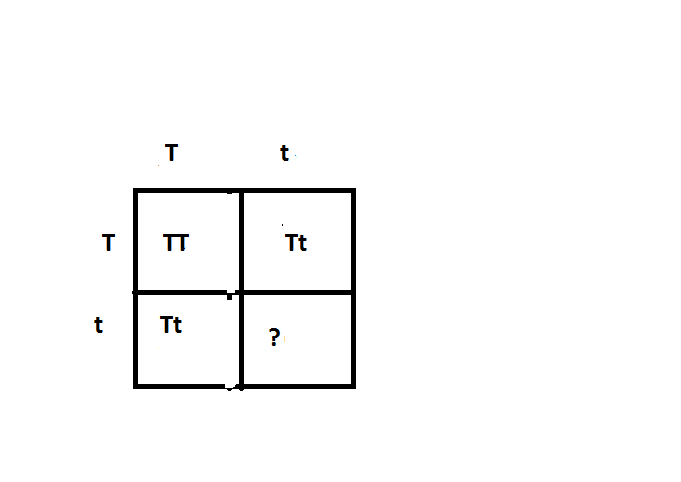
T - tall and t = short
In the punnett square below, what belongs in the missing square
In the punnett square below, what belongs in the missing square
a)
tt
b)
Tt
c)
Bb
d)
TT
18.
What is a punnett square?
a)
graph used to predict the possible genotypes of offspring in a given cross
b)
a graph used to predict the possible birth rate of offspring.
c)
a graph used to predict the possible behavioral characteristics an offspring could have
d)
None of the above
19.
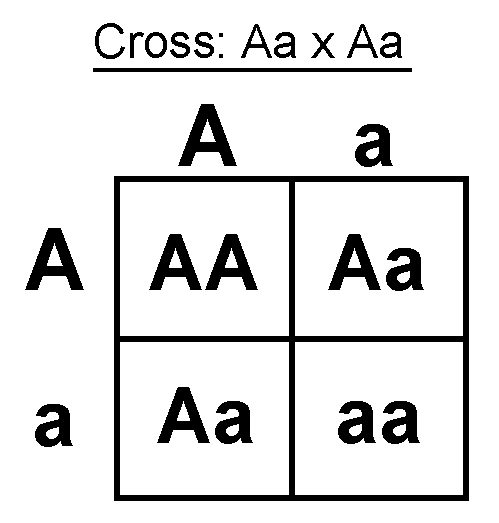
What is the phenotype of the offspring? (A-Brown hair; a-blond hair)
a)
50 % Brown Hair and 50% Blond Hair
b)
25 % Brown Hair and 75% Blond Hair
c)
75 % Brown Hair and 25% Blond Hair
d)
0% Brown Hair and 100% Blond Hair
20.
What process does a multi-cellular organism use to replace its damaged body cells?
a)
mitosis
b)
meiosis
c)
replication
d)
transcription
21.
DNA will condense into...
a)
Centromeres
b)
Chromosomes
c)
Nuclei
d)
Spindle fibers
22.
The result of meiosis is:
a)
two diploid cells
b)
four haploid cells
23.
What causes genetic variation in meiosis?
a)
chromosomes lining up
b)
crossing over of chromosomes
c)
separation of chromosomes
d)
chromosomes pulling apart
24.
What is diploid?
a)
A cell with half the DNA
b)
A cell with a full set of DNA
c)
A cell that doesn't work
d)
A cell that likes Duplo
25.
What is the process called that creates sperm & eggs?
a)
Spermatogenisis
b)
Meiosis
c)
Mitosis
d)
Reproduction
26.
In asexual reproduction, all of the offspring are:
a)
Physically Identical
b)
Genetically Identical
c)
Physically and Genetically Identical
d)
Not Identical
27.

a)
budding
b)
sporulation
c)
vegetative propagation
d)
binary fission
28.
How many parent(s) are needed for asexual?
a)
4
b)
1
c)
9
d)
100
29.
What is an advantage of sexual reproduction?
a)
Allows genetic variation
b)
Only needs one parent
c)
Happens very quickly
d)
Offspring are exact copies of parent
30.
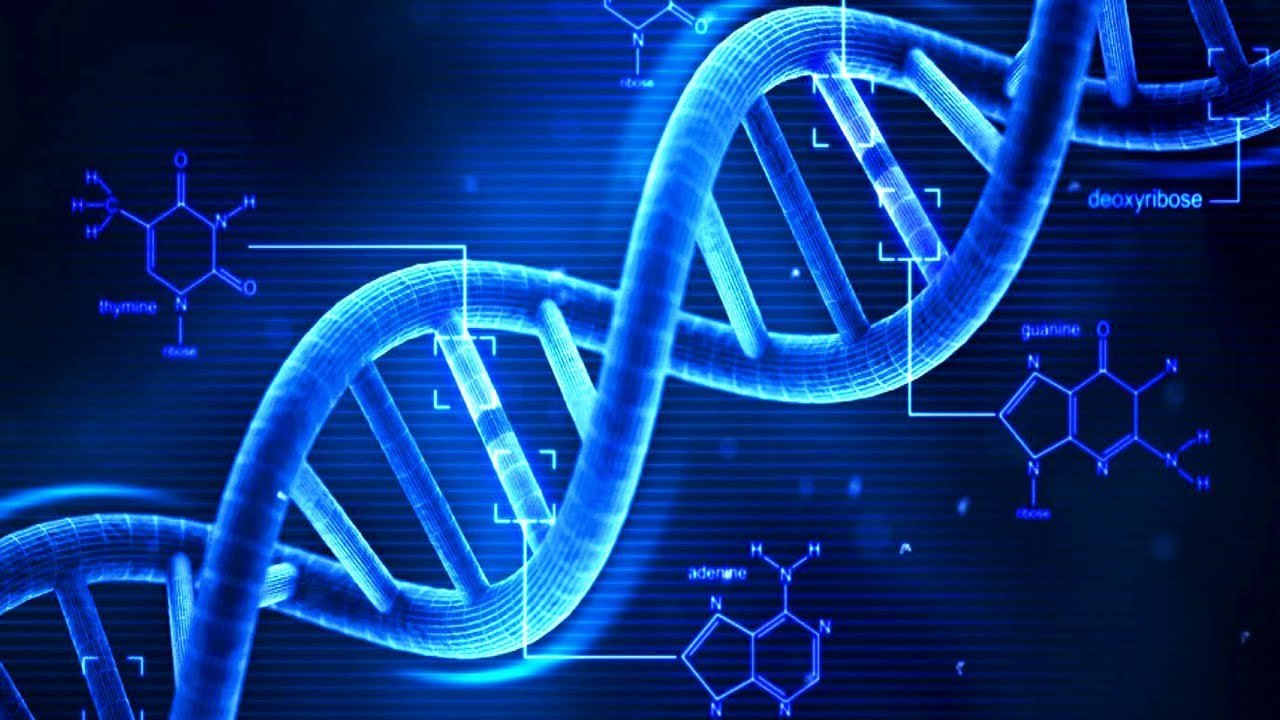
When comparing the offspring of sexually and asexually reproducing organisms, we would expect the genetic material (DNA) of the sexually reproducing organism to -
a)
contain fewer mutations
b)
be lesser in quantity
c)
be simpler overall
d)
show more variation
31.
Selective breeding is...
a)
a process to create an organism with desired traits from parents with those desired traits
b)
natural method of producing offspring with desired traits
c)
creating a new species
d)
making organisms reproduce during times of stress
32.
Which is another term for selective breeding?
a)
Artificial selection
b)
Natural Selection
c)
Intelligent selection
33.

What do you call a section of DNA that codes for a specific trait?
a)
nucleus
b)
chromosome
c)
gene
d)
DNA
34.

How many chromosomes are found in human egg and sperm cells?
a)
20
b)
23
c)
26
d)
46
35.

__________ worked with pea plants to prove that traits are passed from parent to offspring.
a)
Reginald Punnett
b)
Gregor Mendel
36.

The two different forms of a gene are called _________.
a)
zygotes
b)
traits
c)
phenotypes
d)
alleles
100 %

