wayground logo

Free Printable Worksheets

Font size

S
M
L
XL
Worksheets

Final Exam Review Game

Total questions: 73

Worksheet time: 53mins

Name
Class
Date
1.
Surface currents are a result of
a)
Global Wind Patterns
b)
Earth's Rotation
c)
Density
d)
All of the above
2.
Deep Ocean currents are a result of
a)
Global Wind Patterns
b)
Earth's Rotation
c)
Density
d)
All of the above
3.
The Coriolis Effect is caused by
a)
Earth rotating around the sun
b)
Earth rotating on its axis
c)
The tides
d)
Gravity
4.
The Gulf stream carries _____________ water from the east coast of The United States to the West coast of Europe.
a)
Cold
b)
Warm 
c)
Freezing
d)
Fresh
5.
What happens to a current when it comes in contact with a continent or landmass?
a)
It continues over the continent
b)
It stops
c)
It changes direction
d)
It is absorbed by the land
6.
As you go deeper in the ocean, the water is colder and less salty.
a)
True
b)
False
7.
Due to the Coriolis Effect, water in the northern hemisphere moves
a)
clockwise
b)
counter clockwise
c)
both
d)
neither
8.
Due to the Coriolis Effect, water in the southern hemisphere moves
a)
clockwise
b)
counter-clockwise
c)
both
d)
neither
9.
Warm ocean currents generally come from
a)
The North Pole
b)
The South Pole
c)
The Equator
d)
Both A and B
10.
Cold ocean currents generally come from
a)
The North Pole 
b)
The South Pole
c)
The Equator
d)
Both A and B
11.
The California Current (west coast) carries _________ water from canada
a)
Cold 
b)
Warm
c)
Freezing
d)
Fresh
12.
Two types of water currents are
a)
local and global
b)
sea and land
c)
surface and deep
d)
warm and cold
13.
Ocean currents have an affect on which two things
a)
climate and weather
b)
temperature and density
c)
land and sea
d)
equator and poles
14.
A strong surface current that runs along the east coast of the United States and carries warm water to Europe.
a)
California Current
b)
Global Conveyor Belt
c)
Gulf Stream
d)
Surface Current
15.
A cool current in the Pacific Ocean near North America that brings cold water down from Canada.
a)
California Current
b)
Global Conveyor Belt
c)
Gulf Stream
d)
Surface Current
16.
Constantly moving system of deep-ocean circulation driven by temperature and salinity. It moves water around the globe.
a)
California Current
b)
Global Conveyor Belt
c)
Surface Currents
d)
Gulf Stream
17.
A horizontal movement of ocean water that is caused by wind and that occurs at or near the ocean's surface.
a)
Gulf Stream
b)
Global Conveyor Belt
c)
Surface Current
d)
Gyre
18.
The large, circular surface-current pattern found in each ocean.
a)
California Current
b)
Surface Current
c)
Gyre
d)
Global Conveyor Belt
19.
What process brings the deep cold ocean currents up to the surface?
a)
Conduction
b)
Global Wind Patterns
c)
Convection Currents
d)
Temperature and salinity
20.
Why are surface currents at the surface of the ocean?
a)
colder temperature
b)
colder temperature & more salinty
c)
warmer temperature & less salinty
d)
less salinty
21.
A[n] ______________ tide occurs when the sun is at right angles to the line between Earth and the moon. 
a)
high
b)
neap
c)
low
d)
spring
22.
Differences in the moon's and sun's pull on different sides of the Earth cause _________.
a)
gravity
b)
lunar phases
c)
tides
d)
dabbing
23.
A[n] ___________ tide occurs when the sun, Earth, and the moon are nearly in a line. 
a)
spring
b)
high
c)
low
d)
neap
24.
The bulge of water on the side of the Earth closest to the moon produces ___________.
a)
high tide
b)
low tide
c)
neap tide
d)
spring tide
25.
Water flows toward the high tides, halfway between them causing ____________.
a)
neap tide
b)
high tide
c)
spring tide
d)
low tides
26.
Tides are the cycle of rising and falling ocean water that repeats automatically every
a)
24 hours
b)
12.5 hours
c)
25 hours
d)
6.25 hours
27.
A neap tide is a tide with the greatest difference between low and high tides
a)
true
b)
false
28.
Tides are caused mainly by the differences in how much gravity from the moon and the sun pulls on different parts of the Earth. 
a)
True
b)
False
29.
Changes in the positions of Earth, the moon, and the sun affect the height of high tides during a month. 
a)
True
b)
False
30.
What are ocean tides?
a)
Long waves due to the gravitational pull of the moon only.
b)
Long period waves caused by wind.
c)
Short period waves caused by wind. 
d)
Long waves due to the gravitational pull between the Earth,sun and the moon
31.

What is a high tide?

a)

Sea pulled TOWARD the moon where Earth is CLOSEST to the moon

b)

Sea pulled AWAY from the moon where Earth is FARTHEST to the moon

c)

Sea pulled AWAY from the moon where Earth is CLOSEST to the moon

32.
What is a difference between spring and neap tides?
a)
Spring tides occur when the earth and sun are IN LINE with the new or full moon. 
b)
Spring tides occur when moon in 3rd or 1st quarter phases
c)
Spring tides are LOWER than neap tides
33.

Wha type of tide would this arrangement of earth-moon-sun create?

a)

full moon tide

b)

new moon tide

c)

neap tide

d)

spring tide

34.
What type of tides would this arrangement of earth-moon-sun create?
a)
neap tide
b)
spring tide
c)
new moon tide
d)
full moon tide
35.
Physically breaking down rocks and materials is called__________weathering.
a)
Chemical
b)
Mechanical
c)
Biological
d)
Permeable
36.
A rock containing iron is soft, crumbly, reddish in color. It's been chemically weathered by__.
a)
Carbon Dioxide
b)
Oxygen
c)
Nitrogen
d)
Sulfer
37.
Soil formation begins with the weathering of_______.
a)
Humas
b)
Subsoil
c)
Litter
d)
Rock
38.
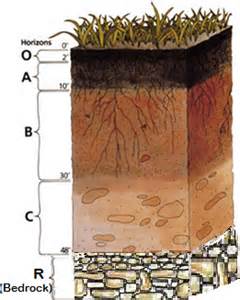
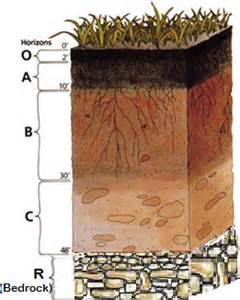
The layer of soil which the topsoil is found.
a)
Horizon A
b)
Horizon B
c)
Horizon C
d)
Horizon D or R
39.
Decayed organic material in soil is called______.
a)
Litter
b)
Silt
c)
Humus
d)
Clay
40.
The movement of rocks and weathered materials is called_________.
a)
Chemistry
b)
Physical
c)
Weathering
d)
Erosion
41.
Which horizon is made up of partially weathered rocks?
a)
Horizon A
b)
Horizon B
c)
Horizon C
d)
Horizon D or R
42.
Topsoil which contains the HUMUS is the soil layer best for growing plants.
a)
True
b)
False
43.
In which horizon is most of the HUMUS?
a)
Horizon A
b)
Horizon B
c)
Horizon C
d)
Horizon D or R
44.
There is an unlimited supply of fertile soil.
a)
True
b)
False
45.
Soil's one of the Earth’s most valuable resources. Everything on Earth depends on soil somehow.
a)
True
b)
False
46.
"When rocks scrape along the river bank and bed" is what type of erosion?
a)
Attrition
b)
Abrasion
c)
Solution
d)
Hydraulic Action
47.
"Where the water filters into the ground and into the tiny pores in the soil" What am I?
a)
Infiltration
b)
Percolation
c)
Precipitation
d)
Interception
48.
"I am a smaller river joining a larger river" What am I?
a)
Confluence
b)
Tributary 
c)
Drainage Basin
d)
Watershed
49.
Able to allow water to pass through
a)
Permeability
b)
Runoff
c)
Pores
d)
Permeable
50.
Which type of river contains rapids and waterfalls?
a)
Young
b)
Old
c)
Mature
51.
A ___________________ is the area of land that collects runoff and channels it into a main river.
a)
rill
b)
gully
c)
stream channel
d)
watershed
52.
Which well(s) end(s) in a saturated zone?
a)
1 and 2
b)
1 only
c)
4 and 5
d)
1,3 and 5
53.
Where do most rivers eventually flow?
a)
Deserts 
b)
Mountains
c)
Lakes
d)
Oceans
54.
What is the area underground where there is not any water?
a)
Zone of Saturation
b)
Zone of Aeration
c)
Water
55.
The amount of space between soil is:
a)
Porosity
b)
Permeability
56.
The ability of a liquid to flow through a substance is:
a)
Porosity
b)
Permeability
57.
What are sources of water pollution?
a)
Precipitation as Acid rain
b)
Runoff water & Groundwater
c)
Industry & Household waste
d)
All of these
58.
An aquifer is a(n)
a)
well in which water rises because of pressure
b)
underground layer of rock or sediment that holds water
c)
type of hot spring from which the water periodically erupts
d)
place where groundwater bubbles or flows out of cracks in the rock
59.
Water pollution that comes from many sources is considered...
a)
point source pollution
b)
nonpoint source pollution
c)
thermal pollution
d)
ocean pollution
60.
97% of the water on earth is _________, making it undrinkable for humans.
a)
fresh water
b)
ground water
c)
salt water
d)
surface water
61.
Which of the following is a way to save water?
a)
Water the lawn at high noon
b)
washing half loads of dishes
c)
taking shorter showers
d)
running the water while brushing your teeth
62.
___________________ washes agricultural wastes, including animal wastes, fertilizers, and pesticides, into bodies of water, causing algae to grow.
a)
Runoff
b)
Peak flow
c)
Groundwater
d)
Municipal sewage
63.
The water cycle includes ...
a)
Evaporation, Condensation, Transportation, Precipitation.
b)
Evaporation, Condensation, Transpiration, Precipitation.
c)
Evaporation, Erosion, Transpiration, Precipitation.
d)
Evaporation, Erosion, Transportation, Precipitation.
64.

A river becomes this when the earth is uplifted and increases the gradient of a river causing it to move faster.

a)

mature river

b)

oxbow lake

c)

braided stream

d)

rejuvenated river

65.

What stage of river has a V shape and does not meander?

a)

old

b)

mature

c)

youthful

d)

broken

66.

A fan shaped deposit that is dry and made of mostly sand and gravel. Occurs in arid climates

a)

delta

b)

alluvial fan

c)

meander

d)

point bar

67.

Triangular shaped deposit at the mouth of a stream where it enters a large body of water.

a)

alluvial fan

b)

delta

c)

meander

d)

oxbow lake

68.
Oxidation is a chemical reaction that takes place when oxygen reacts with another element. Oxygen is very strongly chemically reactive. The most familiar type of oxidation is when iron reacts with oxygen to create rust.
Which chemical creates rust?
a)
Oxygen
b)
Carbon Dioxide
c)
Nitrogen
d)
Neon
69.
How does freezing water cause the weathering of rocks?  The freezing water—
a)
keeps the rocks in place
b)
makes the rocks last longer
c)
expands cracks and breaks rocks
d)
causes rocks to fall in landslides
70.
The process that breaks down rocks and other materials on Earth's surface is called
a)
weathering
b)
erosion
c)
soil conservation
d)
decomposition
71.
What is mechanical weathering?
a)
Process through which rocks are physically broken into smaller pieces.
b)
Rocks are broken down through chemical changes.
c)
Rocks are worn away from acid in plant roots.
d)
Rocks broken down by machinery.
72.
This rock may chemically weather easily because is has many spaces or holes in it that allow water to seep through it called
a)
porosity
b)
abrasive
c)
erosion
d)
unchangable
73.
Deposition changes the Earth’s surface because eroded materials _____.
a)
stop the river's flow
b)
make rich farmlands
c)
are dropped in new places
d)
move very slowly