
 Worksheets
Lesson 1 & 2 Review: Electricity
Total questions: 65
Worksheet time: 2hrs 7mins
Name
Class
Date
1.

What kind of circuit is this?
a)
series
b)
parallel
2.

What kind of circuit is this?
a)
Series
b)
Consecutive
c)
Parallel
d)
Training
3.

What type of circuit is this?
a)
series
b)
parallel
4.

What type of circuit is shown in the picture?
a)
Double circuit
b)
Series circuit
c)
Magnetic circuit
d)
Parallel circuit
5.

What type of circuit is shown in the picture?
a)
Series
b)
Parallel
c)
Double
d)
Switch
6.
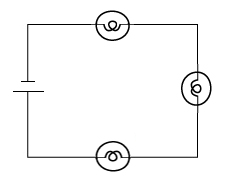
The picture shows an electrical circuit. This circuit is a series circuit because:
a)
It has 3 light bulbs.
b)
The same current flows through all three light bulbs.
c)
It uses a single battery.
d)
The electrical current is divided between the three light bulbs.
7.

A pathway for electricity to travel is called___________
a)
current
b)
static electrcity
c)
circuit
d)
circle
8.

This is the symbol for a _____?
a)
switch
b)
light
c)
battery
d)
wires
9.

A continuous flow of electricity is called_____________
a)
series
b)
circuit
c)
static
d)
current
10.

What component is this?
a)
Bulb
b)
LED
c)
Battery
d)
diode
11.

Two like charges
a)
neutralize each other.
b)
repel each other.
c)
must be neutrons.
d)
attract each other.
12.

The charge of an electron is
a)
positive.
b)
negative.
c)
Electrons have no charge
13.

Which of the following materials conducts electricity the best?
a)
plastic
b)
rubber
c)
metal
d)
glass
14.

Electricity is the flow of _________.
a)
Protons
b)
Neutrons
c)
Electrons
15.

Which of these objects is an insulator?
a)
Copper Wire
b)
Paper Clip
c)
Steel Pole
d)
Rubber Gloves
16.

Which one is a conductor?
a)
wood
b)
iron
c)
plastic spoon
d)
paper
17.
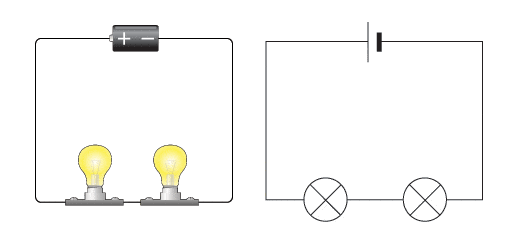
What kind of circuit is this?
a)
Series
b)
Consecutive
c)
Parallel
d)
Training
18.

When a lightbulb lights up in an electrical circuit, __________________________.
a)
light is transformed into electrical energy
b)
electrical energy is transformed to light and heat energy
c)
light and heat are transformed into electrical energy
d)
there is no energy transformation
19.
A material in which electrons are able to move easily
a)
Circuit
b)
Insulator
c)
Resistance
d)
Conductor
20.
A material in which electrons are not able to move easily
a)
Circuit
b)
Insulator
c)
Resistance
d)
Conductor
21.
The flow/movement of electric charges
a)
Voltage
b)
Resistance
c)
Current
d)
Circuit
22.
A closed path that electric current follows
a)
Voltage
b)
Current
c)
Resistance
d)
Circuit
23.
Which on the following is NOT an example of an insulator.
a)
Rubber
b)
Glass
c)
Penny
d)
Wood
24.
The flow of electric charges is
a)
voltage
b)
Electric field
c)
resistance
d)
electric current
25.
A closed path that electric current flows is a
a)
circuit
b)
series circuit
c)
parallel circuit
26.
Where do electrons pick up their energy from?
a)
Battery
b)
wire
c)
Lightbulb
27.

What kind of picture does the picture show?
a)
Closed/Complete
b)
Open/Incomplete
28.
The plastic around an electrical wire is
a)
conductor
b)
insulator
c)
decoration
29.

Which of the following does not conduct electricity?
a)
gloves
b)
penny
c)
paper clip
d)
key
30.
Electricity is the flow of ______.
a)
electrons
b)
protons
c)
neutrons
d)
atoms
31.
Metals such as copper, iron, gold, and silver are ...
a)
conductors
b)
brittle
c)
insulators
d)
resistors
32.

What types of charges attract?
a)
Positive and Positive
b)
Positive and Neutral
c)
Negative and Neutral
d)
Positive and Negative
33.
Mary is making an electrical circuit. They are linked in a series. Which will happen if one of the lights burns out?
a)
Only the burnt out light will not shine.
b)
A short circuit will occur
c)
Current flow will continue, but the burnt out light will not shine.
d)
None of the lights will shine.
34.
David is making an electric circuit. The circuit is correctly linked in two parallel paths. What will happen if one of the lights burns out?
a)
None of the lights will shine.
b)
All current flow will stop
c)
Only the burnt out light will not shine.
d)
A short circuit will occur
35.
What is the most important characteristic of a parallel circuit?
a)
multiple paths for current flow
b)
multiple conductors
c)
multiple power sources (batteries)
d)
multiple devices (like light bulbs)
36.
What do you call an object that allows electricity to flow?
a)
Conductor
b)
Insulator
c)
Resistance
d)
Electromagnet
37.
What is an object that does not conduct electricity?
a)
Conductor
b)
Insulator
c)
Circuit
d)
Resistance
38.
What are the materials that make up a simple circuit?
a)
wires, switch, outlet
b)
battery, switch, motor
c)
wires, light bulb, motor
d)
wires, battery, light bulb
39.

Is this circuit open or closed?
a)
Closed
b)
Open
40.
Voltage is measured in __.
a)
volts
b)
ohms
c)
amps
41.
Like charges ...
a)
attract each other
b)
repel each other
c)
stabilize each other
d)
are not attracted or repelled
42.
Like charges ___________, opposite charges _____________.
a)
repel, repel
b)
attract, attract
c)
attract, repel
d)
repel, attract
43.

What is # 3 pointing to in the diagram?
a)
base contact
b)
button contact
c)
support wires
d)
filament
44.
What charge does an electron have?
a)
negative (-)
b)
positive (+)
c)
neutral or no charge (0)
45.
What charge does a proton have?
a)
negative (-)
b)
positive (+)
c)
neutral or no charge (0)
46.
An example of an insulator is:
a)
iron
b)
silver
c)
copper wire
d)
rubber
47.

a)
Series circuit
b)
Incomplete circuit
c)
Parallel circuit
d)
Power source
48.

a)
Parallel circuit
b)
Series circuit
c)
Incomplete circuit
d)
Switch
49.
____________ allows electricity to flow.
a)
A conductor
b)
An insulator
c)
A magnet
50.
____________ stops the flow of electricity.
a)
A conductor
b)
An insulator
c)
A magnet
51.

In a parallel circuit if one of the light bulbs burns out the rest _________.
a)
stop the flow of electricity
b)
can still light up
c)
will go out
d)
of the light bulbs burn out also
52.
This is the symbol for a _____?
a)
switch
b)
light
c)
battery
d)
wires
53.
What is the major difference between static electricity and current electricity?
a)
Current electricity involves a continuous flow of neutrons; static electricity is a sudden transfer of protons
b)
Current electricity can be deadly; static electricity is almost always safe
c)
In current electricity, there's a single transfer of electrons; in static electricity, there's a steady flow of electrons
d)
Current electricity involves a flow of electrons; static electricity involves a single transfer of electrons
54.

The image on the left is a
a)
series circuit
b)
parallel circuit
c)
a weird circuit
55.

The image on the right is a
a)
series circuit
b)
parallel circuit
c)
looks like the number 8
56.
What supplies the energy in an electric circuit?
a)
light bulb
b)
conductor
c)
wire
d)
battery
57.
A particle that carries a negative electric charge is called a(n) ______.
a)
neutron
b)
atom
c)
proton
d)
electron
58.

Using the picture above, which letter correctly labels the battery?
a)
A
b)
B
c)
C
d)
D
59.
Using the picture above, which letter correctly labels the switch?
a)
A
b)
B
c)
C
d)
D
60.
Using the picture above, which letter correctly labels the light bulb?
a)
A
b)
B
c)
C
d)
D
61.
Which of the following provides stored energy to run the circuit?
a)
Battery
b)
Light Bulb
c)
Switch
d)
Wire
62.
Which of the following controls the flow of electricity by opening and closing the circuit?
a)
Battery
b)
Light Bulb
c)
Switch
d)
Wire
63.
Which of the following produces light when part of a complete circuit?
a)
Battery
b)
Light Bulb
c)
Switch
d)
Wire
64.
Which of the following provides the pathway to carry the electricity from component to component?
a)
Battery
b)
Light Bulb
c)
Switch
d)
Wire
65.
Which kinds of materials make good conductors?
a)
Fabric
b)
Metal
c)
Plastic
d)
Wooden
100 %

