
 Worksheets
MR. W and M 2nd Sem. Science Review Quiz
Total questions: 133
Worksheet time: 2hrs 48mins
Name
Class
Date
1.
Hot coffee is stirred with a spoon; the spoon gets hot due to
a)
conduction
b)
convection
c)
radiation
2.
A chair is several feet from a fireplace. The side of the chair facing the fireplace gets warm due to
a)
conduction
b)
convection
c)
radiation
3.
"Lava lamps" contain colored liquids. These liquids form globs that rise to the top due to
a)
conduction
b)
convection
c)
radiation
4.
Near the ceiling of a room the air is warmer; the warm air rises because of
a)
conduction
b)
convection
c)
radiation
5.
Some cook pans have cooper on the bottom to heat evenly.
Copper transfers heat to the pan by
Copper transfers heat to the pan by
a)
conduction
b)
convection
c)
radiation
6.
In a swimming pool, water near the surface is slightly warmer. The warm water rises because of
a)
conduction
b)
convection
c)
radiation
7.
The metal skewer gets so hot that you drop your marshmallow into the campfire because of
a)
conduction
b)
convection
c)
radiation
8.
A house burns down. The vinyl siding of the house next door warps due to
a)
conduction
b)
convection
c)
radiation
9.
Warm air over the beach rises while cooler, dense air from the ocean rushes in due to
a)
conduction
b)
convection
c)
radiation
10.
A huge rock at the state park gets hot during the day. The rock was warmed from the Sun by
a)
conduction
b)
convection
c)
radiation
11.
You lay on the same hot rock at night and keep warm from the rock by
a)
conduction
b)
convection
c)
radiation
12.
Weather systems in the Earth's atmosphere are due to
a)
conduction
b)
convection
c)
radiation
13.
Any factor that can change in an experiment
a)
variable
b)
constant
c)
independent
d)
dependent
14.
The variable that is being tested or changed
a)
independent variable
b)
dependent variable
c)
control variable
15.
The variable that is being measured
a)
independent variable
b)
dependent variable
c)
control variable
16.
the variable that is kept the same to make sure results are caused by the thing being tested
a)
independent variable
b)
dependent variable
c)
control variable
17.
the manipulated variable
a)
independent variable
b)
dependent variable
c)
control variable
18.
the responding variable
a)
independent variable
b)
dependent variable
c)
control variable
19.
the constant
a)
independent variable
b)
dependent variable
c)
control variable
20.
the variable that is changed by the scientist at the beginning of the experiment
a)
independent variable
b)
dependent variable
c)
control variable
21.
the variable that is observed at the end of the experiment
a)
independent variable
b)
dependent variable
c)
control variable
22.
Scientific Question: Does being tardy impact test scores?
What is the independent variable?
What is the independent variable?
a)
test scores
b)
the time a study arrives to class
c)
amount of time to complete test
23.
Scientific Question: Does being tardy impact test scores?
What is the dependent variable?
What is the dependent variable?
a)
test scores
b)
the time a study arrives to class
c)
amount of time to complete test
24.
Scientific Question: Does being tardy impact test scores?
What is the control?
What is the control?
a)
test scores
b)
the time a study arrives to class
c)
amount of time to complete test
25.
Scientific Question: Does playing video games improve reaction time?
What is the controlled variable?
What is the controlled variable?
a)
playing video games
b)
reaction time
c)
type of video game
26.
Scientific Question: Does playing video games improve reaction time?
What is the independent variable?
What is the independent variable?
a)
playing video games
b)
reaction time
c)
type of video game
27.
Scientific Question: Does playing video games improve reaction time?
What is the dependent variable?
What is the dependent variable?
a)
playing video games
b)
reaction time
c)
type of video game
28.
Scientific Question: Will a person fall asleep faster if they listen to music?
What is the independent variable?
What is the independent variable?
a)
music
b)
time to fall asleep
c)
person
29.
Scientific Question: Will a person fall asleep faster if they listen to music?
What is the dependent variable?
What is the dependent variable?
a)
music
b)
time to fall asleep
c)
person
30.
Scientific Question: Will a person fall asleep faster if they listen to music?
What is the control variable?
What is the control variable?
a)
music
b)
time to fall asleep
c)
person
31.
Scientific Question: Does the type of sneaker you wear affect how fast you can run?
What is the independent variable?
What is the independent variable?
a)
type of sneaker
b)
how fast you run
c)
person
32.
Scientific Question: Does the type of sneaker you wear affect how fast you can run?
What is the dependent variable?
What is the dependent variable?
a)
type of sneaker
b)
how fast you run
c)
person
33.
Scientific Question: Does the type of sneaker you wear affect how fast you can run?
What is the control variable?
What is the control variable?
a)
type of sneaker
b)
how fast you run
c)
person
34.

Which of the following is a scientific observation?
a)
The potato is brown in color.
b)
The potato tastes the best.
c)
The potato may cause allergies.
d)
The potato smells funny.
35.
What is another word for hypothesis?
a)
evidence
b)
graph
c)
investigation
d)
prediction
36.

A scientist is collecting data on the number of times a cricket chips per minute. What sense is the scientist most likely using to make observations?
a)
hearing
b)
smell
c)
sight
d)
touch
37.

Justin blows his nose, but mucus seems to leak through the tissue. He decides to test which tissue holds up the best while sneezing. What is the independent variable?
a)
sneezing
b)
Justin
c)
amount of tissue
d)
type of tissue
38.
Mr. McNeice wanted to know if different types of music affected people's heart rates, so he played different music and checked their pulses. What is the dependent variable?
a)
type of music
b)
heart rate
c)
how long they listend to music
d)
Mr. McNeice
39.
Which question can best be investigated by a scientist?
a)
Should I buy a red shirt or a green shirt?
b)
Does chocolate milk or plain milk taste better?
c)
Does a plant need sunlight to grow?
d)
Which feels softer, cat fur or dog fur?
40.
The container is filled to the 350 mL mark with water.
a)
observation
b)
inference
c)
problem
d)
hypothesis
41.
Why should an experiment be repeated?
a)
to form a hypothesis
b)
to reduce the chance of error
c)
to change controls
d)
to identify the problem
42.
This is the outcome of the experiment. We get data and results from this.
a)
Independent Variable
b)
Dependent Variable
c)
Control
d)
Constant
43.
How many independent variables should be tested at a time in a scientific investigation?
a)
none
b)
one
c)
two
d)
three
44.

Which is the dependent variable in Amelia's experiment?
a)
the number of bean plants in each group
b)
the amount of water given daily to each plant
c)
the height of each bean plant
d)
the amount of fertilizer given to each group of bean plants
45.
To get data from systematic observations, you must:
a)
Create a model of what you are studying
b)
Collect animals to study and bring inside
c)
Design an entire experiment
d)
Use 5 senses or take pictures to study
46.
The variable that is changed on purpose is:
a)
Control
b)
Dependent
c)
Independent
d)
Outcome
47.
How would you collect data about the stars?
a)
Make a bar graph
b)
Read about the stars
c)
Ask a friend what they think
d)
Draw what you see
48.
The variable in the experiment that is the outcome that you measure is called:
a)
Control
b)
Dependent
c)
Independent
d)
Hypothesis
49.
What is an inference?
a)
Just a guess.
b)
A statement based off of your observations.
c)
The same as an observation.
d)
Examples of something.
50.
Which statement is an observation?
a)
That house is empty because there are no lights on.
b)
Her hair is brown.
c)
Her hair is brown because she dyed it.
d)
Her hair has not been cut in two years.
51.
When experimenting with the growth of a plant, a scientist uses three plants, two different fertilizers, equal light, and equal water. What type of variable is the water?
a)
Dependent
b)
Independent
c)
Control
d)
Outcome
52.

In the paper airplane experiment, changing the size of the airplane would be which variable?
a)
Dependent
b)
Independent
c)
Control
d)
Conclusion
53.

Squidward found new reeds to tryout for his clarinet. He used an APPLAUSOMETER to measure clapping/applause after playing Under the Sea with each reed. The results were put in the table.
What was the dependent variable?
What was the dependent variable?
a)
The Song
b)
The Reed
c)
The Applause
d)
The clarinet
54.
During the phases of the Moon, the Moon appears to change shape. This change in appearance is due to the Moon...
a)
physically changing size and shape.
b)
moving closer and then farther away from Earth.
c)
reflecting a different amount of light due to alignment with Earth and the Sun.
d)
having craters on its surface.
55.
What part of the moon do we see from Earth?
a)
all of it
b)
the same side
c)
none of it
d)
only one quarter
56.
As the moon's shape appears to get smaller, we say that the moon is _.
a)
swelling
b)
waxing
c)
waning
d)
disappearing
57.
Which moon phase is when you can't see the moon at all?
a)
Waning crescent
b)
Full moon
c)
Waxing gibbous
d)
New moon
58.
Phases of the moon in which the moon appears to be getting larger are referred to as _.
a)
waxing
b)
waning
c)
new
d)
eclipse
59.
The complete cycle of the moon lasts about a _.
a)
day
b)
year
c)
week
d)
month
60.

What Moon phase is this?
a)
Full Moon
b)
Waxing Gibbous
c)
New Moon
d)
Half Moon
61.

What phase comes AFTER this one?
a)
Waxing Crescent
b)
Waning Gibbous
c)
Waxing Gibbous
d)
Third Quarter
62.

What Moon phase is this?
a)
Waxing Crescent
b)
Waning Gibbous
c)
Waning Crescent
d)
Waxing Gibbous
63.

What phase comes BEFORE this one?
a)
New Moon
b)
Third Quarter
c)
Waxing Crescent
d)
Full Moon
64.

What Moon phase is this?
a)
Last Quarter
b)
New Moon
c)
Third Quarter
d)
First Quarter
65.

What Moon phase is this?
a)
Waxing Gibbous
b)
Waning Crescent
c)
Waning Gibbous
d)
Full Moon
66.

What Moon phase is this?
a)
Old Moon
b)
Far Side of the Moon
c)
New Moon
d)
Waxing Gibbous
67.

What phase comes BEFORE this one?
a)
Waxing Crescent
b)
Waxing Gibbous
c)
Waning Gibbous
d)
Waning Crescent
68.

What Moon phase is this?
a)
Waning Crescent
b)
Waxing Crescent
c)
Waxing Gibbous
d)
Waning Gibbous
69.

What phase comes BEFORE this one?
a)
Full Moon
b)
Third Quarter
c)
New Moon
d)
First Quarter
70.

What phase comes BEFORE this one?
a)
Waxing Gibbous
b)
Waxing Crescent
c)
Waning Gibbous
d)
Waning Crescent
71.

What Moon phase is this?
a)
Waxing Crescent
b)
Waning Gibbous
c)
Waxing Gibbous
d)
Waning Crescent
72.

What phase comes AFTER this one?
a)
Waning Crescent
b)
Waning Gibbous
c)
Waxing Crescent
d)
Third Quarter
73.

What happens when the area in which you live tilts away from the sun?
a)
It is summer.
b)
It is spring.
c)
It is winter.
d)
It is fall.
74.

Why does the area around the equator stay the same temperature all year?
a)
The equator rotates slower than the poles.
b)
The equator remains the same distance from the sun.
c)
The equator always receives direct sunlight.
d)
The equator has 18 hour days.
75.
What are the reasons for the seasons?
a)
Earth's tilt and rotation.
b)
Earth's rotation and revolution.
c)
Earth's tilt and revolution.
d)
Earth's tilt and resolution
76.
The moon cycle (lunar cycle) takes approximately _______________ to complete.
a)
14 days
b)
28 days/approximately one month
c)
58 days
d)
1 week
77.
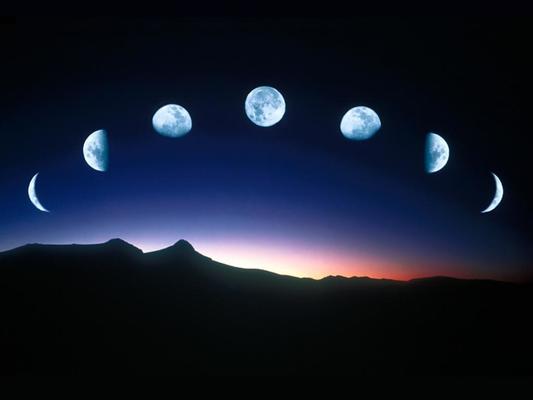
When the moon waxes, it ________.
a)
adds a thick covering to its crust
b)
seems to get bigger in size
c)
goes from a full moon back to a new moon
d)
shaves its legs
78.

When the moon wanes, it ________.
a)
goes from a new moon to a full moon
b)
goes from a full moon to a new moon
c)
appears to get larger in size
d)
cries a lot
79.
Why don't we have a solar or lunar eclipse every month?
a)
The moon and sun don't align properly
b)
because the sun is too big to be blocked
c)
because the moon is usually on a different plane
d)
They DO occur every month, we just don't see them!
80.
Why do we always see the same side of the moon from Earth?
a)
because the phases change
b)
because it rotates and revolves at the same rate
c)
because half of the moon always receives sunlight
d)
The moon changes positions�
81.
How many phases does the moon have?
a)
7 phases
b)
5 phases
c)
I do not know
d)
8 phases
82.
How much of the moon is always lit?
a)
can't tell
b)
always changes
c)
half
d)
3/4
83.

What season is it in the Southern Hemisphere when it is fall in the Northern Hemisphere?
a)
winter
b)
spring
c)
summer
d)
fall
84.
What is the darkest inner part of the shadow cone called, where a total eclipse can be viewed.
a)
Total
b)
Umbra
c)
Penumbra
85.
What is the larger outer lighter part of the shadow cone called, where a partial eclipse can be viewed?
a)
Partial
b)
Umbra
c)
Penumbra
86.
In order to have an eclipse, the Moon, Sun and Earth have to be?
a)
Below each other
b)
Above each other
c)
In alignment
87.
A lunar eclipse can occur only during the _________________.
a)
Full moon
b)
New moon
c)
Waxing moon
88.
A solar eclipse can occur only during the _________________.
a)
Full moon
b)
New moon
c)
Quarter moon
89.
Which type of eclipse occurs when the Moon comes directly between Earth and the Sun?
a)
Lunar eclipse
b)
Solar eclipse
90.
Which type of eclipse occurs when the Moon comes directly between Earth and the Sun?
a)
Lunar eclipse
b)
Solar eclipse
91.
Which type of eclipse occurs when the Earth comes directly between the Sun and Moon?
a)
Lunar eclipse
b)
Solar eclipse
92.

What does number 1 in the image to the left represent?
a)
Umbra
b)
Penumbra
93.
What does number 2 in the image to the left represent?
a)
Umbra
b)
Penumbra
94.
During what phase of the moon can a lunar eclipse occur?
a)
3rd Quarter
b)
1st Quarter
c)
New Moon
d)
Full Moon
95.
For a solar eclipse to occur, what has to happen?
a)
The sun must be directly between Earth and the moon.
b)
The moon must be directly between Earth and the Sun.
c)
Earth must be directly between the Sun and the moon.
96.
When the Earth's shadow falls on the moon, the shadow causes what to happen?
a)
Lunar eclipse
b)
Solar eclipse
c)
Partial eclipse
97.
This type of eclipse occurs when the moon blocks the sunlight from reaching Earth?
a)
Solar eclipse
b)
Lunar eclipse
c)
Total eclipse
98.
Tides are caused mainly by what?
a)
Moon’s gravitational pull
b)
Sun’s gravitational pull
c)
Earth’s gravitational pull
99.
Most places on Earth experience about how many high and low tides in 24 hours?
a)
2 high and 2 low tides
b)
4 high and 4 low tides
c)
1 high and 1 low tides
100.
What type of tide occurs during a new and full moon?
a)
Neap tides
b)
Spring tides
c)
Normal tides
101.
What type of tide occurs during the first or third quarter moon?
a)
Neap tides
b)
Spring tides
c)
Normal tides
102.
If the Sun, Earth, and Moon are in perfect alignment, the Earth would have a _______ tide.
a)
Spring
b)
Neap
c)
Normal
103.
If the Sun, Earth, and Moon create a 90 degree angle, the Earth would have __________.
a)
Spring tides
b)
Neap tides
c)
Normal tides
104.
What natural phenomenon can be viewed from North Platte, NE on August 21st?
a)
Lunar Eclipse
b)
Blood Moon
c)
Total Solar Eclipse
105.

The moon is a natural ______ of Earth.
a)
comet
b)
axis
c)
satellite
d)
space probe
106.

Earth and the other planets closest to the Sun are made mostly of _______
a)
gas
b)
metal
c)
water
d)
rock
107.

Earth's ________ on its axis causes day and night.
a)
rotation
b)
revolution
c)
phase
d)
comet
108.

One full orbit of an object around another object is called a ________.
a)
axis
b)
rotation
c)
revolution
d)
satellite
109.

The __________ has planets, moons, comets, and asteroids.
a)
solar system
b)
earth
c)
rotation
d)
United States
110.
One of the main differences between the outer and inner planets is __________.
a)
The inner planets all have water
b)
the inner planets are much bigger than the outer planets
c)
the outer planets are gas planets
d)
the outer planets have rings, and the inner planets don't
111.
Which outer planets have rings?
a)
Just Saturn
b)
Saturn and Jupiter
c)
Jupiter, Neptune, and Saturn
d)
all 4 of them
112.
Which planet has the smallest pull of gravity?
a)
Saturn
b)
Jupiter
c)
Neptune
d)
Mercury
113.
Besides changing the distance between objects how else can we change the force of gravity?
a)
Change their atmosphere
b)
Change their rotation
c)
Change their mass
d)
Change their volume
114.
Which is the largest object in our solar system?
a)
Sun
b)
Jupiter
c)
Earth
d)
Pluto
115.
A small object that appears as a streak of light as it enters earth's atmosphere.
a)
Asteroid
b)
Comet
c)
Moon
d)
Meteor
116.
The GAS GIANTS or Outer planets are:
a)
Mercury, Earth, Jupiter, Saturn
b)
Saturn, Neptune, Pluto, Mars
c)
Saturn, Jupiter, Uranus, Neptune
d)
Earth, Mars, Saturn, Neptune
117.
The inner planets are:
a)
Jupiter, Earth, Mars, Mercury
b)
Saturn, Uranus, Mars, Earth
c)
Earth, Pluto, Neptune, Mars
d)
Mercury, Venus, Earth, Mars
118.
People used to think that Earth was the center if the solar system, They thought everything orbited around it. They called this the _________ model.
a)
Geocentric
b)
Earth First
c)
Egocentric
d)
Solarology
119.
The four terrestrial planets all have
a)
Rocky surfaces
b)
Hot temperatures
c)
Deep atmospheres
d)
Large size
120.
Which planet is the hottest planet?
a)
Mercury
b)
Mars
c)
Venus
d)
Saturn
121.
Why do the sun and moon appear to move across the sky?
a)
the rotation of the solar system makes the sun and moon seem to move
b)
the rotation of the earth make the sun and moon seem to move
c)
the sun and moon revolve around earth
d)
the earth revolves around the sun and moon
122.
Why does the moon appear to shine?
a)
It is like a star and gives off light
b)
it refracts light from space
c)
It reflects light from the sun
d)
It absorbs light from the sun
123.
How does changing the mass of objects affect the force of gravity?
a)
Increasing mass will decrease gravity
b)
Decreasing mass will increase gravity
c)
Mass will not affect gravity
d)
Increasing mass increases gravity
124.
How does changing the distance between objects affect the force of gravity?
a)
Decreasing distance increases gravity
b)
increasing distance increases gravity
c)
Distance does not affect gravity
125.
The planet with the shortest year is
a)
Earth
b)
Neptune
c)
Pluto
d)
Mercury
126.
What holds the moon, the planets, and all other objects in orbit around the sun?
a)
ocean tides
b)
magnetism
c)
gravity
d)
the sun's heat and light
127.
which model of the solar system has the sun in the center with all of the planets orbiting it?
a)
heliocentric
b)
geocentric
128.
Which type of technology would you use to see far away objects?
a)
computer
b)
rover
c)
satellite
d)
telescope
129.
which technology would you use to collect rock samples from a nearby planet?
a)
computer
b)
rover
c)
satellite
d)
telescope
130.
which technology would you use to analyze data from a NASA mission
a)
computer
b)
rover
c)
satellite
d)
telescope
131.
which of the following is the cause of Mercury having a shorter year than Jupiter
a)
Mercury orbits closer to the sun
b)
Mercurys orbit is more circular than Jupiter
c)
Mercury rotates at a slower speed than Jupiter
d)
Mercury has a more elliptical orbit than Jupiter
132.
Which type of planet rotates faster?
a)
terrestrial
b)
gas giant
133.

Which season is taking place in the Northern Hemisphere in Position 3?
a)
Winter
b)
Spring
c)
Summer
d)
Fall
100 %

