
 Worksheets
Semester Exam Review
Total questions: 134
Worksheet time: 2hrs 24mins
Name
Class
Date
1.

What do we call the curve that a liquid forms in a container?
a)
a curvy thingy
b)
a what do ya call it?
c)
a meniscus
d)
a hibiscus
2.

What is the length of this object?
a)
5.0 cm
b)
5.5 cm
c)
5.3 cm
d)
5.1 cm
3.
If you do not understand a direction or part of a lab procedure, you should
a)
skip it and go on to the next part.
b)
ask the instructor before proceeding
c)
try several methods until something works
d)
figure it out as you do the lab
4.
You have been injured in the laboratory (cut, burn, etc.). First you should
a)
apply first aid yourself
b)
tell the science instructor at once
c)
see a doctor after school
d)
visit the school nurse after class
5.
All chemicals in the lab are to be considered dangerous
a)
True
b)
False
6.

What is the correct value?
a)
5 ml
b)
15 ml
c)
20 ml
d)
25 ml
7.
240 cm = ___________ m
a)
2400
b)
24
c)
2.4
d)
0.24
8.
68 cm = ___________ mm
a)
0.68
b)
6.8
c)
68
d)
680
9.
56 L = ___________ mL
a)
560
b)
5,600
c)
56,000
d)
560,000
10.
330 cm = ___________ m
a)
3,300
b)
33
c)
3.3
d)
0.33
11.

In which region would the nonmentals be found?
a)
1
b)
4
c)
3
d)
5
12.

In which region would the most reactive elements be found?
a)
1
b)
4
c)
5
d)
3
13.

In which region would the least reactive elements be found?
a)
1
b)
4
c)
3
d)
5
14.
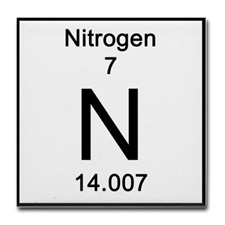
What is the number of protons that the element in this image contain?
a)
14
b)
7
c)
15
d)
18
15.

What is the atomic mass of "F"
a)
9
b)
18
c)
17
d)
19
16.
The positive particles of an atom are
a)
electrons
b)
positrons
c)
neutrons
d)
protons
17.
the central region of an atom where its neutrons and protons are is its
a)
nucleus
b)
electron cloud
c)
core
d)
center
18.
an atom with atomic number 6 would have how many protons
a)
6
b)
12
c)
3
d)
cannot be determined
19.
Where are electrons of an atom found?
a)
Nucleus
b)
Electron Cloud
c)
Some are in the nucleus and some in the electron cloud.
d)
They are moving everywhere.
20.

What is the number of protons that the element in this image contain?
a)
14
b)
7
c)
15
d)
18
21.
The independent variable is the ONE thing you _____.
a)
change
b)
keep the same
c)
experiment with
d)
investigate
22.
What is a hypothesis?
a)
A hypothesis is the right answer to an experiment.
b)
A hypothesis is the wrong answer to an experiment.
c)
A hypothesis is an educated guess.
23.

What is the volume of the fish?
a)
18.0 cm3
b)
6.0 cm3
c)
38.0 cm3
24.
The base unit for length is the
a)
second
b)
gram
c)
meter
d)
liter
25.
The base unit for volume is the
a)
second
b)
gram
c)
meter
d)
liter
26.
Fill in the blank: 1g = _________ mg.
a)
.1
b)
10
c)
100
d)
1000
27.

What is this tool called?
a)
Beaker
b)
Flask
c)
Graduated Cylinder
d)
Measuring Cup
28.
The three main regions on the periodic table are ____________.
a)
solid, liquid, gas
b)
metals, nonmetals, meatlloids
c)
radioactive, man-made, poisonous
29.

Calculate the volume of the rock
a)
10.0 mL
b)
16.0 mL
c)
30.0 mL
d)
40.0 mL
30.
What determines where an element is located on the periodic table?
a)
its atomic mass
b)
its atomic number
c)
its number of electrons
d)
they're arranged alphabeticaly
31.
A "group" is a ____________ on the periodic table.
a)
column
b)
row
32.
A "period" is a ____________ on the periodic table.
a)
column
b)
row
33.
Elements on the periodic table that are usually shiny, easily hammered into thin sheets or pulled into wires, and are good conductors of electricity are called _____________.
a)
metals
b)
nonmetals
c)
metalloids
d)
transition elements
34.
Elements on the periodic table that are often gases at room temperature, are poor conductors of electricity, and are good insulators are called _____________.
a)
metals
b)
nonmetals
c)
metalloids
d)
transition elements
35.
Elements on the periodic table that have physical and chemical properties of both metals and nonmetals are called _____________.
a)
metals
b)
nonmetals
c)
metalloids
d)
transition elements
36.
The tool used to measure the mass of a substance or object is a ______________.
a)
balance
b)
graduated cylinder
c)
ruler
d)
thermometer
37.
Jack has a rock. The rock has a mass of 14g and a volume of 2cm3. What is the density of the rock?
a)
7 mL
b)
7 g/cm3
c)
28 g/cm3
d)
1/7 g/cm3
38.
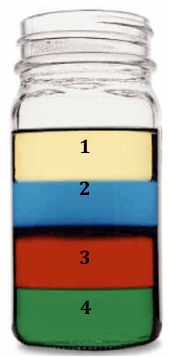
Put the liquids in order from most dense to least dense?
a)
4, 3, 2, 1
b)
1, 2, 3, 4
c)
3, 4, 2, 1,
d)
4, 3, 1, 2
39.
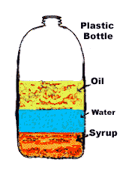
Which liquid is the least dense?
a)
oil
b)
water
c)
syrup
d)
plastic bottle
40.

Which box has a higher density?
a)
Box A
b)
Box B
c)
cannot be determined
d)
they are the same
41.
In general what is the most dense form of matter?
a)
solid
b)
liquid
c)
gas
d)
plasmas
42.

This picture represents which of the following?
a)
element
b)
compound
c)
mixture of elements
d)
mixture of compounds
43.

This picture represents which of the following?
a)
element
b)
compound
c)
mixture
44.

This picture represents which of the following?
a)
element
b)
compound
c)
mixture
45.
Is salt (NaCI) a compound or a element
a)
Compound
b)
element
46.
How many elements are represented in the compound?
Na2CO3
Na2CO3
a)
1
b)
2
c)
3
d)
4
47.
A[n] ______________ tide occurs when the sun is at right angles to the line between Earth and the moon.
a)
high
b)
neap
c)
low
d)
spring
48.
A[n] ___________ tide occurs when the sun, Earth, and the moon are nearly in a line.
a)
spring
b)
high
c)
low
d)
neap
49.
What do we call a tide that has largest range; highest high and lowest low?
a)
gravity
b)
wind
c)
spring
d)
neap
50.
In general, tides occur...
a)
each hour
b)
2 times a day
c)
each month
d)
twice a month
51.

What type of tides would this arrangement of earth-moon-sun create?
a)
neap tide
b)
spring tide
c)
new moon tide
d)
full moon tide
52.
Waning phases are when the light is being:
a)
Gained
b)
Lost
53.
Waxing phases are when the light is being:
a)
Gained
b)
Lost
c)
Staying the same
d)
Neither
54.

What is it called when you are able to see half the moon and the light on the moon is decreasing?
a)
New moon
b)
1st quarter
c)
Full Moon
d)
3rd quarter
55.

What is it called when more than half of the moon is lit on the right side and light is increasing?
a)
Waxing cresent
b)
Waxing gibbous
c)
Waning gibbous
d)
Waning cresent
56.

Does this picture represent a waxing or waning moon?
a)
waxing
b)
waning
57.

The hemisphere where you live
a)
equator
b)
southern
c)
northern
d)
eastern
58.

In winter, the axis of the earth is pointed away or toward the sun?
a)
towards
b)
up
c)
down
d)
away
59.

In summer, the axis of the earth is pointed away or toward the sun?
a)
towards
b)
up
c)
down
d)
away
60.

Which season is taking place in the Southern Hemisphere in Position 1?
a)
Winter
b)
Spring
c)
Summer
d)
Fall
61.

Which season is taking place in the Northern Hemisphere in Position 1?
a)
Winter
b)
Spring
c)
Summer
d)
Fall
62.
no charge, found in nucleus, mass = one
a)
proton
b)
neutron
c)
electron
d)
ion
63.
negative charge, found orbiting nucleus, mass is almost zero
a)
proton
b)
neutron
c)
electron
d)
ion
64.
an atom with an unequal number of electrons and protons
a)
neutron
b)
nucleus
c)
ion
65.
A cation is a positively charged ion.
a)
True
b)
False
66.
An anion is a negatively charged ion.
a)
True
b)
False
67.
share electrons, occur between non-metals and non-metals. Form molecules.
a)
ionic bonds
b)
covalent bonds
c)
metallic bonds
68.
transfer electrons, occur between metals and non-metals. Form crystal lattices.
a)
ionic bonds
b)
covalent bonds
c)
metallic bonds
69.
the ability to be hammered into sheets
a)
conductivitiy
b)
ductility
c)
malleability
70.
the ability to be drawn into wires
a)
conductivity
b)
ductility
c)
malleability
71.
metallic bonding allows metals to conduct electricity
a)
conductivity
b)
ducticility
c)
malleability
72.
Smallest component of an element
a)
atom
b)
molecule
73.
The process in which one or more substances change to produce one or more new and different substances
a)
chemical bonding
b)
chemical reaction
74.
positive charge, found in nucleus, mass = one
a)
proton
b)
neutron
c)
electron
d)
ion
75.
On the HR diagram, a star's luminosity, refers to its ______________.
a)
Magnitude or Color
b)
Magnitude or Brightness
c)
Temperature or Color
d)
Distance or Temperature
76.
Why is it we cannot see the entire shape of The Milky Way?
a)
Because The Milky Way is so far away from Earth
b)
Because there are too many stars at the center of our galaxy
c)
Because we live in the Milky Way, and all of the stars, gases, and dust that are with us inside the galaxy make it difficult for us to see it
d)
Because we are at the center of the Milky Way
77.

If a scientist was trying to observe an object that was emitting waves with a frequency of 10-11 , they would need to use a telescope that could detect what?
a)
X-rays
b)
Radio waves
c)
Gamma Rays
d)
Infared Rays
78.

Using the HR diagram, which of the following is TRUE of Red Supergiants?
a)
They are brighter than our sun, but have a lower temperature
b)
They are brighter than our sun, and have a higher temperature
c)
They are the biggest stars in the galaxy
d)
They are very bright and very hot stars
79.
Currently our sun is in its ___________________ stage of life. Its last phase of life will be when it is a _________________ star.
a)
white dwarf, main sequence
b)
nebulous, red giant
c)
main sequence, white dwarf
d)
yellow giant, white dwarf
80.
Which of the following shows the correct order from GREATEST mass to LEAST mass
a)
Star > moon > planet
b)
Galaxy > star > planet
c)
Galaxy > planet > star
d)
Planet > star > moon
81.
Ultraviolet, Infrared, & visible light are examples of __________ being emitted by our Sun.
a)
radiation
b)
gamma rays
c)
gravity
82.
Light years are most helpful to scientists when they are measuring what?
a)
The speed of light
b)
The distances between objects in space
c)
The life cycle of our Sun
d)
The speed of a planet's orbit around the Sun
83.
True or False: When scientists see visible light from a supernova, they can determine when it occurred by measuring its distance away from earth in light years.
a)
True- its distance away in light years = how long ago it exploded
b)
False- its distance away in light years = how long it took to explode
84.
Determining a star's mass identifies the star's current what?
a)
position in the galaxy
b)
temperature
c)
life cycle
d)
gravitational pull
85.
Galaxies are classified according to their _____________
a)
size
b)
temperature
c)
shape
d)
planets
86.
Our Milky Way is a ______________ galaxy.
a)
spiral
b)
elliptical
c)
irregular
d)
burst
87.
What is created when hydrogen atoms are pulled together by gravity in a cloud of dust & gases?
a)
a black hole
b)
a star
c)
a planet
d)
supernova
88.
Which of the following is true about nuclear fusion?
a)
Occurs at the center of stars & produces energy
b)
Occurs in the process of chemical reactions
c)
Results in the creation of black holes
d)
Occurs when 2 stars collide
89.
Which of the following forces determines Earth's position in space?
a)
The balanced forces of Earth's gravity and the sun's gravity
b)
The balanced forces of the Milky Way acting on Earth
c)
The unbalanced force of the Earth's gravitational pull on the sun
d)
The unbalanced force of the sun's gravitational pull on the Earth
90.
Which of the following can be located between the planet Mars and the planet Jupiter?
a)
meteor shower
b)
asteroid belt
c)
comet
d)
meteorite
91.
Our universe is constantly __________________ because galaxies are moving ______________ each other.
a)
shrinking, towards
b)
rotating, around
c)
growing, away from
92.
According to the HR Diagram, stars that get hotter as they get brighter are what type of stars?
a)
super giants
b)
white dwarf
c)
main sequence
d)
giants
93.

This is a picture of The Milky Way, where would our sun be located?
a)
Directly in the middle
b)
Towards the outside but NOT at the edge
c)
All the way on the outside
d)
Somewhere near the top
94.
Which star will have a longer life cycle- a massive Blue Star or a Red-Dwarf Star? How do you know?
a)
A Red-Dwarf Star bc it has a smaller mass
b)
A Blue Star bc it has a greater mass
c)
A Red-Dwarf star bc it has a lower temperature
d)
A Blue Star bc it more luminous
95.
Which of the following terms is used to refer to a stage in the life cycle of a star?
a)
frequency
b)
nebula
c)
luminosity
d)
magnitude
96.
Why does the Earth orbit the Sun and not a planet in the solar system?
a)
The Sun is more massive than the planets so it's mass causes the gravitational pull.
b)
It just happened that way.
c)
The Earth pulls the Sun toward it because it is so massive.
d)
The Earth is closer than the other planets so the distance causes the gravitational pull.
97.
Some objects like the Sun produce their own light. Others don't. Why can we see objects that don't produce light?
a)
They absorb the light.
b)
They reflect the light.
c)
They transmit the light.
d)
They bounce the light around until it strikes our eyes.
98.
The main element that makes up stars is _________.
a)
Hydrogen
b)
Helium
c)
Nitrogen
d)
Oxygen
99.
What is the formula for density?
a)
density = mass x volume
b)
density = mass / volume
c)
density = mass + volume
d)
density = mass - volume
100.
The higher the temperature of water, the faster an egg will boil. The dependent variable is.....
a)
The temperature of water
b)
Amount of time it takes egg to boil
101.
True or false. The independent variable is graphed on the x axis, and the dependent variable is graphed on the y axis.
a)
True
b)
False
102.
The height of bean plants depends on the amount of water they receive. The independent variable is.....
a)
The height of bean plants
b)
the amount of water
103.

a)
Crescent
b)
Gibbous
c)
New
d)
Full
104.

a)
Waxing
b)
Waning
105.

a)
Waxing
b)
Waning
106.

a)
Waxing
b)
Waning
107.

a)
First Quarter
b)
Third/Last Quarter
108.

a)
Waxing Crescent
b)
Waning Crescent
c)
Waxing Gibbous
d)
Waning Gibbous
109.
Choose the element
a)
H2O
b)
Air
c)
NaHCO3
d)
Au
110.
Which is NOT a pure substance?
a)
mixture
b)
compound
c)
element
111.
Which is NOT an example of a chemical change?
a)
Peroxide bubbling in a cut
b)
Freezing water
c)
Rust forming on a bike
d)
Burning a tree
112.
This substance can keep shape even without a container
a)
Solid
b)
Gas
c)
Liquid
d)
Plasma
113.
Magnetism, conductivity, melting point, boiling point, and the ability to react are examples of
a)
Physical and Chemical changes
b)
Physical and Chemical properties
114.
Dissolved salt in water is an example of
a)
homogeneous mixture
b)
heterogeneous mixture
115.
Iron rusting on a bridge is an example of what?
a)
Chemical Change
b)
Physical Change
116.
Grinding a large crystal into sand is an example of
a)
Chemical Change
b)
Physical Change
117.
If an ice cream cone is melted, then frozen again the amount of matter is
a)
the same
b)
more
c)
less
118.

If more energy is put into a solid, what will happen?
a)
Stays a solid
b)
Becomes a liquid
c)
Becomes a gas
119.
Burning wood, Souring milk, Digesting food, Baking a cake, Rusting of Iron are examples of what?
a)
Chemical Change
b)
Physical Properties
c)
Chemical Properties
d)
Physical Change
120.
Crushing a can, Melting an ice cube, Boiling water, Freezing water, Shredding paper, and Chopping wood are examples of
a)
Physical Properties
b)
Chemical Properties
c)
Chemical Change
d)
Physical Change
121.
A chemical reaction can produce all except
a)
Light
b)
Sound
c)
Gas
d)
Magnetism
122.
The leading theory scientists use to describe the origins of the universe says that that it expanded out from a single, infinitely small point. It is known as the?
a)
Big Bang
b)
Accordion Theory
c)
Soap Bubble Model
d)
Beginning
123.
True or false, there are a only a few million galaxies in the universe.
a)
True
b)
False
124.
The objects that orbit around our Sun are known as the?
a)
Solar System
b)
Planetary System
c)
Galaxy System
d)
Circular System
125.
A ________________ is a spherical body that orbits a star.
a)
Planet
b)
Comet
c)
Meteor
d)
Meteoroid
126.
A _________________ is a cloud of gases that are the beginning of the life cycle of stars.
a)
Nebula
b)
Planet
c)
Neutron
d)
Red Giant
127.
True or false, low mass stars form super giants.
a)
True
b)
False
128.
A __________________ is a point of gravity so dense that not even light can escape.
a)
Black Hole
b)
Blue Hole
c)
Brown Dwarf
d)
Red Giant
129.
A ___________________ is the massive explosion given off when a large mass star burns out.
a)
Supernova
b)
Neutron Star
c)
Black Hole
d)
White Dwarf
130.
Earth's seasons are determined by?
a)
The tilt of Earth's axis.
b)
The magnetic poles.
c)
The period of revolution.
d)
The rotation.
131.
One Earth revolution around the sun takes.
a)
365 days
b)
365.25 days
c)
24 hours
d)
60 minutes
132.
One Earth rotation takes.
a)
365 days
b)
12 hours
c)
24 hours
d)
60 minutes
133.
The ___________________ is made up of all known matter and energy.
a)
Universe
b)
Galaxy
c)
Solar System
d)
Sun
134.
One Earth rotation takes.
a)
365 days
b)
12 hours
c)
24 hours
d)
60 minutes
100 %

