wayground logo

Free Printable Worksheets

Font size

S
M
L
XL
Worksheets

US HISTORY EOC STAAR REVIEW 17-18

Total questions: 178

Worksheet time: 2hrs 17mins

Name
Class
Date
1.

The Progressive goal to implement women’s suffrage was accomplished by —

a)

a national referendum

b)

an executive order

c)

a Supreme Court decision

d)

constitutional amendment

2.

This poster is from the first annual Earth Day in 1970.


Earth Day was created for the purpose of —

a)

celebrating the diversity of humankind

b)

honoring the world’s agricultural workers

c)

raising awareness of environmental issues

d)

promoting peace throughout the world

3.

The Korean War was an effort by the United States to —

a)

carry out its policy of containing the spread of communism

b)

keep its economy strong by maintaining wartime activities

c)

secure additional Asian trading partners

d)

extend the principles of the Marshall Plan to Asia

4.

A heat shield material designed to act as an insulating barrier is now used to protect high-rise buildings from fires. Source: NASA


This technology was originally developed primarily to —

a)

give rockets greater boost during takeoff

b)

protect the space shuttle on reentry

c)

provide astronauts with improved navigational equipment

d)

slow down space capsules as they landed in the ocean

5.

One reason the 2008 presidential election was historically significant is that it was the first time —

a)

traditionally Republican states voted Democratic

b)

voters used computerized ballots

c)

an African American won the presidency

d)

a Southerner won the vice-presidency

6.

An estimated thousand people lived in St. Louis’s Hooverville, located on the banks of the Mississippi near the city dump. In New York, noted one observer in 1931, hobos were “coming into the city in larger numbers than ever before and have set up a ‘jungle’ for themselves in the heart of the East Side” on vacant lots owned by the city. —Kenneth Kusmer, 2002


Which of the following contributed most to the situation described in this excerpt?

a)

The rise of corporate monopolies

b)

Strict banking regulations and high income tax rates

c)

The influx of immigrants into urban areas

d)

High unemployment and widespread home foreclosures

7.

Which of the following is an example of fulfilling a civic responsibility?

a)

Interviewing for employment

b)

Reporting for jury duty

c)

Collecting donations for charities

d)

Preserving records of ethnic ancestry

8.

The main reason the United States launched military operations in Afghanistan in October 2001 was to —

a)

prevent genocide

b)

seize weapons of mass destruction

c)

destroy an international terrorist organization

d)

overthrow an absolute monarchy

9.

The House of Representatives shall be composed of Members chosen every second Year by the People of the several States. —U.S. Constitution, Article I, Section 2


Which statement from the Declaration of Independence influenced Article I, Section 2 of the Constitution?

a)

“He has affected to render the Military independent of and superior to the Civil power.”

b)

“To secure these rights, Governments are instituted among Men, deriving their just powers from the consent of the governed.”

c)

“He has obstructed the Administration of Justice, by refusing his Assent to Laws for establishing Judiciary powers.”

d)

“These United Colonies are, and of Right ought to be Free and . . . they are Absolved from all Allegiance to the British Crown.”

10.

Which of the following was a direct result of the civil rights movement?

a)

An increase in respect for suburban housewives

b)

Increased political participation by minority groups

c)

The revitalization of inner cities

d)

Increased migration to rural areas

11.

The United States is the world’s best hope, but . . . if you tangle her in the intrigues of Europe, you will destroy her power for good, and endanger her very existence. . . . —Senator Henry Cabot Lodge


Senator Lodge made this statement in opposition to —

a)

U.S. membership in the League of Nations

b)

the funding of a massive buildup of the U.S. Navy

c)

a relaxation of U.S. citizenship requirements

d)

U.S. entry into the Spanish-American War

12.

The launch of Sputnik I intensified Cold War tensions and caused the —

a)

United States to increase spending on technology and weapons to compete with the Soviet Union

b)

Soviet Union to move missiles and warships to Cuba in order to threaten the United States

c)

United States to send troops and aid to East Berlin to free it from Soviet control

d)

Soviet Union to threaten Europe with nuclear attack if Soviet airspace were violated

13.

The establishment of speakeasies in the 1920s was an unintended consequence of which federal government action?

a)

The taxation of imported luxury goods

b)

The deportation of suspected communist sympathizers

c)

The prohibition of the sale of alcoholic beverages

d)

The implementation of immigration restrictions

14.

In response to public concern over issues raised by Upton Sinclair’s The Jungle, the federal government expanded its role in —

a)

working with labor unions to increase worker salaries

b)

taking responsibility for the safety of consumers

c)

setting limits on the growth of private industry

d)

implementing social welfare programs

15.

Which of the following demonstrates the diffusion of American culture?

a)

The establishment of multinational research centers in Antarctica

b)

The presence of German immigrants in the United States

c)

The establishment of a Saudi Arabian embassy in the United States

d)

The rise of baseball as a major sport in Japan

16.

The Chinese Exclusion Act of 1882 was primarily a response to —

a)

increased U.S. presence in China

b)

competition for jobs on the West Coast

c)

rapid population growth in the Northeast

d)

China’s actions during the Boxer Rebellion

17.

All who recall the condition of the country in 1890 will remember that . . . the country was in real danger from another kind of slavery . . . that would result from the aggregations of capital in the hands of a few individuals and [businesses] controlling, for their own profit and advantage exclusively, the entire business of the country, including the production and sale of the necessaries of life. —Supreme Court Justice John Marshall Harlan, 1911


In this excerpt, Justice Harlan is warning against —

a)

a civil service based on patronage rather than merit

b)

allowing powerful monopolies to dominate interstate commerce

c)

a lack of federal funding for essential transportation systems

d)

allowing labor unions to interfere with production goals

18.

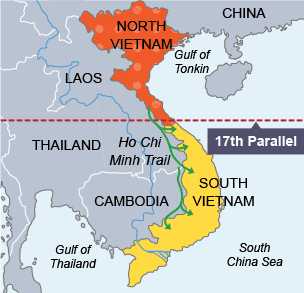
As part of the Nixon administration’s policy of Vietnamization, the U.S. military —

a)

trained South Vietnamese forces to take over combat responsibilities from U.S. troops

b)

shared military technology with North Vietnam

c)

imposed martial law in North Vietnam

d)

installed a puppet government in South Vietnam

19.

In the last half of the nineteenth century, the United States experienced vast industrial growth. A new class of wealthy entrepreneurs and a prosperous middle class emerged. Factory jobs also increased to meet production demands.


Which demographic change in the United States is most associated with this transformation?

a)

Increased property values in rural areas

b)

Increased life expectancies in urban areas

c)

Increased birth rates in rural areas

d)

Increased migration to urban areas

20.

How did the creation of the Federal Deposit Insurance Corporation change the nature of banking in the United States?

a)

The government began to guarantee bank deposits.

b)

Depositors could transfer investments without penalties.

c)

Depositors were guaranteed minimum interest rates on savings accounts.

d)

The government required taxpayers to open savings accounts.

21.

Some of President Franklin D. Roosevelt’s New Deal programs were declared unconstitutional when the Supreme Court held that they —

a)

required U.S. cooperation with foreign nations

b)

prevented equal access to the judicial system

c)

granted privileges to religious organizations

d)

infringed on powers reserved to the states

22.

Which factor contributed most to the flooding in New Orleans during Hurricane Katrina?

a)

The location of the surrounding barrier islands

b)

The city’s low elevation

c)

The presence of offshore oil rigs

d)

The buildup of silt in the Mississippi

23.

During the late nineteenth century, many Irish immigrants were discriminated against for being —

a)

opposed to machine politics

b)

loyal to the United Kingdom

c)

conscientious objectors

d)

Roman Catholics

24.

How did Andrew Carnegie contribute to civic and social life in the United States?

a)

By promoting spiritual and moral values in public schools

b)

By supporting conservative ideals in federal legislation and foreign policy

c)

By establishing philanthropic organizations dedicated to education and the arts

d)

By creating a charitable foundation to end hunger

25.

The fundamental . . . purpose is to conserve the scenery and the natural and historic objects and the wild life therein and to provide for the enjoyment of the same in such manner and by such means as will leave them unimpaired for the enjoyment of future generations. —The Organic Act of 1916


What was the primary result of this legislation?

a)

States instituted their own environmental regulations.

b)

Settlement on lands with fragile ecosystems was prohibited.

c)

Monopolies seized control of natural resources.

d)

National parks were created as a way to manage land resources.

26.

Which of these is the best definition of an era?

a)

A period of time identified by political, economic, or social trends

b)

A series of various changes over many years

c)

A series of events unified by individual or organized protests

d)

A period of time lasting between 10 and 15 years

27.
Which of the following occurred as a result of the Sherman Antitrust Act?
a)
Workers secured a greater share of company profits.
b)
The influence of labor unions on factory owners was reduced.
c)
The federal government could dissolve business monopolies.
d)
Businesses were required to pay fees to open overseas locations.
28.
The policy outlined in the excerpt was directly influenced by problems that the U.S. Navy had recently confronted during —
a)
the Cuban Revolution
b)
the Mexican War
c)
World War I
d)
the Spanish-American War
29.
Which sentence provides information needed to complete both the cause and effect portions of this diagram?
a)
The 1898 Spanish-American War led to world power status for the United States.
b)
The 1914 opening of the Panama Canal encouraged international trade.
c)
The 1919 Treaty of Versailles contributed to the start of World War II in Europe.
d)
The 1929 stock-market crash set off the Great Depression in the United States.
30.
Which of the following was a major contribution of the Harlem Renaissance to U.S. culture?
a)
It led to the increased popularity of vaudeville stage performers.
b)
It brought the most significant beat poets together.
c)
It established jazz as a prominent musical form.
d)
It focused attention on the antiwar literary genre.
31.
Cartoons such as this one took the position that deportation was necessary because —
a)
assimilation programs in the United States had been unsuccessful
b)
economic decline had increased the competition for jobs
c)
communists were infiltrating the United States
d)
political machines had too much power in urban areas
32.
How did the events on this time line affect U.S. businesses?
a)
Profit sharing became a standard practice for industrial corporations.
b)
Monopolistic practices were abolished by federal legislation.
c)
Mass-manufacturing techniques were adopted to maximize production.
d)
Retirement plans were guaranteed to factory workers.
33.
Which Supreme Court case reversed "separate but equal" and led to the desegregation of public schools?  
a)
Brown v Board of Education 
b)
Texas v Johnson 
c)
New Jersey v TLO 
d)
Madison v Marbury 
34.
Muckraker who wrote The Jungle, about the gross meat packing industry of the time.
a)
Jacob Riise
b)
Ida Tarbell
c)
Ida B. Wells
d)
Upton Sinclair
35.
How did the Zimmerman telegram influence U.S. entry into World War I?
a)
It announced the czar's overthrow in Russia. 
b)
It revealed a proposed military alliance between Mexico and Germany. 
c)
It contained orders for German U-boats to destroy British passenger ships. 
d)
It described Romania's plan to abandon neutrality. 
36.
What place were immigrants processed at?
a)
Alcatraz
b)
Statue of Liberty
c)
Liberty Island
d)
Ellis Island
37.
These acts were in place during the World War I  to silence critics
a)
Sherman Antitrust Act 
b)
Espionage and Sedition Act 
c)
Alien and Sedition Act 
d)
Clayton Act 
38.
African American poet of the Harlem Renaissance.
a)
WEB DuBios
b)
Langston Hughes
c)
Jacob Riis
d)
Upton Sinclair
39.
Conflict between USA and USSR, during JFK's presidency, after missiles were placed on island off the coast of Florida.
a)
Berlin Airlift
b)
Cuban Missile Crisis
c)
Bay of Pigs
d)
Iran-Contra Affair 
40.
Why did the government order rationing during WWII?
a)
to increase foreign trade
b)
to limit the growth of industry
c)
to conserve raw materials for the war effort
d)
to encourage women to enter the workforce
41.
Allowing citizens to vote directly on proposed laws and policies 
a)
Referendum 
b)
Initiative 
c)
Recall 
d)
Secret Ballot 
42.
Which of these factors contributed most to the Dust Bowl?
a)
Flash flooding and intense deforestation
b)
Prolonged drought and poor farming practices
c)
High winds and railroad construction
d)
Severe heat and rapid suburban development
43.
Which Supreme Court case stated that all individuals must be read their rights at the time of arrest?  
a)
U.S. v Leon 
b)
Nixon v. U.S. 
c)
Korematsu v U.S. 
d)
Mirranda v Arizonia
44.

The Roaring Twenties were characterized by --

a)

Internment camps, the rationing of goods, and the first use of an atomic bomb

b)

bank failures, the New Deal, and bread lines

c)

Installment plans, Prohibition, and flappers

d)

brinkmanship, McCarthyism, and a policy of Containment

45.

Which of the following was a defining characteristic of the United States during the 1930's?

a)

a sharp increase in the power given to state permissions

b)

An extended period of economic depression

c)

The adoption of an interventionist foreign policy

d)

The formation of a national Civil Rights movement

46.

How did these events affect of the United States?

a)

The increased public support for cuts in US defense spending

b)

They prompted the end of Dollar Diplomacy in Latin America

c)

They set a precedent of including territorial acquisitions in settlements

d)

They helped establish the United States as an imperial power similar to European nations

47.
Name for entrepreneurs who use ruthless tactics to destroy competition or to keep wages low
a)
Captain of Industry
b)
Robber Baron
c)
Philanthropist
d)
Consolidator
48.
Court case that created "Separate-but-equal" doctrine.
a)
Sweatt v. Painter
b)
Brown v. Board of Education
c)
Plessy v. Ferguson
d)
Mendez v. Kirby ISD
49.
President Truman adopted a new foreign policy during the Cold War know as the Truman Doctrine. What was the main goal of the Truman Doctrine?
a)
To expand trade with Europe
b)
To limit the build up of nuclear weapons
c)
To stop the spread of communism
d)
to send financial aid to Europe
50.
What is the purpose of N.A.T.O?
a)
Countries joining together to end democracy
b)
Countries joining together to stop trade between the East and West
c)
Countries joining together to fend off attacks by other communist countries
d)
Countries joining together to create one kind of currency (S)
51.
Which law was passed as a result of the muckraking literature of Upton Sinclair?
a)
Interstate Commerce Act
b)
Sherman Antitrust Act
c)
Meat Inspection Act
d)
Federal Reserve Act
52.
Which statement identifies a major reason for the increased migration of African Americans out of the rural South during and following World War I?
a)
the availability of cheap farmland in the West
b)
the opportunity for factory jobs in the North
c)
the elimination of the Ku Klux Klan in Northern states
d)
the chance to escape racial segregation by enlisting in the army
53.
Which group was most affected by the Supreme Court decisions in Delgado v. Bastrop ISD (1948) and Hernandez v. Texas (1954)?
a)
African Americans
b)
homeless Americans
c)
women in the military
d)
Mexican Americans
54.
Which method of achieving civil rights did Rosa Parks use when she refused to give up her seat to a white passenger on a segregated bus in Montgomery, Alabama in 1955?
a)
lobbying
b)
litigations
c)
amending the U.S. Constitution
d)
non-violent protest
55.
One factor that promoted industrialization in the United States in the late nineteenth century was the --
a)
development of the airplane
b)
expansion of the railroads
c)
mass production of automobiles
d)
widespread use of steamboats
56.
Jane Addams and Dolores Huerta contributed to American society by --
a)
attempting to help the urban poor and ethnic minorities
b)
fighting for temperance and Prohibition
c)
promoting the interests of factory workers
d)
leading Populist political movements on behalf of Midwestern farmers
57.
What effect did Teapot Dome, Watergate, and President Clinton's impeachment have on citizens of the United States?
a)
They led to citizens to demand limits to Presidential power.
b)
They brought about increased regulation of government spending
c)
They damaged popular trust in the federal government and tis leaders
d)
They demanded U.S. foreign policies towards to containing Communism
58.
Which legislation was passed over the objections of Southern Democrats in order to prevent racial discrimination in businesses affecting interstate commerce, such as restaurants?
a)
Civil Rights Act of 1964
b)
Voting Rights Act of 1965
c)
Equal Rights Amendment
d)
American Recovery and Reinvestment Act
59.
Reagan's plan to have a strong national defense in order to make the world a safer place from Communism and the Soviet Union.
a)
Iran-Contra Affair
b)
Peace Through Strength
c)
Marshall Plan
d)
Reaganomics
60.
The surprise attack by terrorists on the World Trade Center and the Pentagon that changed America and the world forever.
a)
Attack on Pearl Harbor
b)
Sinking of the USS Maine
c)
September 11, 2001
d)
Tet Offensive
61.
The economic policy during Reagan's presidency that believed in tax cuts for the wealthy and reducing spending on government programs like foods stamps, social security, etc.
a)
Obamacare
b)
Inflation
c)
Stangation
d)
Reaganomics
62.
Created during President Clinton's presidency to eliminate tariffs between the US, Mexico, and Canada in order to help the economy and encourage trading.
a)
OPEC
b)
NATO
c)
United Nations
d)
NAFTA
63.
Created during President Carter's presidency to try and establish peace in the Middle East, mainly between Israel and Egypt.
a)
United Nations
b)
Middle East Treaty
c)
Camp David Accords
d)
OPEC
64.
Created the software used on personal computers during the early 1990s and is credited for the development of Microsoft.
a)
Bill Gates
b)
Steve Jobs
c)
Michael Dell
d)
Mark Cuban
65.
This war started largely due to Iraq threatening the oil reserves of Saudi Arabia and invading the small country of Kuwait.
a)
Iran-Contra Affair
b)
Persian Gulf War
c)
War on Terror
d)
World War II
66.
The inventor of Facebook that changed how the world uses social media and communicates with one another.
a)
Bill Gates
b)
Al Gore
c)
Mark Zuckerberg
d)
Tom Anderson
67.
President Obama's plan to provide all Americans with healthcare, but also required citizens to have it or face a monetary penalty.
a)
Tariff of Abominations
b)
Affordable Care Act
c)
Social Security Act
d)
Volstead Act
68.
This non-profit organization uses their influence/power to persuade congressmen/congresswomen to pass legislation in favor of gun ownership and gun rights.
a)
National Rifle Association
b)
Environmental Protection Agency
c)
Americans for Responsible Solutions
d)
Congressional Leadership Fund
69.
This major event happened during Carter's presidency and focused on the holding of American 52 officials for over 444 days.
a)
Iran Hostage Crisis
b)
Iran-Contra Affair
c)
Persian Gulf War
d)
September 11 Attacks
70.
She became the FIRST LATINA supreme court justice in American history during Barack Obama's presidency.
a)
Dolores Huerta
b)
Sonya Sotomayor
c)
Cesar Chavez
d)
Soledad O'Brien
71.
This event occurred during President Clinton's tenure and involved the ethnic cleansing of Muslims from Serbia. The US led a United Nations group to stop the conflict.
a)
Persian Gulf War
b)
The Balkan Crisis
c)
The War on Terror
d)
World War II
72.
This government program provides retired individuals with financial assistance and support, typically in the form of a monthly check.
a)
Affordable Care Act
b)
Food Stamp Act
c)
Social Security
d)
Medicare
73.
He beat Al Gore to win the presidency of the United States in 2000. However, he won the Electoral College, not the popular vote. 
a)
Donald Trump
b)
Barack Obama
c)
George Bush
d)
Bill Clinton
74.
The creator of the famous superstore that many Americans shop at for their cheap prices and wide selection of goods.
a)
Sam Walton
b)
Bill Gates
c)
Betty Friedan
d)
Mark Zuckerberg
75.
This natural disaster in the early 2000s caused thousands of Louisiana residents to leave their homes due to the levees breaking and flooding to occur.
a)
3-Mile Island
b)
Hoover Dam Rupture
c)
Tornado Alley
d)
Hurricane Katrina
76.
She was the FIRST ever Supreme Court justice to be a woman and we nominated during President Reagan's tenure. 
a)
Susan B. Anthony
b)
Sandra Day O'Connor
c)
Phyllis Schlafly
d)
Ida B. Wells
77.
He won the Election of 2008.
a)
George H.W. Bush
b)
George W. Bush
c)
Barack Obama
d)
Bill Clinton
78.
During Reagan's presidency the Marine Corps barracks were attacked here and he had to decide whether to go to war or not.
a)
Iran
b)
Syria
c)
Afghanistan
d)
Lebanon
79.
The president after Nixon that pardoned him from Watergate and also created the Helsinki Accords with the Soviet Union.
a)
Gerald Ford
b)
Jimmy Carter
c)
Ronald Reagan
d)
Lyndon B. Johnson
80.
Created after 9/11 in order to prevent future terrorist attacks from happen. However, can violate Americans' privacy.
a)
Executive Order 9066
b)
Gulf of Tonkin Resolution
c)
Volstead Act
d)
Patriot Act
81.
She is a major supporter of the Republican Party and a conservative that is against abortion and feminism
a)
Phyllis Schlafly
b)
Betty Friedan
c)
Susan B. Anthony
d)
Ida B. Wells
82.
The United States fought in this country after 9/11 in order to capture Osama bin Laden, the mastermind behind the terrorist attack.
a)
Iraq
b)
Iran
c)
Afghanistan
d)
Syria
83.

Commanded 1st US Army during D-Day Invasion, lead liberation of Paris, won the Battle of the

Bulge

a)

Cesar Chavez

b)

Omar Bradley

c)

Dwight Eisenhower

d)

Glenn Curtiss

84.

French political thinker and historian who came to the US to study our political and social nature. Identified 5 characteristics that sets Americans apart: liberty, egalitarianism, individualism, populism, laissez-faire.

a)

Alexis de Tocqueville

b)

WEB DuBois

c)

Upton Sinclair

d)

Estee Lauder

85.

Wrote The Feminine Mystic, co–founded NOW (National Organization of Women)

a)

Betty Friedan

b)

Phyllis Schlafly

c)

Jane Addams

d)

Dolores Huerta

86.

Mexican American physician and civil rights advocate who organized the American G.I. Forum (1948) initially to improve veteran benefits and enhance medical attention, but it soon expanded to address educational and vocational training, housing, public education, poll taxation, voter registration, hospitalization, and employment.

a)

Cesar chavez

b)

Dolores Huerta

c)

Hector P. Garcia

d)

Roy Benavidez

87.

Leader of the Civil Rights Movement; preached nonviolent approach and demanded equal rights for African Americans

a)

Rosa Parks

b)

Lester Maddox

c)

Martin Luther King Jr.

d)

Thurgood Marshall

88.

Awarded the Medal of Honor for saving fellow soldiers in Vietnam War

a)

Vernon Baker

b)

Alvin York

c)

Charles Carroll

d)

Roy Benavidez

89.
In 1906 I  Wrote The Jungle which exposed the conditions in the U.S. meat packing industry. (Helped pass the Pure Food and Drug Act) 
a)
Upton Sinclair 
b)
Lincoln Steffens 
c)
Jacob Riis 
d)
Frank Norris 
90.
The U.S. declared war on Spain after
a)
the Maine exploded in Havana Harbor
b)
an attempted assasination of President Cleveland
c)
the Spanish invaded Puerto Rico
d)
the failed rebellion of José Martí
91.
Social Darwinism promoted the idea that..
a)
people in lower classes were not capable of economic success
b)
immigration weakened national unity
c)
the government should take responsibility for the well-being of people
d)
poverty could be eradicated through increased economic regulation
92.
Who was the President during the building of the Canal and was the 1st to leave America?
a)
Teddy Roosevelt
b)
William Howard Taft
c)
Woodrow Wilson
d)
Franklin Roosevelt
93.
What effect did the Dust Bowl storms have on the Great Depression?
a)
Many farmers were forced to leave the Great Plains.
b)
Unemployment decreased gradually.
c)
Many homes along the Mississippi River were flooded.
d)
Hoover was re-elected as president.
94.
What were the major goals of the New Deal?
a)
no gold standard and free coinage of silver
b)
abolition and suffrage
c)
relief, recovery, and reform
d)
expanding the size and economic influence of the United States
95.
In the 1950s, the United States became involved in the Vietnam War. Why did the United States become involved in this war?
a)
to prevent the collapse of the government of North Vietnam
b)
to stop Vietnam from taking over Hong Kong
c)
to stop the spread of communism to South Vietnam
d)
to prevent attacks against United States shipping
96.
How did the Cuban Missile Crisis end?
a)
The Soviets and the U.S. entered into a nuclear war
b)
It never really ended, there are still tensions today
c)
Soviets backed down and pulled their missiles out of Cuba
d)
the Cubans forced the Soviets to leave because they didn't want war with the U.S.
97.
Senator Joseph McCarthy won national attention when he...
a)
Was convicted as a spy.
b)
Claimed hundreds of government employees were communists.
c)
Helped Eisenhower become president.
d)
Went to Korea and said atomic weapons should be used to break the stalemate.
98.
After Brown v. Board of Education, 9 AA students were admitted into a High School. The governor and state national guard stood in front of the doors stopping the admission. President Eisenhower sent federal troops to escort the students. Where did the event take place?
a)
Little Rock, Arkansas
b)
Montgomery, Alabama 
c)
Washington DC
d)
Del Rio, Texas 
99.
How did Martin Luther King, Jr.'s "I Have a Dream" speech impact the civil rights movement?
a)
It called for violent resistance, resulting in riots across the country.
b)
It inspired many people, giving strength and momentum to the movement.
c)
It was largely ignored by the movement, though regarded as a superbly written speech.
d)
It was considered controversial and fragmented the movement into small groups.
100.
The policy objectives of Reaganomics were based on the theory that —
a)
borrowing from foreign countries would help cover the costs of domestic programs
b)
significant increases in government spending would help reduce unemployment
c)
broad tax cuts and financial deregulation would promote economic expansion
d)
reducing trade barriers would result in a budget surplus
101.
How did the Watergate Scandal affect American politics?
a)
It had a negative impact because it caused distrust in the government.
b)
It had a positive impact because it brought the people together.
c)
It didn't impact anything.
102.
What did Iranian student activists do when the Shah of Iran was treated in an American hospital?
a)
they terrorized American travelers in Europe
b)
they forced an attack on Iraq
c)
they seized the American embassy and took hostages
d)
they staged an overthrow of the government
103.
The policy of providing economic and military aid to any country threatened by communism and initially helped Greece and Turkey. 
a)
 Truman Doctrine
b)
Marshall Plan 
c)
Eisenhower Big 5 
d)
Domino Theory
104.
The policy of containment meant that--
a)
The U.S.S.R. would not let democracy spread.
b)
The U.S. would not let Islam spread.
c)
The U.S. would not let Communism spread.
105.
The Marshall Plan was developed to help rebuild ______________ after World War 2.
a)
Eastern European countries
b)
Asian countries
c)
Latin American countries
d)
Western European countries
106.
Joint effort by the US and Britain to fly food and supplies into West Berlin after the Soviets cut off ties between East and West Berlin--
a)
East Berlin 
b)
Berlin Airlift 
c)
Iron Curtain 
d)
Berlin Wall 
107.
How did the growing use of the automobile in the 1920s and the Interstate Highway Act of 1956 affect the United States? 
a)
Resurgence in travel by railroads
b)
Immigration was increasing
c)
Inner Cities were expanding
d)
Suburbs were growing
108.
What event is most closely associated with the end of the Cold War?
a)
President Nixon's visit to China
b)
Withdrawal of United States troops form Vietnam
c)
Tearing down of the Berlin Wall
d)
Sending US troops to Afghanistan 
109.
Cars lining up for miles at gas stations in the 1970s is an effect of what?
a)
The end of oil production in the Gulf of Mexico
b)
Decrease in the amount of oil reserves in the United States
c)
Oil embargo imposed by nations in the Middle East
d)
Terrorist attacks on United States petroleum reserves
110.
Which of the following foreign policy guidelines did the United States follow during the Cold War period?
a)
Great Society
b)
Detente
c)
Containment
d)
McCarthyism
111.
The division between Eastern Europe and Western Europe was called the ____________ by Winston Churchill.
a)
Iron Curtain
b)
Berlin Wall
c)
European Union
d)
38th Parallel 
112.
Which event marked the beginning of the space race with the Soviet Union?
a)
Creation of the space shuttle program
b)
Launch of Sputnik
c)
U-2 spy plan incident
d)
Berlin Airlift
113.
The Truman Doctrine and Eisenhower Doctrine were similar in that they were both designed to do which of the following?
a)
Increase Israel's security against Arab states
b)
Support West Germany and West Berlin
c)
Assist nations abroad to resist communism
d)
Pledge to negotiate rather than use military action to solve disputes
114.
Television shows, advertising, and the methods of mass media suggested that women should fulfill what roles during the 1950s?
a)
Wife, Mother, and Worker
b)
Wife and Mother
c)
Wife and Career Woman
d)
Single Career Woman
115.
What was the primary reason the North Atlantic Treaty Organization (NATO) as formed in 1949? 
a)
Promote social and cultural exchanges between members
b)
Provide for the mutual defense of the member nations
c)
Promote free trade between the United States and Soviet Union
d)
Rebuild Western Europe's war-ravaged economy
116.
How did President Kennedy respond when the Soviet Union attempted to install nuclear weapons in Cuba? 
a)
He ordered a naval blockade of the island of Cuba
b)
He ordered an invasion of Cuba at the Bay of Pigs
c)
He installed more nuclear weapons in Turkey
d)
He ordered "surgical" air strikes against the missile sites
117.
What was the mutual defense alliance of non communist nations?
a)
NATO
b)
Warsaw Pact
c)
Truman Doctrine
d)
Open Skies
118.
How did the US respond to finding out that the Soviets had missiles in Cuba?
a)
They sent the Air Force to bomb Cuba
b)
They began placing missiles in the Soviet Union.
c)
They placed a naval blockade around Cuba.
d)
They invaded Cuba and the Soviet Union.
119.
The United States got involved in conflicts like Korea and Vietnam because they were afraid of the domino theory. What is the domino theory?
a)
If one country fell to democracy, others would follow
b)
If one country fell to communism, others would follow
120.
President Truman adopted a new foreign policy during the Cold War know as the Truman Doctrine. What was the main goal of the Truman Doctrine?
a)
To expand trade with Europe
b)
To limit the build up of nuclear weapons
c)
To stop the spread of communism
121.
Why was the United States involved in the Berlin Airlift?
a)
to airlift food to the people of West Berlin
b)
to bomb East Berlin
c)
to demolish the Berlin Wall
d)
to transport people out of East Berlin
122.
What organization was created by Congress to hunt for communist spies?
a)
Federal Civil Defense Administration (FCDA)
b)
Central Intelligence Agency (CIA)
c)
North Atlantic Treaty Organization (NATO)
d)
House Un-American Activites Commitee (HUAC)
123.
Which country was the aggressor that started the Korean War?
a)
North Korea
b)
South Korea
c)
Neither - they were forced into war by Germany
d)
Japan
124.
What important entertainment industry influenced Americans the most in the 1950's and 1960's?
a)
Internet
b)
Newspapers
c)
Movies
d)
Television
125.
Images like this one refer to what theory about the spread of Communism?
a)
The Mar$hall Plan
b)
The Domino Theory
c)
Proxy Wars
d)
Flexible Response
126.
How did the Soviet Union respond to the formation of NATO?
a)
started the Cold War
b)
created the Warsaw Pact
c)
ended the Cold War
d)
launched Sputnik
127.
What organization, created by WEB Dubois, advocated for rights for blacks and other minorities?
a)
NAACP
b)
NCAA
c)
NATO
d)
NAFTA
128.
Which amendment guarantees equal protection under the law?
a)
13th
b)
14th
c)
15th
d)
16th
129.
Which Supreme Court case integrated public schools?
a)
Plessy v Ferguson
b)
Brown v Board of Education
c)
Schenk v US
d)
Korematsu v US
130.
This president sent federal troops to Arkansas to integrate the schools in Little Rock
a)
Truman
b)
Eisenhower
c)
Roosevelt
d)
Kennedy
131.
Political leaders such as George Wallace, Orval Faubus, and Lester Maddox were committed to the idea of —
a)
women’s rights
b)
racial segregation
c)
school integration
d)
rights for farm workers
132.
Who says, "segregation now, segregation tomorrow, and segregation forever!" He is also the governor of Alabama who does not allow 2 AA students to enter the University of Alabama. 
a)
Lester Maddox 
b)
Joseph McCarthy 
c)
George Wallace 
d)
Orval Faubus 
133.
What event is being described in the picture which used non-violent activist actions? 
a)
Freedom Riders
b)
Montgomery Bus Boycott 
c)
Greensboro Sit-ins
d)
March on Washington 
134.
What court case stated, "We conclude that in the field of public education, the doctrine of 'separate but equal' has no place. Separate educational facilities are inherintly unequal."
a)
Plessy v. Ferguson 
b)
Brown v. Board of Education 
c)
Tinker v. Des Moines 
d)
Delgado v. Bastrop ISD
135.
One result of the civil rights movement has been the —
a)
creation of new forms of legal segregation
b)
elimination of segregation in American society
c)
resurgence of groups advocating violent social change
d)
increased participation of women and minorities in politics
136.
The Civil Rights Era in U.S. History is most characterized by social changes brought about by
a)
groups involved in violent riots and protests in American cities
b)
the efforts of leaders advocating non-violent civil disobedience
c)
the cooperation among the labor unions to pass new legislation
d)
a series of presidential initiatives aimed at ending racial segregation
137.
How did Martin Luther King, Jr.'s "I Have a Dream" speech impact the civil rights movement?
a)
It called for violent resistance, resulting in riots across the country.
b)
It inspired many people, giving strength and momentum to the movement.
c)
It was largely ignored by the movement, though regarded as a superbly written speech.
d)
It was considered controversial and fragmented the movement into small groups.
138.
This NAACP lawyer used the 14th Amendment to work to integrate public schools
a)
Harry Truman
b)
Thurgood Marshall
c)
Antonin Scalia
d)
Sarah O'Connor
139.
Which of the following was NOT advocated by the Black Panthers?
a)
nonviolence
b)
Black Power
c)
black nationalism
d)
community development
140.
One accomplishment of the _____ was to bring about a federal ban on segregation in all interstate travel facilities. 
a)
Little Rock Nine
b)
Freedom Riders
c)
Black Panthers
d)
Montgomery bus boycott
141.
Appealing to many African Americans' anger and frustration over a lack of social and economic power, ______ predicted a militant approach to civil rights. 
a)
Martin Luther King, Jr. 
b)
Malcolm X
c)
Medgar Evans
d)
Fannie Lou Hamer
142.
Which lawyer worked with the NAACP on the Brown v. Board of Education case?
a)
Rosa Parks
b)
James Farmer
c)
Jackie Robinson
d)
Thurgood Marshall
143.
By boycotting the bus system in Montgomery, African Americans hoped to
a)
Abolish the bus system
b)
Exert economic pressure and protest segregation
c)
Get more jobs in the Montgomery bus system
d)
Free Rosa Parks from prison
144.
 A major way in which the Civil Rights Act (1964) and the Americans with Disabilities Act (1990) are similar is that both laws
a)
were intended to lift Americans out of poverty
b)
failed to pass constitutional review by the Supreme Court
c)
gave a minority group the right to vote after years of protest
d)
provided equal protection to groups that had experienced discrimination
145.
These black teenagers were the first to integrate into Little Rock Central High
a)
Elite Eight
b)
Little Rock Nine
c)
Arkansas Seven
d)
Final Four
146.
Which US president signed the Voting Rights Act of 1965?
a)
Lyndon B. Johnson
b)
John F. Kennedy
147.
After the Civil Rights Act of 1964 was passed, it was no longer legal to
a)
let African Americans ride the bus.
b)
deny someone of a job because of their race.
c)
fire someone for not doing their job.
d)
kick someone out of the military.
148.
Name the only President that resigned.
a)
Nixon
b)
JFK
c)
LBJ
d)
Carter
149.
Name the scandal that forced that President to resign.
a)
Watergate
b)
Tapioca
c)
Jim Jones
150.
What is the ‘short’ name for the Organization of Petroleum Exporting Countries?
a)
OPEC
b)
OPTIC
c)
USSR
151.
People waited in lines in their automobiles for what?
a)
Tires
b)
Windshield Wipers
c)
Gas
152.
What Middle East country had taken U.S. hostages making President Carter look weak?
a)
Iraq
b)
Iran
c)
Syria
153.
Name the proposed Amendment that would have gender equality for the U.S.
a)
E.R.A.
b)
Don’t Ask Don’t Tell
c)
Watergate
154.
Name the Army General who took the fall for President Reagan in the Iran-Contra Guns for Arms deal.
a)
Ronald South
b)
Oliver North
c)
Kayne West
d)
Head Mountain East
155.
Name the very outspoken conservative Pastor or the 1980's
a)
Jerry Lewis
b)
Jerry Fallwell
c)
Billy Graham
d)
Gary U.S. Bonds
156.
Name the first female U.S. Supreme court justice
a)
Anita Hill
b)
Sandra Day O'Connor
c)
Elena Kagen
d)
Sonya Sotomayor
157.
The charge that Bill Clinton lied to a grand jury concerning his relationship with Monica Lewinsky eventually led to _____. 
a)
 Clinton’s dismissal from office 
b)
 Republicans winning the 1994 presidential election
c)
 the president’s resignation
d)
 the president’s impeachment
158.
period of large population growth after WWII
a)
Baby Boom
b)
Watergate 
c)
NAFTA
d)
Iran-Contra Scandal 
159.
Which of the following promotes trade between Canada, the United States, and Mexico?
a)
North Atlantic Treaty Organization
b)
North American Free Trade Agreement
160.
What international organization worked with the United States in the Persian Gulf War?
a)
United Nations
b)
League of Nations which did not exist after WWII
c)
World Trade Organization
d)
NAFTA
161.
Which of these individuals was the first Hispanic Supreme Court Justice?
a)
Hillary Clinton
b)
Sonia Sotomayor
c)
Sandra Day O'Connor
d)
Lionel Sosa
162.
Which of these entrepreneurs created a computer software company?
a)
Oprah Winfrey
b)
Sam Walton
c)
Bill Gates
d)
Lionel Sosa
163.
What was an immediate effect of the terrorist attacks on New York City in 2001?
a)
The U.S. canceled its treaties with Iran
b)
The U.S. led airstrikes on the Balkans
c)
The U.S. captured Saddam Hussein in Iraq
d)
The U.S. invaded Afghanistan
164.
Which law pushed to break up the monopolies and ensure competition?
a)
Pendleton Act
b)
Pure Food and Drug Act
c)
Sherman Anti-Trust Act
d)
Interstate Commerce Act
165.
This law regulated railroads and required that their rates be "reasonable and fair."
a)
Pure Food and Drug Act
b)
Sherman Anti- Trust Act
c)
Dawes Act
d)
Interstate Commerce Act
166.
This political party formed to help farmers throughout the West.
a)
Republican
b)
Democrat
c)
Populist
d)
Socialist
167.
Why did farmers support the creation of the Populist Party?
a)
They believed the Populist Party represented the "common man" against growing business interest
b)
They believed that businesses should be allowed to grow stronger
c)
They believed that Populists would pay their large debts 
d)
none of the above
168.
Who wrote "The Jungle" which exposed the conditions in the U.S. meat packing industry?
a)
Upton Sinclair 
b)
Lincoln Steffens 
c)
Jacob Riis 
d)
Frank Norris 
169.
What was a result of The Jungle by Upton Sinclair?
a)
Interstate Commerce Act
b)
Pure Food and Drug Act
c)
Sherman Anti Trust Act
d)
none of the above
170.
Journalists who exposed corruption and problems in society are called--
a)
Gump Mushers
b)
Muckrakers
c)
Scalawags
d)
Dirt Diggers
171.
Banned people from making, drinking or selling alcohol
a)
17th Amendment
b)
18th Amendment
c)
19th Amendment
d)
21st Amendment
172.
This era was most notable for fixing the problems created throughout the Gilded Age?
a)
Progressive
b)
Reconstruction
c)
Populist
d)
Gilded
173.
The primary objective of the Dawes Act was to--
a)
promote cultural assimilation of Native Americans.
b)
turn Native American reservations into corporate farmlands.
c)
end warfare between Native Americans the U.S. military.
d)
promote Native American investment in private industry.
174.
How did New Deal programs like the Civilian Conservation Corps and the Works Progress Administration provide relief to the needy?
a)
by giving loans to the needy
b)
by creating jobs for the needy
c)
by distributing food to the needy
d)
by providing pensions to the needy
175.
What happened to Roosevelt's court-packing plan?
a)
It was rejected by Congress.
b)
It was signed into law by the president.
c)
It was ratified as a constitutional amendment.
d)
It was declared unconstitutional by the Supreme Court.
176.
Which of the following was, to the federal government, the  most immediate problem during the Great Depression?
a)
low prices
b)
buying on margin (credit)
c)
high unemployment
d)
business consolidation
177.
One difference between the administrations of President Roosevelt and President Hoover was that Franklin Roosevelt was-
a)
more willing to use government intervention to solve economic problems
b)
unwilling to allow government agencies to establish jobs
c)
able to ignore economic issues for most of his first term in office
d)
opposed to any type of government regulation of financial institutions
178.
What weather condition led to extreme dust storms in the Midwest region also nicknamed the "Dust Bowl"? 
a)
flooding
b)
tornados 
c)
drought
d)
earthquakes