wayground logo

Free Printable Worksheets

Font size

S
M
L
XL
Worksheets

Physics Spring Final Review

Total questions: 183

Worksheet time: 2hrs 4mins
Name
Class
Date
1.
Three resistors with values of 4.0 Ω, 6.0 Ω and 8.0 Ω respectively, are connected in series. What is their equivalent resistance?
a)
18
b)
8.0
c)
6.0
d)
1.8
2.
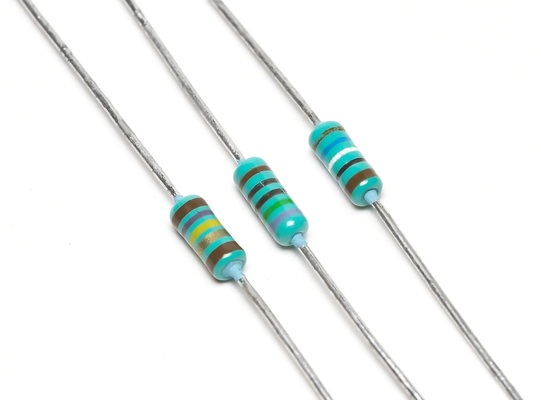
Three resistors with values of R1, R2 and R3 are connected in series.
 
Which of the following expresses the total resistance, R1, of the three resistors?
a)
Rt = R1 + R2 + R3
b)
Rt = 1/R1 + 1/R2 + 1/R3
c)
Rt = R1 = R2 = R3
d)
Rt = (1/R1 + 1/R2 + 1/R3
3.
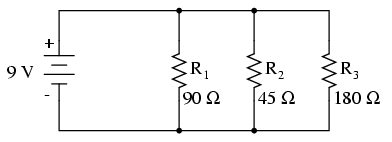
Three resistors with values of 4.0 Ω, 6.0 Ω and 10.0 Ω are connected in parallel. What is their equivalent resistance?
a)
20.0 Ω
b)
7.3 Ω
c)
6.0 Ω
d)
1.9 Ω
4.
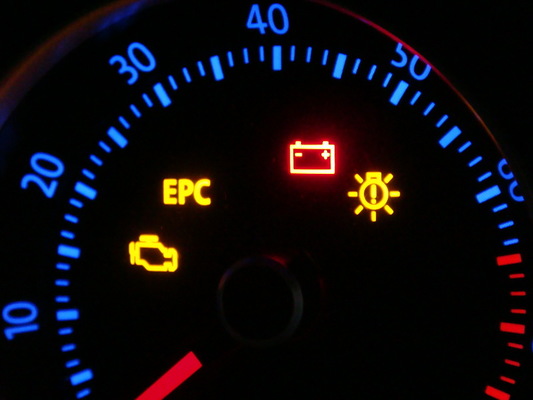
A car dashboard panel bulb has a resistance of 33 Ω when it is placed across a 12 V battery. What is the current through the circuit?
V=IR
a)
0.36 A
b)
2.8 A
c)
3.96 A
d)
396 A
5.
If a resistor is added to a parallel circuit, the total resistance:
a)
increases.
b)
decreases.
c)
remains the same.
d)
becomes zero.
6.

Identify the following as characteristics of either a series circuit or a parallel circuit:


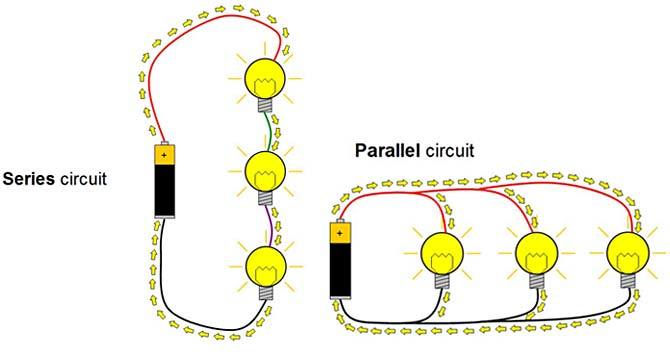
When one light bulb burns out, the rest stay lit.

a)

Series circuit

b)

Parallel circuit

7.
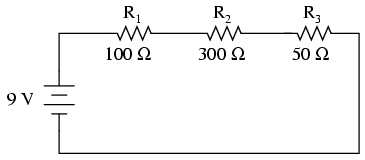
Identify the following as characteristics of either a series circuit or a parallel circuit:

When one light bulb burns out, they all go out.
a)
Series circuit
b)
Parallel circuit
8.
This is an example of a _______ circuit
a)
open
b)
series
c)
parallel
d)
square
9.
This is an example of a ______ circuit
a)
Series
b)
Parallel
c)
Open
d)
Dihexihedral
10.
The job of a battery in a circuit is to...
a)
move the charges
b)
charge the charges
c)
make the charges
d)
electrify the charges
11.
What do resistors do to charges?
a)
Stop the flow of charge
b)
slow the flow of charge
c)
speed up the flow of charge
d)
reverse the flow of charge
12.
The battery determines the direction of charge flow in a circuit.
a)
True
b)
False
13.
Do resistors use up the charges?
a)
Yes
b)
No
14.
If light bulbs always have charge in them, why aren't the bulbs always lit?
a)
the charges must be positive
b)
there must be unequal numbers of + and -
c)
the charges aren't strong enough
d)
the charges must be moving
15.
What kind of charge is required to light up a light bulb?
a)
positive
b)
negative
c)
neutral
d)
moving
16.
If 3 Amps go into a resistor, how many Amps come out of a resistor?
a)
3
b)
more than 3
c)
less than 3
d)
impossible to determine
17.
In a series circuit, which light bulb lights first?
a)
the one closest to the positive end of the battery
b)
the one closest to the negative end of the battery
c)
the one in the middle of the circuit
d)
they all light at the same time
18.
Most conductors are made out of what material?
a)
plastic
b)
wood
c)
glass
d)
metal
19.
Charge moves out of both ends of the battery.
a)
True
b)
False
20.
As resistors are added in series, the total resistance...
a)
increases
b)
decreases
c)
stays the same
d)
goes to zero
21.
As resistors are added in parallel, the total resistance...
a)
increases
b)
decreases
c)
stays the same
d)
goes to zero
22.
To increase the resistance of a circuit, you should connect the resistors in...
a)
a circle
b)
parallel
c)
series
d)
backwards
23.
To decrease the resistance of a circuit, you should connect the resistors in...
a)
a circle
b)
parallel
c)
series
d)
backwards
24.
In a series circuit, the total resistance is always bigger than the biggest individual resistor.
a)
True
b)
False
25.
In a parallel circuit, the total resistance is always smaller than the smallest individual resistor.
a)
True
b)
False
26.
How are light bulbs like resistors?
a)
They both use up charge
b)
They both slow down charge
c)
They both change the direction of charge flow
d)
They both break when Max touches them
27.
The electric pressure felt by the charges as they move around the circuit.
a)
resistance
b)
current
c)
voltage
d)
power
28.
The flow of charges through a circuit (# of charges past a point each second)
a)
resistance
b)
current
c)
voltage
d)
power
29.
All common batteries (AAA, AA, C, D) have this voltage.
a)
1.5 V
b)
3 V
c)
6 V
d)
2 V
30.
The unit for resistance
a)
amps
b)
volts
c)
watts
d)
ohms
31.
The unit for current
a)
amps
b)
volts
c)
watts
d)
ohms
32.
A light bulb with ____ resistance is brighter.
a)
more
b)
less
c)
no
d)
negative
33.
A light bulb with ____ resistance is dimmer.
a)
more
b)
less
c)
no
d)
negative
34.
Thinner wires have ___ resistance than thicker wires.
a)
more
b)
less
c)
equal
d)
no
35.
More resistance generates ____ friction.
a)
more
b)
less
c)
no
d)
equal
36.
In this circuit, all of the charges go through all of the resistors.
a)
complete
b)
parallel
c)
series
d)
circular
37.
When light bulbs are added in a circuit, there is always more total resistance as a result.
a)
True
b)
False
38.
When measuring the current, a multimeter should be connected in
a)
series
b)
parallel
c)
it doesn't matter
39.
When measuring the voltage, a multimeter should be connected in
a)
series
b)
parallel
c)
it doesn't matter
40.
Things in series have the same
a)
current
b)
voltage
c)
resistance
d)
power
41.
Things in parallel have the same
a)
current
b)
voltage
c)
resistance
d)
power
42.
In a series circuit, what do you know about the currents?
a)
They decrease as you travel around the circuit
b)
They increase as you travel around the circuit
c)
They are the same everywhere in the circuit
d)
They change directions as you travel around the circuit
43.
In a parallel circuit, what do you know about the voltages?
a)
They decrease as you travel around the circuit
b)
They increase as you travel around the circuit
c)
They are the same everywhere in the circuit
d)
They change directions as you travel around the circuit
44.
Opposite charges
a)
attract
b)
repel
c)
have no effect on each other
45.
Like charges
a)
attract
b)
repel
c)
have no effect on each other
46.
How does something become positively charged?
a)
gaining protons
b)
gaining electrons
c)
losing protons
d)
losing electrons
47.
How does something become negatively charged?
a)
gaining protons
b)
gaining electrons
c)
losing protons
d)
losing electrons
48.
The particle with the positive charge is the
a)
proton
b)
electron
c)
neutron
49.
The particle with the negative charge is the
a)
proton
b)
electron
c)
neutron
50.
How do you find the voltage of something?
a)
current / resistance
b)
current x resistance
c)
resistance / current
d)
power / resistance
51.
When you charge by conduction, you begin with
a)
2 charged objects
b)
2 neutral objects
c)
1 neutral object
d)
1 neutral object and 1 charged object
52.
When you charge by induction, you begin with
a)
2 charged objects
b)
2 neutral objects
c)
1 neutral object
d)
1 neutral object and 1 charged object
53.
When you charge by friction, you begin with
a)
2 charged objects
b)
2 neutral objects
c)
1 neutral object
d)
1 neutral object and 1 charged object
54.
Charging by ___ causes charges to transfer from a charged object to a neutral object.
a)
conduction
b)
induction
c)
friction
55.
Charging by ___ causes charges inside a neutral object to be rearranged.
a)
conduction
b)
induction
c)
friction
56.
Charging by ___ causes charges to transfer between two neutral objects - one object loses electrons, the other object gains electrons.
a)
conduction
b)
induction
c)
friction
57.
Charging by ___ involves rubbing two objects together.
a)
conduction
b)
induction
c)
friction
58.
Charging by ___ creates two objects with the same charge.
a)
conduction
b)
induction
c)
friction
59.
Charging by ___ creates two objects with opposite charge.
a)
conduction
b)
induction
c)
friction
60.
The ocean is blue because it is reflecting
a)
all colors of light except blue
b)
blue light
c)
yellow light
d)
no colors of light.
61.
The color of light is determined by _______ of the light waves?
a)
the medium
b)
the frequency
c)
the amplitude
d)
the speed
62.
Unlike mechanical waves, EM waves can travel through
a)
a vacuum
b)
water
c)
the ground
d)
air
63.
Through what kind of matter does light move fastest?
a)
liquids
b)
air
c)
matter that is lighter in color
d)
matter that is in larger objects 
64.
How does light travel? 
a)
in all directions
b)
in transverse waves
c)
in a zig zag line
d)
back and forth
65.
What form of energy travels faster?  Light or Sound?
a)
light
b)
sound
66.
Light waves need matter to travel.
a)
True
b)
False
67.
Which of the following statements best explains why lightning is seen before thunder is heard?
a)
Electromagnetic waves travel faster than mechanical
waves in air.
b)
Electromagnetic waves have a higher frequency
than mechanical waves.
c)
Electromagnetic waves experience less interference
than mechanical waves.
d)
Electromagnetic waves form faster than mechanical
waves during a thunderstorm.
68.
An object appears red because it
a)
reflects light waves of all colors
b)
reflects light waves of red
c)
absorbs light waves of red
d)
transmits light waves of all colors
69.
A light year is a measure of
a)
time
b)
distance
c)
speed
d)
wavelength
70.
Which is true of a green grape?
a)
It absorbs green light.
b)
It absorbs white light.
c)
It reflects green light.
d)
It reflects white light.
71.
Convex mirrors produce
a)
only virtual images
b)
virtual or real images
c)
only real images
d)
inverted images
72.
What does REFRACTION mean?
a)
the bending of light
b)
the "soaking up" of light
c)
bouncing off of light on an object
d)
something that totally blocks light
73.
A lens that is thicker in the center and thinner at the edges and bends light inwards is a ____________________
a)
concave lens
b)
convex lens
74.
Convex Mirrors produce...
a)
only virtual images
b)
virtual or real images
c)
only real images
d)
inverted images
75.
Why do we see objects as black?
a)
They absorb all the light
b)
They reflect all the light
c)
They absorb some light and reflect 
76.
Concave mirrors can create virtual and real images.
a)
True
b)
False
77.
Convex mirrors can create real images.
a)
True
b)
False
78.

Convex lenses can produce...

a)

Only real images

b)

Only virtual images

c)

Both real and virtual images

d)

no images form

79.
A concave lens...
a)
Bends light rays towards each other and creates only real images
b)
Bends light rays towards each other and creates only virtual images
c)
Bends light rays away from each other and creates only virtual images
d)
Bends light rays away from each other and creates only real images
80.
A convex lens...
a)
Bends light rays towards each other and can create real images
b)
Bends light rays towards each other and creates only virtual images
c)
Bends light rays away from each other and creates only virtual images
d)
Bends light rays away from each other and creates only real images
81.

Converging mirrors make

a)

only real images

b)

only virtual images

c)

both real and virtual images

82.

Diverging mirrors make

a)

only real images

b)

only virtual images

c)

both real and virtual images

83.

Concave mirrors are

a)

diverging

b)

converging

84.

Concave lenses are

a)

diverging

b)

converging

85.

Convex lenses are

a)

diverging

b)

converging

86.

Convex mirrors are

a)

diverging

b)

converging

87.
When fans do the wave at a football game, this is an example of
a)
a longitudinal wave
b)
a transverse wave
88.
the time it takes for a wave to complete one cycle
a)
frequency
b)
wavespeed
c)
period
d)
wavelength
89.
the distance from crest to crest or trough to trough
a)
frequency
b)
wavespeed
c)
period
d)
wavelength
90.
if the frequency (wave-maker) increases, the wavelength
a)
increases
b)
decreases
c)
stays the same
d)
impossible to determine
91.
if the wavespeed (paper-puller) increases, the wavelength
a)
increases
b)
decreases
c)
stays the same
d)
impossible to determine
92.
wavelength and frequency have this type of relationship
a)
direct
b)
inverse
c)
no relationship
93.
wavelength and wavespeed have this type of relationship
a)
direct
b)
inverse
c)
no relationship
94.
longer instruments produce a _____ pitch
a)
higher
b)
lower
95.
shorter instruments produce a _____ pitch
a)
higher
b)
lower
96.
Waves travel _____ in a less massive medium
a)
slower
b)
faster
c)
the same speed
97.
a wave where the particles move parallel to the actual wave is called a
a)
transverse wave
b)
longitudinal wave
98.
a wave where the particles move perpendicular to the actual wave is called a
a)
transverse wave
b)
longitudinal wave
99.
An example of a transverse wave
a)
light
b)
sound
c)
ocean waves
d)
earthquake waves
100.
An example of a longitudinal wave
a)
light
b)
sound
c)
ocean waves
d)
earthquake waves
101.
these waves must have a medium to travel through
a)
transverse
b)
longitudinal
102.
these waves do not have to have a medium to travel through
a)
transverse
b)
longitudinal
103.
waves that repeat themselves are called
a)
harmonic waves
b)
transverse waves
c)
periodic waves
d)
longitudinal waves
104.
periodic waves that have the shape of a sine or cosine function are called
a)
harmonic waves
b)
transverse waves
c)
sine waves
d)
longitudinal waves
105.
the speed of light is
a)
343 m/s
b)
434 m/s
c)
3 x 10⁸ m/s
d)
9.8 m/s
106.
the speed of sound in air is
a)
343 m/s
b)
434 m/s
c)
3 x 10⁸ m/s
d)
9.8 m/s
107.
opera singers can break glass with their voice because of...
a)
doppler effect
b)
resonance
c)
wave travel
d)
frequency
108.
when the apparent frequency of a wave is different than the real frequency
a)
doppler effect
b)
resonance
c)
wave travel
d)
frequency
109.
why does the doppler effect happen?
a)
two objects are moving at the same speed in the same direction
b)
the object making the noise is moving
c)
the distance between the source of the sound and the observer is changing
d)
the sound waves are changing frequency
110.
interference where the crests of one wave match up with the crests of another wave and produce 1 big wave is called
a)
constructive
b)
destructive
c)
combination
d)
frequent
111.
interference where the crests of one wave match up with the troughs of another wave and produce 1 smaller wave is called
a)
constructive
b)
destructive
c)
combination
d)
frequent
112.
How many waves are shown in wave 1?
a)
1
b)
1/2
c)
2
d)
1 1/2
113.
How many waves are shown in wave 2?
a)
1
b)
1/2
c)
2
d)
1 1/2
114.
How many waves are shown in wave 3?
a)
1
b)
1/2
c)
2
d)
1 1/2
115.
when standing waves are produced in pipes, it is the _____ that is vibrating to create the notes
a)
air column
b)
pipe
c)
liquid in the bottom
116.
Who came up with the equation E=mc2?
a)
Albert Einstein
b)
Isaac Newton
c)
Niehl's Bohr
d)
Archimedes
117.
What is it called when atoms are split and energy is released?
a)
fission
b)
fusion
c)
meltdown
d)
hydrogen core
118.
What is it called when atoms are combined to form larger atoms and energy is released?
a)
fission
b)
fusion
c)
meltdown
d)
hydrogen core
119.
A generator converts another form of energy into what?
a)
light
b)
mass
c)
potential energy
d)
electrical energy
120.
What device can convert another form of energy into electrical energy?
a)
a motor
b)
a spindle
c)
a fuel assembly
d)
a generator
121.
What is NOT a benefit of alternative energy?
a)
No undesired consequences
b)
Renewable
c)
Lower Carbon Emissions
d)
Always available
122.
What do all types of energy have in common?
a)
turbines drive generators which produce electricity
b)
water is heated
c)
energy is released in a reaction
d)
steam is produced
123.
Energy that comes from the ground is called what?
a)
magma energy
b)
geothermal energy
c)
lava energy
d)
geodismal energy
124.
People who live near dams typically are supplied by what type of energy?
a)
hydrothermal
b)
geothermal
c)
solar
d)
hydroelectric
126.
Crude oil is also called what?
a)
biomass
b)
fossils
c)
coal
d)
petroleum
126.
Crude oil is also called what?
a)
biomass
b)
fossils
c)
coal
d)
petroleum
127.
Which of the following is NOT a fossil fuel?
a)
oil
b)
coal
c)
natural gas
d)
biomass
128.
Gasoline comes from which fossil fuel?
a)
Coal
b)
Petroleum
c)
Natural Gas
129.
Which of the following is NOT a product made from petroleum?
a)
paper
b)
paint
c)
gasoline
d)
plastic
130.
What is hydroelectric energy?
a)
heat energy naturally produced within Earth
b)
fuels made from organic matter
c)
electricity made from the energy of moving watetr in a dam
d)
sources of energy that do not come from fossil fuels
131.
What is geothermal energy?
a)
sources of energy that do not come from fossil fuels
b)
fuels made from organic matter
c)
electricity made from the energy of moving water in a dam 
d)
heat energy naturally produced with Earth 
132.
The U.S. imports about how much of its petroleum from other countries?
a)
1/4
b)
1/3
c)
1/2
d)
2/3
133.
The main ingredient in natural gas is:
a)
Butane
b)
Methane
c)
Propane
d)
Urethane
134.
Fossil fuels are considered nonrenewable resources because of - 
a)
Where they come from
b)
How they are produced 
c)
How useful they are 
d)
How long they take to form 
135.
What is biomass? 
a)
energy from the sun
b)
energy from water
c)
energy from wind
d)
energy from plant and animal waste
136.
One of the risks when fracking for natural gas is _________________________
a)
contamination of drinking water
b)
spills resulting in kerogen exposure in the ecosystem
c)
mine collapse
d)
flooding
137.
Most of the oil imported in the United States comes from what country?
a)
Saudi Arabia
b)
Mexico
c)
Nigeria
d)
Canada
138.
One barrel of oil is how many gallons?
a)
40
b)
42
c)
44
d)
46
139.

Fracking is a way to extract which fossil fuel?

a)

oil

b)

coal

c)

natural gas

d)

petroleum

140.
What are the 3 main fossil fuels?
a)
Coal, Oil, and Gasoline
b)
Coal, Oil, and Natural Gas
c)
Electricity, Gasoline, Petroleum
d)
Coal, Oil, Non-renewable Resources
141.

Fossil fuels are classified as nonrenewable because they.......

a)

require expensive equipment

b)

cannot be replenished in a human lifetime

c)

can be found all over

d)

provide all the energy we use

142.
Which astronomer used a telescope to prove that the planets revolved around the sun?
a)
Ptolemy
b)
Brahe
c)
Kepler
d)
Galileo
143.
Which astronomer said that all planets revolve around the sun, but not in circular orbits?
a)
Ptolemy
b)
Brahe
c)
Kepler
d)
Galileo
144.
Newton's Law of Gravity explained why the planets orbit the sun. 
a)
The sun is a star.
b)
The sun was there first.
c)
The sun is the most massive.
d)
The sun has both a magnetic and gravitational field.
145.
The force of gravity between two objects depends on the mass of the objects and what else?
a)
the distance between them
b)
the speed of objects
c)
the acceleration of the objects
d)
the direction of the objects motion
146.
When did scientists first discover something outside of our galaxy?
a)
1920's
b)
1930's
c)
1940's
d)
1950's
147.
What scientist proved that other galaxies existed outside of the Milky Way?
a)
Galileo
b)
Newton
c)
Hawking
d)
Hubble
148.
The Milky Way is the name of our...
a)
solar system
b)
galaxy
c)
universe
d)
planet
149.
What is it called when light is bent around a black hole?
a)
gravitational bending
b)
gravitational lensing
c)
gravitational moving
d)
gravitational refracting
150.
Supernovas occur because...
a)
gravity over powers the fusion explosions in a star
b)
the fusion explosions inside a star over power gravity
c)
the fusion explosions and gravity are balanced
d)
a star is born
151.
Gravitational lensing is a way to find what?
a)
black holes
b)
supernovas
c)
dark matter
d)
nebulae
152.
What is at the center of the Milky Way?
a)
the sun
b)
the earth
c)
a black hole
d)
nothing
153.
Which type of galaxy is the Milky Way?
a)
barred
b)
spiral
c)
elliptical
d)
irregular
154.
Andromeda is our closest...
a)
galaxy
b)
planet
c)
solar system
d)
universe
155.
All stars start out as what?
a)
supernovas
b)
nebulae
c)
planets
d)
black holes
156.
Most of the universe is thought to be made of what material?
a)
plasma
b)
anti-matter
c)
matter
d)
dark matter
157.
Which of these is the correct order of the planets in our solar system?
a)
Mercury, Venus, Earth, Mars, Jupiter, Saturn, Uranus, Neptune
b)
Mercury, Earth, Venus, Mars, Jupiter, Saturn, Uranus, Neptune
c)
Mercury, Venus, Earth, Mars, Jupiter, Uranus, Saturn, Neptune
d)
Mercury, Venus, Earth, Mars, Jupiter, Saturn, Neptune, Uranus
158.

What does NASA stand for?

a)

National Astronomy and Space Administration

b)

National Aeronautics and Space Administration

c)

NATO Aeronautics and Space Administration

d)

Naval Astronomy and Space Administration

159.
Which president established NASA?
a)
Kennedy
b)
Nixon
c)
Eisenhower
d)
Obama
160.
What was the name of the monkey that went into orbit?
a)
Ham
b)
Chicken
c)
Bacon
d)
Turkey
161.
Who was the first American in space?
a)
Neil Armstrong
b)
Alan Shepard
c)
Ed White
d)
Buzz Aldrin
162.

What program had a mission of landing on the moon?

a)

Gemini

b)

Mercury

c)

Apollo

d)

Explorer

163.
Which space shuttle was used to launch the Hubble Space Telescope?
a)
Atlantis
b)
Columbia
c)
Challenger
d)
Discovery
164.
Which space shuttle exploded during launch in 1986?
a)
Atlantis
b)
Columbia
c)
Challenger
d)
Disc
165.
Which space shuttle was the last to fly?
a)
Atlantis
b)
Columbia
c)
Challenger
d)
Discovery
166.
What is pictured in the image?
a)
The International Space Station
b)
Voyager Probe
c)
The Hubble Telescope
d)
The Discovery Shuttle
167.
What planet is this?  It has a prominent ring system and 62 moons.
a)
Pluto
b)
Jupiter
c)
Saturn
d)
Neptune
168.
What planet is this?  It is the largest in our solar system and has a characteristic red spot on its surface.
a)
Pluto
b)
Jupiter
c)
Saturn
d)
Neptune
169.
What planet is this?  It rotates sideways compared to all the other planets.
a)
Uranus
b)
Venus
c)
Jupiter
d)
Neptune
170.
What is in the middle of a heliocentric universe?
a)
the earth
b)
the sun
c)
the moon
d)
a black hole
171.
What is in the middle of a geocentric universe?
a)
the earth
b)
the sun
c)
the moon
d)
a black hole
172.
Who developed the Law of Universal Gravitation?
a)
Galileo
b)
Newton
c)
Einstein
d)
Hawking
173.
How long does it take the International Space Station to orbit the earth?
a)
90 minutes
b)
30 minutes
c)
1 day
d)
12 hours
174.

The upward force that fluids exert on all matter.

a)

Pascal

b)

Fluid

c)

Atmospheric

d)

Buoyant

175.

The principle that states that the buoyant force of an object in a fluid is an upward force equal to the weight of the volume of the displaced fluid.

a)

Bernoulli’s

b)

Archimedes’

c)

Hodder’s

d)

Nelson's

176.

Fluid pressure increases as depth increases.

a)

True

b)

False

177.

Hot air balloons are able to float because of...

a)

Charles Law only

b)

Boyles Law only

c)

Density only

d)

Charles Law and Density

e)

Boyles Law and Density

178.

Why do objects float in water?

a)

The buoyant force is greater than or equal to the weight of the object

b)

The buoyant force is smaller than the weight of the object

c)

Both the buoyant force and gravitational force push up

d)

Both the buoyant force and the gravitational force push down

179.

How can you change the gravitational force on an object submerged in a liquid?

a)

change the volume

b)

change the mass

c)

change the liquid it is submerged in

d)

change the pressure

180.

The buoyant force acting on an object submerged in a liquid depends on what?

a)

the weight of the object

b)

the mass of the object

c)

the volume of the object

d)

the type of material

181.

How are airplanes able to fly?

a)

Bernoulli's Principle

b)

Archimedes Principle

c)

Density

d)

Charles Law

182.

Slow moving air = high pressure. Fast moving air = low pressure

a)

Charles Law

b)

Bernoulli's Law

c)

Archimedes Principle

d)

Pascal's Principle

183.

Increase in Temperature = Increase in Volume.

Decrease in Temperature = Decrease in Volume.

a)

Charles Law

b)

Bernoulli's Law

c)

Archimedes Principle

d)

Pascal's Principle