
 Worksheets
Circular and Grav Review
Total questions: 185
Worksheet time: 5hrs 14mins

A pilot experiences centripetal acceleration of 2g's (2 x 9.8 m/s2) while maneuvering a loop at a speed of 400 m/s. What is the radius of the loop?
203 m
8163 m
80,003 m
23 m

A satellite of mass m and speed v orbits the Earth at a distance r from the center of the Earth. The gravitational acceleration due to the Earth at the satellite is equal to.
v/r
v2/r
mv/r
mv2/r
Centripetal force is...
the inward force acting on a body moving at constant speed in a circle
the outwards force acting on a body moving at constant speed in a circle

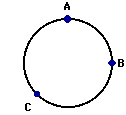
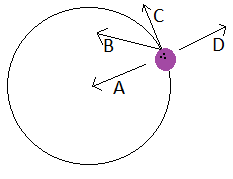
A ball is moving at constant speed around the circle. Which letter represents the acceleration of the ball?
A
B
C
D
Nonsense. The ball can't be accelerating while moving at a constant speed.


Why do objects experience centripetal acceleration even though they can have a constant speed?
Because they are speeding up as they move in a circle
Because they are constantly changing direction and hence, velocity changes, and that net change is directed inward.
Because they are constantly changing both speed and direction
Because when you have 100 people pedaling, you can speed up more easily.
The linear velocity is always _____ to the line of a circle.
outwards
towards the center
tangent
faster


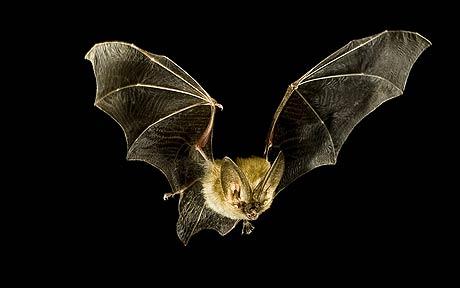
Bentley the bat has a mass of 0.58 kg and flies at a speed of 0.8 m/s in circle of radius 0.5 m. What is his centripetal acceleration?
0.25 m/s2
1.3 m/s2
1.6 m/s2
0.74 m/s2
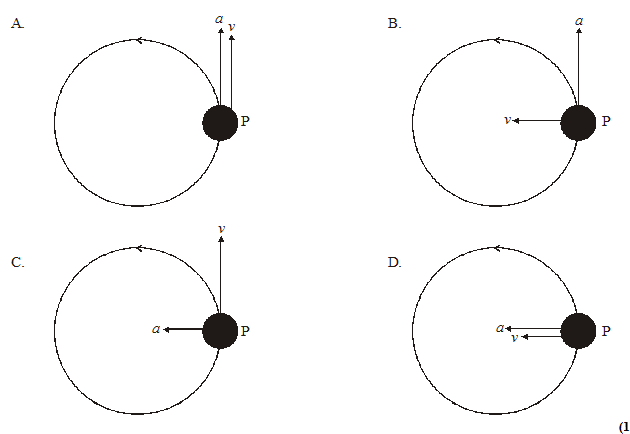
Particle P is moving in a circle with uniform speed. Which one of the following diagrams correctly shows the direction of the acceleration and velocity of the particle at one instant of time?

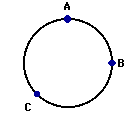

A race car completes three laps of a circular track with a radius of 35 m in 9.0 seconds. Determine the speed of the car.
3.9 m/s
73.3 m/s
24.4 m/s
1.0 m/s

Centripetal force is an acceleration of an object moving in circular path whose direction is _________________________of the circular path and whose magnitude is equal to the square of the speed divided by the radius.
towards the tangent
towards the centre
towards the minimum point
towards the maximum point
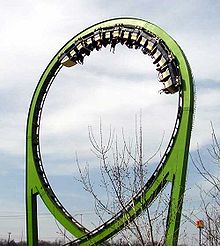
Where is the net force when the rollercoaster is at the top of the loop?
Towards the sky
Towards the Right
Towards the left
Towards the center of the circle
In uniform circular motion, the magnitude of the _______________________of an object is constant but the __________ is continually changing.
speed, acceleration
speed, direction
acceleration, speed
acceleration, velocity
________________________ defined as the number of revolutions (cycles/rotations) completed in one second.
frequency
period
distance
centripetal acceleration
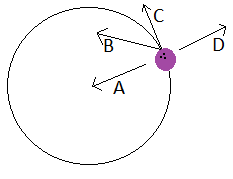
If an object is spinning around on a string and the string was suddenly cut, the object would move in a
curved path
straight line
Why does an object experiencing uniform circular motion have an acceleration?
because it ir changing speed
because it is changing direction
because it is moving n a straight line
because it has mass

The _______________________ supplies the centripetal force requirement for the car to move in a horizontal circle. Without it, the car would turn its wheels but would not move in a circle (as is the case on an icy surface).
friction force
centrifugal force
normal force
applied force

In this diagram, what do the red arrows represent?
the acceleration vector
the velocity vector
the centripetal force vector
the force of gravity

When the car is at the top of the loop it just maintains contact with the tract. What is the car's acceleration at this point?
g upwards
0.5g upwards
zero
g downwards

The car just maintains contact with the track at the top of the loop. What is it's velocity at this point?
Rg
g/R
Zero
√Rg
Consider the case of vertical circular motion when you are riding in a Ferris Wheel. What is the correct expression that relates all the forces when you are at the top of the circle?
Fc = mg + Reaction
Fc = mg - Reaction
Fc = mg
Fc = -Reaction - mg
Which one is the right relationship when you are at the bottom of a Ferris Wheel ride?
W = Fc
Reaction = mg + Fc
Fc = mg - Reaction
mg = Reaction
A fighter aeroplane flying in the sky dives with a speed of 100 ms-1 in a vertical circle of radius 200 m. Mass of the pilot sitting in it is 75 kg. What will be the value of force with which the pilot presses his seat when the aeroplane is at highest position (g = 10 ms-2)
3000 N
1500 N
(75 × g)N
300 N
A motor cyclist loops a vertical circular loop of diameter 18 m. What should be his minimum speed at the highest point of the loop?
9.4 m/s
16 m/s
21 m/s
30 m/s
A Ferris wheel has radius 5.0 m and makes one revolution every 8.0 s. A person who normally weighs 670 N is sitting on one of the benches attached at the rim of the wheel. What is the apparent weight (the normal force exerted on her by the bench) of the person as she passes through the highest point of her motion?
460 N
132 N
763 N
284 N
Pulling out of a dive, the pilot of an airplane guides his plane into a vertical circle with a radius of 600 m. At the bottom of the dive, the speed of the airplane is 150 m/s. What is the apparent weight of the 70-kg pilot at that point?
3300 N
690 N
2600 N
490 N
When describing gravitational field strength, we can use
N/kg
m/s2
both
neither
When visualizing gravitational field strength, we know that it is stronger in some places because
the gravitational field lines are longer
the gravitational field lines are shorter
the gravitational field lines are further apart
the gravitational field lines are closer together
True or false? Gravitational fields only act on places that have objects there
True
False
Why would we experience less of a gravitational pull toward Earth when standing on a very tall mountain?
We are further away from the center of the Earth
Air is less dense at that altitude
The gravitational field lines are closer together
We have greater gravitational potential energy
In which of these locations would we feel the weakest gravitational pull from Earth?
In the mall
In a space station orbiting Earth
In a castle in the sky
On a tall mountain
If you are trying to get somewhere, can gravitational field lines "get in your way?"
Yes
No
g = Gm/r2 describes the magnitude of a gravitational field. In which direction does the field act?
away from the mass in the equation (push)
toward the mass in the equation (pull)
toward the 4th dimension
toward the Earth
Select all that apply. When on the surface of Earth, we only consider g = GM/r2 = 9.8 N/m. This is because
the Earth is the only mass that is generating a gravitational field
the Earth generates a gravitational field that is approximately 9.8 N/m
every mass that we see generates a gravitational field, pulling us toward them, but are much smaller and negligible compared to the gravitational field of Earth
Mars has a gravitational field strength of 0.375 N/m near its surface
We experience gravitational fields due to
masses around us
charges around us
colors around us
heat around us
Newton's law of gravitation
Kepler's first law
Kepler's second law
Kepler's third law
In Fields, The constant of proportionality, G, is called the
gravitational field strength
universal constant of gravitation
Gibb's free energy
acceleration due to gravity
The gravitational force between two objects is (a) proportional to the distance between them
The units of G are
N m2 kg2
N m−2 kg−2
N m2 kg−2
N m−2 kg2
Newton's Law of Gravitation assumes the masses are point masses. This means that the masses have zero (a)
The value of G is
6.67x10⁻¹¹
6.67x10¹¹
6.67x10⁻¹
6.67x101
True or false:
m s−2 = N kg−1True
False
True or false:
You and the Earth exert an equal magnitude gravitational force on each other.
True
False
The path which a small mass would follow towards a large mass is called the line of force or (a)
The symbol for gravitational field strength is
GF
gfs
g
G
The unit for gravitational field strength is
N s−2
N kg−1
m s−2
N kg

What sort of field pattern is shown here?
A (a) field.
Which definition is correct?
Gravitational potential energy is the energy of an object due to its position in a gravitational field.
Gravitational potential energy is the energy of an object due to its position in a magnetic field.
Gravitational potential energy is the energy of an object due to its position in a field.
Gravitational potential energy is the acceleration of an object due to its position in a gravitational field.
The gravitational potential energy is zero at
just above the surface
the surface
infinity
just before infinity
The gravitational potential, V, at a point is the work done to move a small object from (a) to that point
Surfaces of constant potential are called
(a)
True or false:
True
False
Which equation shows the gravitational potential, V?
V = − r2G M
V = − rG M
V = r2G M
V = rG M
The radius of the Earth is 6400 km
The mass of the Earth is 6 x 1024 kg
G = 6.67 x 10⁻¹¹ N m2 kg−2
Which is the correct approximation for the escape velocity of the Earth?
12.0 km s−1
11.5 km s−1
11.2 km s−1
10.8 km s−1
What is the time period of a geostationary satellite?
24 h
12 h
0 h
6 h
Suppose a body of large mass is close to a body of small mass. Which statement correctly describes the force due to gravity in this system?
The small body alone experiences a force.
Both bodies experience a force of equal magnitude.
Each body experiences a different force in proportion to its mass.
Each body experiences a different force in proportion to the square of its radius.
What is meant by a quantity having an inverse-square relationship with distance?
The quantity is proportional to the reciprocal of the square of a distance.
The quantity is not proportional to the square of the distance.
The quantity is proportional to the reciprocal of the square root of a distance.
The square of the quantity is proportional to the reciprocal of a distance.
r3=4π2GMT2 Using this equation it can be shown that a geostationary satellite orbits the earth at a radius of 42 000 km. Approximately how high in metres is the satellite above the Earth's surface?
3.6×10⁷ m
4.2×10⁷ m
42000 m
36000 m
We generally think of satellites of small mass in orbit around bodies of much larger mass. In the case of two bodies of equal mass is it proper to treat one as being at the centre and the other as its satellite?
The two bodies can be treated as each being in orbit around a point in space equidistant between them.
The equal bodies collide rather than orbit each other, so the situation does not arise.
It is possible for a heavenly body to have a moon equal to its own mass, but the separation would need to be 2r for the system to be stable.
If a 'moon's' mass is too large, gravitational attraction will exceed the centripetal force needed to keep it in orbit, therefore the situation is unstable in the long term.
Which of the following statements is true about the gravitational field around a body?
A gravitational field only exists around the body if there is a test mass nearby to be attracted to it.
A gravitational field exists around the body even if there is no test mass nearby but the field has no direction.
A gravitational field exists around the body even if there is no test mass nearby and the field points inwards towards the body.
The direction of the gravitational field around the body depends on the position of a test mass placed nearby.
The energy involved in moving a 1 kg mass from infinity to the surface of a planet or star is -GM/r. Does this imply that to move a 1 kg mass from infinity to a black hole singularity of radius zero, would involve an infinite negative amount of energy?
Theoretically, the equation does indeed predict that an infinite energy would be involved.
Since an infinite amount of energy is obviously not possible, there must be an area over which this equation cannot apply.
Black holes are a mathematical concept and do not describe bodies in the real world.
Since the 1 kg mass would never come out again, the problem of explaining the disappearance of an infinite amount of energy disappears with it.

The graph shows how the force of gravity on a 1 kg mass varies with the distance r from the centre of the Earth. What does the area beneath the curve of the graph represent?
The work done to move a 1 kg mass from the surface of the Earth to infinity.
The force required to move a 1 kg mass from the surface of the Earth to infinity.
The work done to move a 1 kg mass from the centre of the Earth to infinity.
The force required to move a 1 kg mass from the centre of the Earth to infinity.
What are the units of the gravitational constant, G?
r3=4π2GMT2
N kg m−2
N m kg−2
N kg−2 m2

Region of space where a mass experiences an attractive force.
Gravitational force
Gravitational field
Gravitational field strength
Gravitational potential at a point
Force exerted per unit mass acting on a small test mass place at that point.
Gravitational force
Gravitational field
Gravitational field strength
Gravitational potential at a point
The work done per unit mass in bringing a small test mass from infinity to the point.
Gravitational force
Gravitational field
Gravitational field strength
Gravitational potential at a point
How does the gravitational force the Earth exerts on the sun compare to the gravitational force the sun exerts on the Earth?
The gravitational force the sun exerts on the Earth is larger
The gravitational force the Earth exerts on the sun is larger
Their gravitational forces are equal
There is not enough information
Find the force due to gravity if the mass of the object is 2300 kg and the mass of the other object is 4000 kg. The distance between the two objects is 0.150 m.
4.09 x 10⁻³ N
244 N
2.7 x 10⁻² N
6.14 x 10⁻⁴ N

Geosynchronous orbits take ______ to complete a full cycle.
24 hours
12 hours
48 hours
36 hours
What is gravity?
A type of energy that objects emit
The natural tendency for things to move towards massive objects
A force that repels objects away from each other
The speed at which objects fall to the ground
Which celestial body has the most powerful gravitational pull in our solar system?
Mars
Jupiter
The Sun
The Moon
Does the Moon have its own gravity?
No, gravity only exists on Earth
Yes, but only during a full moon
Yes, because it has mass
No, because it orbits the Earth
What determines the strength of an object's gravitational pull?
Its distance from the Sun
The color of the object
The mass of the object
Its temperature
Can smaller objects have a gravitational pull?
No, only planets and stars can have a gravitational pull
Yes, but only if they are made of metal
Yes, all objects with mass have some form of gravitational pull
No, gravity is a property of the Earth's core only
How does the gravitational force between two objects change if the distance between them is halved?
It doubles
It quadruples
It halves
It remains the same
What would happen to the gravitational force between two objects if one of their masses doubled?
The gravitational force would double
The gravitational force would halve
The gravitational force would remain unchanged
The gravitational force would quadruple
Which of the following is NOT a consequence of gravity?
Orbits of planets around the Sun
The tides in Earth's oceans
The color of the sky
The structure of galaxies
Rate this statement: No force due to Earth's gravity acts on astronauts inside the orbiting space station.
always true while in orbit, the astronaut is weightless
sometimes true while in orbit, depending on the angular speed of the space station
always false, centripetal force is needed
What is the gravitational field strength at a point one Earth radius above the surface?
g/2
g
g/4
g/9
What happens to the force of gravity between 2 objects if one mass is tripled?
1/3F
3F
4F
1/4F
What happens to the force of gravity between 2 objects if both masses were tripled?
18F
6F
1/9F
9F
What happens to the force of gravity between 2 objects if one mass is doubled?
1/4F
1/2F
2F
4F
What happens to the force of gravity between 2 objects if the distance is cut in half?
1/4F
1/2F
2F
4F
What happens to the force of gravity between 2 objects if the distance between them is doubled?
1/4F
1/2F
2F
4F
What happens to the force of gravity between 2 objects if one mass is quadrupled and the other mass is tripled and the radius is divided by 3?
12F
54F
207F
108F
Earth's mass is approximately 81 times the mass of the Moon. If Earth exerts a gravitational force of F on the Moon, the magnitude of the gravitational force of the Moon on the Earth is?
F
81/F
9F
81F
What happens to the Force of Gravity if an object is 2 Earth radius above the surface?
F
1/3F
1/9F
3F
Compute g for the surface of a planet whose radius is double that of Earth and whose mass is triple that of Earth.
g on earth's surface is
1.64 m/s2
7.36 m/s2
9.81 m/s2
14.7 m/s2
In uniform fields, all points have ________ field strength.
Zero
Same
Infinity
Different
A field that spreads outwards in all directions is __________
Linear
Radial
Weak
Strong

A body weighs more at the poles than at the equator. True or false?
True
False
Gravitational law is also called
Universal law
Newton’s law
Constant law
True law
Force acting on two point masses is directly proportional to
sum of masses
difference of masses
distance between masses
product of masses

On scale of building, gravitational field is
energy increasing
decreasing
uniform
varying

