wayground logo

Free Printable Worksheets

Font size

S
M
L
XL
Worksheets

Organ system

Total questions: 73

Worksheet time: 55mins

Name
Class
Date
1.
Which system absorbs oxygen and releases carbon dioxide?
a)
respiratory
b)
excretory
c)
endocrine
d)
immune
2.
Which system acts as a barrier from the sun and helps regulate body temperature?
a)
integumentary
b)
muscular
c)
digestive
d)
circulatory
3.
This system transports oxygen and nutrients around the body.
a)
circulatory
b)
respiratory
c)
skeletal
d)
digestive
4.
Which system controls voluntary and involuntary movement?
a)
muscular
b)
skeletal
c)
immune
d)
excretory
5.
This system fights pathogens (germs) and produces and stores white blood cells.
a)
immune
b)
muscular
c)
endocrine
d)
integumentary
6.
This system breaks down food into nutrients that the body can absorb.
a)
digestive
b)
excretory
c)
reproductive
d)
immune
7.
This system supports the body and protects vital organs.
a)
skeletal
b)
muscular
c)
circulatory
d)
nervous
8.
This system sends chemical messagengers (hormones) that regulate growth, development, and metabolism.
a)
endocrine
b)
nervous
c)
immune
d)
skeletal
9.
Lungs are the primary organs of this system.
a)
muscular system
b)
nervous system
c)
circulatory system
d)
respiratory system
10.
Which system sends electrical messages that helps control the body's responses to internal and external changes?
a)
nervous
b)
endocrine
c)
reproductive
d)
integumentary
11.
Which of these is the least complex level of organization?
a)
earthworm
b)
digestive system
c)
skin cell
d)
stomach
12.
What two systems work together to supply the body with oxygen?
a)
respiratory and muscular
b)
respiratory and circulatory
c)
circulatory and digestive
d)
muscular and digestive
13.
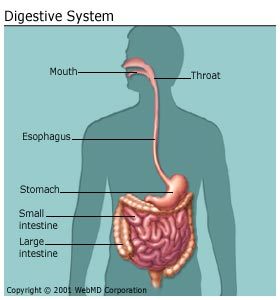
Which example best shows structures that make up the digestive system in the human body? 
a)
Lungs, Heart, Arteries
b)
Brain, Spinal Cord, Nerves
c)
Stomach, Intestines, Esophagus
d)
Nose, Lungs
14.
What is included in the nervous system?
a)
Heart
b)
Skin
c)
Brain
d)
Lungs
15.
What is the function of the digestive system?
a)
Helps different parts of the body to move
b)
Carries digested food, water and oxygen in the blood to all parts of the body
c)
Carries waste materials away from different parts of the body
d)
Breaks down food into simple substances
16.
What is the function of the skeletal system?
a)
Supports the body
b)
Removes air from the body
c)
Absorbs substances so that they can be used by the body
d)
Breaks down food into simple substances
17.
In which part of the digestive system is digestion completed?
a)
Stomach
b)
Small intestine
c)
Large intestine
d)
Anus
18.
Digestive juices are added to the food in the _______________.
a)
mouth, gullet and small intestine
b)
stomach, small intestine and large intestine
c)
stomach, gullet and large intestine
d)
mouth, stomach and small intestine
19.

Which of the following would be considered a major partof the Immune system?

a)

stomach

b)

bladder

c)

bones

d)

lymph nodes

20.

How many bones does an adult have?

a)

101

b)

200

c)

206

d)

300

21.

Which is the longest bone in the human body?

a)

ribs

b)

femur

c)

tibia

d)

patella

22.

Which off the following is an important part of the central nervous system?

a)

lungs

b)

spinal cord

c)

tongue

d)

stomach

23.

Which type of cells plays an important role in the immune system?

a)

red blood cells

b)

immune cells

c)

white blood cells

d)

germs

24.

What is the outer layer of skin called?

a)

dermis

b)

epidermins

c)

melanoctes

d)

fatty tissue

25.
Which of the following is the correct order of organization in living things from most basic (simple) to most complex?
a)
a.  Organism, cell, tissue, organ, organ system
b)
a.  Organ system, organ, tissue, cell, organism
c)
a.  Cell, tissue, organ, organ system, organism
d)
a.  Cell, organ, tissue, organ, organism, organ system
26.
When a group of organs work together to perform a particular function they create a/an
a)
organ system
b)
organism
c)
tissue
d)
organ
27.
The cell is the building block of all living things.
a)
True
b)
False
28.
Tissue that works together to perform a function
a)
organ
b)
cell
c)
organ system
d)
organism
29.
What do you have when organ systems work together?
a)
organs
b)
organism
c)
cells
d)
tissue
30.
A group of cells that work together
a)
organ system
b)
organism
c)
organ
d)
tissue
31.
This is a example of........ 
a)
organ system
b)
cells
c)
organ
d)
tissue
32.
This is a example of ........
a)
cell
b)
organ system
c)
organ
d)
tissue
33.
This is a example of ........
a)
organ
b)
organ system
c)
tissue
d)
cell
34.
The _______________ system has been called both a membrane, because it covers the body, and an organ, because it contains several types of tissues. However, most refer to it as a system.
a)
respiratory 
b)
integumentary
c)
cardiovascular
d)
muscular
35.
Heat escapes when blood vessels _________.
a)
constrict
b)
dilate
36.
The skin helps to produce _______________ by using UV rays from the sun.
a)
Vitamin A
b)
Vitamin C
c)
Vitamin D
d)
Vitamin K
37.
Number 5 is pointing to the...
a)
Liver
b)
Gallbladder
c)
Pancreas
d)
Stomach
38.
Which is NOT a function of the Digestive System?
a)
To rid the body of solid waste
b)
Absorb nutrients for energy & growth
c)
Break down nutrients from food
d)
Pump blood around the body
39.
Endocrine glands produce __________ which maintain the body in homeostasis
a)
oils
b)
neurotransmitters 
c)
tears
d)
hormones
40.
targets bone and muscle to promote growth and development
a)
growth hormone
b)
prolactin
c)
oxytocin
d)
ADH (antidiuretic hormone)
41.
this hormone causes an increase in bone density, deepening of the voice, and increased production of body and facial hair
a)
estrogen
b)
insulin
c)
testosterone
d)
progesterone
42.
this hormone stores sugar in the liver and muscles when sugar levels are high
a)
insulin
b)
glucagon
c)
T3
d)
melatonin
43.
these hormones promote secondary sex characteristics in females
a)
testosterone and GH
b)
epinephrine and nor-epinephrine
c)
estrogen and progesterone
d)
prolactin and oxytocin
44.
 Like all other body systems, the immune system helps the body maintain homeostasis.  Which statement best describes how the immune system does this?  
a)
it protects other organs and tissues from infection and disease
b)
it breaks down food to provide cells with nutrients
c)
it gathers information through the senses and controls all other body systems
d)
 it transports oxygen and carbon dioxide
45.
The picture below illustrates one internal part of the body’s immune system. What process is illustrated in the picture?  
a)
a skin cell destroying germs.
b)
inflammation near an opened wound
c)
a white blood cell destroying pathogens
d)
mucus in the lungs destroying pathogens
46.
What do scientists call bacteria and viruses that can make people sick?  
a)
diseases
b)
vaccines
c)
antibodies
d)
pathogens
47.
Antibiotics work against most
a)
Bacteria
b)
Bacteria & Viruses
c)
Vaccines
d)
Viruses
48.

A tissue that is vasoconstricted has

a)

increased edema and muscle spasm

b)

decreased blood flow to the area

c)

increased blood flow to the area

d)

decreased chances of infection

49.

Cells that engulf and destroy pathogens are called:

a)

cilia

b)

phagocytes

c)

killer cells

d)

mucous

50.

which aspect includes the anterior portion of the hand?

a)

ulnar

b)

palmar

c)

dorsal

d)

radial

51.

The brain structure that controls heart rate, blood pressure, breathing, swallowing, and vomiting is the:

a)

cerebral spinal fluid

b)

cerebral

c)

reticular formation

d)

medulla oblongata

52.

a bubble-like collection of fluid beneath or within the epidermis of the skin is called a:

a)

blister

b)

contusion

c)

laceration

d)

hot spot

53.

A narrow band of fibrous that attaches muscle to bone is called

a)

ligament

b)

fascia

c)

tendon

d)

muscle

54.

Which upper leg muscles is known as the runners muscle

a)

Quadriceps

b)

gastrocnemius

c)

soleu

d)

sartorius

55.

which tissue type is found in smooth hollow organs

a)

fascia

b)

smooth

c)

striated

d)

cardiac

56.

When an athlete is fitted for a knee sleeve the front of brace should fit over the ...

a)

patella

b)

ulna

c)

femur

d)

fibula

57.

which muscle is located on the posterior side of the body

a)

pectoralis major

b)

quadriceps

c)

latissimus dorsi

d)

adominals

58.

Carrying oxygenated blood to the body is the primary function of

a)

plasma

b)

granulocytes

c)

erythrocytes

d)

lukeocytes

59.

The suffix -itis means

a)

discoloration

b)

pain

c)

infammation

d)

treatment

60.

The pelvic bone consists of the ilium, the ischium and the

a)

pubis

b)

coccyx

c)

sacrum

d)

acetabulum

61.

Which muscle attaches the soleus and the Achilles' tendon to the calcaneus?

a)

vastus lateralis

b)

sartorius

c)

quadriceps femoris

d)

gastrocnemius

62.

Pectoralis major is a muscle of the?

a)

neck

b)

thigh

c)

chest

d)

abdomen

63.

which muscle is considered a shoulder pad of the arm

a)

pectoralis major

b)

latissimus dorsi

c)

deltoid

d)

biceps

64.
Which plane divides the body into left and right sides
a)
Frontal
b)
Coronal
c)
Sagittal 
d)
Transverse
65.
Which of the following is NOT a plane of the body?
a)
Coronal
b)
Frontal
c)
Transverse
d)
Vertical
66.
Which of the following planes has a horizontal line through the body
a)
Transverse
b)
Coronal
c)
Lateral
d)
Frontal
67.
Your elbow is _______ to your wrist
a)
Lateral
b)
Distal
c)
Inferior
d)
Proximal
68.
Your thumb is ______ to your pinky
a)
Lateral
b)
Medial
c)
Proximal
d)
Distal
69.
Ligaments connect:
a)
Bone to bone
b)
Muscle to bone
c)
Joint to joint
d)
Bone to joint
70.
skull, vertebral column, and thorax
a)
axial skeleton
b)
appendicular skeleton
c)
skeleton
d)
bones 
71.
which one of these IS  a function of the skeletal system 
a)
vitamin D production
b)
fat storage
c)
movement
72.
What are the 3 types of muscle tissue?
a)
Thigh, Calf, & Shoulder
b)
Traps, Forearm, & Abs
c)
Hamstring, Biceps, & Triceps
d)
Smooth Muscle, Cardiac Muscle, & Skeletal Muscle
73.

Gastrointestinal best describes which organ system?

a)

respiratory

b)

digestive

c)

immune system

d)

muscular