wayground logo

Free Printable Worksheets

Font size

S
M
L
XL
Worksheets

Week 1-4 Distance learning Aquatics

Total questions: 75

Worksheet time: 2hrs 53mins

Name
Class
Date
1.
What are vertebrates?
a)
Animals with a backbone
b)
Animals without a backbone
c)
Fish
d)
All types of animals
2.
Which class of vertebrates has the most species?
a)
Jawless Fish
b)
Bony Fish
c)
Birds
d)
Mammals 
3.
Which group of vertebrates is found only in water?
a)
Fish
b)
Crustaceans
c)
Amphibians
d)
Fish and amphibians
4.

Which is not a Feature of Vertebrates

a)

Postanal tail, pharyngeal pouches

b)

Specialized sensory organs

c)

No Vertebral Column

d)

Closed-loop circulatory system

5.

What body shape allows fish to be fast or agile?

a)

Oval

b)

Laterally

c)

Flat fish

d)

Truncate

e)

Both Oval and Laterally

6.
BONY FISH
a)
CHONDRICHTHYES
b)
AGNATHA
c)
OSTEICHTHYES
7.
Fish with bodies of cartilage and scales.
a)
chondrichthyes
b)
osteichthyes
c)
agnatha
8.

A fish has _____ heart chambers.

a)

1

b)

2

c)

3

d)

4

9.

Fish belong to the phylum

a)

Vertebrata

b)

Osteichthyes

c)

Eukarya

d)

Chordata

10.

Behaviors used by some fish to disguise their presence in the enviornment

a)

Schooling

b)

Learning

c)

Camouflage

d)

Advertising Behavior

11.

Bunching or grouping of fish all orienting in one direction and keeping equal spacing

a)

Aggregation

b)

Food Searching

c)

Camouflage

d)

Schooling

12.

Threatening or Frightening others

a)

Movement

b)

Aggression

c)

Agregation

d)

Food Searching

13.
A form of camouflage that uses contrasting coloring  to blend many animals together
a)
Countershading
b)
Mimicry
c)
Disruptive coloration
14.
A protective coloration to help an animal blend in
a)
camouflage
b)
countershading
c)
mimicry
15.
A form of camouflage in which an animal's belly is lighter and its back is darker
a)
countershading
b)
mimicry
c)
disruptive coloration
16.

Choose all that apply to the reproduction of fish

a)

Lays eggs

b)

Ovoviparous

c)

They hug for a long time

d)

Viviparous

17.

Cartilaginous fishes that have long, eel-like bodies, no scales, no appendages, and no jaws

a)

Superclass Agnatha

b)

Class Osteichthyes

c)

Class Chondrichthyes

d)

Superclass Gnathostomata

18.

Jawless fish that lack vertebrae, have two rows of teeth on their tongue; scavengers; produce huge amounts of slime

a)

hagfish

b)

lampreys

c)

guitarfish

d)

sunfish

19.

Jawless fish that have a circular mouth that is continuously open; many are parasitic; some migrate to freshwater to reproduce

a)

hagfish

b)

lampreys

c)

guitarfish

d)

sunfish

20.

Cartilaginous fishes that include sharks, skates, and rays

a)

Superclass Agnatha

b)

Class Osteichthyes

c)

Class Chondrichthyes

d)

Superclass Gnathostomata

21.

Bony fishes that include perch, trout, catfish, salmon, seahorses

a)

Superclass Agnatha

b)

Class Osteichthyes

c)

Class Chondrichthyes

d)

Superclass Gnathostomata

22.

The organ that adjusts the buoyancy of bony fishes is called the

a)

cerebellum

b)

lateral line

c)

operculum

d)

swim bladder

23.

Chordates possess the following type of skeleton

a)

endoskeleton

b)

cartilaginous skeleton

c)

exoskeleton

d)

body armor

24.
Cartilaginous fish that have flattened bodies with paired winglike fins are ____
a)
sharks and perch 
b)
rays and skates
c)
rays and sharks 
d)
lampreys and hagfish 
25.
What structure do sharks use to detect electrical currents?
a)
Cuadal fins
b)
Rostral area
c)
Ampullae of Lorenzini
d)
Lateral line
26.
Which groups of invertebrates exist? 
a)
Arthropods, molluscs and worms
b)
Arachnics, worms, molluscs and echinoderms 
c)
Sponges, insects, worms, molluscs and arthropods
d)
Arthropods, sponges, jellyfish, echinoderms, worms and molluscs
27.

What kind of symmetry do cnidarians have?

a)

None

b)

Pentaradial

c)

Radial

d)

Hexaradial

28.

Which invertebrate has poisonous tentacles?

a)

Cnidarians

b)

Annelids

c)

Porifera

d)

Arthropods

29.

What do porifera use to filter water

a)

Respiratory cavity

b)

Radula

c)

Palps

d)

Pores

30.

What does invertebrate mean?

a)

Animals without a backbone

b)

Animals that change their form

c)

Animals with a backbone

d)

Animals that lay eggs

31.
I have a digestive cavity with one opening, and have tentacles.  I am a hydra.
a)
Echinoderm
b)
Cnidarian
c)
Arthropod
d)
Mollusk
32.
In what phylum am I?
a)
Annelid
b)
Mollusk
c)
Echinoderm
d)
Cnidarian
33.

What is the most abundant of the freshwater Cnidarians?

a)

box jellyfish

b)

hydra

c)

coral

d)

anthozoa

34.

The skeleton, and the calyx, of corals is made out of what substance?

a)

silica

b)

calcium carbonate

c)

silica carbonate

d)

phosphorous

35.

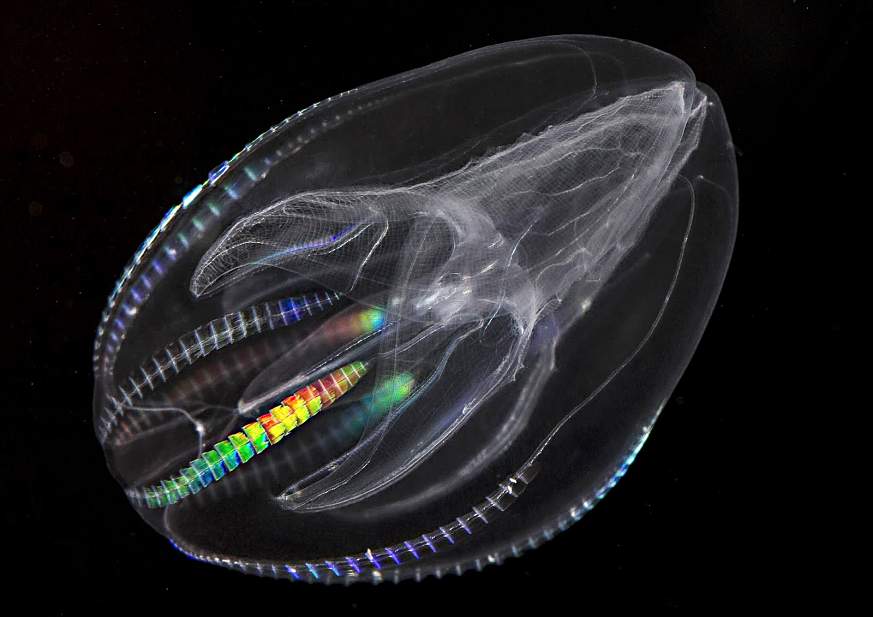
What phylum do comb jellies belong in?

a)

Cnidaria

b)

Porifera

c)

Chordata

d)

Ctenophora

36.
What trait gives jellies in the Phylum Ctenophora their common name? 
a)
Box shape
b)
Combs
c)
Tentacles
d)
Polyps
37.
Which of the following phyla contains  mostly parasitic roundworms?
a)
Annelida
b)
Trematoda
c)
Nematoda
d)
Platyhelminthes
38.
What phylum?
a)
Platyhelminthes
b)
Nematoda
c)
Annelida
d)
Rotifera
39.
Which of these is a common way that parasitic worms can be transmitted? 
a)
fecal-oral contact
b)
arthropod vectors
c)
consuming contaminated food or water
d)
all of these are ways you can get worms! 
40.
Rotifers have the ability to reproduce without males. This is known as 
a)
parthenogenesis
b)
femgenesis
c)
eugenesis
d)
ecdysis
41.
Three layers, but no body cavity
a)
Radiata
b)
Bilateria
c)
Aceoelomates
d)
Deuterostomic
42.
a body cavity that is fully surrounded by mesodermal tissue
a)
coelom
b)
pseudocoelom
c)
mesoderm
d)
endoderm
43.
Which two phyla are the only two groups we studied that are pseudocoelomate?

a)
Rotifera and Nematoda
b)
Platyhelmentyese and Rotifera
c)
Nemeterea and Bryozoa
d)
Monogenea and Trematoda
44.

This parasitic worm forms cysts in the skeletal muscle of pigs and other animals

a)

Trichinella spiralis

b)

Necator

c)

Ascaris

d)

Filarial worm

45.

The large opening at the top of the sponge is called the

a)

Osculum

b)

Porocyte

c)

Spicule

d)

Spongocoel

46.

The sponge has no organs, tissues, and no nervous system.

a)

True

b)

False

47.

What moves water through the sponge?

a)

Collar cell

b)

Flagella

c)

Porocyte

d)

Amebocyte

48.
Most sponges are hermaphrodites.  What does this mean?
a)
sponges can produce their own food
b)
sponges can produce both eggs and sperm
c)
sponges cannot reproduce
d)
sponges can swim around
49.

How can flatworms reproduce?

a)

sexually

b)

regeneration

c)

fission

d)

all of these

50.

Class Cestoda

a)

ringworms

b)

tapeworms

c)

flukes

d)

roundworms

51.

Segments of a tapeworm that break off and exit through the feces.

a)

tegument

b)

scolex

c)

proglottids

d)

neck

52.

method of pork tapeworm transmission

a)

undercooked meat

b)

ingesting contaminated feces

c)

drinking contaminated water

d)

stepping on contaminated feces

53.

ALL members of Phylum Platyhelminthes have a gastrovascular cavity.

a)

true

b)

false

54.

fully functional body cavity. Tissue derived from mesoderm only partly lines the fluid filled body cavity of these animals

a)

Acoelomates

b)

Psuedocoelomates

c)

Coelomates

55.
Mollusks are acoelomates. 
a)
True
b)
False
56.
Which of these is NOT one of the three main body parts of a mollusk? 
a)
Head
b)
Valve
c)
Foot
d)
Visceral Mass
57.
What is the radula used for?
a)
Locomotion
b)
Feeding
c)
Swimming
d)
Digging
58.
The protective shell of a mollusk...
a)
is secreted by the mantle.
b)
Grows from the end of the mollusk foot. 
c)
Is constantly replaced by bigger shells as the mollusk grows. 
d)
forms when the mollusk reaches adulthood. 
59.

What TYPE of mollusk is this?

a)

Bivalve

b)

Gastropod

c)

Cephalopod

60.

What TYPE of mollusk is this?

a)

Bivalve

b)

Gastropod

c)

Cephalopod

61.
The image represents a planaria which would belong to which class in the phylum Platyhelminthes?
a)
Cestoda
b)
Trematoda
c)
Turbellaria
d)
Platyhelminthes
62.
Which of the following phyla was the first to exhibit body segmentation?
a)
Annelida
b)
Arthropoda
c)
Cnidara
d)
Echindermata
63.
What class /subclass?
a)
Oligochaeta 
b)
Polychaeta
c)
Hirudinea
64.
Earthworms have setae, which are like bristles that help them ___.
a)
move
b)
eat
c)
reproduce
65.
Which of the following is a thickened segment of the earthworm’s body is used in reproduction?
a)
Septa
b)
Setae
c)
Clitellium
d)
Ganglia
66.
What class / subclass?
a)
Oligochaeta 
b)
Polychaeta
c)
Hirudinea
67.
The leg-like structures seen in polychaetes are called
a)
Setae
b)
Parapodia
c)
Antennae
d)
Trochophores
68.

What type of circulatory system do arthropods have?

a)

open

b)

closed

69.

The exoskeleton of an arthropod is made of which of the following?

a)

chitin

b)

dentin

c)

protin

d)

chlorotin

70.

Which class of arthropods are mainly aquatic?

a)

Crustacea

b)

Insecta

c)

Diplopoda

d)

Chilopoda

71.

True or False: The round, muscular structure attached to a tube foot is the ampulla...

a)

True

b)

False

72.

What process to echinoderms use to replace a lost/broken ray?

a)

Reproduction

b)

Metamorphosis

c)

Parthenogenesis

d)

Regeneration

73.

What phylum do sea stars, sea urchins, sand dollars, brittle stars, and sea cucumber belong to?

a)

Animalia

b)

Annelida

c)

Echinodermata

d)

Mollusca

74.

What part of a sea star allows it to move from one place to another?

a)

Radial canal

b)

Tube feet

c)

Ampullae

d)

Stone canal

75.

What class are sea stars a part of?

a)

Asteroidea

b)

Echinoidea

c)

Holothuroidea

d)

Ophiuroidea