wayground logo

Free Printable Worksheets

NEW

Font size

S
M
L
XL
Worksheets

8th Science STAAR Review

Total questions: 70

Worksheet time: 1hrs 5mins

Name
Class
Date
1.

Rift valleys can form when fractures in Earth’s crust widen. The valley walls slowly move at a rate of only a few millimeters a year. Which of these best describes the type of tectonic activity that forms rift valleys?

a)

Rift valleys form where a continental plate moves under an oceanic plate.

b)

Rift valleys form where two plates move away from each other.

c)

Rift valleys form where a plate slides horizontally past another plate.

d)

Rift valleys form where an oceanic plate moves under another oceanic plate.

2.

Which statement correctly describes the location and charge of the electrons in an atom?

a)

The electrons are inside the nucleus and have no charge.

b)

The electrons are outside the nucleus and have no charge.

c)

The electrons are inside the nucleus and have a negative charge.

d)

The electrons are outside the nucleus and have a negative charge.

3.

Two friends want to go for a night hike when there is a full moon in July. If there is a third-quarter moon on July 2, what is the approximate date of the next full moon?

a)

July 9

b)

July 23

c)

July 16

d)

July 30

4.

Both primary and secondary succession begin with pioneer species that —

a)

modify the area and allow larger and more complex organisms to appear

b)

change the area and make it safer from predatory organisms

c)

invade the area so that new organisms cannot be established

d)

use up all the existing resources and prevent establishment of non-native organisms

5.

Which of these changes would likely occur if the rate of Earth’s rotation on its axis increased?

a)

The length of the seasons would be shorter.

b)

The length of a day would be shorter.

c)

The length of the seasons would be longer.

d)

The length of a day would be longer.

6.

The universe has many different components. Which list places four components of the universe in the most likely order from smallest to largest?

a)

Planets, stars, galaxies, nebulae

b)

Nebulae, stars, planets, galaxies

c)

Galaxies, stars, planets, nebulae

d)

Planets, stars, nebulae, galaxies

7.

Tin, Sn, is a soft white metal. It has a low melting point compared with other metals. Tin is widely used as a coating for cans of food. Which statement accurately describes atoms of tin?

a)

Tin atoms have 50 protons.

b)

Tin atoms have 68 electrons.

c)

Tin atoms have 119 neutrons.

d)

Tin atoms have five valence electrons.

8.
Which of the following is the name of the ancient supercontinent formed 28 Million Years ago.
a)
Pangea
b)
Gondwanda
c)
Laurasia
d)
Neverland
9.
Islands can from from magma which is pushed up at a __________ plate boundary
a)
Divergent
b)
Convergent
c)
Transform
10.
The Himalayas in Asia are an example of what type of plate boundary?
a)
divergent
b)
continent-to-continent convergent
c)
ocean-to-continent convergent
d)
transform
11.
What is this image...
a)
Revolving boundary
b)
San Andreas (Transform)
c)
Convergent
12.
What does the theory of continental drift state?
a)
The continents were once joined in a super-continent and have moved over time
b)
Continents are stationary and do not move
c)
The Earth is broken into lithospheric plates that move due to convection currents
d)
none of the above
13.
What evidence did Wegener use in his theory?
a)
Continents and fossils fitting together/matching-up like puzzle pieces 
b)
glacier scars and evidence from temperature
c)
mountain ranges and coal deposits line up across continents
d)
all of the above
14.
What is the elevation of point B?
a)
800 ft
b)
850 ft
c)
900 ft
d)
1000 ft
15.
A mountaineer is planning an expedition. He wants to follow the easiest possible path, which means he needs to find the most gentle slope up the mountain. Which route should the mountaineer choose?
a)
Route A
b)
Route B
c)
 Route C
d)
Route D
16.
Which group of the periodic table is composed of inert (not reactive)  gases?
a)
alkali metals
b)
alkaline earth metals
c)
halogens
d)
noble gases
17.
Elements in a ..................have similar chemical properties.  
a)
period
b)
group
c)
row
18.
A proton is....
a)
A negatively charged subatomic particle
b)
A positively charged subatomic particle
c)
A neutrally charged subatomic particle
d)
The only subatomic particle located in the nucleus
19.
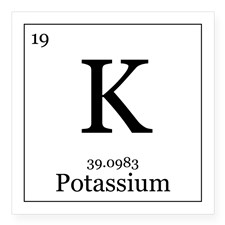
Which elements have the most similar chemical properties?
a)
K and Na
b)
K and Ca
c)
K and Cl
d)
K and S
20.
What period and group is Silver (Ag)? 
a)
Period 2, Group 1
b)
Period 3, Group 16
c)
Period 5, Group 11
d)
Period 2, 14
21.
The elements in this group have 5 valence electrons and include elements N, P, and As.
a)
Group 5
b)
Group 1
c)
Group 18
d)
Group 15
22.
The particles that are found in the nucleus of an atom are
a)
neutrons and electrons
b)
electrons only
c)
protons and neutrons
d)
protons and electrons
23.
How many neutron are in the atom "K"?
a)
7
b)
2
c)
39
d)
12
24.

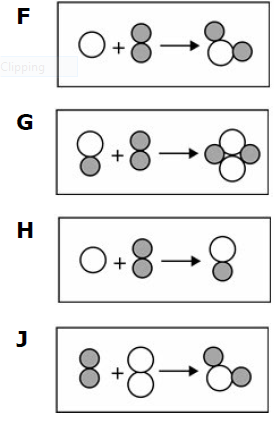
Which of the following models best demonstrates the law of Conservation of Mass?

a)

F

b)

G

c)

H

d)

J

25.
Which of these formulas contain equal numbers of nitrogen atoms?
a)
Formulas I and III
b)
Formulas I and IV
c)
Formulas II and III
d)
Formulas I, II, and V
26.

How many atoms in all are in a molecule of serotonin?

C10H12N2O

a)
22
b)
24
c)
25
d)
4
27.
Which of the following tells you that a chemical change may have occurred?
a)
Change Shape
b)
Melting
c)
Vaporizing
d)
Change in color
28.
Is copper tarnishing a physical or chemical change?
a)
Physical 
b)
Chemical
29.
When all the forces on an object are equal and opposite, & the net force is zero, that's...
a)
balanced forces
b)
unbalanced forces
c)
terminal velocity
d)
reaction forces
30.
A cannonball with a mass of 0.5 kg is flying at an acceleration of 10 m/sec/sec. What is it's force?
a)
50 Newtons
b)
5 Newtons
c)
20 Newtons
d)
9.5 Newtons
31.
In the picture, the blocks are flying out of the truck based on which of Newton's laws?
a)
Newton's 1st Law
b)
Newton's 2nd Law
c)
Newton's 3rd Law
d)
Newton's 6th Law
32.
In the picture, the vehicle will move because of...
a)
Newton's 1st Law
b)
Newton's 2nd Law
c)
Newton's 3rd Law
d)
Newton's 9th Law
33.
A greyhound dog can run about 40 mph.
a)
Speed
b)
Velocity
c)
Acceleration
34.
A car increases speed from 30 mph to 65 mph.
a)
Speed
b)
Velocity
c)
Acceleration
35.
Monarch butterflies fly 12 mph south as they migrate.
a)
Speed
b)
Velocity 
c)
Acceleration
36.
During which interval is the object speeding up?
a)
A to B
b)
B to C
c)
D to E
d)
E to F
37.
Which runner stopped for a rest?
a)
Albert
b)
Bob
c)
Charlie
38.
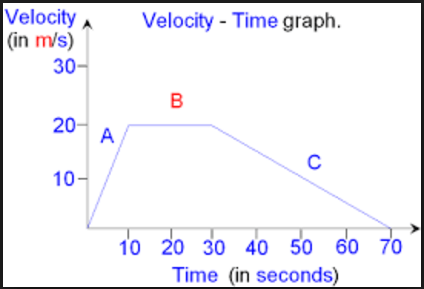
This is a velocity-time graph.  What is the object doing in segment C?
a)
Positive acceleration
b)
Negative acceleration
c)
Constant Velocity
d)
Not moving
39.
Which organism do the owl and the weasel compete for in the food web?
a)
Hawk
b)
Spider
c)
Grasshopper
d)
Shrew
40.
Which of the following would be the most likely effect, if there were a sudden increase in the cricket population?
a)
There would be a decrease in the small bird population.
b)
There would be a decrease in the grass/flowers population.
c)
There would be a decrease in the mice population.
d)
There would be an increase in the grass/flowers population.
41.
A frog eats a fly. The frog and fly are demonstrating ________.
a)
mutualism
b)
competition
c)
predator/prey
d)
parasitism
42.
A tapeworm inside a dog is
a)
competition
b)
predation
c)
commensalism
d)
parasitism
43.
What are the the 3 types of galaxies?
a)
Spiral, Regular, and Elliptical 
b)
Spiral, Irregular, and Elliptical 
c)
 Milky Way, Elliptical, and Spiral 
d)
Milky Way, Elliptical, and Irregular 
44.
Look at the H-R diagram. Which star is
sort of cool, dim (not too much light), and red?
a)
Betelguse
b)
Sirius B
c)
Procyon B
d)
Barnard's star
45.
This is an image of the formation of a star, also known as a .... 
a)
Main Sequence
b)
Planetary System
c)
Supernova
d)
Stellar Nebula
46.

What is a high tide?

a)

Sea pulled TOWARD the moon where Earth is CLOSEST to the moon

b)

Sea pulled AWAY from the moon where Earth is FARTHEST to the moon

c)

Sea pulled AWAY from the moon where Earth is CLOSEST to the moon

47.
Which body has the greater effect on Earth's tides?
a)
Sun
b)
Saturn
c)
Moon 
d)
Venus
48.
Where does an off spring get its traits in asexual reproduction?
a)
From both parents
b)
From only one parent
c)
From neither parent
d)
There are no traits handed down
49.
When a starfish grows a new body off a broken arm, what kind of reproduction is this?
a)
Sexual
b)
Differentiation
c)
Asexual 
d)
Specialization
50.
What is an advantage of sexual reproduction?
a)
Allows genetic variation
b)
Only needs one parent
c)
Happens very quickly
d)
Offspring are exact copies of parent
51.
An illustration and a dichotomous key are given. What is the correct classification for this organism?
a)
Class Insecta
b)
Order Amblygygi
c)
Order Araneae
d)
Order Scorpiones
52.
What is the definition of Prokaryote? 
a)
cell without a nucleus
b)
cell with a nucleus
c)
makes its own food
d)
one cell
53.
What is the definition of Eukaryote 
a)
cell without a nucleus
b)
cell with a nucleus 
c)
get its food
d)
many cells
54.
What is the definition of Auto Trophic?
a)
many cells
b)
one cell
c)
Gets its food
d)
Makes its food
55.
What is the definition Hetero trophic? 
a)
One cell
b)
Makes its food
c)
Gets its food
d)
Many cell
56.
What is the definition of Unicellular?
a)
Many cells
b)
One cell
c)
No cells
d)
To many cells
57.
What is the definition on Multi-cellular? 
a)
Many cells
b)
One cell
c)
No cell
d)
Too many cells
58.
Which cell structure is found in plant and animals cells and controls what can come into or leave a cell?
a)
cell membrane
b)
cytoplasm
c)
nucleus
d)
vacuole
59.
What is the function of the cell nucleus found in both plant and animal cells?
a)
to produce energy
b)
to control cell activity
c)
to remove waste products
d)
to allow molecules to enter the cell
60.
All cells need energy to function.  Which cell organelle is responsible for producing energy in the cell?
a)
chloroplasts
b)
mitochondria
c)
nucleus
d)
vacuoles
61.
If there is a full moon on March 2, when would you expect the Third Quarter?
a)
March 5
b)
March 9
c)
March 16
d)
March 23
62.
If today was a full moon, what would be the moon phase in one week?
a)
New Moon
b)
First Quarter
c)
Third Quarter
d)
Full Moon
63.
Approximately how much time passes between the new moon and full moon?
a)
one month
b)
two weeks
c)
3 days
d)
24 hours�
64.

What moon phase is shown and what special tide will occur?

a)

New moon; neap tide

b)

New moon; spring tide

c)

Full moon; neap tide

d)

Full moon; spring tide

65.
A change in the shape of an object is an example of _________________.
a)
a chemical change
b)
energy
c)
an endothermic change
d)
a physical change
66.
What type of change occurs when a new substance is formed that has different properties from the original substances?
a)
chemical change
b)
nuclear change
c)
physical change
d)
mutation
67.
In any chemical reaction, the mass of the products is always:
a)
slightly less than the mass of the reactants
b)
much less than the mass of the reactants
c)
the same as the mass of the reactants
d)
greater than the mass of the reactants
68.
The rings around the nucleus of an atom are called...
a)
energy levels
b)
electron circles
c)
proton levels
d)
neutron clouds
69.
Rows ⋘---⋙ on the periodic table indicate the number of...
a)
groups
b)
energy levels
c)
valence electrons
d)
total electrons
70.
This rule says that the amount of atoms in the reactants is equal to the amount of atoms in the products...
a)
Conservation of Energy
b)
E=MC2
c)
Conservation of Mass
d)
Rule of 8