wayground logo

Free Printable Worksheets

Font size

S
M
L
XL
Worksheets

LE Midterm Review

Total questions: 70

Worksheet time: 52mins

Name
Class
Date
1.

What is the function of the cell membrane?

a)

To control what comes in and out of the cell

b)

To break down food inside the cell

c)

to serve as a barrier

d)

to eat the cells food

2.

Which organelle produces the energy a cell needs to carry out its function

a)

Mitochondria

b)

Golgi Bodies

c)

Cytoplasm

d)

Nucleus

3.

What is the function of the Vacuoles

a)

Store food, water and waste

b)

Receive proteins

c)

Assembles amino acids

d)

Found inside the nucleus

4.

what is the function of ribosomes

a)

to assemble amino acids to create proteins

b)

to pack proteins

c)

to clean proteins

5.
What type of transport moves molecules from areas of lower concentration to areas of higher concentration?
a)
Passive
b)
Active
6.
What type of transport does not require the use of ATP (energy)?
a)
Passive
b)
Active
7.
Which term refers to the movement of water?
a)
Diffusion
b)
Facilitated diffusion
c)
Active transport
d)
Osmosis
8.

Plants and animal cells have...

a)

Mitochondria and chloroplasts

b)

Nucleus and chloroplast

c)

Cell wall and chloroplast

d)

Mitchochodria and cytoplasm

9.

Which 2 elements are found in ALL organic molecules?

a)

Carbon

b)

Nitrogen

c)

Oxygen

d)

Hydrogen

e)

Phosphorus

10.

H2O is an organic molecule.

a)

True

b)

False

11.

CH4 is an organic molecule.

a)

True

b)

False

12.

C6H12O6 is an organic molecule.

a)

True

b)

False

13.

Proteins are made of many ____ bonded together.

a)

amino acids

b)

enzymes

c)

polypeptides

14.

Dehydration synthesis is the reaction that occurs, allowing amino acids to bond. What happens during this process?

a)

add water to build a bond

b)

add water to break a bond

c)

remove water to build a bond

d)

remove water to break a bond

15.

What is DIFFUSION?

a)

none

b)
c)
d)
16.

What was most likely added to this slide?

a)

Distilled Water

b)

Salt Water

c)

nothing

17.

Which is the initial color of starch indicator solution?

a)

blue

b)

yellow/brownish orange

c)

amber

d)

blue-black

18.

If starch is present in a solution ___________ should produce a __________________ color.

a)

glucose; yellow/orange/brownish

b)

starch indicator/iodine; blue-black

c)

glucose indicator; blue

d)

Benedict's solution; yellow/orange.brownish

19.

Which molecule is too large to cross the cell membrane?

a)

water

b)

glucose

c)

O2

d)

starch

20.

After 24 hours, where will starch be found in this experiment?

a)

outside the cell, only

b)

outside and inside the cell

c)

inside the cell, only

21.

Diffusion is the movement of molecules from ______ concentration to ______ concentration.

a)

high, low

b)

low, high

c)

high, high

d)

low, low

22.

The specimen slide is placed on the ___

a)

platform

b)

table

c)

stage

d)

base

23.

Identify the microscope part:

a)

revolving nosepiece

b)

coarse focus knob

c)

diaphragm

d)

fine focus knob

24.
What is the total magnification of a microscope with two lenses when one lens has a magnification of 10x, and the other lens has a magnification of 30x?
a)
15x
b)
30x
c)
40x
d)
300x
25.
Which sequence of complementary DNA bases would pair with this partial strand
ATG TGA CAG?
a)
ATG TGA CAG
b)
TAC ACT GTC
c)
GTA AGT GAC
d)
CAT TCA CTG
26.
Which of the following best describes a DNA molecule?
a)
double helix
b)
contains ribose
c)
made of amino acids
d)
contains uracil
27.
Adenine bonds with ______________.
a)
Guanine
b)
Thymine
c)
Cytosine
d)
Adenine
28.

What type of organism makes its own food?

a)

Autotroph

b)

Heterotroph

29.

What are humans?

a)

Autotrophs

b)

Heterotrophs

30.

What is a lion?

a)

autotroph

b)

heterotroph

31.

What is a lily pad?

a)

autotroph

b)

heterotroph

32.

Which organelle is only in the plant cell?

a)

cell membrane

b)

cell wall

c)

nucleus

33.

The organelle that carries photosynthesis is called...

a)

Golgi apparatus

b)

Endoplasmic reticulum

c)

Chloroplast

34.

Changes to a population caused by nonliving things like pollution and extreme weather:

a)
b)
35.
All the living things in an ecosystem are called ______________________ factors.
a)
Ecosystem
b)
Environment
c)
Biotic
d)
Abiotic
36.

Biotic or abiotic?

a)

Biotic

b)

Abiotic

37.

Biotic or abiotic?

a)

Biotic

b)

Abiotic

38.
Why does sexual reproduction result in more genetic diversity than asexual reproduction? 
a)
Traits from two parents are combined. 
b)
More organisms reproduce this way. 
c)
Offspring grow in different environments. 
d)
Offspring come from identical parents. 
39.
Organisms that reproduce asexually generally have offspring that are 
a)
unicellular. 
b)
multicellular. 
c)
genetically varied. 
d)
genetically identical. 
40.
Requires only one parent
a)
sexual
b)
asexual
41.
In RNA, Uracil pairs with ______. 
a)
cytosine
b)
adenine
c)
guanine
d)
thymine
42.
The process to go from DNA to mRNA is _______
a)
translation
b)
transcription
c)
replication
43.
The process to go from mRNA to a protein is called ____
a)
transcription
b)
rRNA
c)
replication
d)
translation
44.
DNA holds the code for
a)
lipids
b)
carbohydrates
c)
protein
d)
sugar
45.
Choose the nucleotide sequence of the RNA strand that would be complementary to the following strand: 
GTAGTCA
a)
UATUAGA
b)
ACGACTG
c)
CAUCAGU
d)
CATCAGT
46.
The main function of tRNA is to...
a)
carry a message that, when translated, forms proteins
b)
form a portion of ribosomes
c)
string together complementary RNA and DNA strands
d)
bring amino acids from the cytoplasm to the ribosomes
47.
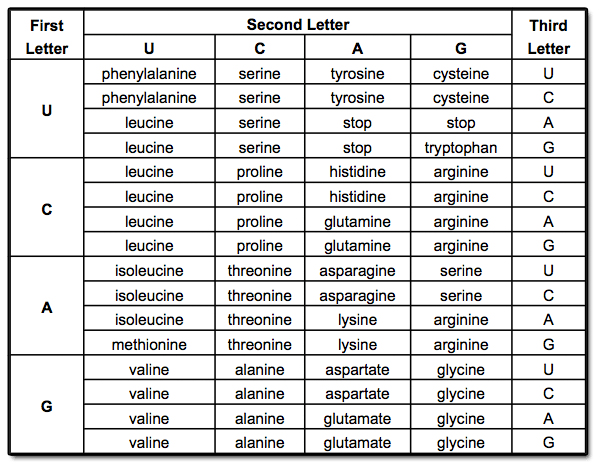
What amino acid is represented by the codon UUA?
a)
Phenylalanine
b)
Tyrosine
c)
Leucine
d)
Stop codon
48.
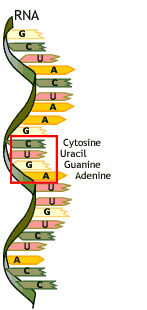
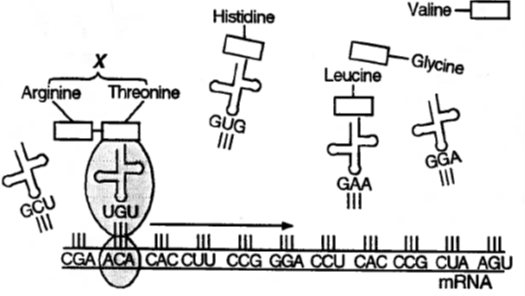
What process is going on in this photo? 
a)
Transcription 
b)
Translation 
c)
Replication 
d)
All the above 
49.
What is the location in the cell for transcription?
a)
nucleus
b)
cytoplasm
c)
ribosome
d)
mitochondria
50.
Which is the mRNA molecule that would be transcribed from this DNA template:
TGGCAAGTACGT
a)
ACCGTTCATGCA
b)
UGGCAAGUACGU
c)
UCCGUUCUUGCU
d)
ACCGUUCAUGCA
51.
How many amino acids are coded for by this sequence of nucleotides:
ATG GGA ACT CCA
a)
4
b)
2
c)
6
d)
12
52.
RNA is read in sections called:
a)
Triplets
b)
Genes
c)
Codons
d)
Genes
53.
Enzymes are considered to be 
a)
Lipids
b)
Carbohydrate
c)
Protein
d)
Nucleic Acid
54.
Which of the following conclusions can be drawn from this graph?
a)
The optimum pH of the enzyme is 6.6.
b)
The optimum pH of the enzyme is 5.8
c)
The enzyme’s activity increases as pH increases 5.0 to 9.0
d)
The enzyme’s activity is greater around pH of 8.0 .
55.
What is the optimum pH of pepsin?
a)
b)
2
c)
3
d)
7
56.
Which molecule represents the substrate specific for the shown enzyme?
a)
A
b)
B
c)
C
d)
D
57.
Where do we read the level of liquid?
a)
The highest point the liquid touches
b)
The bottom of the meniscus
c)
Half way between, we make an educated guess and round it
d)
Somewhere about there
58.
What is the correct value?
a)
5 ml
b)
15 ml
c)
20 ml
d)
25 ml
59.

What is the volume of the liquid in this graduated cylinder to the nearest .5 ml? Tip: figure out what each line is worth. You do NOT have to include the units.

(a)  

60.

Proteins that respond to cell stimuli across a membrane...

a)

receptor proteins

b)

hormonal proteins

c)

transport proteins

d)

storage proteins

e)

motor proteins

61.
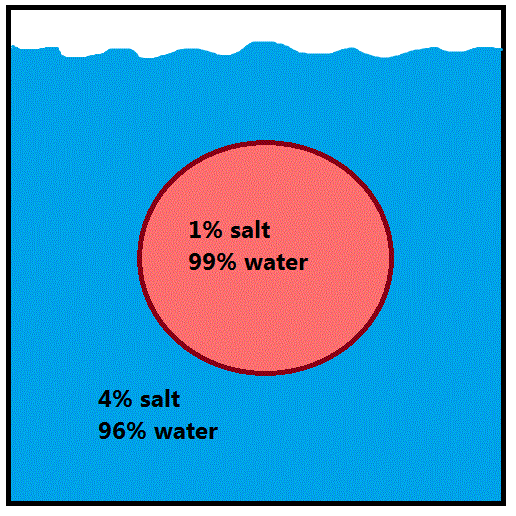
Where will the water go?
a)
Into the cell
b)
Out of the cell
c)
Equally in & out - it's isotonic
d)
There is no water
62.

Mr. Soz set up an experiment to see how the mass of a ball affects the distance it rolls off a ramp. What is the dependent variable?

a)

Distance traveled by the ball

b)

Height of the ramp

c)

Mass of the ball

63.
The independent variable is the ONE thing you _____.
a)
change
b)
keep the same
c)
experiment with
d)
investigate
64.
Mrs. LaRue wants to know which brand of paper towels is the strongest.  In this experiment, what is the INDEPENDENT variable? 
a)
Stength 
b)
Brand of paper towel
c)
Weight
d)
Environment
65.
Which is a monosaccharide?
a)
sucrose
b)
glucose
c)
starch
d)
glycogen
66.
The smallest sugars are
a)
polysaccharides 
b)
disaccharides
c)
monosaccarides 
67.
What molecule is this
a)
sucrose
b)
protein
c)
glucose
d)
cellulose
68.
Which of the following is a lipid?
a)
cholesterol
b)
cellulose
c)
glucose
d)
protein
69.
Which macromolecule is this?
a)
carbohydrate
b)
lipid
c)
protein
d)
nucleic acid
70.
Homeostasis
a)
allows for a wildly fluctuating internal environment
b)
is impossible in vertebrates
c)
is the maintenance of a relatively stable internal environment and often incorporates a form of feedback regulation
d)
is the maintenance of a relatively stable external environment and often incorporates a form of feedback regulation