wayground logo

Free Printable Worksheets

NEW

Font size

S
M
L
XL
Worksheets

Taxonomy Review

Total questions: 68

Worksheet time: 1hrs 20mins

Name
Class
Date
1.

Which of these kingdoms cannot be unicellular?

a)

Fungi

b)

Animalia

c)

Bacteria

d)

Protista

2.
The science of describing, classifying, and naming living things is called:
a)
Geology
b)
Biology
c)
Taxonomy
d)
Chemistry
3.
An organism that consists of a single cell is called?
a)
multicellular
b)
unicellular
c)
autotroph
d)
heterotroph
4.
An example of an unicellular organism would be:
a)
monkey
b)
bacteria
c)
spider
d)
human
5.
An organism made up of more than one cell would be called:
a)
multicellular
b)
unicellular
c)
heterotroph
d)
autotroph
6.
An organism that CAN make its own food is called:
a)
heterotroph
b)
unicellular
c)
autotroph
d)
multicellular
7.
An organism that CANNOT make its own food and must consume other living things:
a)
heterotroph
b)
multicellular
c)
unicellular
d)
autotroph
8.

Which of the following is NOT one of the four Kingdoms that scientists use for Domain Eukarya?

a)

Plants

b)

Bacteria

c)

Animals

d)

Fungi

9.
Which of the following is NOT one of the Domains that scientists use to classify?
a)
Bacteria
b)
Eukarya
c)
Fungi
d)
Archaea
10.

A tool used by a taxonomist to identify an unknown organism is known as a __________.

a)

taxonomic key

b)

binomial nomenclature

c)

scientific name

d)

binomial key

11.
The science of classifying and naming organisms is ______________.
a)
evolution
b)
taxonomy
c)
grouping
d)
scientific names
12.
An illustration and a dichotomous key are given. What is the correct classification for this organism?
a)
Class Insecta
b)
Order Amblygygi
c)
Order Araneae
d)
Order Scorpiones
13.
Who first proposed binomial nomenclature as a way of classifying organisms?
a)
Carolus Linnaeus
b)
Aristotle
c)
Charles Darwin
d)
Louis Pasteur
14.
Smallest taxonomic group with many similar characteristics...
a)
domain
b)
kingdom
c)
species
d)
class
15.

A student discovers an arachnid with a segmented abdomen, long legs, and a tail with no stinger. The student uses the taxonomic key below to identify it. Which arachnid has the student found?

a)

Whip Scorpion

b)

Wind Scorpion

c)

Daddy long legs

d)

Scorpion

16.
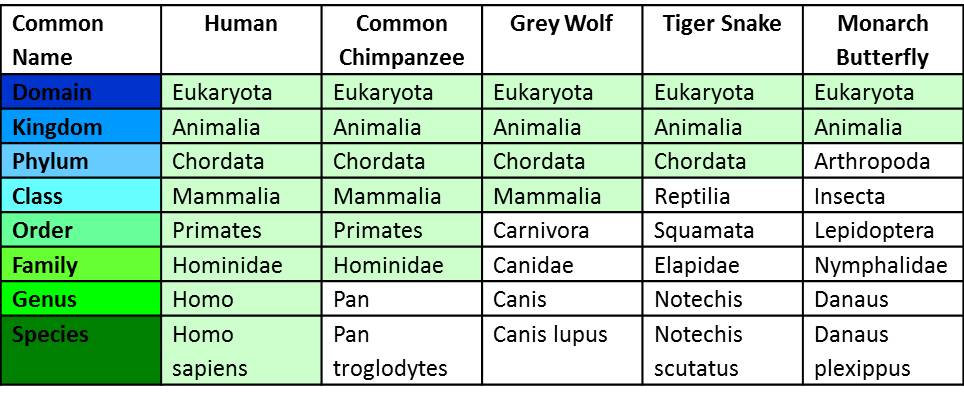
Which organism in the table shown is most closely related to the common dolphin?
a)
human
b)
killer whale
c)
giant kelp
d)
bat star
17.
Which kingdom contains members who are prokaryotic?
a)
Archaebacteria and Eubacteria
b)
Archaebacteria and Protista
c)
Eubacteria and Animalia
d)
Eubacteria  and Fungi
18.

Members of this domain live in unusual conditions such as deep ocean trenches or volcanoes

a)

Eubacteria

b)

Protista

c)

Fungi

d)

Archaea

19.
Members  of this kingdom are multicellular and heterotrophic
a)
Plantae
b)
Protista
c)
Animalia
d)
Achaebacteria
20.
Members of this kingdom never have a cell wall
a)
Animalia
b)
Plantae
c)
Archaebacteria
d)
Protista
21.
Members of this kingdom are multicellular and autotrophic
a)
Plantae
b)
Animalia
c)
Protista
d)
Fungi
22.
Algae, seaweeds, and protozoans belong to kingdom:
a)
Protista
b)
Animalia
c)
Plantae
d)
Fungi
23.
The scientific name for an organism is made from the:
a)
class and family name
b)
genus and species name
c)
domain and kingdom name
d)
kingdom and phylum name
24.
Which 2 organisms would be able to reproduce  and produce fertile offspring?
a)
2 organisms in the same class
b)
2 organisms in the same family
c)
2 organisms in the same genus
d)
2 organisms in the same species
25.
Term given to describe the 2 name naming system is:
a)
dichotmous key
b)
binomial nomenclature
c)
2 scientific names
d)
binomial key
26.

What is the correct way of writing our scientific name?

a)

homosapiens

b)

homo sapiens

c)

Homo Sapiens

d)

Homo sapiens

27.
An organism whose cell contains a nucleus
a)
Prokaryote
b)
Eukaryote
28.

Which scientific name is written correctly?

a)

Okapia Johnstoni

b)

Carcharodon carcharias

c)

balaenoptera Musculus

d)

panthera leo

29.
The closer animals are, the more _________ they share.
a)
Levels of taxonomy
b)
Adaptations
c)
Food
d)
Scientific names
30.
"Pinus taeda" is an example of what?
a)
Adaptations
b)
Common name
c)
Scientific name
d)
Food
31.
Mushrooms are a type of fungus. What characteristic of fungi makes them different from plants?
a)
Fungal cells are eukaryotic.
b)
Fungi are multicellular.
c)
Fungi are heterotrophic.
d)
Fungi have cell walls.
32.
The 8 levels of classification, largest to smallest.
a)
Species, Genus, Family, Order, Class, Phylum, Kingdom, Domain
b)
Genus, Species, Kingdom, Domain, Phylum, Family, Class, Order
c)
Domain, Kingdom, Phylum, Class, Order, Family, Genus, Species
33.
The domain Archaea: 
a)
are multicellular
b)
Undergo photosynthesis
c)
have membrain bound organelles
d)
are able to tolerate extreme conditions
34.
What do protists, plants, fungi, and animals have in common?
a)
Multicellular
b)
Eukaryotic
c)
Prokaryotic
d)
Consumers
35.
Which domain contains organisms that are unicellular, prokaryotic, and can cause illness yet also make food such as yogurt.
a)
Eukarya
b)
Archaea
c)
Bacteria
36.
Which of the following organisms are LEAST closely related?
a)
organisms that share a domain
b)
organisms that share a family 
c)
organisms that share a genus 
d)
organisms that share a species 
37.
Molds, yeast, and mushroom belong to kingdom:
a)
Eubacteria
b)
Archaebacteria
c)
Protista
d)
Fungi
38.

Which kingdom consists of heterotrophic organisms or decomposers that grow on or in what they eat?

a)

archaea

b)

bacteria

c)

protists

d)

fungi

39.
Which kingdoms have photosynthetic organisms?
a)
fungi and plants
b)
fungi and protists
c)
protists and plants
d)
plants and animals
40.
Which organism in the table is least closely related to the chimpanzee?
a)
human
b)
grey wolf
c)
tiger snake
d)
monarch butterfly
41.
I am prokaryotic and am found everywhere. What kingdom do I belong to?
a)
Eubacteria
b)
Archaebacteria
c)
Fungi
d)
Protista
42.
I have a nuclear membrane, can do photosynthesis and am multicellular. What kingdom do I belong to?
a)
Animalia
b)
Archaebacteria
c)
Plantae
d)
Protista
43.

I'm mobile, heterotrophic, and have no cell walls. What kingdom do I belong to?

a)

Animalia

b)

Archaebacteria

c)

Eubacteria

d)

Plantae

44.
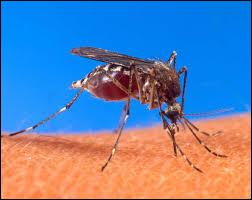
Mosquito  belongs to what kingdom?
a)
Animal Kingdom
b)
Plant Kingdom
c)
Fungi Kingdom
d)
Protista Kingdom
45.
Dandelion, What kingdom does it belongs to?
a)
Plant Kingdom
b)
Animal Kingdom
c)
Fungi Kingdom
d)
Protista Kingdom
46.

Which organisms are most closely related?

a)

Equus caballas (Horse) & Equus burchellii (Zebra)

b)

Cyanea artica (Jellyfish) &

Ctenodiscus crispatus (Mud Starfish)

c)

Naja naja (cobra) & Glycine max (soya bean)

d)

Ophiocomina nigra (black brittle star) & Brassica nigra (black mustard)

47.
An example of an unicellular organism would be:
a)
monkey
b)
bacteria
c)
spider
d)
human
48.
This organism is found in pond water.  It has a nucleus, is microscopic, unicellular and can perform photosynthesis.  What kingdom does it belong in?
a)
protista
b)
eubacteria
c)
archaebacteria
d)
plantae
49.
Why do we use scientific names to name organisms instead of relying on common names?
a)
Because common names vary regionally
b)
Because everyone understands and speaks Latin
c)
To make scientists sound smart
d)
Because they are the most descriptive
50.
The first part of a scientific name is an organism's _______________ and the second part is its ________________.
a)
species, genus
b)
phylum, order
c)
class, spices
d)
genus, species
51.

How do archaea get energy?

a)

autotroph

b)

heterotroph

c)

chemoautotroph

d)

decomposer

52.

Which of these is not a group that Aristotle put living creatures into?

a)

Flies

b)

Swims

c)

Crawls

d)

Slithers

53.

Which is the correct order?

a)

Kingdom Phylum Order Class

b)

Class Order Family Genus

c)

Domain Phylum Kingdom Species

d)

Order Family Species Genus

54.

Identify the one that is NOT an archaea.

a)

Methanogen

b)

Thermophile

c)

Halophile

d)

Virus

55.

Which is NOT a eukaryote?

a)

Plants

b)

Animals

c)

Archaea

d)

Protists

56.
Based on their scientific names, a scientist would know that the organisms Entamoeba histolytica and Entamoeba dispar do not belong to the same --
a)
class
b)
family
c)
genus
d)
species
57.
The two kingdoms composed entirely of unicellular organisms without a nucleus are --
a)
Bacteria and Archaea
b)
Bacteria and Protista
c)
Archaea and Protista
d)
Protista and Fungi
58.
A student collected the animal shown  on a field trip. The student used a dichotomous key and a microscope to classify the animal. 
How should this animal be classified?
a)
Arthropoda
b)
Annelida
c)
Mollusca
d)
Platyhelminthes
59.
Using the information below, which of the following would be characteristic of the kingdom bacteria?  
I.  Cell wall
 
II. Cell Membrane
 
III.  Multicellular
 
IV.  Heterotrophic
 
V. 
Autotrophic
a)
I and III
b)
I, II and V
c)
I, II, IV, and V
d)
I, II, III, and IV
60.
 An autotroph feeds on other organisms?
a)
True 
b)
False
61.
Which term means "True Nucleus" or cell(s) with a nucleus?
a)
Eukaryotes
b)
Prokaryotes
c)
Multi-cellular
62.
The 2 kingdoms that make up Prokaryotes are?
a)
Animals and Plants 
b)
Protists and Fungi
c)
Archea and Bacteria
63.
What kingdom's organisms often live in super harsh environments?
a)
archea
b)
animalia
c)
plantae
d)
protista
64.
Which kind of archaea live in extremely warm environments?
a)
Halophiles 
b)
Thermophiles 
c)
Methanogens 
d)
Psychophiles 
65.

The prefix "halo" such as in halophile most likely means...

a)

Salt

b)

High temperatures

c)

Self-serving

d)

Gram

66.

What kind of Archaea would you find in places such as volcanoes and hot vents on the ocean floor?

a)

Thermophiles

b)

Halophiles

c)

Cyanobacteria

d)

Plasmophiles

e)

Volcanophiles

67.

What does the suffix "troph" indicate?

a)

How a creature acquires its energy

b)

What kind of temperature a creature prefers

c)

Whether its gram positive or negative

d)

Whether its an Archaea or not

68.

The Dead Sea is a large salt lake bording Jordan and Israel. It has a salt concentration of 34.2%, which is too hypertonic for most life. What life might still survive and thrive there?

a)

Halophiles

b)

Thermophiles

c)

Heterotrophs

d)

Cyanobacteria