
NEW
Font size
S
M
L
XL
 Worksheets
science review
Total questions: 55
Worksheet time: 1hrs 1mins
Name
Class
Date
1.
Succession that occurs in an area with NO SOIL
a)
ecological succession
b)
primary succession
c)
secondary succession
d)
pioneer speciles
2.

The picture shows what type of succession?
a)
primary
b)
secondary
c)
tertiary
d)
quadanary
3.
Which of these is a property of metals?
a)
It's malleable
b)
It can't conduct electricity
c)
They are used in food
d)
It's very brittle
4.
Which of the following is NOT a characteristic of most metals?
a)
Brittle
b)
Good conductor
c)
Ductile
d)
Malleable
5.
Which of these grouping of elements could have the characteristic of luster (shiny)?
a)
Metal
b)
Nonmetal
c)
metalloids
d)
Both metals and metalloids
6.
I have an object that is dull, brittle, and an insulator, what is it?
a)
metalloid
b)
non-metal
c)
metal
d)
matter
7.

When an object shatters when struck by a hammer.
a)
luster
b)
malleable
c)
brittleness
d)
ductile
8.
Jack has a rock. The rock has a mass of 14g and a volume of 2cm3. What is the density of the rock?
a)
7 mL
b)
7 g/cm3
c)
28 g/cm3
d)
1/7 g/cm3
9.
What is the formula for density?
a)
density = mass x volume
b)
density = mass / volume
c)
density = mass + volume
d)
density = mass - volume
10.
Frank has an eraser. It has a mass of 4g, and a volume of 2cm3. What is its density?
a)
8 g/cm3
b)
2 g/cm3
c)
1/2 g/cm3
d)
24 g/cm3
11.
Will an object with a density of 0.999 sink or float in water?
a)
sink
b)
float
12.
Which of these would be correct to put at the end of a density answer?
a)
g/cm
b)
cm3
c)
g/ml
d)
g/lb
13.
Will an object with a density of 1.01 g/cm3 float or sink?
a)
float
b)
sink
14.
Which organelle belongs in plant cells only?
a)
Cell Membrane
b)
Mitochondrion
c)
Chloroplast
d)
Nucleus
15.
Which organelle belongs in plant cells only?
a)
Cytoplasm
b)
Mitochondrion
c)
Cell Wall
d)
Nucleus
16.
what organelle controls the cell.
a)
Lysosome
b)
Nucleus
c)
Nucleolus
d)
Chromosomes
17.
What is the job of mitochondria in a cell.
a)
make ribosomes
b)
control the cell
c)
produce energy
d)
make protien
18.
This type of cell needs a cell wall and chloroplasts
a)
Plant cell
b)
Animal Cell
c)
Bacteria
19.
The powerhouse of the cell is the...It converts energy from food into energy the cell can use
a)
Mitochondrion
b)
Golgi body
c)
Nucleus
d)
Ribosomes
20.
This structure controls what can enter and leave a cell.
a)
Nucleus
b)
Cytoplasm
c)
Cell Membrane
d)
Golgi Body
21.
Cells are the basic unit of _________.
a)
life
b)
atoms
c)
matter
d)
the nucleus
22.

a)
Plant
b)
Animal
23.

a)
Plant
b)
Animal
24.
Where does an off spring get its traits in asexual reproduction?
a)
From both parents
b)
From only one parent
c)
From neither parent
d)
There are no traits handed down
25.
What is an advantage of sexual reproduction?
a)
Allows genetic variation
b)
Only needs one parent
c)
Happens very quickly
d)
Offspring are exact copies of parent
26.
Which is a type of Asexual Reproduction
a)
Sexual
b)
Binary fission
c)
Cells
d)
organism
27.

How many parents does asexual reproduction involve?
a)
one
b)
two
c)
three
d)
four
28.
Sexual reproduction requires _____ parents and asexual reproduction requires ___ parents
a)
1,1
b)
2,2
c)
2,1
d)
1,2
29.
What is the ultimate ORIGINAL source of energy for living things
a)
Sugar
b)
Sun
c)
Moon
d)
Carbon Dioxide
30.

Which of the following best describes photosynthesis?
a)
Photosynthesis converts radiant energy into chemical energy.
b)
Photosynthesis produces carbohydrates.
c)
Plants need sunlight, carbon dioxide, water, nutrients, and chlorophyll to complete photosynthesis.
d)
Plants use chlorophyll, water, and carbon dioxide to make sugar.
31.

Which product is produced during the light-dependent reactions?
a)
water
b)
oxygen
c)
glucose
d)
carbon dioxide
32.
What are the products of photosynthesis?
a)
water and carbon dioxide
b)
oxygen and glucose
c)
oxygen and carbon dioxide
d)
oxygen and water
33.
Which gas is removed from the atmosphere during photosynthesis?
a)
hydrogen
b)
oxygen
c)
nitrogen
d)
carbon dioxide
34.

What major energy transformation occurs during photosynthesis?
a)
Thermal --> Chemical
b)
Kinetic --> Radiant
c)
Chemical --> Radiant
d)
Radiant --> Chemical
35.
The way energy is passed from one organism to another
a)
food chain
b)
energy
c)
extinct
d)
habitat
36.

What are plants called in a food chain?
a)
Producers
b)
Consumers
c)
Decomposers
d)
Scavengers
37.

What are animals called in a food chain?
a)
Producers
b)
Consumers
c)
Decomposers
d)
Plants
38.

What are the organisms that break down dead stuff?
a)
Producers
b)
Consumers
c)
Decomposers
d)
Organisms
39.

Where does the energy start in this food chain?
a)
Plant
b)
Sun
c)
Deer
d)
Wolf
40.

Which organism do the owl and the weasel compete for in the food web?
a)
Hawk
b)
Spider
c)
Grasshopper
d)
Shrew
41.

Which of the following is a herbivore?
a)
cricket
b)
frog
c)
hawk
d)
shrew
42.
A frog eats a fly. The frog and fly are demonstrating ________.
a)
mutualism
b)
competition
c)
predator/prey
d)
parasitism
43.
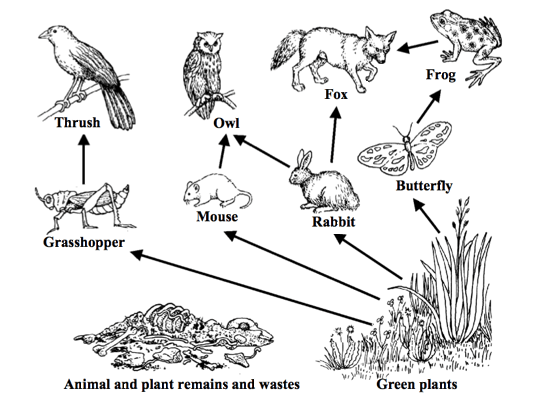
The owl receives energy from which organisms?
a)
grasshopper and mouse
b)
mouse and rabbit
c)
rabbit and butterfly
d)
butterfly and frog
44.

In the energy pyramid here, which organisms have the most energy available?
a)
Producers
b)
Carnivores
c)
Herbivores
d)
Top Predator
45.

In the energy pyramid below, which organism has the least amount of energy available?
a)
Producers
b)
Herbivores
c)
Carnivores
d)
Top Predator
46.

In the energy pyramid here, how much of the energy in the producers gets passed to the herbivores?
a)
10%
b)
20%
c)
80%
d)
90%
47.
What is the speed of a car that travels 400 m in 20 minutes?
a)
20 miles/hr
b)
20 m/min
c)
800 m/min
d)
200 miles/hr
48.
What is the equation to calculate speed?
a)
speed = distance/time
b)
speed = time/distance
c)
speed = time x distance
d)
speed = speed/time
49.

What is this objects speed at 2 s?
a)
5 m/s
b)
5 s/m
c)
20 m/s
d)
20 s/m
50.
____________ is the ability to cause change.
a)
Energy
b)
Force
c)
Friction
d)
Motion
51.
Energy due to motion is ____________ energy.
a)
Potential
b)
Energy
c)
Kinetic
d)
Friction
52.
__________ is stored energy.
a)
Potential
b)
Kinetic
c)
None of the above
d)
All of the above
53.

What kind of energy is in a moving skateboard?
a)
Potential
b)
Kinetic
c)
Both potential and kinetic energy
d)
none of the above
54.

What kind of energy is in a rock at the edge of a cliff?
a)
Potential
b)
Kinetic
c)
Both potential and kinetic energy
d)
none of the above
55.

Does this phrase describe potential or kinetic energy:
The energy of a spinning bicycle wheel.
a)
Potential Energy
b)
Kinetic Energy
Reset

