wayground logo

Free Printable Worksheets

Font size

S
M
L
XL
Worksheets

Darwin and Natural Selection

Total questions: 102

Worksheet time: 2hrs 23mins

Name
Class
Date
1.
What did Darwin infer from his observations of organisms in South America and the Galápagos Islands?
a)
The organisms on the Galápagos Islands were virtually identical to mainland organisms.
b)
A small number of different plant and animal species had come to the mainland from the Galápagos Islands.
c)
The organisms on the Galápagos Islands were completely unrelated to mainland organisms.
d)
A small number of different plant and animal species had come to the Galápagos Islands from the mainland.
2.
What did Darwin observe about finches in the Galápagos Islands?
a)
Their feathers were adapted to match their environment.
b)
Their beaks were adaptations related to the foods the finches ate.
c)
Their beaks were adaptations related to the foods the finches ate.
d)
They had identical genotypes in all locations.
3.
The gradual change in a species over time is called
a)
mutation.
b)
evolution.
c)
migration.
d)
variation.
4.

A trait that helps an organism survive and reproduce is called

a)

mutation.

b)

selection.

c)

adaptation.

d)

variation.

5.
Which term refers to the process by which individuals that are better adapted to their environment are more likely to survive and reproduce?
a)
natural selection
b)
overproduction
c)
competition
d)
variation
6.
How does natural selection lead to evolution?
a)
Stronger offspring kill weaker members of the species.
b)
Helpful variations accumulate among surviving members of the species.
c)
Overproduction provides food for stronger members of the species.
d)
Environmental changes favor weaker members of the species.
7.
Darwin concluded that organisms on the Galápagos Islands
a)
had changed over time.
b)
had remained the same.
c)
were the result of selective breeding.
d)
had no variations.
8.
Which term refers to a species creating more offspring than can possibly survive?
a)
natural selection
b)
overproduction
c)
evolution
d)
variation
9.
Who created the theory of evolution?
a)
Charles Darwin
b)
Charles Derwin
c)
Charlie Darwin
d)
Chris Darwin
10.
What was the name of the ship Charles Darwin sailed on?
a)
Boaty McBoaty Face
b)
HMS Beagle
c)
HMS Britannia
d)
HMS Bulldog
11.
Where did Charles Darwin travel to?
a)
Australia
b)
Barbados
c)
Galapagos 
d)
Trinidad
12.
What animals did Charles Darwin study when at the Galapagos Islands?
a)
Giraffes
b)
Seagulls
c)
Seals
d)
Finches
13.
What is the title of Charles Darwin's famous book?
a)
The origin of species
b)
Origin of species
c)
On the origin of species
d)
Species. The origin
14.
For Darwin, how have animals and plants survived?
a)
Through luck
b)
Through natural selection
c)
Through careful management
d)
Through choice
15.
What is survival of the fittest?
a)
It is where the fittest die out and therefore reproduce and pass on their genes
b)
It is where the fittest die out and therefore can't reproduce and pass on their genes
c)
It is where the fittest don't die out and therefore can't reproduce and pass on their genes
d)
It is where the fittest don't die out and therefore reproduce and pass on their genes
16.
Which statement best describes the process of evolution?
a)
Populations can survive in different locations on earth
b)
Environmental conditions limit the number of species on Earth
c)
Populations grow when resources are abundant
d)
The traits of a species can change over time
17.
developed the theory of evolution by natural selection (survival of the fittest)
a)
Galapagos Islands
b)
Charles Dickens
c)
Charles Darwin
d)
Jay Wright
18.
Which process produced the two different types of beaks in the ground finch and the tree finch?
a)
artificial selection
b)
geographical distribution
c)
natural selection
d)
disuse of the beak
19.
the soot from industries changed the color of the peppered moths 
a)
true
b)
false
20.
before the Industrial Revolution the largest percentage of peppered moths were
a)
light
b)
dark
21.
A group of similar organisms that can mate with each other and produce fertile offspring.
a)
evolution
b)
fossil
c)
adaptation
d)
species
22.
The process by which individuals that are better adapted to their environment are more likely to survive and reproduce than other members of the same species.
a)
natural selection
b)
scientific theory
c)
adaptation
d)
species
23.
Any difference between individuals of the same species.
a)
evolution
b)
adaptation
c)
variation
d)
scientific theory
24.
Which of the following ideas is supported by Darwin’s observation of local variation among tortoises in the Galápagos Islands? 
a)
artificial selection
b)
adaptation
c)
acquired characteristics
d)
tendency towards perfection
25.
Charles Darwin’s observation that finches of different species on the Galápagos Islands have many similar physical characteristics supports the hypothesis that these finches 
 
a)
have the ability to interbreed.
b)
acquired traits through use and disuse.
c)
all eat the same type of food.
d)
descended from a common ancestor.
26.
Jean-Baptiste Lamarck proposed that organisms 
a)
have an innate tendency toward complexity and perfection.
b)
have an innate tendency to become simpler as time passes.
c)
inherit all of the adaptations they display.
d)
belong to species that never change.
27.
Lamarck’s ideas about evolution include the concept that differences among the traits of organisms arise as a result of
a)
continual increases in population size.
b)
the actions of organisms as they use or fail to use body structures.
c)
an unchanging local environment.
d)
the natural variations already present within the population of organisms.
28.
The economist Thomas Malthus suggested that
a)
in the human population, people die faster than babies are born.
b)
without certain checks on population size, there would soon be insufficient food for the growing human population.
c)
in the 1700s, England needed more housing.
d)
the majority of a species’ offspring die.
29.
Darwin realized that the economist Malthus’s theory of population control 
a)
applied only to humans.
b)
 could be generalized to any population of organisms.
c)
could be generalized only when populations lived in crowded conditions.
d)
explained why the number of deaths exceeded that of births.
30.
According to Darwin’s theory of natural selection, individuals who survive are the ones best adapted for their environment. Their survival is due to the 
a)
possession of adaptations developed through use.
b)
 possession of inherited adaptations that maximize fitness.
c)
lack of competition within the species.
d)
choices made by plant and animal breeders.
31.
The principle of common descent helps explain why
a)
well-adapted species have many offspring.
b)
conditions in an organism’s environment ensures the organism’s survival.
c)
birds and reptiles share a number of inherited characteristics.
d)
tigers are so different from cheetahs.
32.
Charles Darwin’s theory of evolution by natural selection explains each of the following EXCEPT how 
a)
species can become extinct.
b)
inherited traits are passed from parent to offspring
c)
species descend from common ancestors. 
d)
evolution takes place in the natural world.
33.
what did Charles Darwin observe in finch populations of the Galapagos Islands off the coast of South America?
a)
different species on different islands
b)
all species on one of the islands
c)
identical species on all the islands
d)
the same species as North America
34.
Genetic variation can arise from a random change in the DNA of a gene.  The change is called a(n)
a)
mutation
b)
gene flow
c)
gene pool
d)
allele
35.
The disappearance of a species.
a)
Evolution
b)
Extinction
c)
Migration
d)
Mutation
36.
The variety of living things on Earth is called:
a)
Life
b)
Biodiversity
c)
Similarity
d)
Genetics
37.
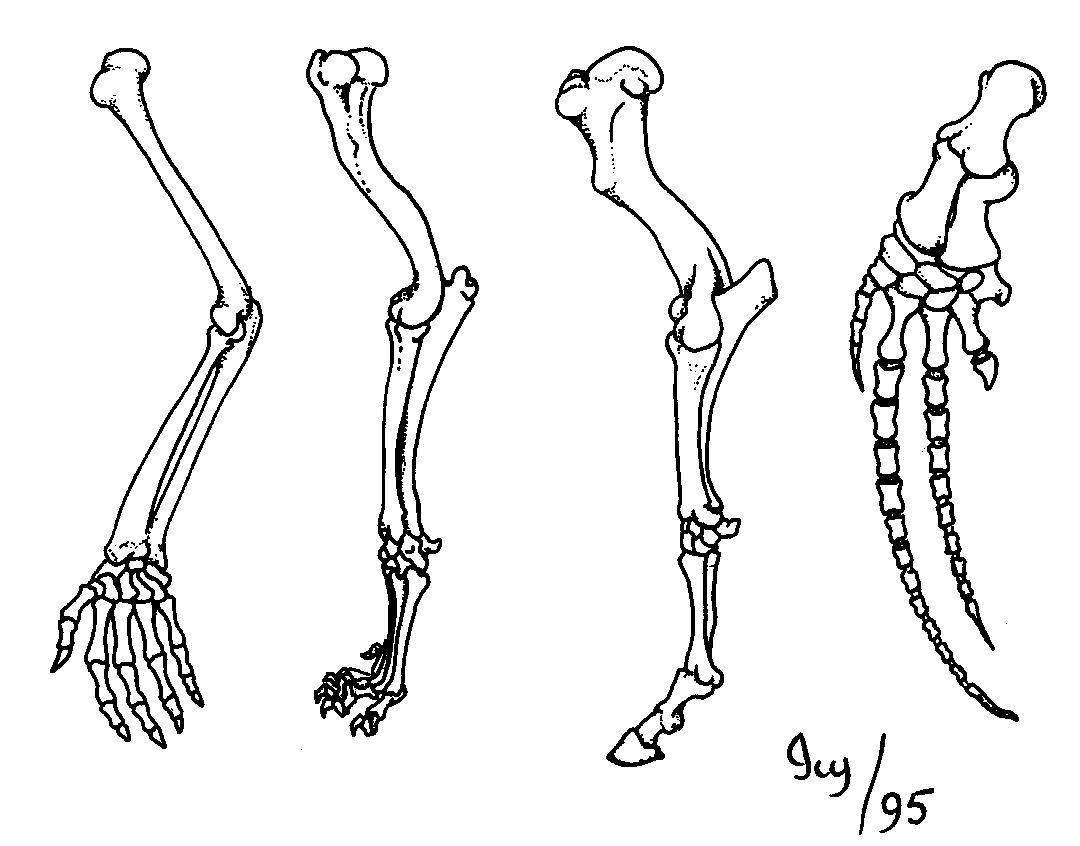
This image shows that 
a)
These animals have no simliarities in their structures. 
b)
two different species may have evolved from a common ancestor. 
c)
These animals are from the same species. 
d)
These animals likely evolved from different ancestors due to their differences. 
38.
Two organisms that are closely related would have
a)
very similar DNA sequence
b)
exactly the same DNA sequences
c)
no proteins in common
d)
completely different DNA sequence
39.
what gave Charles Darwin the idea of evolution?
a)
google
b)
wikipedia
c)
mans attempt to destroy mankind
d)
finches in the Galapagos island
40.
Which statement best describes the process of evolution?
a)
Populations can survive in different locations on earth
b)
Environmental conditions limit the number of species on Earth
c)
Populations grow when resources are abundant
d)
The traits of a species can change over time
41.
Darwin theorized that individuals having an advantage due to their traits or abilities will be more likely to survive and reproduce.  This theory is known as
a)
evolution
b)
speciation
c)
adaptation
d)
natural selection
42.
The ship Charles Darwin spent 5 years aboard as the Naturalist is the
a)
QEll
b)
HMS Beagle
c)
Pinta
d)
HMS Pinaphore
43.
Which type of evidence is illustrated in this picture
a)
fossil evidence
b)
molecular
c)
anatomical
d)
embryological
44.
Which best defines homologous structures
a)
structures with same function different ancestors
b)
reduced form of a structure indicating shared ancestry
c)
adapting to surrounding
d)
similar structures inherited from a common ancestor
45.
These structures are shaped similar, but they do not come from a common ancestor, this would be a ______________ structure
a)
Homologous
b)
Analogous
46.
Why did the population of peppered moths in England change from light to dark after the Industrial Revolution?
a)
Light moths were easy to see against sooty trees and were eaten
b)
Light moths were killed by soot
c)
The birds that ate the dark moths were killed by soot
d)
Dark moths were produced by industrial processes
47.
Which is NOT a factor of  Natural Selection?
a)
variation
b)
competition
c)
mutation
d)
acquired characteristics
48.
All of these finches have different shaped beaks, they are an adaptation to gain access of 
a)
Water
b)
Food
c)
Shelter
49.
According to the theory of natural selection, why are some individuals more likely than others to survive and reproduce? 
a)
Some individuals pass on to their offspring new characteristics they have acquired during their lifetimes. 
b)
Some individuals are better adapted to exist in their environment than others are. 
c)
Some individuals do not pass on to their offspring new characteristics they have acquired during their lifetimes. 
d)
Some individuals tend to produce fewer offspring than others in the same environment. 
50.
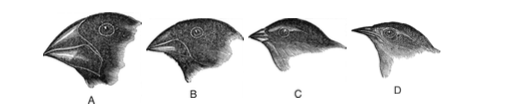
Base your answer(s) to the following question(s) on the diagram below that shows variations in the beaks of finches in the Galapagos Islands and on your knowledge of biology. 
The diversity of species seen on the Galapagos Islands is mostly due to 
a)
gene manipulation by scientists 
b)
gene changes resulting from mitotic cell division 
c)
natural selection 
d)
selective breeding 
51.
Base your answer(s) to question(s) on the diagram below and on your knowledge of biology. The diagram shows the heads of four different species of Galapagos Islands finches. 
The four different types of beaks shown are most likely the result of 
a)
gene manipulation 
b)
natural selection 
c)
unchanging environmental conditions 
d)
patterns of behavior learned from parents 
52.

This occurs when humans breed plants/animals so the most useful traits appear in offspring:

a)

Coevolution

b)

Adaptive radiation

c)

Convergent evolution

d)

Artificial selection

53.

Structures with similar functions; they evolved to do the same job, but the organisms did not evolve from a common ancestor:

a)

Homologous structures

b)

Analogous structures

c)

Vestigial structures

54.

Structures reduced in size because they are non-functional and no longer used:

a)

Homologous structures

b)

Analogous structures

c)

Vestigial structures

55.

Structures that are similar in related organism because they were inherited from a common ancestor:

a)

Homologous structures

b)

Analogous structures

c)

Vestigial structures

56.

Human tailbone and wisdom teeth, mole rat eyes and the pelvic bones of whales:

a)

Homologous structure


b)

Vestigial structure

c)

Analogous structure

d)

Sequential structure

57.

According to natural selection:

a)

Individuals are modified by environmental conditions

b)

The environment affects all organisms in a population in the same way

c)

Populations of organisms continuously increase

d)

Organisms that have more favorable traits have more offspring
58.
Which of the following is an example of a vestigial structure?
a)
the wings of a red-tailed hawk
b)
the hind limbs of a house cat
c)
the fins of sharks
d)
the tailbone of a human
59.
Preserved remains of an organism that lived in the past…..
a)
fossil
b)
picture
c)
dinosaur
d)
animal
60.

the idea that all species have evolved from common ancestors is

a)

descent with modification

b)

speciation

c)

natural selection

d)

adaptation

61.

Related native species are found only where they could have migrated on their own explains

a)

comparative embryology

b)

geographic distribution

c)

comparative anatomy

d)

comparative genetics

62.
Structures with the same parts have different functions; suggests that organisms share a common ancestry
a)
vestigial structures
b)
homologous structures
c)
adaptive radiation
d)
fossil
63.
If an organism has a vestigial structure, that structure likely once had a function in a(n)
a)
close relative
b)
early ancestor
c)
unrelated organism
d)
embryological stage
64.
The process by which populations slowly change over time is called__________
a)
selective breeding
b)
adaptation
c)
sepeciation
d)
evolution
65.
Some organisms that share a common ancestor have features that have different functions, but similar structures.  These are known as
a)
vestigial structures
b)
analogous structures
c)
homologous structures
d)
fossil structures
66.
Study of embryos of various organisms to show a common ancestor because of similarities in development
a)
natural selection
b)
embryology
c)
speciation
d)
evolution
67.
Which of the following is an example of a vestigial structure?
a)
the wings of a red-tailed hawk
b)
the hind limbs of a house cat
c)
the fins of sharks
d)
the tailbone of a human
68.
What type of structures are these?
a)
homologous
b)
vestigial 
c)
analogous
d)
fossil
69.
Structures that have the same function but different structures are...
a)
homologous structures
b)
analogous structures
c)
vestigial structures
d)
embryology 
70.
Two organisms that are closely related would have
a)
very similar DNA sequence
b)
exactly the same DNA sequences
c)
no proteins in common
d)
completely different DNA sequence
71.
If two organisms have similar traits of DNA they are probably
a)
share a common ancestor
b)
share a common environment
c)
share a common population
d)
speciation
72.
What does Darwin's theory of evolution suggest?
a)
species change over time
b)
extinct species are not related to living species
c)
different species can interbreed
d)
animals that look alike are most closely related
73.
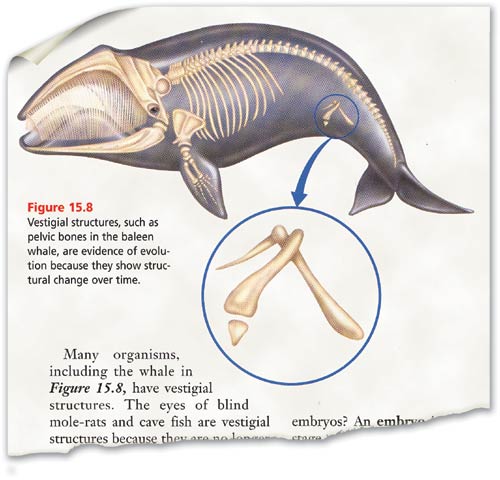
Whales are aquatic mammals that contain a pelvis bone.  Even though it does not aid in its movement, the function must have been used by a common ancestor of the whale.  Thus, the pelvis is referred to as a(n)
a)
vestigial structure
b)
analogous structure
c)
homologous structure
74.
If species A and B have very similar genes and proteins, what is probably TRUE?
a)
species A and B share a relatively recent common ancestor
b)
species A evolved independently of species B for a long period
c)
species A is younger than species B
d)
species A is older than species B
75.
Individuals that are well adapted to their environment will survive and produce:
a)
Fewer mutations
b)
Stronger genes
c)
More offspring
d)
Better traits
76.
On this map there are many different geographical barriers, which could be mountains, rivers, or oceans. Animals that do not have a barrier between them have more similarities, which set shows that common ancestry existed?
a)
1 and 2
b)
3 and 4
c)
7 and 8
77.
If an organism has a vestigial structure, that structure likely once had a function in a(n)
a)
close relative
b)
early ancestor
c)
unrelated organism
d)
embryological stage
78.
Which of the following pieces of evolution evidence contain both homologous and vestigial structures?
a)
fossil record
b)
comparing embryology
c)
comparing biochemistry
d)
comparing anatomy
79.
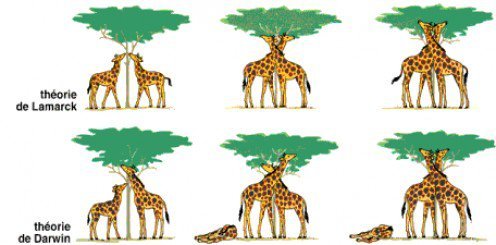
What would happen if the Giraffes never evolve?
a)
they would survive
b)
They would thrive
c)
They would become extinct
d)
They will find another source of food
80.
The forelimbs of penguin, alligator, bat, human are which of the following?
a)
homologous structures
b)
vestigial structures
81.
How would you describe this evolution?
a)
Homologous structure
b)
Analogous structure
c)
Structural adaption
d)
Functional adaption
82.
Structures with the same parts have different functions; suggests that organisms share a common ancestry
a)
vestigial structures
b)
homologous structures
c)
adaptive radiation
d)
fossil
83.
The diagram above shows an embryo of different vertebrates at different stages of development. Which field of study would support the similarities in development as evidence for evolution?
a)
comparative biochemistry
b)
paleontology
c)
comparative biogeography
d)
comparative embryology
84.
A fossil of an extinct dinosaur is found and the anatomy of the fossil shows similarities to that of a bird. What could this mean?
a)
This is purely by chance and isn't significant
b)
The extinct dinosaur and modern bird share a common ancestor
c)
All dinosaurs evolved into birds and that's why there aren't any dinosaurs alive today
d)
Dinosaurs choose to fly, and evolved into birds to escape predation and capture food
85.
Anatomical remnants (left over structures) that were important in the organism's ancestors, but are no longer used in the same way.
a)
Homologous Structures
b)
Analogous Structures
c)
Vestigial Structures
d)
Comparative Anatomy
86.

What is the value of a transitional fossil?

a)

Transitional forms show the evolutionary steps between species.

b)

Transitional forms are evidence of punctuated equilibrium.

87.

50 million years ago, the Pakicetus had nostrils toward the front of it's skull Gray whales, modern-day descendants of the Pakicetus have nostrils toward the back of the skull. The Aetiocetus lived 25 million years ago, and it's nostril was in the middle of the skull. In this case, the Aetiocetus serves as a ______________.

a)

index fossil

b)

transitional fossil

88.

_______________, or selective breeding, is one way that humans impact evolution. One example is how the Belgian Blue cow has been bred to have greater muscle mass.

a)

Artificial selection

b)

Homologous

89.

Lamarck was wrong because

a)

Organisms cannot acquire a trait in their lifetime and pass it on

to their offspring. Behavior has no effect on traits.

b)

Evolution does not occur

c)

Change in species happens overnight

d)

Adaptation is not possible

90.

What is the correct order of scientists who helped to develop the natural selection theory?

a)

Hutton, Lyell, Lamarck, Darwin

b)

Darwin, Lamarck, Lyell, Hutton

c)

Lyell, Lamarck,Darwin, Hutton

d)

Lamarck, Hutton, Darwin, Lyell

91.

Charles Lyell

a)

stated the earth was old and had been changing of millions of years

b)

stated human population was growing so fast the resources couldn't keep up

c)

wrote an essay on the theory of evolution that encouraged Darwin to publish his work

d)

thought organisms acquired traits in their lifetime

92.

Lamarck

a)

stated the earth was old and had been changing of millions of years

b)

stated human population was growing so fast the resources couldn't keep up

c)

wrote an essay on the theory of evolution that encouraged Darwin to publish his work

d)

thought organisms acquired traits in their lifetime

93.

Thomas Malthus

a)

stated the earth was old and had been changing of millions of years

b)

stated human population was growing so fast the resources couldn't keep up

c)

wrote an essay on the theory of evolution that encouraged Darwin to publish his work

d)

thought organisms acquired traits in their lifetime

94.

Alfred Wallace

a)

stated the earth was old and had been changing of millions of years

b)

stated human population was growing so fast the resources couldn't keep up

c)

wrote an essay on the theory of evolution that encouraged Darwin to publish his work

d)

thought organisms acquired traits in their lifetime

95.

Random changes in DNA are sometimes passed on to offspring

a)

mutations

b)

adaptations

c)

resources

96.

Variation is caused by

a)

mutations and random mating

b)

mutations only

c)

random mating only

d)

none of the above

97.

Inheritance is when

a)

Traits are passed down from one generation to the next through genes

b)

mutations occur

c)

when offspring give genes to parents

d)

all of the above

98.

Steps of natural selection in order

a)

variation-inheritance-selection-time-adaptation

b)

time-adaptation-variation-inheritance-selection-

c)

time-inheritance-selection-adaptation-variation

d)

selection-adaptation-variation-time-inheritance

99.

____________ is when organisms compete for resources such as shelter, food, and maters

a)

selection

b)

adaptation

c)

reproduction

d)

artificial selection

100.

happens when Successful traits are passed to the next generation and more members of the population are being born with the successful variation than those with the less suited allele

a)

time

b)

variation

c)

adaptation

d)

selection

101.

entire species is now better suited to its environment is

a)

adaptation

b)

speciation

c)

time

d)

variation

102.

Darwin realized the Lyell's ideas about the changes of earth because

a)

if earth never changes, species can change

b)

if earth changes, so can species

c)

if earth never changes, species also cannot change

d)

if earth changes, species cannot change