
 Worksheets
LR Chemistry Revision
Total questions: 45
Worksheet time: 34mins
Name
Class
Date
1.
Which particle has a positive charge?
a)
electron
b)
orbital
c)
proton
d)
neutron
2.
The particles of the atom you can find by knowing the atomic number.
a)
neutrons
b)
protons and electrons
c)
protons and neutrons
d)
atomic mass
3.
What charge does the nucleus have and why?
a)
positive - the neutrons do not have a charge
b)
positive - the neutrons and protons are positively charged particles
c)
neutral - the neutral charge dominates the positive charge
d)
neutral - electrons cancel out the positive charge of the atom
4.
An element with a mass number of 11 and an atomic number of 5 has how many neutrons?
a)
11
b)
5
c)
6
d)
16
5.
What is happening when my ice cream changes from a solid to a liquid?
a)
freezing
b)
melting
c)
burning
d)
evaporation
6.
Particles of a liquid
a)
are tightly packed together and stay in a fixed position.
b)
have no viscosity.
c)
decrease in volume with increasing temperature.
d)
are free to move around one another but still touch.
7.
What term describes a solid changing to a gas?
a)
Deposition
b)
Sublimation
c)
Evaporation
d)
Freezing
8.
The slower the particles in a substance move,
a)
the colder it is.
b)
the warmer it is.
c)
the more energy it has.
d)
the less energy it has.
9.
What happens when my glass of water is sitting in the sun and disappears into a gas?
a)
evaporation
b)
burning
c)
melting
d)
freezing
10.
Which factors increase the rate of a reaction.
a)
increasing temperature
b)
increasing concentration
c)
increasing surface area
d)
all of these
11.
Why does a catalyst increase the rate of reaction?
a)
it produces extra energy for the reactants
b)
it increases the speed of the reactant particles
c)
it increases the frequency of particle collisions
d)
it reduces the activation energy of the reaction
12.
Reactions that give out heat to the surrounding are classified as one of the following:
a)
Spontaneous
b)
Sluggish
c)
Exothermic
d)
Endothermic
13.
A chemical reaction that requires energy to happen
a)
Exothermic
b)
Endothermic
c)
Explosive
d)
Hot reaction
14.
A substance that speeds up a chemical reaction without being consumed (used up)
a)
Collision
b)
Explosion
c)
Reaction
d)
Catalyst
15.
Ionic Bonding involves...
a)
The transfer of protons
b)
The transfer of nuetrons
c)
The transfer of electrons
d)
None Of the above
16.
What usually forms the positive ion?
a)
Metal
b)
Non Metals
c)
None
17.
Covalent compounds
a)
Share electrons
b)
transfer electrons
c)
contain a sea of electrons
d)
conduct electricity
18.
What two types of atoms make a covalent bond?
a)
2 Nonmetals
b)
1 Nonmetal and 1 Metal
c)
2 Metals
d)
2 Noble Gases
19.

What elements generally make an ionic bond?
a)
metal and nonmetal
b)
2 or more nonmetals
c)
metal
d)
none of the above
20.

What elements generally make a covalent bond?
a)
metal and nonmetal
b)
2 or more nonmetals
c)
metal
d)
none of the above
21.
What is the number of outer electrons for Oxygen?
a)
8
b)
6
c)
2
d)
1
22.

How many electrons does potassium K contain? (click to see image)
a)
19
b)
39
c)
20
d)
40
23.
Ions are:
a)
atoms with a positive or negative charge
b)
atoms with no charge
c)
atoms with ONLY a positive charge
d)
atoms with ONLY a negative charge
24.
Isotopes...
a)
same number of protons and electrons
b)
same number of protons and different numbers of neutrons
c)
different number of protons and the same number of neutrons
d)
different arrangement of atoms in a molecule
25.
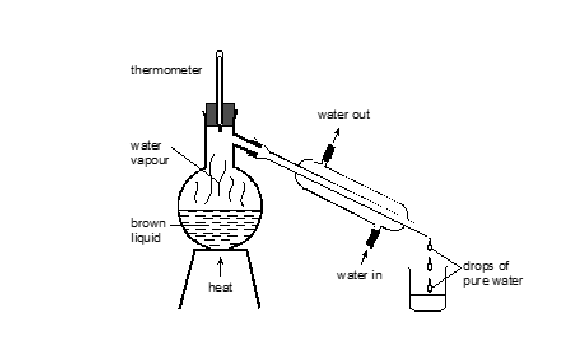
Which separation technique uses the apparatus shown in the diagram?
a)
filtration
b)
crystallisation
c)
distillation
d)
chromatography
26.
A saturated solution:
a)
is always cold
b)
as a lot of water in it
c)
will not dissolve any more solvent
d)
will not dissolve anymore solute
27.
How can we separate an insoluble solid from a liquid?
a)
chromatography
b)
crystallisation
c)
filtration
d)
condensation
28.

In filtration, the liquid part collected is called the filtrate and the solid bit that remained on the filter paper is called the residue.
In filtration, what is the part that remains called?
In filtration, what is the part that remains called?
a)
Solid
b)
Filtrate
c)
Remainder
d)
Residue
29.
A leibeg condenser is used in
a)
Filtration
b)
Chromatography
c)
Evaporation
d)
Distillation
30.
Dyes separating as they run along a column of paper is an example of
a)
evaporation
b)
sieving
c)
chromatography
d)
distillation
31.
what is an example of a pure substance
a)
gold
b)
orange juice
c)
salt water
d)
ice cream
32.
what is an example of a mixture
a)
cake
b)
distilled water
c)
iron
33.
C4H10 is an example of a _________________.
a)
molecular formula
b)
structural formula
c)
space-filling model
d)
ball-and-stick model
34.
During the process of fractional distillation, the petroleum compounds are separated according to the difference in their _______________.
a)
boiling point
b)
density
c)
unsaturation
d)
mass
35.
Which of the following compounds is an example of hydrocarbon?
a)
CO2
b)
C2H6
c)
C2H5OH
d)
CH3COOH
36.

At which pipe: M or N are hydrocarbons with lower boiling points collected?
a)
M
b)
N
37.

How does the temperature change from top to bottom?
a)
Increases
b)
Decreases
c)
It does not change
d)
Cannot be determined
38.
As the number of carbons increases in an homologous series the melting point generally...
a)
increase
b)
decrease
c)
stay the same
d)
varies
39.
When the ring on a Bunsen burner is closed during a combustion reaction , soot forms. Soot is?
a)
carbon dioxide
b)
carbon
c)
carbon monoxide
d)
burnt propane
40.
If an alkane has 20 carbon atoms, how many hydrogen atoms will it have?
a)
20
b)
22
c)
40
d)
42
41.
What is the general formula of an alkane
a)
2n+2
b)
CnH2n+2
c)
CnH2n
d)
CnHn
42.
Hydrocarbons are compounds that contain
a)
Carbon, only
b)
Carbon and Hydrogen, only
c)
Carbon, Oxygen, and Hydrogen, only
d)
Carbon, Oxygen, Hydrogen, and Nitrogen, only
43.
Give the name of this compound...
C3H8
C3H8
a)
Propene
b)
Butane
c)
Butene
d)
Propane
44.
Which of the following, when fossil fuels are burned, is formed when there is lack of oxygen?
a)
carbon monoxide
b)
sulphur dioxide
c)
nitrogen dioxide
d)
carbon dioxide
45.
Which is a definition of a molecule?
a)
the smallest particles of matter that make up substances
b)
two or more elements chemically joined together and not easily separated
c)
two or more atoms joined together to make a bigger particle
d)
collection of substances which keep their own properties and easily easily separated
100 %

