
 Worksheets
Algebra 2 S2 17-18 Final Review
Total questions: 135
Worksheet time: 6hrs 1mins
Name
Class
Date
1.

a)
xy√y
b)
x²y²√y
c)
xy√xy
d)
2x2y√y
2.

a)
x3√x
b)
7x√x2
c)
x6√x
d)
√x
3.

a)
x4y4√y
b)
72xy
c)
xy√y
d)
x2y3√x2
4.

a)
y
b)
y2
c)
√y
d)
y√0
5.

a)
y2z10√xy
b)
20yz√xy
c)
xy2z10√y
d)
yz6√xy2z2
6.

SIMPLIFY:
a)
A
b)
B
c)
C
d)
D
7.

SIMPLIFY:
a)
A
b)
B
c)
C
d)
D
8.

SIMPLIFY:
a)
A
b)
B
c)
C
d)
D
9.

SIMPLIFY:
a)
A
b)
B
c)
C
d)
D
10.

SIMPLIFY:
a)
A
b)
B
c)
C
d)
D
11.

SIMPLIFY:
a)
A
b)
B
c)
C
d)
D
12.

Simplify:
a)
4√30
b)
√4√30
c)
√2√30
d)
2√30
13.
Simplify the following radical: √150
a)
5√15
b)
5√2
c)
5√6
d)
15√5
14.

Simplify:
a)
√4√12
b)
4√12
c)
4√3
d)
2√3
15.
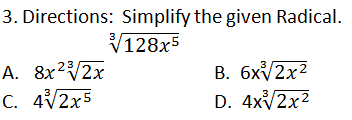
a)
A
b)
B
c)
C
d)
D
16.

Find the cube root.
a)
-10
b)
10
c)
100
d)
-100
17.

a)
3x2y ∛15y
b)
3xy ∛15y
c)
9x3y2√5
d)
3x2y
18.
Simplify ∛343.
a)
7
b)
±7
c)
-7
19.
Simplify (3 + 4 - 5)0
a)
1
b)
2
c)
0
d)
go jump in a lake
20.
What is the cube root of 27?
a)
9
b)
3
c)
-3
d)
-9
21.
What is the cube root of 8?
a)
4
b)
2
c)
-2
d)
-4
22.
What is the square root of 1?
a)
18
b)
27
c)
45
d)
1
23.
Find the cube root(s): ∛1
a)
1
b)
-1
c)
±1
d)
none
24.
The number under the radical sign or square root sign is called the ______.
a)
radical sign
b)
radicand
c)
factor
d)
exponent
25.

Simplify:
a)
4√10x8
b)
80x4
c)
4x4√10
d)
2x4√40
26.

In the picture, the "3" is called...
a)
the index
b)
the radical sign
c)
the radicand
d)
none
27.
√28m⁴n³
a)
m²n√7n
b)
7m²n√n
c)
2m²n√7n
d)
7m²n²√n
28.
-3√20x⁴y²
a)
-6x²y√5
b)
6xy√5
c)
-3xy√2
d)
3x²y√5
29.

a)
A
b)
B
c)
C
d)
D
30.

a)
A
b)
B
c)
C
d)
D
31.

a)
A
b)
B
c)
C
d)
D
32.

a)
A
b)
B
c)
C
d)
D
33.

a)
A
b)
B
c)
C
d)
D
34.

a)
A
b)
B
c)
C
d)
D
35.

a)
A
b)
B
c)
C
d)
D
36.

a)
A
b)
B
c)
C
d)
D
37.

Write the expression in exponential form.
a)
A
b)
B
c)
C
d)
D
38.

a)
a
b)
b
c)
c
d)
d
39.

Rewrite in radical form.
a)
A
b)
B
c)
C
d)
D
40.

Rewrite in Radical Form.
a)
A
b)
B
c)
C
d)
D
41.

Rewrite in Exponential Form.
a)
A
b)
B
c)
C
d)
D
42.

Rewrite in Exponential Form.
a)
A
b)
B
c)
C
d)
D
43.

a)
x = 12
b)
x = 24
c)
x = 144
d)
x = 121
44.

Solve the equation.
a)
A
b)
B
c)
C
d)
D
45.

Solve the equation.
a)
A
b)
B
c)
C
d)
D
46.

Solve
a)
-5
b)
5
c)
10
d)
25
47.

Solve
a)
20
b)
-4
c)
4
d)
-10
48.

Solve
a)
2
b)
1
c)
-1
d)
8
49.

Solve
a)
-14
b)
14
c)
no solution
d)
28
50.

a)
36
b)
18
c)
-18
d)
27
51.

Solve the radical equation
a)
9
b)
82
c)
-9
d)
-82
52.

a)
9
b)
18
c)
486
d)
54
53.

Solve the radical equation
a)
25
b)
50
c)
125
d)
5
54.

Solve the radical equation and check for extraneous solutions:
a)
A
b)
B
c)
C
d)
D
55.

Solve the radical equation and check for extraneous solutions:
a)
A
b)
B
c)
C
d)
D
56.

Solve the radical equation and check for extraneous solutions:
a)
A
b)
B
c)
C
d)
D
57.

Solve the radical equation and check for extraneous solutions:
a)
A
b)
B
c)
C
d)
D
58.
f(x) = 9-3x
g(x) = 5x-7
Find f(x)+g(x).
g(x) = 5x-7
Find f(x)+g(x).
a)
14x-10
b)
-8x+2
c)
2x+2
d)
2x-2
59.
f(x) = x2+9
g(x) = x-9
Find f(x)-g(x).
g(x) = x-9
Find f(x)-g(x).
a)
x2+x+9
b)
x2-x+9
c)
x2-x
d)
x2-x+18
60.
f(x)=x2+1
g(x)=2x-5
Find f(x)-g(x)
g(x)=2x-5
Find f(x)-g(x)
a)
x2-2x+6
b)
-x2+2x+4
c)
-x2-2x-6
d)
x2-2x-4
61.
f(x) = 4x+8
g(x) = x+3,
Find f(x) * g(x)
g(x) = x+3,
Find f(x) * g(x)
a)
4x2+24
b)
4x2+20x+24
c)
4x2+12x+24
d)
4x2+4x+24
62.
f(n)=2n+1
g(n)=3n
Find f(n)+g(n)
g(n)=3n
Find f(n)+g(n)
a)
5n+1
b)
-5n+1
c)
-2n+1
d)
-6n-1
63.
f(n)=n2+4n
g(n)=-n-5
Find f(n)+g(n)
g(n)=-n-5
Find f(n)+g(n)
a)
n2+3n-5
b)
-n3+2n-7
c)
n3+3n-3n
d)
n2-3n-5
64.
f(n)=x2+1
g(n)=2x-5
Find f(n)-g(n)
g(n)=2x-5
Find f(n)-g(n)
a)
x2-2x+6
b)
-x2+2x+4
c)
-x2-2x-6
d)
x2-2x-4
65.
f(x) = 3x + 10
g(x) = x - 2
Find f(g(5))
g(x) = x - 2
Find f(g(5))
a)
19
b)
23
c)
-10
d)
None of these.
66.
p(x) = 3x + 4
q(x) = 2x2
Find q(p(-2))
q(x) = 2x2
Find q(p(-2))
a)
8
b)
-8
c)
28
d)
None of these.
67.
Given
f(x) = 3x2 + 7x and g(x) = 2x2 - x - 1, find (f + g)(x).
f(x) = 3x2 + 7x and g(x) = 2x2 - x - 1, find (f + g)(x).
a)
11x2 - 1
b)
5x4 + 6x2 - 1
c)
5x2 + 6x - 1
d)
5x2 + 8x - 1
68.

a)
-2x+3
b)
-2x-9
c)
-8x+9
d)
-8x-9
69.
f(x)=4x+2 g(x)=x2
f(g(x))=
f(g(x))=
a)
16x2+16x+4
b)
16x2+4
c)
16x+4x+4
d)
4x2+2
70.
f(x)=2x+3 g(x)=x2
g(f(x))=
g(f(x))=
a)
4x2+12x+9
b)
4x2+9
c)
4x+9
d)
2x2+3
71.
Find the inverse of f(x) = -4x - 12
a)
f-1(x) = 4x - 3
b)
f-1(x) = -1/4x - 3
c)
f-1(x) = 1/4x + 3
d)
f-1(x) = -4x - 3
72.
What is the inverse of the given coordinates: (1, 2) (3, 8) (-3, 6)
a)
(1, 2) (3, 8) (-3, 6)
b)
(1, 2) (8, 3) (-3, 6)
c)
(-1, -2) (-3, -8) (3, -6)
d)
(2, 1) (8, 3) (6, -3)
73.
What does it mean to find the inverse of a function?
a)
the x's and y's are switched
b)
the x's and y's are divided by 2
c)
the x's and y's are made negative
d)
the x's and y's are the same
74.
What is the inverse in the given coordinates {(1,8), (2,16), (3,24), (4,32)}
a)
{(8,1), (2,8), (3,24), (4,32)}
b)
{(8,1), (16,2), (3,24), (32,4)}
c)
{(8,1), (2,16), (3,24), (32,4)}
d)
{(8,1), (16,2), (24,3), (32,4)}
75.

What is the inverse of this function?
a)
A
b)
B
c)
C
d)
D
76.
Find the inverse of f(x) = x2 - 5
a)
f-1(x) = √(x) + 5
b)
f-1(x) = ∛(x-5)
c)
f-1(x) = ±√(x+5)
d)
f-1(x) = x2 - 5
77.

a)
A
b)
B
c)
C
d)
D
78.

Condense
a)
logxyz3
b)
log(xy/z3)
c)
logx+logy+logz3
d)
logx3y3z3
79.

Condense
a)
log8(x6)/log8(y3)
b)
log8(x6/y3)
c)
log8(x/y3)
d)
log8(x6y3)
80.

Condense
a)
log8(a18/b3)
b)
log8(a18b3)
c)
log8(a/b3)
d)
15log8(a/b3)
81.

Condense
a)
A
b)
B
c)
C
d)
D
82.

Expand
a)
6log8v-2log8u
b)
6log8u-2log8v
c)
3log8u-2log8v
d)
6log8u+2log8v
83.

Expand
a)
log8x+log8y+log8z
b)
5log8x+5log8y+5log8z
c)
log8xy+5log8z
d)
log8x+log8y+5log8z
84.

Condense
a)
log8x3y9
b)
log8(x3/y9)
85.

Expand
a)
4log4u - 16log4v
b)
4logu + 16logv
c)
4logu - 4logv
d)
4logu / 16logv
86.

Condense
a)
A
b)
B
c)
C
d)
D
87.

Condense
a)
A
b)
B
c)
C
d)
D
88.
Evaluate:
log416
log416
a)
2
b)
4
c)
1/2
d)
-2
89.
Simplify the expression log5(625)
a)
125
b)
620
c)
4
d)
5
90.

Using the change of base rule, what is this logarithm equivalent to?
a)
A
b)
B
c)
C
d)
D
91.

Using the change of base rule, what is this logarithm equivalent to?
a)
A
b)
B
c)
C
d)
D
92.

Using the change of base rule, what is this logarithm equivalent to?
a)
A
b)
B
c)
C
d)
D
93.

Using the change of base rule, what is this logarithm equivalent to?
a)
A
b)
B
c)
C
d)
D
94.
Find the vertical asymptote(s) (if any) of the graph of the function.
3x / (x2 - 9)
3x / (x2 - 9)
a)
x=3
b)
x=0
c)
None
d)
X=3, x=-3
95.
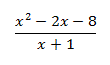
Determine whether the graph of the function has a vertical asymptote or a removeable discontinuity at x = -1.
a)
Vertical Asymptote
b)
Discontinuity
c)
Bob, bob, bob
d)
Infinite
96.

Which of the following best describes the continuity at x = 5?
a)
Continuous
b)
Removable Point Discontinuity
c)
Non-removable Infinite Discontinuity
d)
Non-removable Jump Discontinuity
97.

What is the hole?
a)
x= 4
b)
x= -4
c)
x= 5
d)
x= -5
98.
The holes of a rational function occur when :
a)
my pencil pokes a hole in the paper I'm working on
b)
there is something left in the denominator
c)
the value of f(0)
d)
a factor in the denominator cancels with a factor in the numerator
99.
What is the definition of an ASYMPTOTE?
a)
A curved line.
b)
A line that only touches the origin.
c)
A line that only lives on the first quadrant.
d)
A line that a curve approaches, as it heads towards infinity.
100.
Which asymptote(s) are determined by looking at the denominator?
a)
vertical
b)
horizontal
c)
slant
d)
none
101.

Simplify.
a)
(m+6)/(m-3)
b)
7/(m-3)
c)
7(m+6)
d)
(m-3)
102.

Simplify.
a)
(x+6)/(x+4)
b)
(x+6)(x+4)
c)
(x+6)
d)
(x+6)/(x-5)
103.

SIMPLIFY
a)
A
b)
B
c)
C
d)
D
104.

SIMPLIFY
a)
A
b)
B
c)
C
d)
D
105.

a)
A.4x³/(x+2)
b)
B.4x³/(x+10)
c)
C.2x³/(5x+1)
d)
D. 2x³/(x+5)
106.

a)
(x-9)/(x+9)
b)
1/(x-9)
c)
(x+9)
d)
1/(x+9)
107.
Simplify
4x2 + 24x + 32
----------------------
2x2 - 2x - 12
a)
2(x + 2)
------------
(x - 3)
b)
4(x + 4)
---------
2(x + 2)
c)
2(x + 4)
-----------
(x - 3)
d)
4(x + 4)
--------------
2(x - 3)
108.
Simplify
2x2 + 10x - 48
-------------------------
8x + 64
a)
(x - 3)
--------
4(x + 1)
b)
2(x - 3)
--------
(x + 1)
c)
(x - 3)
--------
4
d)
4
--------
(x - 3)
109.

Simplify by cancelling
a)
1
b)
-1
c)
Can't be simplified
110.
a)
A.4x³/(x+2)
b)
B.4x³/(x+10)
c)
C.2x³/(5x+1)
d)
D. 2x³/(x+5)
111.

a)
A
b)
B
c)
C
d)
D
112.

a)
A
b)
B
c)
C
d)
D
113.

Simplify.
a)
A
b)
B
c)
C
d)
D
114.

Simplify.
a)
A
b)
B
c)
C
d)
D
115.

Simplify.
a)
2p
b)
p/2
c)
2/p
d)
4p
116.

Simplify
a)
A
b)
B
c)
C
d)
D
117.

Simplify.
a)
A
b)
B
c)
C
d)
D
118.

SIMPLIFY
a)
A
b)
B
c)
C
d)
D
119.

Multiply and Simplify
a)
(n-10)/8n+56
b)
(n-10)(n+7)/8n+56
c)
(n-10)/8
d)
(n+10)/8
120.

Simplify.
a)
A
b)
B
c)
C
d)
D
121.

Simplify and state the excluded values.
a)
A
b)
B
c)
C
d)
D
122.
Divide the Rational Expression
x2 – 4x – 5 ÷ x2 – 3x – 10
x2 – 3x + 2 x2 - 4
x2 – 4x – 5 ÷ x2 – 3x – 10
x2 – 3x + 2 x2 - 4
a)
(x - 5)/ (x - 1)
b)
(x + 1)/(x - 1)
c)
1/(x - 1)
d)
(x + 1)
123.
Divide the Rational Expression
3x + 12 ÷ x + 4
x2 + 5x + 6 5x + 15
3x + 12 ÷ x + 4
x2 + 5x + 6 5x + 15
a)
(x + 4)/(x + 3)
b)
(x + 2)/15
c)
15/(x + 2)
d)
5/(x + 2)
124.

a)
A
b)
B
c)
C
d)
D
125.
Simplify and state the excluded values.
a)
A
b)
B
c)
C
d)
D
126.

Simplify.
a)
A
b)
B
c)
C
d)
D
127.

Add.
*Note that denominators are the same already!
*Note that denominators are the same already!
a)
A
b)
B
c)
C
d)
D
128.

a)
A.
b)
B.
c)
C.
d)
D.
129.

a)
A.
b)
B.
c)
C.
d)
D.
130.

a)
A
b)
B
c)
C
d)
D
131.

a)
A
b)
B
c)
C
d)
D
132.

Subtract the following rational expression.
a)
(28x-29) / 5(7x+6)
b)
(28x-11) / 5(7x+6)
c)
(7x-11) / 5(7x+6)
d)
(7x-29) / 5(7x+6)
133.

Add the following rational expression.
a)
(7x+3) / (x-5)(x+8)
b)
(2x+3) / (x-5)(x+8)
c)
(2x+4) / (x-5)(x+8)
d)
(7x+4) / (x-5)(x+8)
134.

Find the LCD of these fractions.
a)
3x
b)
9x
c)
x
d)
18x
135.

Find the LCD of these fractions. Start by factoring denominators!
a)
(x+2)(x-2)
b)
(x+2)
c)
(x-2)
d)
(x2-4)(x+2)
100 %

