wayground logo

Free Printable Worksheets

NEW

Font size

S
M
L
XL
Worksheets

2018 Final Exam Review

Total questions: 69

Worksheet time: 15hrs 43mins

Name
Class
Date
1.

According to the graph, what material’s recycling would reduce the largest portion of America’s trash?

a)

Metals

b)

paper

c)

plastics

d)

Yard trimmings

2.

1. Which level of the food chain is most affected by biomagnifications?

a)

Producers

b)

primary consumers

c)

secondary consumers

d)

tertiary consumers

3.

1. Why is firewood considered to be a renewable resource?

a)

It can be replenished over time.

b)

It is used up faster than it can form.

c)

It is made from coal.

d)

It can be made synthetically.

4.

1. Which of the following is not a renewable resource?

a)

coal

b)

wind energy

c)

solar energy

d)

water

5.

What is global warming

a)

the normal temperature fluctuations of Earth's climate cycle

b)

the melting of the polar ice caps

c)

the trend of increasing temperatures on Earth

d)

the changes in Earth's biosphere that affect the atmosphere

6.

Which member of the following food chain is most likely to be affected by mercury, a pollutant? Algae - zooplankton - salmon – bear

a)

algae

b)

salmon

c)

zooplankton

d)

bear

7.
The picture shows what type of succession?
a)
primary
b)
secondary
c)
tertiary
d)
quadanary
8.
The picture shows what type of succession?
a)
primary
b)
secondary
c)
tertiary
d)
quadanary
9.
What type of growth is represented behind?
a)
exponential
b)
logistics
c)
a good kind
d)
representative
10.
What is the carrying capacity of this population?
a)
100
b)
200
c)
300
d)
400
11.
What is the carrying capacity for this sheep population?
a)
1.8 million
b)
1.25 million
c)
1.6 million
d)
1.o million
12.

What is a keystone species?

a)

A species that helps to hold an ecosystem together

b)

A species that lives in or around rocks

c)

Keys and stones have nothing to do with ecology

d)

A keystone isn't a living thing, it's just a stone

13.

Will other animals lose their homes if bees go extinct?

a)

No, they don't live in hives

b)

No, bees have nothing to do with the creation of other animal homes

c)

Yes, trees need pollination and they create homes for wild animals

d)

Yes, but not because of bees. Animals are losing natural homes anyways

14.
Food, water, sunlight, shelter, and space are resources that are  __________.
a)
limiting factors
b)
wet
c)
messy
d)
found in rocks
15.
If the population of a certain predator increases, there is often _______ its prey
a)
a decrease the population of
b)
an increase of the population of 
c)
great news for its prey of
d)
no  impact found on
16.
If a disease destroying barley plants in a field swept through an ecosystem, what would happen to the barley eating bird population in the the field ?
a)
The bird population would stay the same
b)
The bird population would infinitely increase
c)
The bird population would decrease
17.
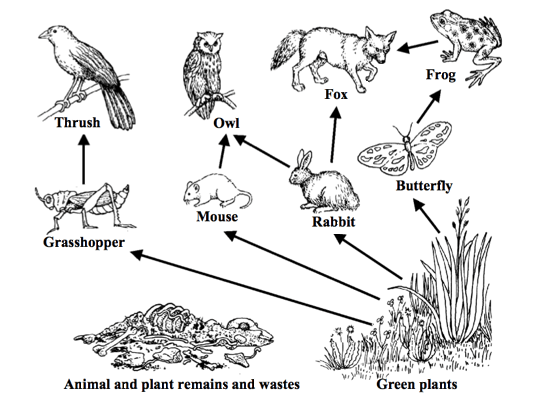
Which of the following organisms is a herbivore.
a)
butterfly
b)
snake
c)
fox
d)
ladybird
18.
The owl receives energy from which organisms?
a)
grasshopper and mouse
b)
mouse and rabbit
c)
rabbit and butterfly
d)
butterfly and frog
19.
In the energy pyramid below, which organism has the least amount of energy available?
a)
Producers
b)
Herbivores
c)
Carnivores
d)
Top Predator
20.
If there is 1000 Kcal available in the producers in trophic level 1, how much energy is available in the herbivores in trophic level 2?
a)
10 Kcal
b)
1 Kcal
c)
100 Kcal
d)
1000 Kcal
21.
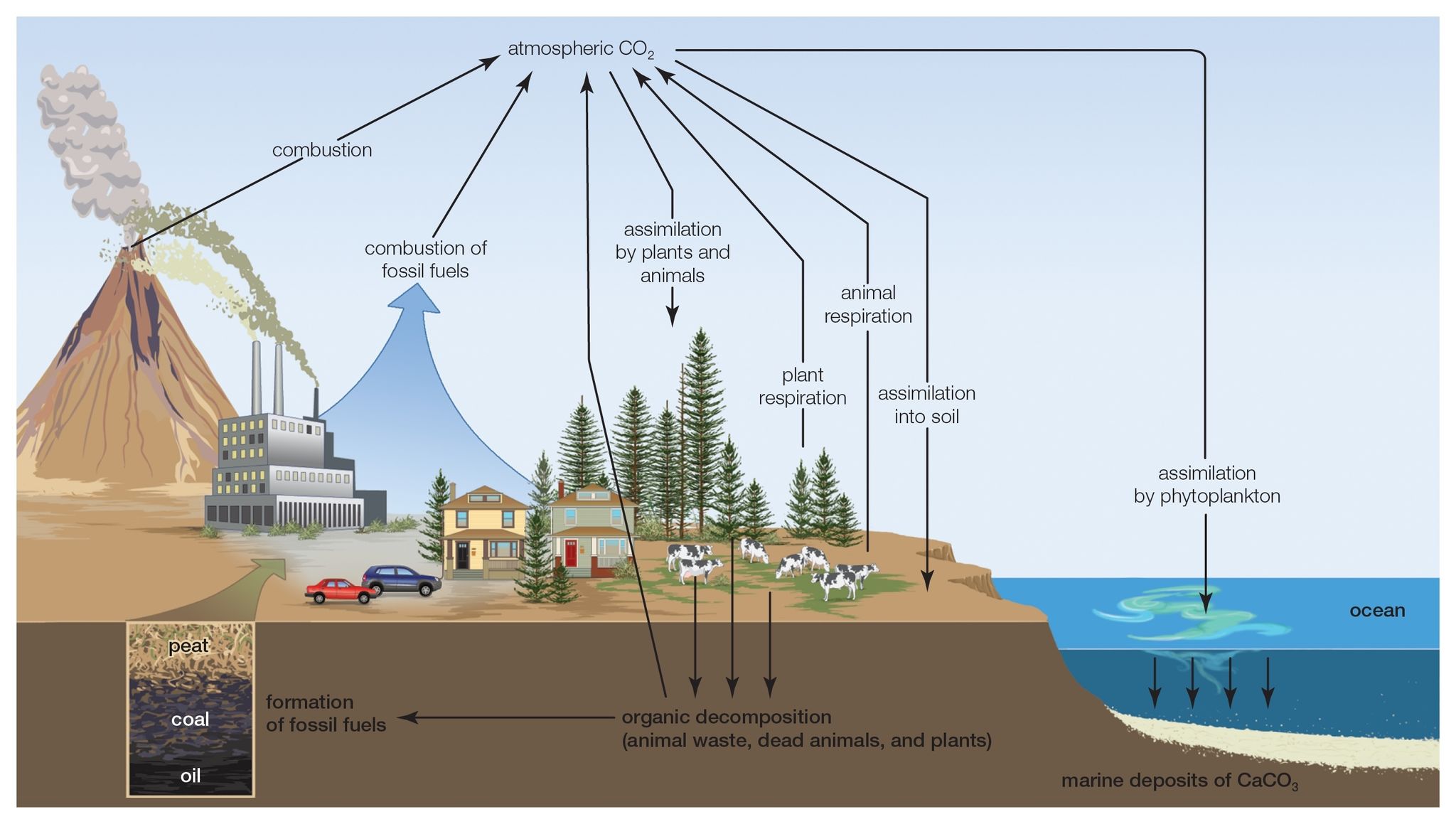
When humans burn fossil fuels, most of the carbon quickly enters the                       as carbon dioxide.
a)
Water
b)
Atmosphere
c)
Sun
d)
Air
22.
Which one of these does not add CO2 to the atmosphere?
a)
cooking with gas
b)
planting trees
c)
burning wood
d)
riding in a bus
23.
What does not produce carbon dioxide?
a)
Photosynthesis
b)
Burning Fossil Fuels
c)
Animal respiration
d)
Plants decaying
24.
In the carbon cycle, producers take in the gas __
a)
carbon dioxide
b)
oxygen
c)
nitrogen
d)
carbon monoxide
25.
Which of the following describes the role of nitrogen-fixing bacteria in the nitrogen cycle? Nitrogen-fixing bacteria convert
a)
nitrates intro nitrogen gas
b)
ammonia into proteins
c)
nitrogen gas into ammonia
d)
proteins into nitrates
26.
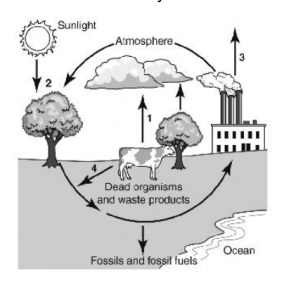
What is happening at 1?
a)
respiration: releasing CO2
b)
decomposing CO2 in the soil
c)
photosynthesis: absorbing CO2
d)
turning CO2 from the atmosphere into organic molecules
27.
Which of the following add carbon dioxide to the atmosphere?
a)
volcanoes
b)
combustion of fossil fuels
c)
animal and plant respiration
d)
all of these
28.
Every living thing is made of
a)
Cells
b)
Viruses
c)
Prokaryotes
d)
Eukaryotes
29.

Have genetic material

a)

Viruses

b)

Living Things

c)

Both

30.

Can respond to their environment

a)

Viruses

b)

Living Things

c)

Both

31.

Are made of cells

a)

Viruses

b)

Living Things

c)

Both

32.

Have an organized structure

a)

Viruses

b)

Living Things

c)

Both

33.
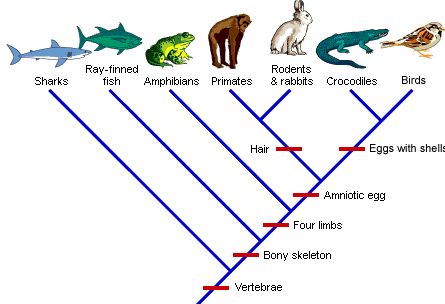
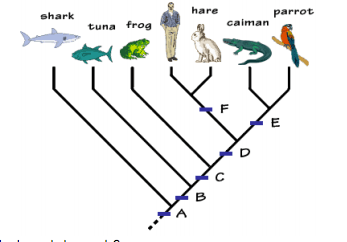
According to this cladogram, primates are most closely related to -
a)
Amphibians
b)
Rodents and rabbits
c)
Crocodiles
d)
Birds
34.
According to this cladogram, birds are LEAST related to -
a)
Amphibians
b)
Sharks
c)
Ray Finned Fish
d)
Crocodiles
35.
On the cladogram, which organism is the closest relative of the human?
a)
Frog
b)
Hare
c)
Caiman
d)
Parrot
36.
The diagram shows fossils in different rock layers. Which of these statements about the age of these fossils is most likely correct?
a)
Fossil A and C are the same age
b)
Fossil B is older than fossil C
c)
Fossils A is older than fossil B
d)
Fossil D is older than fossil C
37.
Scientists compare the limbs of organisms to look for evidence of common ancestry. These limbs provide evidence of common ancestry because they -
a)
perform the same function
b)
are the same size
c)
have the same basic structure
d)
are parts of the same animal
38.
Which evidence of common ancestry is being studied in this visual?
a)
biogeography
b)
fossil record
c)
anatomical homology
39.
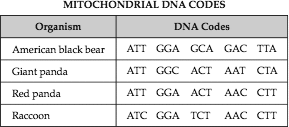
What conclusions can be made based on this table shown?
a)
the American black bear and the giant panda are most closely related
b)
the giant panda and the red panda are most closely related
c)
the red panda and the racoon are the most closely related
40.
"Endosymbiosis" means
a)
Living together
b)
Living inside
c)
Entering together
d)
Joining together
41.
The theory of Endosymbiosis explains
a)
The origin of eukaryotes
b)
How species develop
c)
How bacteria live
d)
Why cells rely on one another
42.

Which of the following is evidence to support the endosymbiotic theory?

a)

Prokaryotes have the same number and types of enzymes as eukaryotes.

b)

Mitochondria and chloroplasts have their own DNA, which is similar to prokaryotic DNA.

c)

All eukaryotic cells have a double-layered membran composed of phosplipids and proteins.

d)

Fossil evidence shows that the first forms of life were prokaryotic cells.

43.
Which kingdom is; 
Eukaryotic
Autotrophic
Multicellular
Immobile
a)
Plant 
b)
Animal
c)
Fungi
d)
Bacteria 
44.
Which kingdom is;
Prokaryotic
Heterotrophic
Unicellular
Motile
a)
Plant
b)
Animal
c)
Bacteria
d)
Fungi 
45.
Which kingdom is;
Heterotrophic
Mostly Multicellular 
Immobile
Eukaryotic 
a)
Plant 
b)
Animal
c)
Fungi
d)
Bacteria 
46.
This kingdom includes complex, multicellular organisms that are usually green, have cell walls, and make sugar by photosynthesis
a)
fungi
b)
bacteria
c)
plantae
d)
archaea
47.
I thrive in extreme environments.  I have a cell wall WITH NO peptidoglycan and do NOT have a nucleus.  Which DOMAIN do I belong to?
a)
Archaea
b)
Bacteria
c)
Eukarya
d)
Prokarya
48.
I am an organim that is eukaryotic, has a cell wall made with CHITIN, is usually multicellular and is heterotrophic.  Which KINGDOM should this organism be classified in?
a)
Animalia
b)
Protista
c)
Fungi
d)
Plantae
49.
In convergent evolution, organisms share physical similarities because they 
a)
have a common ancestor
b)
live in similar environments
c)
develop homologous structures
d)
are closely related 
50.
A bumble bee has just enough weight to open up the snapdragon flower and get the nectar/pollen inside.  Other insects cannot do this. This adaption is an example of........
a)
convergent evolution
b)
co-evolution
c)
divergent evolution
d)
speciation
51.

Coyotes and wolves occupy different niches, but are also closely related.

a)

Allopatric Speciation

b)

Adaptive Radiation

c)

Convergent Radiation

d)

Coevolution

e)

Sympatric Speciation

52.

Many fruit-eating birds, especially in tropical rain forests, have adapted with the plants whose fruits they eat. The birds get nourishment, and in the process the plants get their digestion-resistant seeds dispersed (spread out) by regurgitation (throwing up, ew?) or along with the birds' droppings.

a)

Allopatric speciation

b)

Adaptive radiation

c)

Convergent evolution

d)

Coevolution

e)

Sympatric speciation

53.

Antibiotic resistant bacteria are a problem because:

a)

we can't help people with those infections

b)

bacteria smell pretty bad

c)

they turn into viruses

d)

they are not a problem, I love being sick
54.
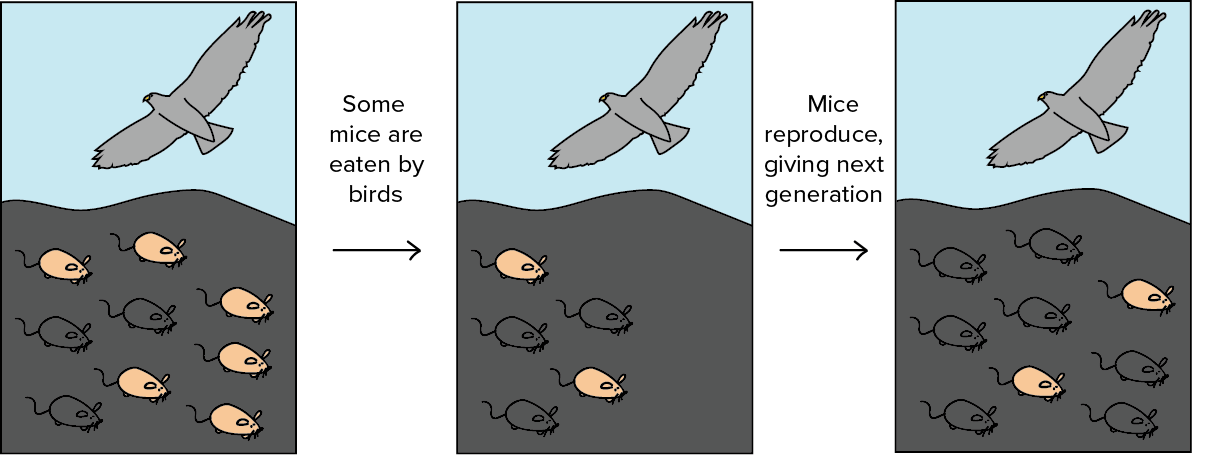
Why is the mouse population changing over time?
a)
The light mice can reproduce more successfully than the dark mice
b)
The hawks eat more dark mice than light mice because the dark mice taste better
c)
The hawks eat more light mice than dark mice because they can see the light mice more easily
d)
The hawks eat more dark mice than light mice because they can see the dark mice more easily
55.
Favors the middle of the population.
a)
Disruptive selection
b)
Stabilizing selection
c)
Directional selection
56.
Middle is wiped out, extremes survive.
Red is previous, blue represents the change.
a)
Stabilizing selection
b)
Disruptive selection
c)
Directional selection
57.
Which best describes fossils?
a)
They are the preserved remains or evidence of ancient living things
b)
They are the preserved remains or evidence of ancient living and nonliving things
c)
They are the preserved bones of ancient animals
d)
They are impressions of plant leaves in ancient rocks
58.
Where does an off spring get its traits in asexual reproduction?
a)
From both parents
b)
From only one parent
c)
From neither parent
d)
There are no traits handed down
59.
When a starfish grows a new body off a broken arm, what kind of reproduction is this?
a)
Sexual
b)
Differentiation
c)
Asexual 
d)
Specialization
60.
Which man is the father of the child?
a)
1
b)
2
c)
3
d)
4
61.
Whose blood was found at the crime scene?
a)
John
b)
Lisa
c)
Bob
d)
Sure
62.
A scientist cloned a goat. Which of these is a true statement about the cloned goat?
a)
It has new genes and traits
b)
It lacks the genes for reproduction
c)
It has the genes that are identical to the original goat
d)
It looks the same but has different genes.
63.
A scientist cloned a goat. Which of these is a true statement about the cloned goat?
a)
It has new genes and traits
b)
It lacks the genes for reproduction
c)
It has the genes that are identical to the original goat
d)
It looks the same but has different genes.
64.
____ are produced when DNA from another species is inserted into the genome of an organism, which then begins to produce the protein encoded on the recombinant DNA.
a)
vectors
b)
plasmids
c)
transgenic organisms
d)
gene guns
65.
Stem Cells don't have a __________ or __________.
a)
Specific Structure or Function
b)
Membrane or Nucleus
c)
Specific Structure or Nucleus
d)
Membrane or Function
66.
Which Suspect Committed the crime?
a)
Suspect #1
b)
Suspect #2
c)
Suspect #3
d)
Suspect #4
67.
What is the purpose of gel electrophoresis?
a)
helps cut DNA
b)
count the genes in DNA
c)
separates DNA based on size
d)
allows for an exact replicated organism
68.
What applications can gel electrophoresis be used for?
a)
Parental Testing
b)
Criminal Investigations
c)
Sequence Endangered Species DNA
d)
All of the above
69.
GMO stands for
a)
genetically made organism
b)
genetically modified organism
c)
gene manipulated organism
d)
Genetic mutant organism