wayground logo

Free Printable Worksheets

Font size

S
M
L
XL
Worksheets

Unit 2 Quiz Vocab review

Total questions: 71

Worksheet time: 45mins

Name
Class
Date
1.

What macromolecule is made up of C,H,O,N?

a)

Carbohydrates

b)

Lipids

c)

Proteins

d)

Nucleic acids

2.

What is the function of Carbohydrates?

a)

Long-term energy

b)

Muscle development

c)

Short-term energy

d)

enzyme activity

3.

Which macromolecule has amino acids as monomers?

a)

Carbohydrates

b)

Lipids

c)

Proteins

d)

Nucleic acids

4.

Which one of the macromolecules are instrumental in the cell membrane?

a)

Carbohydrates

b)

Lipids

c)

Proteins

d)

Nucleic acids

5.

This macromolecules is responsible for providing our genetic material. Choose the macromolecule that best fits.

a)

Carbohydrates

b)

Lipids

c)

Proteins

d)

Nucleic acids

6.

Which one of our macromolecules would you consume in order to receive long-term energy?

a)

Carbohydrates

b)

Lipids

c)

Proteins

d)

Nucleic acids

7.

My monomers are glycerol and fatty acids. Which macromolecule am I?

a)

Carbohydrates

b)

Lipids

c)

Proteins

d)

Nucleic acids

8.

My monomers are monosaccharides. Which macromolecule am I?

a)

Carbohydrates

b)

Lipids

c)

Proteins

d)

Nucleic acids

9.

My monomers consist of a phosphate group, a sugar, and a nitrogenous base. Which macromolecule am I?

a)

Carbohydrate

b)

Lipids

c)

Proteins

d)

Nucleic Acids

10.

I assist with keeping you well (immune health). Which macromolecule am I?

a)

Carbohydrates

b)

Lipids

c)

Proteins

d)

Nucleic acids

11.

Which macromolecule has this structure?

a)

Carbohydrate

b)

Lipids

c)

Proteins

d)

Nucleic acids

12.

Which macromolecule is structured this way?

a)

Carbohydrates

b)

Lipids

c)

Proteins

d)

Nucleic acids

13.

Which macromolecule is structured in this way?

a)

Carbohydrates

b)

Lipids

c)

Proteins

d)

Nucleic acids

14.

Which of the macromolecules are structured in this way?

a)

Carbohydrates

b)

Lipids

c)

Proteins

d)

Nucleic acids

15.
Enzymes are...
a)
nucleic acids
b)
proteins
c)
lipids
d)
carbohydrates
16.
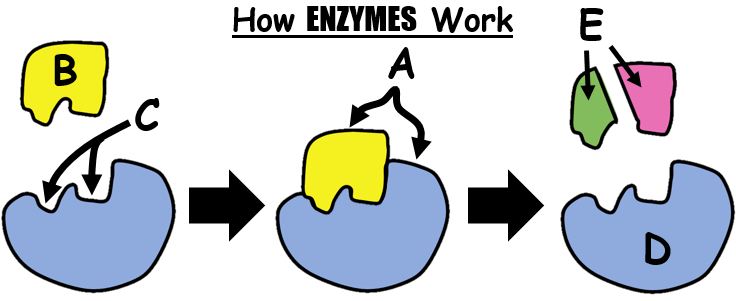
In the diagram, what is letter A? 
a)
product
b)
substrate
c)
enzyme-substrate complex
d)
active site
17.
Any substance that is acted upon by an enzyme is called a(n)?
a)
Coenzyme
b)
Substrate
c)
Vitamin
d)
Polypeptide
18.
What is a substance called if it speeds up a chemical reaction?
a)
reusable
b)
catalyst
c)
specific
d)
fragile
19.
What will most likely happen if an appropriate enzyme is added to a chemical reaction? 
a)
The reaction rate will increase.
b)
The equilibrium of the reaction will be maintained. 
c)
The reaction rate will decrease.
d)
The reaction will stop. 
20.
Which of the following best explains why enzymes are necessary for many cellular reactions?
a)
Enzymes supply the oxygen necessary for the reactions
b)
 Enzymes change reactants from solid to liquids during the reactions.
c)
The reactions take up too much space in the cell if the enzymes are missing.
d)
The reactions are too slow to meet the needs of the cell if enzymes are missing. 
21.
Which enzyme is most efficient in a basic solution?
a)
A
b)
B
22.
What happens when enzymes are heated to a high temperature?
a)
The enzymes die.
b)

The shapes of the enzyme are altered

c)
The enzymes' amino acid sequence changes.
d)
The enzymes remain the same
23.
What is being represented by the letter A in the image?
a)
Substrate
b)
Enzyme
c)
Product
d)
Complex
24.
What is being represented by the letter B in the image?
a)
Substrate
b)
Enzyme
c)
Substrate
d)
Product
25.
If an enzyme becomes over heated what effect, if any, will the heat have on the enzymatic activity? 
a)
The enzyme will not store much chemical energy.
b)
The enzyme will not be able to catalyze reactions.
c)
The enzyme will lose its net electrical charge.
d)
The enzyme will lose stored genetic information.
26.
Enzymes will make a reaction go _______ and use ______ energy.
a)
faster, less
b)
faster, more
c)
slower, less
d)
slower, more
27.
Which of the following tasks listed below is most associated with enzymes?
a)
catalyze chemical reactions                  
b)
store genetic information       
c)
store chemical energy in the cell   
d)
dissolve nutrients and minerals 
28.
Enzymes are capable of increasing the rate of a chemical reaction within a living cell.  Enzymes accomplish this through which of the following means?
a)
reducing the number of products   
b)
reducing the activation energy
c)
increasing the temperature of the cell
d)
increasing the concentration of reactants 
29.

Which factors can change the shape of an enzyme?

a)
Excessive heat and changes in pH
b)
Nothing can
c)
Exposure to light and sound
d)
Exposure to bacteria and Amoebas
30.
ALL organisms can be divided into two groups.
a)
Prokaryotes and Eukaryotes
b)
Plants and Animals
c)
Us and Them
d)
Hot blooded or Cold Blooded
31.
Bacteria are
a)
Prokaryotic Cells
b)
Eukaryotic Cells
c)
Animal Cells
d)
Plant Cells
32.
Where does photosynthesis happen?
a)
mitochondria
b)
chloroplast
c)
ribosomes
d)
on a lake during sunset
33.
Which type of cell contains chloroplasts?
a)
Animal cell
b)
Bacteria cell
c)
The shy ones
d)
Plant cell
34.
Which cells are smaller, simpler, and have no organelles?
a)
eukaryotic cells
b)
your little brother's cells
c)
plant cells
d)
prokaryotic cells
35.
Which cells DO NOT have a cell wall?
a)
animal cell
b)
plant cell
c)
bacteria cell
d)
prison cell
36.
Plants, fungus, animals, and protists are
a)
Prokaryotic
b)
Eukaryotic
37.
In the microscope you see a cell with a large central vacuole and rigid cell wall. What type of cell is this?
a)
animal cell
b)
plant cell
c)
human cheek cell
d)
the result of a strange science experiement
38.

These cells have cytoplasm

a)

Prokaryotic

b)

Eukaryotic

c)

Both

39.

These cells HAVE a nucleus

a)

Prokaryotic

b)

Eukaryotic

c)

Both

40.

These cells have no nucleus

a)

Prokaryotic

b)

Eukaryotic

c)

Both

41.

These cells make up protists

a)

Prokaryotic

b)

Eukaryotic

c)

Both

42.

The DNA of these cells is found in the Nucleus

a)

Prokaryotic

b)

Eukaryotic

c)

Both

43.

E-Coli, a type of bacteria is this type of cell.

a)

Prokaryotic

b)

Eukaryotic

c)

Both

44.
What structures distinguish a plant cell from an animal cell?
a)
Plant cells have cell walls and ribosomes.
b)
Plant cells have cell walls and chloroplasts.
c)
Plant cells have chloroplasts and a nucleus.
d)
Plant cells have chloroplasts and mitochondria.
45.

What organelle controls and regulates cellular activity?

a)

Ribosome

b)

Nucleus

c)

Mitochondria

d)

Nucleolus

46.

The major function of ribosomes is to

a)

Make rRNA

b)

Synthesize protein

c)

Digest protein

d)

Make sugars

47.

The ____________ packages and processes material before it exports out of the cell.

a)

vacuoles

b)

mitochondria

c)

Golgi apparatus

d)

nucleus

48.
Which of the following is an enzyme filled organelle that breaks down waste in the cell?
a)
lysosomes
b)
chloroplast
c)
mitochondria 
d)
Golgi apparatus 
49.

Select the statement that best describes the function of the cell wall.

a)

It gives structural support to plant cells.

b)

Its jelly-like fluid surrounds the nucleus and most of the cell’s internal parts.

c)

It contains the cell’s nuclear material.

d)

It produces chemical energy from sunlight.

50.

In what type of cells would you expect to find the most mitochondria ?

a)

muscle cells

b)

nerve cells

c)

skin cells

d)

fat cells

51.
Supports cells structure & drives cell movement.  Composed of microfilaments, microtubules, & centrioles.
a)
endoplasmic reticulum
b)
golgi apparatus
c)
cytoskeleton
d)
vacuole
52.
Stores materials such as water, salts, proteins, & carbohydrates.
a)
ribosome
b)
lysosome
c)
vacuole
d)
endoplasmic reticulum
53.
Transports materials throughout the cell.  Acts as an assembly line for proteins.
a)
endoplasmic reticulum
b)
vacuole
c)
nucleus
d)
ribosome
54.
Which organelles would be found in an animal cell but not in a plant cell?
a)
centrioles and vacuoles
b)
centrioles and lysosomes
c)
cytoskeleton and vacuoles
d)
cytoskeleton and lysosomes
55.

In what organelle does photosynthesis occur in eukaryotic cells?

a)

mitochondria

b)

chloroplasts

c)

nucleus

d)

cell membrane

56.
What is the pigment in chloroplasts that performs photosynthesis?
a)
Chlorosynthesis
b)
Chlorophyll
c)
ADP
d)
Electron Transport
57.

Which of the following equations represents the overall chemical reaction for photosynthesis?

a)

6O2+ 6H2O → C6H12O6+ 6O2

b)

C6H12O6 + 6H2O→ 6O2+ 6O2

c)

6CO2+ 6H2O→ C6H12O6+ 6O2

d)

6O2 + 6H2O→ C6H12O6 + 6CO2

58.
What is the chemical formula for glucose?
a)
C6H12O6
b)
C6H6O12
c)
C12H6O12
d)
C6O2H6
59.
What is the chemical formula for water?
a)
H2O
b)
HO2
c)
CHO2
d)
CO2H
60.
What is the chemical formula for carbon dioxide?
a)
H2O
b)
CO2
c)
CHO2
d)
CO2H
61.
What is the chemical formula for oxygen?
a)
H12O2
b)
C6O2
c)
O3
d)
O2
62.

Why are plants usually green?

a)

Because the chlorophyll reflects green light

b)

Because the chlorophyll absorbs green light

c)

Because the accessory pigments combine to make green

d)

Because the accessory pigments only absorb green light

63.
Which choice correctly shows the gases that enter and exit plants during photosynthesis?
a)
Enter: Oxygen
Exit: Carbon dioxide
b)
Enter: Water vapor
Exit: Glucose
c)
Enter: Carbon dioxide
Exit: Oxygen
d)
Enter: Light
Exit: Water vapor
64.
Which of the following go through the process of photosynthesis?
a)
bees
b)
algae
c)
humans
d)
mushrooms
65.
A student is collecting the gas given off from a plant in bright sunlight at a temperature of 27°C. The gas being collected is probably ________.
a)
oxygen
b)
carbon dioxide
c)
ATP
d)
glucose
66.
If carbon dioxide is completely removed from a plant’s environment, what would you expect to happen to the plant’s production of high-energy sugars (rate of photosynthesis)?
a)
Sugar production will likely increase.
b)
Sugars will not be produced.
c)
The rate of sugar production will decrease .
d)
Fewer sugars will be produced at first, but then the plant will recover.
67.

Which of the following is needed for the process of photosynthesis?

a)

Water

b)

Oxygen

c)

Starch

d)

Carbon dioxide

68.

Which of the following statements best describes the term photosynthesis?

a)

When plants absorb the energy from the sun.

b)

How plants reproduce.

c)

The process by which plants make their own food.

d)

The process by which animals make their own food.

69.

Which of the following is produced by the process of photosynthesis?

a)

Water

b)

Oxygen

c)

Starch

d)

Carbon dioxide

70.

Chlorophyll is:

a)

The substance that makes plants green.

b)

Found inside the chloroplast cells.

c)

Used to absorb energy from the sun.

d)

All of the above.

71.
Plants need what to do photosynthesis?
a)
Food absorbed from ground
b)
Sun's energy
c)
Food broken down
d)
Minerals from the soil