wayground logo

Free Printable Worksheets

Font size

S
M
L
XL
Worksheets

MISA Practice!

Total questions: 75

Worksheet time: 44mins

Name
Class
Date
1.

Which statement describes how honeybees experiencing harsh winters could impact an almond orchard ecosystem?

a)

There will be more honeybees, which would increase the number of honeybees surviving after the almond bloom.

b)

There will be fewer honeybees, which would cause a decrease in pollination.

c)

There will be fewer almond trees, which would decrease the food needed for honeybees.

d)

There will be more almond trees, which would increase the food needed for honeybees.

2.

which is heterozygous ?

a)

Tt

b)

TT

3.

Which is homozygous ?

a)

Zz

b)

SS

4.

What is a phenotype

a)

The genetic make up (code)

b)

The physical trait

5.
What is the source of energy for photosynthesis?
a)
carbohydrates-chemical
b)
sunlight-radiant
c)
heat-thermal
d)
television-electrical
6.
What are the reactants (what's needed) for photosynthesis?
a)
glucose and oxygen
b)
light, water, and carbon dioxide
7.
What is the purpose of photosynthesis?
a)
make glucose
b)
make ATP
c)
make light
d)
release carbon dioxide
8.
What is the energy conversion during photosynthesis?
a)
chemical --> chemical
b)
thermal --> electrical
c)
chemical --> electrical 
d)
radiant --> chemical
9.
In which organelle (part of the cell) does photosynthesis take place?
a)
mitochondria
b)
chloroplast
c)
nucleus
d)
cell membrane
10.
What is the gas we breath out that plants use for photosynthesis?
a)
sulfur
b)
carbon dioxide
c)
oxygen
d)
hydrogen
11.

Which statement best describes whether the impact of humans on the predicted sea ice melt is reversible or irreversible?

a)

All impacts are irreversible; temperatures will continue to rise and severe weather events will continue.

b)

Some impacts are irreversible; carbon emissions will continue to increase, but hurricane power may decrease.

c)

All impacts are reversible; climates fluctuate naturally and over time Earth’s systems will be restored to their usual conditions.

d)

Some impacts may be reversible; if carbon emissions are reduced, temperatures may decrease and some Arctic sea ice could be restored.

12.
The energy provided by ATP comes from what?
a)
Adenosine
b)
The phosphate groups
c)
The bonds between the phosphate groups
d)
The excited electron
13.

What are the limiting factors to photosynthesis?

a)

Amount of Water

b)

Amount and Intensity of Light

c)

Temperature

d)

Amount of Carbon Dioxide

14.

(a)   pathways do not require oxygen

15.
How does the amount of energy resulting from fermentation compare with that of aerobic respiration? 
a)
Aerobic respiration results in less energy.
b)
Each process results in equal amounts of energy.
c)
Aerobic respiration results in more energy.
d)
Each process results in variable amounts of energy. 
16.
What are the two reactants of cellular respiration?
a)
C6H12O6 & 6CO2
b)
6 CO2 & 6H2O
c)
C6H12O& 6O2
d)
6CO2 & 6O2
17.
The mitochondria is responsible for ...
a)
photosynthesis
b)
anaerobic respiration
c)
aerobic respiration
d)
fermentation
18.

Most living things do which of the following?

a)

Chemosynthesis

b)

Respiration

c)

photosynthesis

d)

all of the answers

19.

Which of these will not affect cellular respiration?

a)

Light

b)

Temperature

c)

Glucose Availability

d)

Oxygen Availability

20.

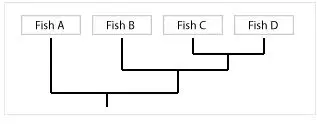
The Phylogenetic Tree diagram can be used to show relatedness. Select the two fishes that are most closely related to each other.

a)

Fish A and Fish B

b)

Fish B and Fish C

c)

Fish B and Fish D

d)

Fish C and Fish D

21.

Which of the following is a good claim that addresses the prompt above?

a)

Women tend to have lower resting heart rates than men. 

b)

Older men tend to have lower resting heart rates than younger men

c)

Older women tend to have lower resting heart rates than younger women.

d)

Athletes tend to have lower resting heart rates than those who don’t exercise much

22.
The non living parts of an ecosystem
a)
abiotic factors
b)
biotic factors
c)
oxygen
d)
soil
23.
All of the different populations that live in a specific area.
a)
ecosystem
b)
habitat
c)
ecology
d)
community
24.
An abiotic part of an ecosystem; required by plants to perform photosynthesis.
a)
water
b)
soil
c)
sunlight
d)
oxygen
25.
the living parts of an ecosystem
a)
biotic factors
b)
biology
c)
abiotic factors
d)
animals
26.
Any characteristic that helps an organism survive in its ecosystem is an ____________. 
a)
Niche
b)
Habitat
c)
Adaptation
d)
Organism
27.
What is the long-lasting relationship between two different organisms?
a)
Symbiosis
b)
Mutualism
c)
Parasitism
d)
Commensalism
28.
Which type of symbiosis has both organisms benefit?
a)
Symbiosis
b)
Commensalism
c)
Parasitism
d)
Mutualism
29.
In which type of symbiosis does one organism benefit and one is not affected?
a)
Symbiosis
b)
Commensalism
c)
Mutualism
d)
Parasitism
30.
In which type of symbiosis does one benefit and one is harmed?
a)
Symbiosis 
b)
Mutualism
c)
Parasitism
d)
Commensalism
31.
A clownfish cleaning a sea anemone and the anemone protecting the clownfish is an example of what?
a)
Commensalism
b)
Parasitism
c)
Organism
d)
Mutualism
32.
A hookworm living in the intestines of a dog and taking nutrients away from the dog, making it sick shows:
a)
Parasitism
b)
Organism
c)
Mutualism
d)
Commensalism
33.

A producer is something that:

a)

Eats plants

b)

Makes its own food

c)

Eats animals

d)

Eats plants and animals

34.

As you move through a food chain, the amount of energy stored....

a)

Increases

b)

Decreases

c)

Stays the same

d)

It depends on the ecosystem

35.

Arrows in a food web show the flow of

a)

energy

b)

protein

c)

nutrients

d)

glucose

36.

In this energy pyramid, which organism would most likely be in level 2?

a)

bird

b)

fox

c)

caterpillar

d)

tree

37.

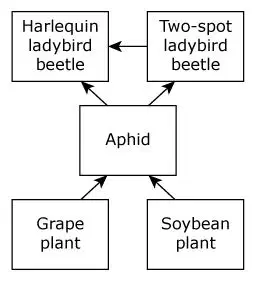
A food web for ladybird beetles is shown. For which organism in the food web do the harlequin and two-spot ladybirds compete?

a)

aphid

b)

grape plant

c)

harlequin ladybird

d)

soybean plant

38.

How would the removal of earthworms from the food chain affect the other organisms?

a)

The number of bass will increase.

b)

The number of crayfish will decrease.

c)

The crayfish will get their energy directly from the sun.

d)

The number of bass and ospreys (bird) will increase.

39.

Suppose that a new predator of the rabbit migrated to this ecosystem. What is the most likely initial effect on the other organisms?

a)

More competition among the mice for food

b)

More competition among the hawks for food

c)

Less competition among snakes for food

d)

Less grass available for food

40.

For the food chain shown, which of the following changes would have the most severe consequences?

a)

a drastic decrease in rainfall, causing a drought

b)

the poaching of predatory hawks by game hunters

c)

the introduction of a second predator that eats field mice

d)

a parasitic infestation that reduces the cricket population

41.

The picture shows an energy pyramid. What will most likely happen to the foxes and the wolves if the rabbits are removed?

a)

The foxes will eat more wolves.

b)

The foxes will eat fewer wolves.

c)

There will be more foxes and wolves.

d)

There will be fewer foxes and wolves.

42.
What is climate?
a)
What's happening in space at a time and place.
b)
What's happening in our atmosphere at a time and place
c)
The average weather over many years
d)
The average temperature over many years.
43.
All of the following are causes of Global Warming except
a)
Rotation of the Earth
b)
Deforestation
c)
Increases in Greenhouse Gases
d)
Burning Fossil Fuels
44.
All of the following are effects of Global Warming EXCEPT
a)
increase in hurricanes
b)
lower sea levels
c)
increase in disease
d)
melting polar ice caps
45.
What are greenhouse gases?
a)
gases that cause climate change
b)
gases that emit green smoke
c)
gases that are used to make green colored glass
46.
Visible light reaches Earth’s surface while infrared light is trapped as heat. Which characteristic of Earth’s atmosphere causes this to happen?
a)
the hole in the ozone
b)
the greenhouse effect
c)
atmospheric pressure
d)
the inversion layer
47.
The average temperature of the surface of Earth has increased approximately 1°C in the past century. Which reason best explains this increase in temperature?
a)
lower levels of ozone in the atmosphere
b)
lower levels of nitrogen in the atmosphere
c)
higher levels of carbon dioxide in the atmosphere
d)
higher levels of oxygen in the atmosphere
48.
Which of the following is the best conclusion that can be made from this graph?
a)
atmospheric carbon dioxide levels have been decreasing since 1960
b)
Hawaii has a lot of carbon dioxide
c)
humans have been working hard to decrease carbon dioxide levels
d)
atmospheric carbon dioxide levels have increased steadily since 1960
49.
Which of the following have been linked to climate change?  
a)
droughts
b)
flooding
c)
melting of polar ice caps
d)
all of the above
50.
The main human activity that releases greenhouse gases is
a)
using bottled water
b)
burning fossil fuels
c)
texting on cellphones
d)
eating meat
51.
The disappearance of a species.
a)
Evolution
b)
Extinction
c)
Migration
d)
Mutation
52.
The variety of living things on Earth is called:
a)
Life
b)
Biodiversity
c)
Similarity
d)
Genetics
53.
This image shows that 
a)
These animals have no simliarities in their structures. 
b)
two different species may have evolved from a common ancestor. 
c)
These animals are from the same species. 
d)
These animals likely evolved from different ancestors due to their differences. 
54.
Two organisms that are closely related would have
a)
very similar DNA sequence
b)
exactly the same DNA sequences
c)
no proteins in common
d)
completely different DNA sequence
55.
Darwin theorized that individuals having an advantage due to their traits or abilities will be more likely to survive and reproduce.  This theory is known as
a)
evolution
b)
speciation
c)
adaptation
d)
natural selection
56.

Examples of homologous structures include

a)

the wings of a bat and a bird

b)

the wings of a bat and the limbs of a cat

c)

the limbs of a cat and the limbs of a tortoise

d)

none of the above

57.

Examples of analogous structures include

a)

the wings of a bat and a bird

b)

the wings of a bat and the limbs of a cat

c)

the limbs of a cat and the limbs of a tortoise

d)

all of the above

58.

The strongest evidence for evolution from a common ancestor is

a)

similar DNA sequences

b)

similar body structures

c)

similar fossils

d)

all of the above

59.
A beetle's ability to camouflage (blend in) with a nearby leaf allows it to escape a hungry frog's appetite.
This is an example of an:
a)
overproduction
b)
genetic variation
c)
selection
d)
adaptation
60.
a)
The image shows convergent evolution.
b)
The image shows divergent evolution.
c)
The image shows adaptive radiation.
d)
The image shows homologous structures.
61.
A population of chimpanzees was separated when the forest that they lived in had a section cut down and a town was built. After a long period of time, the chimpanzees came back into contact but were incapable of breeding. Which of the following best describes the process that occurred?
a)
adaptation
b)
speciation
c)
convergent selection
d)
stabilizing selection
62.
The Florida panther is a large cat related to lions. Panthers eat deer, rodents, and farmers' livestock. Panthers once lived in Tennessee. Which of these most likely caused panthers to disappear from Tennessee?
a)
Panthers in Tennessee were unable to reproduce.
b)
People hunted panthers and destroyed their habitats.
c)
Natural predators killed and ate all the panthers in Tennessee.
d)
Panthers in Tennessee ran out of food. 
63.
Who is the closest relative to the birds?
a)
crocodiles
b)
sharks
c)
fish
d)
amphibians
64.
Which sequence of DNA bases would pair with this partial strand
ATG TGA CAG
a)
ATG TGA CAG
b)
TAC ACT GTC
c)
GTA AGT GAC
d)
CAT TCA CTG
65.
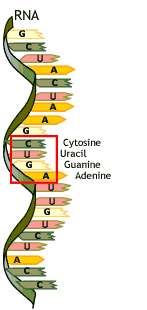
In RNA, Uracil pairs with ______. 
a)
cytosine
b)
adenine
c)
guanine
d)
thymine
66.
Which amino acid is made from the RNA codon UUA?
a)
Phenylalanine
b)
Leucine
c)
Serine
d)
Tyrosine
67.

What are the four stages of mitosis?

a)

Interphase, Prophase, Mitosis, Anaphase

b)

Interphase, Mitosis, Cytokinesis, Telophase

c)

Prophase, Metaphase, Anaphase, Telophase

d)

Prophase, Metaphase, Telophase, Cytokinesis

68.
Which RNA bases would pair with TACGAA in transcription
a)
AUGCUU
b)
ATGCTT
c)
GCATCC
d)
GCAUCC
69.
Which of the following polypeptides is coded for by the mRNA sequence 5' AUGGUUAAA 3'?
a)
Val, Lys, Phe, Gly
b)
Met, Asp, Phe
c)
Met, Val, Lys
d)
Ile, Gln, Leu, Ser
70.
What do helpful mutations do? 
a)
Increases chances of survival 
b)
Decreases changes of survival 
c)
Increases chances of developing cancer
d)
Decreases skills
71.
What causes genetic variation in meiosis?
a)
chromosomes lining up
b)
crossing over of chromosomes
c)
separation of chromosomes
d)
chromosomes pulling apart
72.

What characteristic does "survival of the fittest" need for survival of a species.

a)

Genetic Variation

b)

Speed

c)

Beak shape

d)

Biodiversity

73.

Darwin found the following finches on the Galapagos islands. What best describes why they have different beaks?

a)

Genetic variation has made it possible for birds to feed on different forms of food due to their beak shape.

b)

Genetic variation has made it possible for larger eyes on the birds to see.

c)

Genetic variation has made it possible for the birds to camouflage themselves on the island.

d)

Genetic has made it possible for the birds to feed at different times of the day due to competition.

74.

The variation and distribution of traits observed depends on two factors?

a)

physical and environmental

b)

physical and genetic

c)

genetic and environmental

d)

environmental and chemical

75.

What are three pieces of evidence that inheritable genetic variations result from?

a)

new genetic combinations through meiosis, errors in DNA replication, and mutations from environmental factors

b)

errors in DNA replication, genetic combinations through mitosis, and mutations from chemical exposure

c)

mutations from bacteria, errors in DNA translation, and genetic combinations through phosphorylation

d)

errors in DNA transcription and new genetic combinations from DNA methylation