
 Worksheets
Fall Final
Total questions: 78
Worksheet time: 39mins
Name
Class
Date
1.
What is not a characteristic of a living thing
a)
Reproduction
b)
Change over time
c)
Made of cells
d)
Movement
2.
Eukaryotic cells have all of the following except
a)
Nucleus
b)
Organelles
c)
Circular DNA
d)
Multicellular
3.
An animal cell is prokaryotic
a)
True
b)
False
4.
Levels of organization: largest to smallest
a)
cells, tissues, organs, organ systems, organsim
b)
Organism, organs, organ systems, cells, tissues
c)
tissues, organs, cells, organisms, organ systems
d)
organisms, organ system, organs, tissues, cells
5.
There are four types of tissues, which is not a type?
a)
connective
b)
epithelial
c)
nervous
d)
bone
6.
The genetic make up is the _______
a)
Genotype
b)
Phenotype
c)
Homozygous
d)
Heterozygous
7.

What has happened to this chromosome?
a)
Substitution
b)
Inversion
c)
Duplication
d)
Deletion
8.
In cats, the diploid # of chromosomes is 38. How many chromosomes are found in haploid cells?
a)
76
b)
38
c)
83
d)
19
9.
An extra chromosome on a gene results in a condition called
a)
Monosomy
b)
Quadosomy
c)
Deuterosomy
d)
Trisomy
10.
What type of mutation results in a mutated codon that codes for a different amino acid?
a)
Insertion
b)
Nonsense
c)
Missense
d)
Silent
11.
The tongue is a/an
a)
tissue
b)
muscle
c)
organ
d)
organ system
12.
The cell membrane is made of
a)
Phosphates and sugars
b)
Phosphates and lipids
c)
Lipids and sugar
d)
Proteins and sugar
13.
Diffusion is the movement of water from ________ to ___________.
a)
Low to high
b)
Right to left
c)
High to low
d)
Left to right
14.
The head of the phospholipid bilayer is polar, meaning
a)
Hydrophobic
b)
Hydrophilic
c)
Hypertonic
d)
Hypotonic
15.
To have more solutes inside the cell means the solution is
a)
Hypertonic
b)
Isotonic
c)
Hypotonic
d)
We never learned this
16.
Which of the following is NOT a difference between mitosis and meiosis?
a)
2 vs 4 daughter cells
b)
DNA is not replicated before meiosis
c)
Separation of Homologous pairs
d)
Diploid vs Haploid products
17.

Assuming both parents in the pedigree below are homozygous, what would be the genotypes of the f1 generation?
a)
Yy
b)
YY
c)
yy
18.
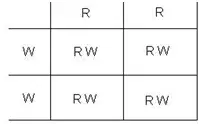
The above Punnett square shows a cross between a red flower and a white flower. If this is a case of codominance, what will be the phenotypes of the offspring?
a)
Red and white spotted
b)
Pink
c)
Red
d)
White
19.
Which of the following is NOT a reason that your body would undergo mitosis?
a)
Create gametes
b)
Replace dead or damaged cells
c)
Growth
d)
Replace old or dying cells
20.
If a plant with red flowers is crossed with a plant with white flowers and the resulting offspring are pink, it is known as
a)
Co-dominance
b)
Polygenic traits
c)
Incomplete dominance
d)
Dihybrid traits
21.
If a solution is hypertonic, what is going to happen to the water?
a)
Water will move out of the cell
b)
Water will move into the cell
c)
Nothing
d)
What does this mean
22.
Negative feedback loops do what?
a)
Increase the change
b)
Reverse the change
23.
What is energy for the cell?
a)
Sunshine
b)
Water
c)
Carbon Dioxide
d)
ATP
24.
What are the products of cellular respiration?
a)
water and oxygen
b)
sugar and water
c)
water and carbon dioxide
d)
sugar and oxygen
25.
What are the reactants of photosynthesis?
a)
Water and carbon dioxide
b)
Water and sugar
c)
Carbon dioxide and oxygen
d)
Oxygen and glucose
26.
In foxes, brown fur (B) is dominant to white fur (b). If a homozygous brown fox is crossed with a white fox, what is the probability that the offspring will be white?
a)
100%
b)
50%
c)
0%
d)
25%
27.
During which phase of the cell cycle does DNA replicate?
a)
G1
b)
Anaphase
c)
Metaphase
d)
Synthesis
28.
Having two identical alleles for a trait (HH or hh) is said to be
a)
Heterozygous
b)
Homozygous
c)
Genotypic
d)
Phenotypic
29.
If an animal has 24 chromosomes in its liver cells, then how many chromosomes are found in its skin cells?
a)
12
b)
24
c)
48
d)
42
30.
If a diploid cell has 16 chromosomes, then, after mitosis, how many chromosomes will each of the daughter cells have?
a)
8
b)
32
c)
16
d)
64
31.
What is the correct order of cellular respiration?
a)
Electron Transport Chain, Glycolosis, Kreb's cycle
b)
Kreb's cycle, Glycolosis, Electron Transport Chain
c)
Glycolosis, Krebs cycle, Electron Transport Chain
d)
Glycolosis, Electron Transport Chain, Kreb's cycle
32.
Anaerobic means
a)
without water
b)
without oxygen
c)
with carbon dioxide
d)
with oxygen
33.
What type of cells do photosynthesis?
a)
Animal
b)
Eukayrotic
c)
Plant
d)
Green
34.
What makes plants green?
a)
Chloroplast
b)
Pigments
c)
Mitochondria
d)
Chlorophyll
35.
How do plants take in carbon dioxide?
a)
Roots
b)
Stomata
c)
Leaves
d)
Flowers
36.

The above image is a karyotype depicting
a)
Male
b)
Male with down syndrome
c)
Female
d)
Female with down syndrome
37.
Which of these is the correct order of the process of Protein Synthesis.
a)
Transcription, mRNA moves to the ribosome, translation, amino acids folds to form protein
b)
Transcription, Translation, mRNA moves to the ribosome, amino acid folds to form protein
c)
Translation, mRNA moves to the ribosome, Transcription, amino acid folds to form protein
d)
amino acid folds to form protein, Transcription, Translation, mRNA moves to the ribosome
38.
The end product of protein synthesis is?
a)
1 new strand of DNA
b)
2 new strands of DNA
c)
Protein
d)
1 new strand of RNA
39.
If a person has a trisomy disease, such as Down syndrome, how many total chromosomes will be in each of their cells.
a)
48
b)
46
c)
45
d)
47
40.
Hitchhikers thumb is a recessive trait. Can two parents that are homozygous recessive have a child with a straight thumb?
a)
No, they do not carry the allele for straight thumbs
b)
Yes, they are homozygous for that trait
c)
Yes, being homozygous means they have both traits
41.
What is the main source of energy for photosynthesis?
a)
Water
b)
Oxygen
c)
Sunshine
d)
Carbon dioxide
42.
What does hydrophilic mean?
a)
Water fearing
b)
High solutes
c)
Low solutes
d)
Water loving
43.

What is the solution in the beaker?
a)
Hypertonic
b)
Hypotonic
c)
Isotonic
44.
How do plants release oxygen?
a)
Roots
b)
Stomata
c)
Leaves
d)
Flowers
45.
What happens when animal cells do not have enough oxygen to go into the Kreb's cycle?
a)
Alcohol fermentation
b)
Lactic Acid fermentation
c)
Electron transport chain
d)
Glycolysis
46.

What are the possible parents?
a)
Hh, Hh
b)
Hh, HH
c)
HH, hh
d)
HH, HH
47.
When mRNA is being translated into amino acids during protein synthesis, the sequence is being read in codons. What is a codon? How many combinations are there?
a)
3 sugars, 64 combinations
b)
3 bases, 64 combinations
c)
3 bases, 20 combinations
d)
3 sugars, 20 combinations
48.
What is the end product of DNA Replication?
a)
Protein
b)
amino acid chain
c)
1 new strand of RNA
d)
2 new strands of DNA
49.
Long chains of amino acids connected by peptide bonds make?
a)
DNA
b)
Fat
c)
Proteins
d)
Necklaces
50.
What does a nucleotide consist of?
a)
Phosphate, sugar, acid
b)
Phosphate, water, base
c)
Phosphate, oxygen, water
d)
Phosphate, sugar, base
51.
Mitosis is where cells make new cells. What kinda of cells are being made?
a)
Somatic
b)
Gametes
c)
Sex cells
d)
Blood cells only
52.
What does the water do in a hypertonic solution?
a)
Goes into the cell
b)
Goes out of the cell
c)
Nothing happens
53.
Skeletal muscle is voluntary
a)
True
b)
False
54.
The cell membrane is everything but
a)
Semi-permeable
b)
Bilayered
c)
Hydrophobic
d)
Made of phosphates and lipids
55.
Number of ATP made during cellular respiration
a)
24
b)
36
c)
38
d)
26
56.
Osmosis is
a)
movement of water from high to low
b)
movement of oxygen from high to low
c)
movement of water from low to high
d)
movement of oxygen from low to high
57.
During protein synthesis, the process of transcription occurs in the ____________ of the cell.
a)
Cell
b)
Ribosome
c)
Cytoplasm
d)
Nucleus
58.
What sugar can be found in RNA
a)
Deoxyribose
b)
Glucose
c)
Deoxose
d)
Ribose
59.
Which of the following would be a nucleotide found in DNA?
a)
Phosphate, ribose, thymine
b)
Phosphate, deoxyribose, cytosine
c)
Phosphate, deoxyribose, uracil
d)
Phosphate, ribose, uracil
60.
In which process are gametes produced?
a)
Mitosis
b)
Osmosis
c)
Meiosis
d)
Protein synthesis
61.
What is the process in meiosis where genes exchange creating more genetic variation?
a)
germ cell assortment
b)
crossing over
c)
independent assortment
d)
replication bubble
62.
Which of these is NOT part of a nucleotide?
a)
amino acid
b)
sugar
c)
phosphate
d)
base
63.
In RNA what does Guanine pair with?
a)
Uracil
b)
Adenine
c)
Cytosine
d)
Thymine
64.

What happened to this chromosome?
a)
Inversion
b)
Deletion
c)
Duplication
d)
Substitution
65.

The above image is a karyotype depicting
a)
Male
b)
Female
c)
Male with Down Syndrome
d)
Female with Down Syndrome
66.
The base that changes in DNA is _________ instead you can find _________ in RNA
a)
Adenine, Uracil
b)
Thymine, Uracil
c)
Uracil, Thymine
d)
Cytosine, Uracil
67.
In DNA what does cytosine pair with?
a)
Uracail
b)
Guanine
c)
Thymine
d)
Adenine
68.
What type of mutation occurs that stops the process of translation?
a)
Deletion
b)
Missense
c)
Silent
d)
Nonsense
69.
Since the chromosomes are all replicated during Interphase, when the cell first starts mitosis there are _____ chromosomes in a human cell
a)
46
b)
92
c)
23
d)
42
70.
In which phase of mitosis do chromosomes line up in the middle of the cell?
a)
Metaphase
b)
Anaphase
c)
Prophase
d)
Telophase
71.

What level of organization does this picture show?
a)
Organ
b)
Cell
c)
Organ system
d)
Tissue
72.
Having alleles for both traits is called _____________.
a)
Phenotypic
b)
Genotypic
c)
Homozygous
d)
Heterozygous
73.
The Mendelian principle that states that genes for different traits can segregate independently during gamete formation is known as ______________
a)
Incomplete dominance
b)
Independent assortment
c)
Cross dominance
d)
Polygenic traits
74.
Where does the process of translation take place?
a)
Nucleus
b)
Ribosome in cytoplasm
c)
Vacuole
d)
Outside
75.
The physical features are referred to as the ________
a)
Gentotype
b)
Homozygotic
c)
Phenotype
d)
Heterozygoti
76.
Name the process where the codon matches with the amino acid
a)
Transcription
b)
Replication
c)
Translation
d)
Transformation
77.
Which of these is true for RNA but not DNA?
a)
Can leave the nucleus
b)
Single stranded
c)
Has uracil as a base
d)
All of these
78.

What level of organization does this cross section of a leaf show?
a)
organ
b)
tissue
c)
cell
d)
organ system
100 %

