wayground logo

Free Printable Worksheets

Font size

S
M
L
XL
Worksheets

6th Final

Total questions: 80

Worksheet time: 1hrs 14mins

Name
Class
Date
1.

The process that breaks down rock and other substances is called.....?

a)

deposition

b)

preserving

c)

sediment

d)

weathering

2.

The process by which sediment is laid down in new locations is called...?

a)

abrasion

b)

deposition

c)

weathering

d)

erosion

3.

What kind of weathering causes the composition of rocks to change?

a)

mechanical weathering

b)

permeable weathering

c)

chemical weathering

d)

general weathering

4.

In which layer of soil would you find humus?

a)

A horizon

b)

B horizon

c)

C horizon

d)

Bedrock

5.

Which of the following are landforms created by glaciers?

a)

kettle lake, horns, and U-shaped valleys

b)

oxbow lakes, deltas, and gullies

c)

dunes, sandhills and deflation

d)

headlands, beach and spit

6.

A large mass of ice that slowly moves over land causing erosion and deposition is a ....?

a)

moraine

b)

horn

c)

cirque

d)

glacier

7.

What is the slow, downhill mass movement of rock and soil?

a)

creep

b)

slump

c)

landslide

d)

mudslide

8.
Weathering, erosion, and deposition are caused by...
a)
wind
b)
water
c)
ice
d)
all of the above
9.
This sphere is composed of all the living things 
a)
Hydrosphere 
b)
Biosphere 
c)
Atmosphere 
d)
Geosphere 
10.
Water evaporating from the surface of a lake moves from the...
a)
Atmosphere to the geosphere 
b)
Geosphere to the hydrosphere 
c)
Hydrosphere to the atmosphere 
d)
Atmosphere to the hydrosphere 
11.
When dead plants decompose and nitrogen is returned to the soil, the interaction is between which two spheres? 
a)
The biosphere and atmosphere 
b)
The atmosphere and geosphere 
c)
The geosphere and atmosphere 
d)
The biosphere and geosphere 
12.
Oceans, rivers, lakes, and the moisture in the air are all part of which of Earth's spheres? 
a)
Hydrosphere 
b)
Biosphere 
c)
Atmosphere 
d)
Geosphere 
13.
Which of the following statements about air pressure is true?
a)
Air pressure increases as altitude increases.
b)
Air pressure decreases as altitude increases.
c)
The atmosphere's air pressure does not vary
d)
Warm air tends to have higher air pressure than cold air
14.

What are the three types of rocks in the rock cycle?

a)

hard, soft, brittle

b)

sand, stone, volcanic

c)

igneous, sedimentary, metamorphic

d)

fossils, magma, sand

15.
Which layer of the atmosphere is closest to Earth?
a)
mesosphere
b)
troposphere
c)
exosphere
d)
thermosphere
16.
In which layer of the atmosphere would we experience weather?
a)
troposphere
b)
thermosphere
c)
exosphere
d)
stratosphere
17.
This sphere includes the continents, the ocean floor, all the rocks on the surface, and all of the sand in the deserts. 
a)
Hydrosphere 
b)
Biosphere 
c)
Atmosphere 
d)
Geosphere 
18.

The breakdown of rock into smaller pieces of the same rock without any change in its composition

a)

mechanical weathering

b)

chemical weathering

c)

erosion

d)

deposition

19.

When rock is broken by the freezing and thawing of ice, it is known as...

a)

chemical weathering

b)

mechanical weathering

c)

erosion

d)

deposition

20.
A fossil in which minerals replace all or part of an organism.
a)
trace fossil
b)
mold fossil
c)
petrified fossil
d)
cast fossil
21.
In horizontal layers of sedimentary rock, each layer is older than the layer above it.
a)
mass extinct
b)
geologic time scale
c)
era
d)
law of superposition
22.
The age of a rock compared to the ages of other rocks.
a)
relative age
b)
half-life
c)
absolute age
d)
radioactive decay
23.
Which fossil is an impression left by the original organism?
a)
cast
b)
mold
c)
trace
d)
preserved remains
24.
Which type of dating method can be used on rock layers by applying the Law of Superposition?
a)
relative dating
b)
absolute dating
c)
radioactive dating
d)
radiometric dating
25.

Which of the following correctly lists the layers in order from oldest to youngest?

a)

A, B, C, D, E

b)

E, B, C, D, A

c)

E, D, C, B, A

d)

C, B, A, D, E

26.
What does the theory of continental drift state?
a)
The continents were once joined in a super-continent and have moved over time
b)
Continents are stationary and do not move
c)
The Earth is broken into lithospheric plates that move due to convection currents
d)
none of the above
27.

This idea states that the same processes that occurred in the past operate in the same way as they do in the present.

a)

Absolute Dating

b)

Relative Dating

c)

Catastrophism

d)

Uniformitarianism

28.
Which of the following organisms formed last on Earth?
a)
Jellyfish
b)
Shark
c)
Lizards
d)
Horses
29.
Precambrian time is nearly ____% of Earth's history.
a)
75
b)
50
c)
80
d)
90
30.
Which of these describes a species that has become extinct?
a)
fewer members of the species are dying than being born
b)
more members of the species are dying than being born
c)
very few members of a species are alive
d)
all members of a species have died
31.
Which of the following places the geologic time eras in order from oldest to most recent?
a)
Precambrian, Paleozoic, Mesozoic, Cenozoic
b)
Mesozoic, Cenozoic, Paleozoic, Precambrian
c)
Cenozoic, Mesozoic, Paleozoic, Precambrian
d)
Paleozoic, Cenozoic, Precambrian, Mesozoic
32.
The Earth is approximately _________________________.
a)
4,600 years old
b)
2017 years old
c)
6.4 billion years old
d)
4.6 billion years old
33.
Which layer formed first?
a)
Rock Layer W
b)
Rock Layer X
c)
Rock Layer Y
d)
Rock Layer Z
34.
What are the main categories of sedimentary rock?
a)
extrusive and intrusive
b)
clastic, chemical, & organic
c)
felsic and mafic
d)
foliated and non-foliated
35.
The time it takes for half of a radioactive element's atoms to decay is its:
a)
Era
b)
Half life
c)
Relative age
d)
Absolute age
36.
The half-life of Zn-71 is 2.4 minutes. If one had 100.0 g at the beginning, how many grams would be left after 7.2 minutes has elapsed?
a)
100.0g
b)
50.0g
c)
12.5g
d)
8.5g
37.
a)
luster
b)
streak
c)
scratch
d)
hardness
38.
a)
Gold
b)
Hematite
c)
Pyrite
d)
Galena
39.
What would you use to determine the hardness of a mineral?
a)
color tiles
b)
streak test
c)
Mohs Scale
d)
weight scale
40.
What type of rock forms when sand, particles of rock, bits of soil, and remains of once-living things are cemented?
a)
igneous
b)
sedimentary
c)
minerals
d)
metamorphic
41.
The five characteristics that all minerals share are:
a)
Definite Chemical Composition, Color, Density, Igneous, and Solid
b)
Definite Chemical Composition,  Crystal Structure, Inorganic, Naturally Occurring, and Solid
c)
Cleavage, Faces, Hardness, Metamorphic, and Streak
d)
Cleavage, Crystal Structure, Density, Igneous, and Solid
42.
_______ is found by rubbing the mineral against an unglazed tile called a plate.
a)
Cleavage
b)
Color
c)
Luster
d)
Streak
43.
This is how a mineral reflects light.
a)
Cleavage
b)
Density
c)
Hardness
d)
Luster
44.
In order for a metamorphic rock to form, _______ is needed.
a)
Pressure
b)
Heat 
c)
Heat and Pressure
d)
Weathering
45.
This rock was formed when magma cooled very slowly inside the Earth. What specific type of rock is it?
a)
Intrusive Igneous Rock
b)
Extrusive Igneous Rock
c)
Foliated Metamorphic Rock
d)
Clastic Sedimentary Rock
46.
Which of the words below describe mud, sand, and tiny bits of rocks that cement together to form a type of rock?
a)
stalactites
b)
magmas
c)
metamorphs
d)
sediments
47.

This is a natural solid that is made of one or more minerals.

a)

Mineral

b)

Fossil

c)

Rock

d)

Sediment

48.
Which layer is made up of iron and nickel?
a)
Crust
b)
Mantle
c)
Inner Core
d)
Lithosphere
49.
What are the two types of crust?
a)
top crust,bottom crust
b)
oceanic crust, continental crust
c)
water,land
d)
none of the above 
50.

Which layer has convection currents where the hot, less dense magma rises and the cooler, dense magma sinks?

a)

inner core

b)

outer core

c)

mantle

d)

crust

51.
What is the correct order (starting from the surface) of Earth's layers?
a)
crust, outer core, inner core, mantle
b)
mantle, outer core, inner core, crust
c)
crust, mantle, outer core, inner core
d)
outer core, inner core, crust, mantle
52.

Which type of plate boundary would cause mountains to form?

a)

Transform

b)

Convergent

c)

Divergent

d)

Reform

53.
Earthquakes and volcanoes are most likely found in which locations?
a)
At plate boundaries
b)
in oceans
c)
in the middle of continents
d)
in the middle of plates
54.
Transform boundaries are most likely to produce what phenomenon?
a)
volcanoes
b)
deep sea trenches
c)
underwater mountain ranges
d)
earthquakes
55.
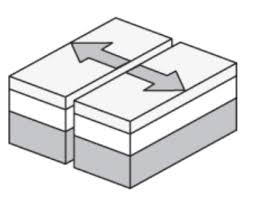
Name the boundary
a)
convergent boundary
b)
divergent boundary
c)
transform boundary
d)
sergent boundary
56.
Earthquakes under the water can cause _________________________________.
a)
tornadoes
b)
tsunamis
c)
lightening
d)
hailstorms
57.

Which kind of waves usually do the most damage in an earthquake?

a)

P Waves

b)

Surface waves

c)

S Waves

d)

M waves

58.

A sleeping volcano is called what?

a)

active

b)

dormant

c)

extinct

d)

structural

59.
line of volcanic activity that is found along the plate boundaries of the Pacific Ocean is known as...
a)
Ring of Fire
b)
Aleutian Islands
c)
Hawaiian Islands
d)
Caribbean Islands
60.
What is the point on Earth's surface directly above the focus of an earthquake?
a)
earthquake
b)
epicenter
c)
fault
d)
focus
61.
Name the point underground where the faulting in an earthquake occurs.
a)
earthquake
b)
epicenter
c)
fault
d)
focus
62.

The image is showing what process?

a)

condensation

b)

transpiration

c)

precipitation

d)

liquification

63.

What is a wavelength?

a)

The horizontal distance between wave crests

b)

The highest point of the wave

c)

The lowest point of the wave

d)

The amount of energy a wave carries

64.

The measure of dissolved salts in water

a)

acidity

b)

oxygenation

c)

salinity

d)

saturation

65.
Which represents the distribution of water on Earth?
a)
3% freshwater, 97% salt water
b)
97% freshwater, 3% salt water
c)
71% freshwater, 29% salt water
d)
29% freshwater, 71% salt water
66.

The energy that drives the water cycle comes from the _____?

a)

Sun

b)

Earth

c)

rain

d)

ocean

67.

Water is a _____________ molecule meaning the positive hydrogen end attracts the negative oxygen end.

a)

balanced

b)

universal

c)

non polar

d)

polar

68.

What is the lowest part of a wave called?

a)

crest

b)

trough

c)

wave length

d)

wave height

69.
Most of Earth's fresh water is found
a)
Frozen in glaciers
b)
Underground
c)
In the Great Lakes
d)
In Oceans
70.
Which gas in our atmosphere is most abundant?
a)
Argon
b)
Oxygen
c)
Nitrogen
d)
Carbon Dioxide
71.
What is the outer most main layer of Earth's atmosphere?
a)
Thermosphere
b)
Troposphere
c)
Stratosphere
d)
Mesosphere
72.
What symbol is this?
a)
warm front
b)
cold front
c)
stationary front
d)
occluded front
73.
What does this symbol indicate on a weather map? 
a)
High pressure system
b)
Low pressure system
c)
Cold front
d)
Warm front
74.
Which weather tool measures temperature?
a)
thermometer
b)
barometer
c)
psychrometer
d)
anememeter
75.
The amount of moisture (water vapor) in the air
a)
Barometer
b)
Humidity
c)
Rain gauge
d)
Evaporation
76.
Which is the warmest climate zone?
a)
Arctic Zone
b)
Temperate Zone
c)
Tropical Zone
d)
Intermediate Zone
77.
Suppose you are swimming in a lake when a thunderstorm approaches. Which of the following would be the best way to protect yourself from lightning?
a)
diving underwater
b)
going fishing instead of swimming
c)
taking shelter in an automobile
d)
taking shelter under a tree
78.
Which of the following is typical of a tropical climate?
a)
cold, dry air
b)
cool, moist air
c)
hot, dry air
d)
warm, moist air
79.
Which is a period of dryer weather than normal?
a)
drought
b)
equinox
c)
monsoon
d)
upswelling
80.
The sun’s rays are least direct
a)
near the poles
b)
near the equator
c)
at high altitudes
d)
far from the ocean