wayground logo

Free Printable Worksheets

Font size

S
M
L
XL
Worksheets

Spring World Final Exam

Total questions: 85

Worksheet time: 50mins

Name
Class
Date
1.
What was a success of the Ming Dynasty?
a)
Finished the Great Wall of China
b)
Built the Eifel Tower
c)
Created the Silk Road
d)
Built Big Ben
2.
What ancient enemy of China set up the Yuan Dynasty that ruled before the Ming`s took over? 
a)
The Japanese
b)
The Mongols
c)
The Persians
d)
The English
3.

What was the goal of the Boxer Rebellion?

a)

Bring Communism to China

b)

Overthrow the government

c)

Eliminate foreign influence

d)

Increase religious freedom

4.

Who won the Opium War?

a)

China

b)

Britain

c)

United States

d)

France

5.
What modern country descended from the Safavid Empire?
a)
Iran
b)
Iraq
c)
Afghanistan 
d)
Nepal
6.
What is the title given to THE leader of the Ottoman Empire?
a)
Janissary
b)
Rajput
c)
Sultan
d)
Emperor
7.
The Ottoman Empire was ruled from ___________________. 
a)
The Atlantic.
b)
Russia.
c)
Istanbul, formerly Constantinople.
d)
The Mediterranean. 
8.
What did the Ottoman Empire do to the Hagia Sofia?
a)
burned it to the ground
b)
turned it into a mosque
c)
made it their capitol
d)
turned it into a hotel
9.
Which event directly caused the collapse of the Ottoman Empire?
a)
World War I
b)
World War II
c)
Revolutionary War
d)
Iraq War
10.
The Mughal Empire was able to rule over a society that was predominantly
a)
Buddhist
b)
Christian
c)
Hindu
d)
Muslim
11.
What did John Locke believe all people were born with? 
a)
Natural Rights
b)
Life
c)
Liberty
d)
Property
12.
Your Natural Rights include: Life, Liberty, and ...
a)
the Pursuit of Happiness
b)
Property
c)
Slaves
d)
Money
13.
Enlightenment philosopher who believed people had natural rights of life, liberty, and property.
a)
John Locke
b)
Montesquieu
c)
Rousseau
d)
Voltaire
14.
Enlightenment philosopher who did not agree with censorship.
a)
Voltaire
b)
Denis Diderot
c)
Mary Wollstonecraft
d)
Adam Smith
15.
Which of the following documents made England a Constitutional Monarchy?
a)
English Bill of Rights
b)
Common Law
c)
Magna Carta
d)
Declaration of Independence
16.
The French Revolution began in 
a)
1776
b)
1789
c)
1876
d)
1798
17.
The idea that reason should guide society rather than tradition helped cause the revolution and came from
a)
the Declaration of Independence
b)
the Scientific Revolution
c)
the Enlightenment
d)
all of the above
18.
The Radicals eliminated anyone accused of being against the Revolution during 
a)
the Terror
b)
the Great Fear
c)
Thermidorian Reaction
d)
Thermidorian Reaction
19.

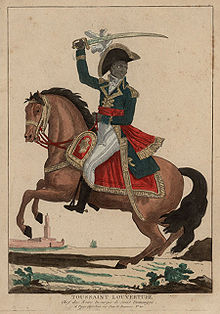
Who was the leading general of the Haitian Revolution?

a)

Napoleon Bonaparte

b)

Jean Jacques Dessalines

c)

Hidalgo

d)

Toussaint L'Ouverture

20.
Who led the slaves in Haiti in a revolt against France?
a)
Miguel Hidalgo
b)
Simon Bolivar
c)
Toussaint L'Ouverture 
d)
Jose de San Martin
21.
Where was the only successful slave revolt in history?
a)
Cuba
b)
Ecuador
c)
Haiti
d)
Venezuela
22.
Which of the following was a way in which Napoleon's reforms positively impacted the French economy?
a)
Created a centralized banking system known as the National Bank of France
b)
Created an equal taxation system that helped finance new roads and canals
c)
Created a new currency which led to France's most stable economy in recent years
d)
All of the above
23.
The Napoleonic Code also established a secret force that arrested people without a fair and equal trial 
a)
True
b)
False
24.
Name the inventor of the cotton gin.
a)
Eli Whitney
b)
Henry Bessmer
c)
Alexander Bell
d)
Thomas Edison
25.
The movement from rural areas and clustering of people into towns and cities is called:
a)
Urbanization
b)
Revolution 
c)
Industrialization
d)
Civilization
26.
How did the development of the factory system encourage urbanization? 
a)
Industrialists invested in cotton plantations.
b)
Workers moved closer to manufacturing centers
c)
Labor unions were formed to protect mill workers.
d)
Manufacturers produced goods to export overseas.
27.
Scottish Professor who believed that the successful market economy is based on competition.
a)
Adam Smith
b)
Bourgeoisie
c)
Capital
d)
Capitalism
28.
The capitalist class who own most of society's wealth and means of production.
a)
Adam Smith
b)
Bourgeoisie
c)
Capital
d)
Capitalism
29.
Philosopher and economist famous for his ideas about capitalism and communism.
a)
Capitalism
b)
Free enterprise system
c)
Karl Marx
d)
Law of competition
30.
The Meiji Restoration in Japan was a response to...
a)
nationalism and imperialistic threats
b)
isolationism
c)
converting to Christianity
d)
socialism and the cottage industry
31.
What was the war between Russia and Japan called?
a)
Opium War
b)
Sino-Japanese War
c)
Russo-Japanese War
d)
French and Indian War
32.
When a stronger country takes over a weaker country. 
a)
Nationalism
b)
Imperialism
c)
Militarism 
d)
Alliance System 
33.
Who did the Zulus fight against?
a)
French 
b)
Belgian
c)
Italian 
d)
British
34.
Wealthy businessman; Englishman; outspoken advocate of Social Darwinism
a)
Cecil Rhodes
b)
Rudyard Kipling
c)
Menelik II
d)
Shaka
35.
What was the main problem that African nations had in stopping the spread of imperialism?
a)
Population 
b)
Economy
c)
Weapons
d)
Language
36.
Because militarism had been a major cause of the war, the framers of the Treaty of Versailles
a)
made Germany pay reparations.
b)
stripped Germany of its colonies.
c)
forced Germany to sign a war-guilt clause
d)
barred Germany from maintaining a military
37.
Because of the Treaty of Versailles …
a)
Germany had to give up 1 million square miles of land
b)
Germany had to pay war reparations to the Allies
c)
Germany’s government was reconstructed.
d)
ALL OF THE ANSWERS ARE CORRECT
38.
 Which event best replaces the question mark in this sequence?  
Russia 1917-1918
• Czar Nicholas II abdicated Russian Imperial throne
•  ?
• Bolsheviks seized power and became the Communist Party
• Russia signed a peace treaty with the Central Powers
a)
A.  Vladimir Lenin returned to lead the Russian Revolution 
b)
B. Leon Trotsky escaped Russia for exile in Mexico 
c)
C. The Russian government adopted the New Economic Policy 
d)
D. The Red Army won the Russian Civil War
39.
What was the major consequence of the February Revolution of 1917?
a)
A.  It forced Kerensky to surrender to the Bolsheviks. 
b)
B. It secured Stalin as leader of Russia. 
c)
C. It allowed Trotsky to negotiate peace with Germany. 
d)
D. It forced Tsar Nicholas II to abdicate the throne.
40.
Which group of people revolted against the Russian revolutionary provisional government in 1917?
a)
A.  the Bolsheviks 
b)
B. the Czarists 
c)
C. the nobility 
d)
D. the clergy
41.
Which statement describes the ideology of V.I. Lenin during the Bolshevik Revolution?
a)
A.  He preserved the monarchy as a national symbol. 
b)
B. He called for authoritarian rule to implement communism. 
c)
C. He promoted the use of nonviolent protest for social change. 
d)
D. He held parliamentary elections to legitimize the new government.
42.
Who promised to restore Germany to its former power?
a)
Joseph Stalin
b)
Benito Mussolini
c)
Adolf Hitler
d)
Napoleon Bonaparte
43.
What country was punished most severely by the Treaty of Versailles?
a)
Italy
b)
Japan
c)
Russia
d)
Germany
44.
Appealed to Italy's wounded pride and fear of communism, established the first Fascist Party, took over the Italian government after the march on Rome
a)
Adolf Hitler
b)
Benito Mussolini
c)
Francisco Franco
d)
Joseph Stalin
45.
What was Mein Kampf?
a)
This was Hitler's book, which title means "My Struggle", in which Hitler set forth his goals for Germany.
b)
This was the German brand of Fascism also known as the Nationalist Socialist German Worker's Party and is known for its Anti-Semitism.
c)
This was Hitler's private militia of storm troopers or "thugs".
d)
This was a hooked cross that the Nazi's adopted for their symbol.
46.
What was "Mein Kampf"?
a)
The Communist Bible
b)
Germany's economic recovery plan
c)
Action plan of the Nazis, written by Hitler
d)
A book banned in Germany during WWII for being too controversial
47.
Who was the ruler of U.S.S.R?
a)
Joseph Stalin
b)
Winston Churchill
c)
Adolf Hitler
d)
Harry S. Truman
48.
Nazi-Soviet Nonaggression Pact
a)
Hitler wanted to gain Stalin as an ally
b)
Hitler wanted to avoid a two front war
c)
To secure Siberia
d)
In pursuit of a route to Japan
49.
Which battle led to the German surrender and retreat of the Afrika Korps in North Africa?
a)
El Alamein
b)
Dunkirk
c)
Kursk
d)
Midway
50.
What was the date of  Pearl Harbor
a)
December 7 ,1941
b)
February 3 ,1956
c)
August 2 ,1478
d)
September 28 ,2000
51.
Who bombed Pearl Harbor
a)
Italy 
b)
Germany 
c)
Japan 
d)
Canada 
52.
What strategy did the United States develop to help defeat Japan?
a)
island hopping
b)
total war
c)
Anaconda plan
d)
blockade
53.
Naval battle that took out Japanese aircraft carriers.
a)
Iwo Jima
b)
Pearl Harbor
c)
Guadalcanal 
d)
Midway
54.
Germany employed a tactic that used extremely quick attacks. What was this called 
a)
blitzkrieg 
b)
lebenbaum
c)
leningrad
d)
Trench warfare 
55.
Last German offensive. 
a)
Stalingrad
b)
Operation Barbarossa
c)
Battle of Britain
d)
Battle of the Bulge
56.
What was June 6, 1945?
a)
V-J Day
b)
V-E Day
c)
D-Day
d)
The day the war ended
57.
US decides to use atomic weapons to end the war & save American lives.
a)
Tokyo 
b)
Iwo Jima & Nagasaki
c)
Hiroshima & Nagasaki
d)
Okinawa & Hiroshima
58.
How many Jews were murdered during the Holocaust?
a)
1 million
b)
6 million
c)
100'000
d)
60 million
59.
What does the term "Final Solution" mean?
a)
Germany's plan to send all the Jews to Israel
b)
Hitler's plan to commit suicide
c)
Hitler's plan to kill all the Jews in Germany
d)
Hitler's plan to move all Jews to the U.S.
60.
What does the term genocide mean?
a)
the killing of all the pets in a country
b)
The murder of all the children in a country
c)
The murder of a particular gender of people like all the males
d)
the deliberate killing of a large group of people, especially those of a particular ethnic group or nation.
61.
What was a concentration camp?
a)
a place where large numbers of people, especially political prisoners or members of persecuted minorities, are deliberately imprisoned 
b)
A place where prisoners of war are placed
c)
A camp where people go to do work for the government
d)
A camp for students that have a hard time focusing on school
62.

Who was the Marshall Plan named for?

a)

Marshall Tucker

b)

President Truman

c)

George C. Marshall

d)

Thurgood Marshall

63.

What was Marshall's biggest fear?

a)

Communist takeover from Soviet Union

b)

World War 3

c)

Economic ruin for America

d)

Alien encounter

64.
North Atlantic Treaty Organization. European/US group for self defense against Russia. 
a)
NATO
b)
Marshall Plan 
c)
Fair Deal
d)
Berlin Airlift 
65.
Who are the 5 permanent members of the Security Council?
a)
United States, Germany, Russia, China and the United Kingdom
b)
United States, France, Japan, China and the United Kingdom
c)
United States, Russia, China, France and the United Kingdom
d)
United States, Russia, China, Canada and the United Kingdom
66.
Why was there an influx of Jewish immigrants in the 1930s?
a)
Diasporas
b)
British control
c)
The Holocaust
d)
Vacation
67.
Who created the state of Israel in 1948?
a)
The British
b)
United States
c)
Arabs
d)
United Nations
68.
Which U.S. President is credited with securing peace between Egypt and Israel?
a)
Carter
b)
Clinton
c)
Eisenhower 
d)
Bush 
69.

What did the students/protestors want from the Chinese government?

a)

More strict control

b)

Democracy

c)

Dictatorship

d)

Free school

70.

Where is Tiananmen Square?

a)

Beijing

b)

Ningbo

c)

Seoul

d)

Shanghai

71.
The side of Berlin that was aided by the U.S. Democracy
a)
North Berlin
b)
West Berlin
c)
East Berlin
d)
South Berlin
72.
What country had control over the government of East Germany?      
a)
Soviet Union
b)
China 
c)
Poland 
d)
Hungary
73.
When did the Berlin Wall fall?
a)
November 9, 1989
b)
June 26, 1963
c)
Neither
d)
Both
74.
What happened during the Rwanda Genocide of 1994?
a)
The Tutsi government murdered 1 million Hutu Rwandans.
b)
The Hutu army and local militias killed over 1 million Tutsi Rwandans.
c)
The Hutu and Tutsi tribes invade South Africa and freed Nelson Mandela.
d)
Somalia militias entered Rwanda, murdering some 1 million Hutu.
75.
Perestroika
a)
 Khrushchev's policy of aggression w/ U.S. 
b)
Gorbachev' policy of reform and restructuring
c)
Russian term for admiration of a comrade 
d)
Capital of Sudetenland
76.
Who introduced glasnost and freedom for people of Russia?
a)
Gorbachev
b)
Lenin
c)
Putin
d)
Stalin
77.

First female Prime Minister of Britain

a)

Margaret Thatcher

b)

Indira Gandhi

c)

Mother Teresa

d)

Golda Meir

78.

First female Prime Minister of India

a)

Margaret Thatcher

b)

Indira Gandhi

c)

Mother Teresa

d)

Golda Meir

79.

First female Prime Minister of Israel

a)

Margaret Thatcher

b)

Indira Gandhi

c)

Mother Teresa

d)

Golda Meir

80.

The ‘Virgin Queen’ and set an example of independent female leadership in England

a)

Queen Victoria

b)

Queen Elizabeth

c)

Queen Isabelle

81.
Why was OPEC created?
a)
To regulate the supply and price of oil
b)
to help the Palestinians in their problems with Israel
c)
to design new machinery to get oil out of the ground
d)
to keep countries that are not members from producing any oil
82.
What happens to the price of oil when OPEC countries decide to limit production?
a)
prices rise
b)
Prices Drop
c)
prices stay the same
d)
oil stops being sold
83.
A large company that has operations in more than one country.
a)
Domestic Corporation
b)
Multinational Corporation
c)
Foreign Corporation
d)
State Corporation
84.
The development of a worldwide economy where  resources flow fairly freely across borders
a)
Globalization
b)
Economy
c)
GDP
d)
Economic Independence 
85.

This organization is responsible for fair trade across the Globe?

a)

NAFTA

b)

WTO

c)

EU

d)

NATO