wayground logo

Free Printable Worksheets

Font size

S
M
L
XL
Worksheets

4th Quarter Review

Total questions: 100

Worksheet time: 1hrs 7mins
Name
Class
Date
1.
What is a change in an organism that allows for it to survive in its environment?
a)
homologous
b)
vestigial
c)
variation
d)
adaptation
2.
When all of the organisms of a species have died it is called
a)
evolution
b)
extinction
c)
adaptation
d)
natural selection
3.
What is an organism that has similar characteristics and can reproduce?
a)
species
b)
organism
c)
embryology
d)
vestigial 
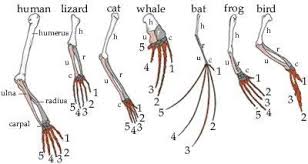
4.
What is this an example of?
a)
vestigial structures
b)
embryology
c)
homologous structures
d)
fossil record
5.
Which layer is the oldest?
a)
1
b)
2
c)
3
d)
4
6.
What is this an example of?
a)
diversity of species
b)
variation
c)
vestigial structures
d)
DNA studies
7.
Which term refers to the process by which individuals that are better suited to the environment survive and reproduce therefore passing down their genes to their offspring? 
a)
Evolution 
b)
Variation 
c)
Adaptation
d)
Natural Selection 
8.
The environment around Manchester, England, changed during the Industrial Revolution.  How did this change affect peppered moths living in the area?
a)
Natural selection favored moths with dark wings because predators could not see them on the soot-colored trees.
b)
Natural selection favored moths with white wings that were easy for predators to see.
c)
Natural selection favored moths with white wings because predators could not see them on the soot-colored trees.
d)
Natural selection caused moths with white wings to become extinct.
9.
Two organisms that are closely related would have
a)
very similar DNA sequence
b)
exactly the same DNA sequences
c)
no proteins in common
d)
completely different DNA sequence
10.
Why are advantageous traits more likely to be passed onto offspring?
a)
Because they are more likely to survive and reproduce.
b)
Because they come from dominant alleles.
c)
Because they come from recessive alleles.
d)
Because the trait is an acquired phenotype.
11.
What is the gradual development of a species into a new one to survive?
a)
Evolution
b)
Natural Selection
c)
Extinction
d)
Artificial Selection
12.
Lamarck thought that the differences in traits of organisms are a result of
a)
increases in population size.
b)
the actions of organisms as they change a body structure. 
c)
an unchanging local environment.
d)
the natural variations already present within the population of organisms.
13.
Charles Darwin called the ability of an organism to survive and reproduce in its specific environment 
a)
diversity.
b)
evolution.
c)
adaptation. 
d)
 fitness.
14.
Whose theory included "acquired traits" such as a giraffe needing a long neck so they stretch it over time?
a)
Darwin
b)
Lamarck
15.
Which scientist's theory would include
"acquired characteristics are inherited".
a)
Darwin 
b)
Lamarck
16.
Which scientist's theory would include
"organisms change due to need or want"?
a)
Darwin 
b)
Lamarck
17.
The graph to the right shows long periods of stability, followed by sudden change, this sounds like __________ evolution
a)
Gradualism
b)
Punctuated equillibrium
18.
The idea that living organisms are created from nonliving matter.
a)
Organic Evolution
b)
Chemical Evolution
c)
Spontaneous Generation
d)
Predictable Regeneration 
19.

Scientists attempted to determine the evolutionary relationships between three different finch species, A , B , and C . In order to do this, they examined the physical characteristics and DNA of these species. DNA was extracted from all three species and analyzed using gel electrophoresis. The results are shown in the diagram. Which statement best describes the method used above to determine the evolutionary relationships between three species of finches?

a)

Examine the structure of the beaks and compare them.

b)

Observe behavioral and physical characteristics of all the finches and group them by similarities.

c)

Obtain molecular evidence from all three species and identify similarities.

d)

Compare common ancestors of all three of the species to see if they are the same.

20.

A drug company has discovered an endangered plant that produces a chemical that might be used to cure cancer. A first step in developing this cancer cure could be to

a)

preserve the habitat where the species is found

b)

introduce a new plant species that will share the habitat of the plant

c)

eliminate every species that eats this plant

d)

harvest all of the plants of this species and use them to treat cancer patients

21.

A plant was discovered that contained a compound that was found to have potential medicinal value. However, the plant is rare, so it is important to see if a related plant might also produce the same compound. The chart shows some characteristics of the plant and four possible relatives. Which plant in the chart would be selected as most similar to the medicinal plant?

a)

A

b)

B

c)

C

d)

D

22.

Which chemicals are used to cut DNA into fragments for a gel electrophoresis procedure?

a)

molecular bases

b)

enzymes

c)

hormones

d)

ATP molecules

23.
Which of the following is used to cut DNA so it can be studied?
a)
Gel Electrophoresis
b)
Restriction Enzymes
c)
Karyotypes
d)
Haplotypes
24.
Which piece of DNA would move faster in gel electrophoresis?
a)
100 Base Pairs Long
b)
1000 Base Pairs Long
c)
5000 Base Pairs Long
d)
100,000 Base Pairs Long
25.
What is shown here?
a)
DNA Microarrays
b)
Virus Scans
c)
Recombinant DNA
d)
DNA Fingerprints
26.
Which Suspect Committed the crime?
a)
Suspect #1
b)
Suspect #2
c)
Suspect #3
d)
Suspect #4
27.
Which two bear species are most closely related?
a)
Bear 1 and Bear 2
b)
Bear 1 and Bear 3
c)
Bear 2 and Bear 3
d)
There’s no way to tell
28.
One function of gel electrophoresis is to
a)
separate DNA fragments
b)
cut DNA
c)
recombine DNA
d)
extract DNA
29.
The transfer of a gene from the DNA of one organism into another organism in order to produce an organism with desired traits.
a)
Genetic Engineering
b)
Karyotype
c)
Pedigree
d)
Genome
30.
Which of the following have been produced by selective breeding?
a)
horse breeds
b)
cat breeds
c)
dog breeds
d)
all of the above
31.
Which characteristic is necessary for natural selection to occur in a species? 
a)
stability 
b)
variation 
c)
complex cellular organization 
d)
a very low mutation rate 
32.
 Which two processes result in variations that commonly influence the evolution of sexually reproducing species? 
a)
mutation and genetic recombination 
b)
mitosis and natural selection 
c)
extinction and gene replacement 
d)
environmental selection and selective breeding 
33.
The different tools used during the beaks of finches lab represented 
a)
feeding adaptations in finches 
b)
nest construction adaptations 
c)
variations in seed size 
d)
variations in ecosystems 
34.
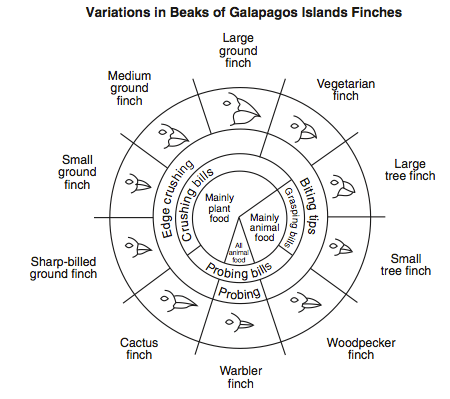
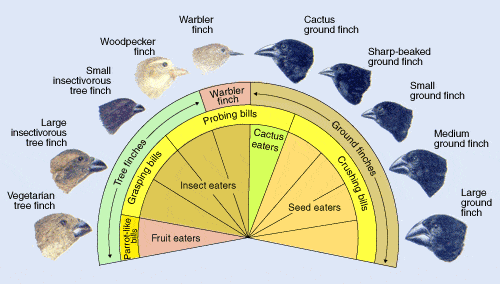
Base your answer(s) to the following question(s) 8. on the diagram below and on your knowledge of
biology.
Several of the Galapagos Islands are inhabited by grasshoppers, beetles, flies, bees, and butterflies. Finches that feed on these consumers would have beaks adapted for 
a)
probing, only 
b)
probing or grasping 
c)
crushing or probing 
d)
parrotlike feeding or grasping 
35.
All of these finches have different shaped beaks, they are an adaptation to gain access of 
a)
Water
b)
Food
c)
Shelter
36.
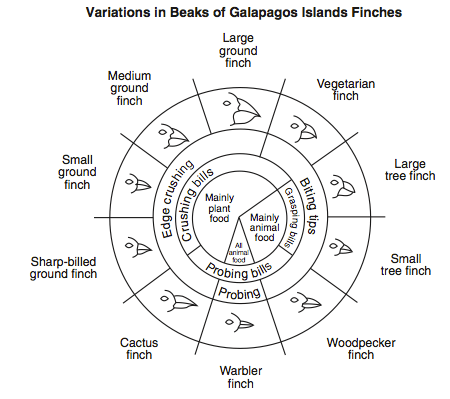
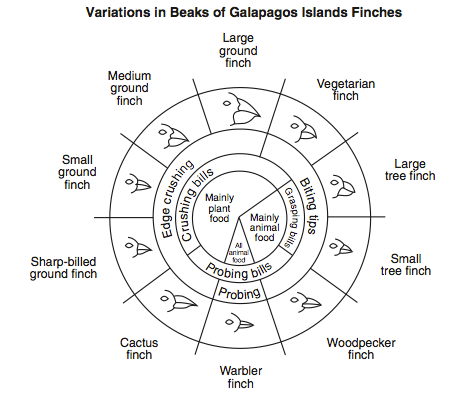
Base your answer(s) to the following question(s) on the diagram below and on your knowledge of biology.
Which two finches would compete the least for food? 
a)
small ground finch and large ground finch 
b)
large ground finch and sharp-billed ground finch 
c)
small tree finch and medium ground finch 
d)
vegetarian finch and small ground finch 
37.
Base your answer(s) to the following question(s) on the diagram below and your knowledge of biology.  Which species of finch has an edge-crushing bill that can also probe into plants for food? 
a)
cactus finch 
b)
sharp-billed ground finch 
c)
warbler finch 
d)
large ground finch 
38.

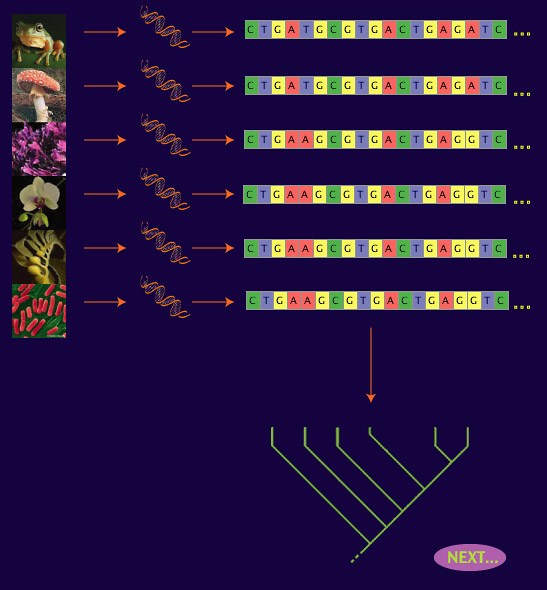
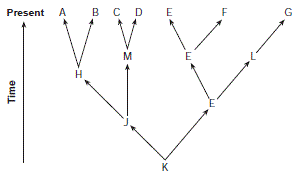
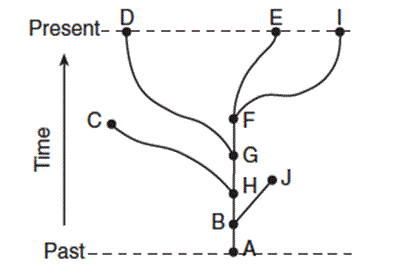
The diagram represents evolutionary pathways of seven groups of organisms alive today. Which two living species would be expected to have the most similar proteins?

a)

A and C

b)

B and C

c)

E and F

d)

H and M

39.

Which statement would most likely be correct, based on the information in the diagram?

a)

Species C had many variations and lived in a stable, unchanging environment.

b)

Species D, C, and J are extinct.

c)

Species F evolved from species D.

d)

Species J had little variation and lived in a changing environment.

40.
An organism that produces its own food supply from inorganic compounds is called a(an)
a)
heterotroph
b)
consumer
c)
detritivore
d)
autotroph
41.
What is the original source of almost all energy in most ecosystems?
a)
carbohydrates
b)
sunlight
c)
water
d)
carbon
42.
symbiotic relationship in which both organisms benefit
a)
competition
b)
Mutualism
c)
nitrogen fixation
d)
energy pyramid
43.
A living relationship between two species in which one organism is harmed is called...
a)
mutualism
b)
commensalism
c)
parasitism
d)
niche
44.
What does a food web represent?
a)
All connections of energy flow throughout all organisms in a habitat.
b)
The specific ways that mutualism is carried out.
c)
A single pathway or energy flow between organisms. 
d)
How carnivores get their food. 
45.

Which of the following would be the definition of a decomposer?

a)

Animals that eat insects.

b)

Organisms that feed on rocks, recycling the nutrients back into the ground.

c)

Organisms that eat only pants

d)

Things that feed on dead organisms, recycling the nutrients back into the ground.

46.
An illustration that uses arrows to show the many possible directions in which matter and energy can pass through the organisms in an ecosystem.
a)
Food chain
b)
Food web
c)
Energy Pyramid
d)
Succession Map
47.
The nonliving aspects of an ecosystem.
a)
Abiotic factors
b)
Biotic factors
48.
The living portions of the ecosystem.
a)
Biotic factors
b)
Abiotic factors
49.
A collection of organisms that belong to different populations but all live in the same area and interact with one another.
a)
Population
b)
Ecosystem
c)
Community
d)
Ecosphere
50.
A place where an organism lives.
a)
Terrain
b)
Habitat
c)
Community
d)
Population
51.
A collection of organisms that make up a community as well as all of the nonliving aspects of the environment.
a)
Population
b)
Community
c)
Habitat
d)
Ecosystem
52.
Organisms that can capture energy from inorganic, nonliving sources.
a)
Producers
b)
Consumers
c)
Detritivores
d)
Carnivores
53.
Organisms that feed on both living producers and other consumers.
a)
Carnivores
b)
Omnivores
c)
Herbivores
d)
Detritivores
54.
The general name for organisms like animals and fungi that get their energy from eating other organisms.
a)
Producers
b)
Consumers
c)
Detritivores
d)
Carnivores
55.
relationship in which two species live closely together
a)
resource
b)
mutualism
c)
succession
d)
symbiosis
56.
As you move upward, from level to level, in an energy pyramid, energy _____.
a)
increases
b)
decreases
c)
stays the same
d)
increases exponentially
57.
Sometimes a population cannot grow to its biotic potential due to environmental factors. What are these environmental factors called?
a)
limiting factors
b)
biomes
c)
ecological pyramids
d)
carrying capasity
58.
An organism's specific role in its habitat is called its
a)
consumer
b)
niche
c)
birth right 
d)
mutalism
59.
What is the carrying capacity of the following graph?
a)
1000
b)
8000
c)
800
d)
600
60.
When a population grows past the ecosystem's carrying capacity, what happens to the population?
a)
Continues to grow
b)
The population starts to die off to return to carrying capcity
c)
The population will go extinct due to lack of resources
d)
The population grows then finds a new carrying capacity
61.
The largest number of individuals in a species that an environment can support long term
a)
carrying capacity
b)
emigration
c)
immigration
d)
population density
62.

What are renewable resources?

a)

. Resources that are used faster than they form

b)

resources that can replenish themselves over time

c)

resources that formed over millions of years

d)

resources that exist only in rural areas

63.

Which level of the food chain is most affected by biomagnification?

a)

Producers

b)

primary consumers

c)

secondary consumers

d)

tertiary consumers

64.

What is global warming

a)

the normal temperature fluctuations of Earth's climate cycle

b)

the melting of the polar ice caps

c)

the trend of increasing temperatures on Earth

d)

the changes in Earth's biosphere that affect the atmosphere

65.

1. Why might an introduced animal species overrun native species in an ecosystem?

a)

. Its population size is smaller than those of native species.

b)

. It is more energy efficient, so it eats less food.

c)

It is a predator of the native species.

d)

It often has no natural enemies

66.
Many different types of organisms. 
a)
Pioneer species
b)
Community
c)
Biodiversity
d)
Population
67.
The first species to move into a forming ecosystem. Mosses and small grasses are examples. 
a)
Pioneer
b)
Opportunistic
c)
Climax community
d)
Primary
68.
Final stage of succession
a)
Climax community
b)
Terminal Community
c)
Secondary community
d)
End phase
69.
The process of change in the living parts of the ecosystem 
a)
ecological succession 
b)
primary succession 
c)
climax community
d)
pioneer species
70.
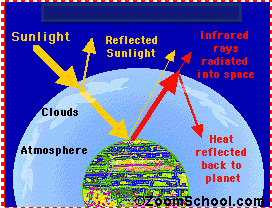
What does this diagram illustrate?
a)
Ozone Layer
b)
The Greenhouse Effect
c)
Ultraviolet Radiation
d)
Layers of the atmosphere
71.
This protects us from harmful UV rays from the sun
a)
Troposphere
b)
Stratosphere
c)
Greenhouse Effect
d)
Ozone Layer
72.
The scientific name for an organism is made from the:
a)
class and family name
b)
genus and species name
c)
domain and kingdom name
d)
kingdom and phylum name
73.
Term given to describe the 2 name naming system is:
a)
dichotmous key
b)
binomial nomenclature
c)
2 scientific names
d)
binomial key
74.
Cells that do not have a true nucleus are called....
a)
eukaryote
b)
prokaryote
c)
unicellular
d)
multicellular
75.
Cells that have a true nucleus are called....
a)
eukaryotes
b)
prokaryotes
c)
unicellular
d)
multicellular
76.
The science of describing, classifying, and naming living things is called:
a)
Geology
b)
Biology
c)
Taxonomy
d)
Chemistry
77.
An illustration and a dichotomous key are given. What is the correct classification for this organism?
a)
Class Insecta
b)
Order Amblygygi
c)
Order Araneae
d)
Order Scorpiones
78.

Which 2 organisms would be able to reproduce and produce fertile offspring?

a)

2 organisms in the same class

b)

2 organisms in the same family

c)

2 organisms in the same genus

d)

2 organisms in the same species

79.
The most general in the order of classification is?
a)
Kingdom 
b)
Phylum 
c)
Class 
d)
Order
80.
The most specific of the classifications is?
a)
class 
b)
order 
c)
genus 
d)
species
81.
Kingdom, Phylum, Class, _______
a)
Family 
b)
Order
c)
Genus 
d)
Species
82.
High biodiversity is 
a)
having a lot of the same organism.
b)
having a few of the same organism.
c)
having a lot of variety of different organisms.
d)
only having one of each organism. 
83.
Two organisms that are closely related would have
a)
very similar DNA sequence
b)
exactly the same DNA sequences
c)
no proteins in common
d)
completely different DNA sequence
84.
Protein sequences in one organism that resemble those of another suggest a 
a)
coincidence
b)
lack of evolutionary relationship
c)
great number of mutations
d)
shared ancestry
85.
If I wanted to look at DNA to study evolution, I am using what evidence?
a)
comparative anatomy
b)
embryology
c)
fossil record
d)
molecular
86.
Solution that shows the presence of certain substances
a)
Benedicts
b)
Lugols
c)
Indicator
d)
Solution
87.
The physical separation of mixtures into individual components is..
a)
chromatography
b)
opacity 
c)
latent
d)
trace evidence 
88.

Ink can be separated by a method of -----------------------------------------------

a)

distillation

b)

filtration

c)

chromatography

d)

sedimentation

89.

Evolution is best defined as:

a)

the process which organisms die.

b)

the process which organisms change over time.

c)

the process which organisms that are extinct become revived.

d)

the process which non-living things fossilize.

90.

What type of evidence is represented in the picture above:

a)

Fossils

b)

Vestigial Structures

c)

DNA

d)

Homologous Structures

91.

What type of evidence is shown in this picture?

a)

Fossils

b)

Homologous Structures

c)

Vestigial Structures

d)

DNA

92.

Adaptations are:

a)

physical or behavioral tendencies.

b)

physical or behavioral characteristics that help an organisms survive and reproduce.

c)

physical or behavioral characteristics that do not help the organism in any way.

d)

genetic mutations that have gone wrong.

93.
The diagram shows fossils in different rock layers. Which of these statements about the age of these fossils is most likely correct?
a)
Fossil A and C are the same age
b)
Fossil B is older than fossil C
c)
Fossils A is older than fossil B
d)
Fossil D is older than fossil C
94.
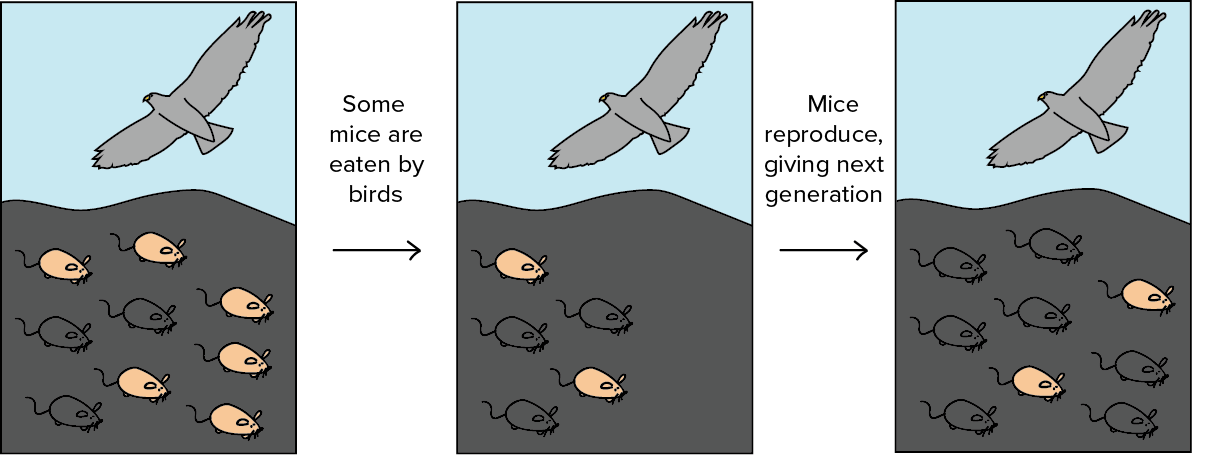
Why is the mouse population changing over time?
a)
The light mice can reproduce more successfully than the dark mice
b)
The hawks eat more dark mice than light mice because the dark mice taste better
c)
The hawks eat more light mice than dark mice because they can see the light mice more easily
d)
The hawks eat more dark mice than light mice because they can see the dark mice more easily
95.

Which scientist is known for his work that he did on the Galapagos Islands to develop his theory of natural selection?

a)

Gregor Mendel

b)

Charles Darwin

c)

Anton Van Leewenhoek

d)

Robert Brown

96.

The process by which two populations of the same species become so different that they can no longer interbreed.

a)

natural selection

b)

artificial selection

c)

speciation

d)

fossilization

97.
Choose which scientist corresponds best with the statement: 
use or disuse
a)
Darwin 
b)
Lamarck
98.
Choose which scientist corresponds best with the statement: 
acquired characteristics are inherited

a)
Darwin 
b)
Lamarck
99.
Mutations are important because they bring about
a)
death of the organism in which they develop
b)
genetic variation needed for a population to evolve
c)
benefits for the individual, not for the population
d)
Hardey-Weinberg equilibrium within a population
100.
What is the process in which humans breed organisms for certain traits?
a)
natural selection
b)
inheritance
c)
artificial selection
d)
descent withOUT modification