
 Worksheets
Earth Space Science Final
Total questions: 50
Worksheet time: 35mins
Name
Class
Date
1.
Air pressure is greatest:
a)
closer to Earth
b)
farther from Earth
2.
A severe storm that involves winds over 119mph and forms over water is:
a)
tornado
b)
thunderstorm
c)
hurricane
d)
blizzard
3.
The boundary between two air masses is known as:
a)
front
b)
storm
c)
climate
d)
flood
4.
When air contains as much moisture as possible at a specific temperature, it is:
a)
at its dew point
b)
saturated
c)
at its dew point AND saturated
d)
none of the rest
5.
Humidity is the...
a)
Amount of Water Vapor in the Air
b)
Amount of Wind in the Air
c)
Amount of Precipitation in the Air
d)
Amount of Pressure in the Air
6.
Because the earth is spinning on its axis, the global winds appear to curve. This is known as the __________ ________.
a)
Coriolis Effect
b)
Greenhouse Effect
c)
Climate Effect
d)
Atmosphere Effect
7.
Where is the ozone layer located?
a)
Thermosphere
b)
Troposphere
c)
Stratosphere
d)
Mesosphere
8.
What measures temperature?
a)
barometer
b)
anemometer
c)
thermometer
d)
psychrometer
9.

What type of cloud looks like cotton and is in the lower altitudes?
a)
Cumulus
b)
Stratus
c)
Cirrus
10.
Hurricanes form when
a)
A cold front meets a warm front
b)
updrafts in a thunderstorm rotate
c)
warm, moist air rises over an ocean
d)
air pressure explodes
11.
What is the ISS?
a)
International Student Services
b)
Inside Sun Secrets
c)
International Space Station
d)
Iraq Space Services
12.
Instrument that travels into the solar system, gathers information and sends it back to Earth
a)
Space shuttle
b)
Rocket
c)
Space ship
d)
Space probe
13.
Which space equipment transports humans into space from Earth?
a)
space shuttle
b)
space prove
c)
satellite
14.
What object is launched into orbit and designed to send and receive information?
a)
rover
b)
satellite
c)
space shuttle
15.
Which were the first to walk on the moon?
a)
Buzz Lightyear and Woody
b)
Alan Shepard and Sally Ride
c)
Buzz Aldrin and Neil Armstrong
d)
John Glenn and Yuri Gargarin
16.
A vehicle designed to propel itself by ejecting exhaust gas from one end
a)
shuttle
b)
rocket
c)
satellite
d)
probe
17.
what was the first creature in space
a)
a dog
b)
a human
c)
a hamster
d)
monkey
18.
What country was the first to put a man into space?
a)
USA
b)
Canada
c)
Russia
d)
England
19.
What was the name of the first satellite to orbit Earth?
a)
Sputnik
b)
Skylab
c)
Challenger
d)
Curiosity
20.
Type of optical telescope that uses convex lenses
a)
Reflecting
b)
Orbital
c)
Refracting
d)
Magnifying
21.
What do ocean currents carry that MOST affects climates?
a)
heat
b)
fish
c)
ships
d)
salt
22.
Which movement of ocean water is caused by the Moon?
a)
waves
b)
tides
c)
shallow currents
d)
deep currents
23.
The amount of space an object takes up.
a)
wave
b)
area
c)
volume
d)
ocean
24.
The process of removing salt from sea water.
a)
desaliniation
b)
salinity
c)
ocean water
d)
purification
25.
The repeated rise and fall in the level of the ocean.
a)
tide
b)
tide pool
c)
wave
26.
What is the deepest part of the ocean?
a)
continental shelf
b)
abyssal plain
c)
trench
d)
tidal wave
27.
Which gas in our atmosphere is most abundant?
a)
Argon
b)
Oxygen
c)
Nitrogen
d)
Carbon Dioxide
28.
The air in the troposphere has a greater density than the air in any other layer of the atmosphere,
a)
True
b)
False
29.
Temperature in the stratosphere warms as altitude increases.
a)
True
b)
False
30.
What percentage of our atmosphere is made up of other gases such as argon, water vapor, and carbon dioxide?
a)
1%
b)
21%
c)
78%
d)
90%
31.
What is the percentage of oxygen in Earth's atmosphere?
a)
1%
b)
21%
c)
78%
d)
90%
32.
What is the percentage of nitrogen in Earth's atmosphere?
a)
1%
b)
21%
c)
78%
d)
90%
33.
Which layer of the atmosphere contains the greatest amount of water vapor?
a)
Thermosphere
b)
Troposphere
c)
Mesosphere
d)
Stratosphere
34.
In which layer of the atmosphere does weather occur?
a)
Mesosphere
b)
Thermosphere
c)
Stratosphere
d)
Troposphere
35.
What is the outer most main layer of Earth's atmosphere?
a)
Thermosphere
b)
Troposphere
c)
Stratosphere
d)
Mesosphere
36.
The type of plate boundary where two plates come together is a .....
a)
Convergent Boundary
b)
Divergent Boundary
c)
Transform Boundary
d)
Plate Boundary
37.
Which of the following causes Earth's tectonic plates to move?
a)
Energy from the Sun
b)
Magnetic Pole Reversal
c)
Convection currents in the mantle
d)
Faults in Mountain Ranges
38.

What type of plate boundary is this?
a)
Plate
b)
Divergent
c)
Convergent
d)
Transform
39.

What type of event will occur at this boundary?
a)
Earthquake
b)
Volcano Eruption
c)
Tornado
d)
Mountain Building
40.
A divergent boundary occurs when plates ....
a)
Pull apart
b)
Come together
c)
Slide past each other
d)
subducting
41.
Which of the following is the name of the ancient supercontinent formed 28 Million Years ago.
a)
Pangea
b)
Gondwanda
c)
Laurasia
d)
Neverland
42.
Which of the following is NOT evidence to support the theory of plate tectonics?
a)
Fossils
b)
Mountains
c)
Glaciers
d)
Sand Erosion
43.
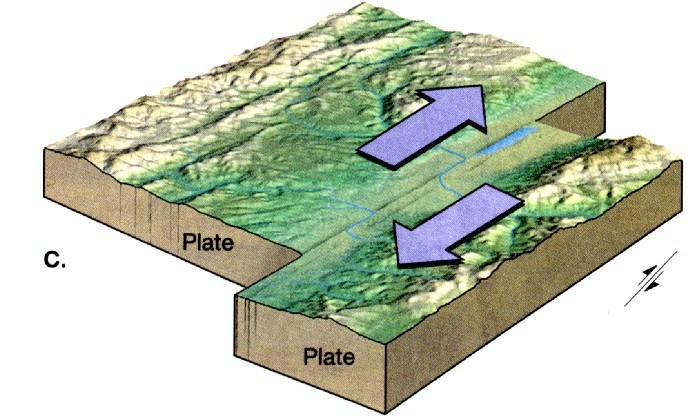
What type of plate boundary is this?
a)
Transform
b)
Convergent
c)
Divergent
d)
Plate
44.
The theory that says Earth's continents once made up an ancient supercontinent, and have been drifting apart ever since, is called the theory of...
a)
Pangea
b)
Plate Tectonics
c)
Natural Selection
d)
Gravity
45.
Oceanic Trenches are formed by _______ plate boundaries
a)
Convergent
b)
Transform
c)
Plate
d)
Divergent
46.
What are the two main factors that determine the climate of an area?
a)
precipitation and humidity
b)
temperature and air pressure
c)
wind conditions and humidity
d)
temperature and precipitation
47.
What causes winds to form on Earth?
a)
solar energy
b)
ocean currents
c)
elevation differences
d)
uneven heating of the Earth by the sun
48.
What are the 3 major climate zones in order from equator to the poles?
a)
polar, temperate, tropical
b)
tropical, temperate, polar
c)
temperate, polar, tropical
49.
What causes some areas of Earth to receive less intense solar energy than others?
a)
the mass of earth
b)
the curve of earth
c)
the density of earth
d)
the elevation of earth
50.
Which sentence best describes the relationship between elevation and air temperatures?
a)
LOWER elevation = COLDER temperatures
b)
HIGHER elevation = COLDER temperatures
c)
HIGHER elevations = WARMER temperatures
100 %

