wayground logo

Free Printable Worksheets

Font size

S
M
L
XL
Worksheets

Final Exam Review - Life Science Trimester 3

Total questions: 88

Worksheet time: 2hrs 31mins

Name
Class
Date
1.
Survival of the Fittest and Evolution were proposed by what scientist?
a)
Charles Darwin
b)
Albert Einstein
c)
Steven Hawking
d)
Isaac Newton
2.
Behavioral changes of individuals of a species that allow for better survival. (Acquired traits)
a)
Variation
b)
Adaptation
c)
Behavior
d)
Environment
3.
When every organism of a species has died.
a)
Evolution
b)
Natural Selection
c)
Extinction
d)
Artificial Selection
4.
Where the better adapted organisms survive to pass traits along to offspring.
a)
Evolution
b)
Natural Selection
c)
Extinction
d)
Artifical Selection
5.
What is the advantage of having different shaped beaks?
a)
To look different from other species.
b)
To be able to eat the food readily available in the environment.
c)
To protect itself against predators.
d)
To protect itself against prey.
6.
The theory of evolution by natural selection means that what is changing over time?
a)
The inherited traits of a population.
b)
The acquired traits of a population.
c)
Hair color and eye color
d)
Attractive features.
7.
Why are advantageous traits more likely to be passed onto offspring?
a)
Because they are more likely to survive and reproduce.
b)
Because they come from dominant alleles.
c)
Because they come from recessive alleles.
d)
Because the trait is an acquired phenotype.
8.
Mutations are a change in what?
a)
DNA
b)
tRNA
c)
genotype
d)
phenotype
9.
The gradual change in species over time is...
a)
Evolution
b)
Nucleotide 
c)
Adaptation
d)
Natural Selection
10.
To adjust to a changing environment
a)
Mutation
b)
Adapt
11.
Darwin wrote that organisms with traits that are best suited to the environment will ________________
a)
increase in number
b)
become extinct
12.
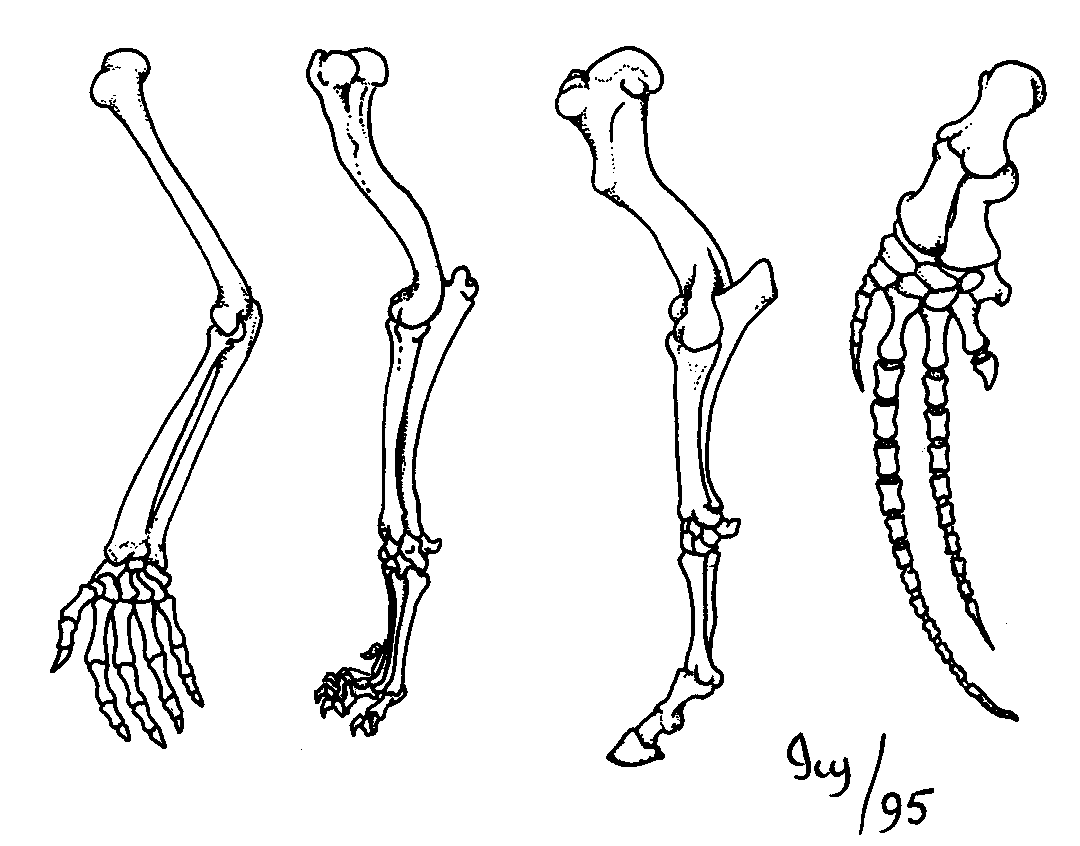
Structures with the same parts have different functions; suggests that organisms share a common ancestry
a)
vestigial structures
b)
homologous structures
c)
adaptive radiation
d)
fossil
13.
If an organism has a vestigial structure, that structure likely once had a function in a(n)
a)
close relative
b)
early ancestor
c)
unrelated organism
d)
embryological stage
14.
The process by which populations slowly change over time is called__________
a)
selective breeding
b)
adaptation
c)
sepeciation
d)
evolution
15.
Study of embryos of various organisms to show a common ancestor because of similarities in development
a)
natural selection
b)
embryology
c)
speciation
d)
evolution
16.
Two organisms that are closely related would have
a)
very similar DNA sequence
b)
exactly the same DNA sequences
c)
no proteins in common
d)
completely different DNA sequence
17.
If two organisms have similar traits of DNA they are probably
a)
share a common ancestor
b)
share a common environment
c)
share a common population
d)
speciation
18.
What does Darwin's theory of evolution suggest?
a)
species change over time
b)
extinct species are not related to living species
c)
different species can interbreed
d)
animals that look alike are most closely related
19.
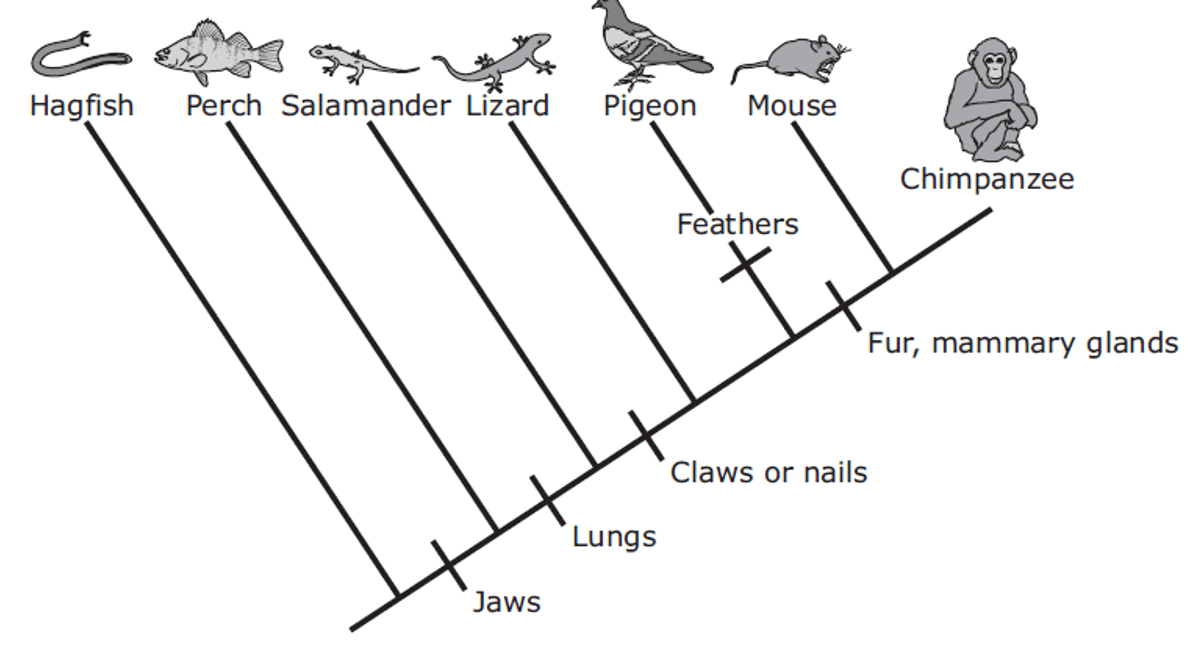
All the animals to the right of the hagfish would have the common characteristic of -
a)
Fur
b)
Claws or nails
c)
Lungs
d)
Jaws
20.
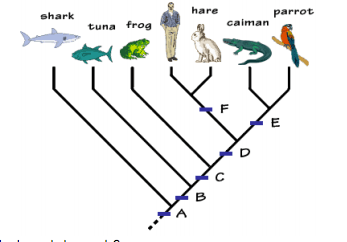
According to this cladogram, birds are LEAST related to -
a)
Amphibians
b)
Sharks
c)
Ray Finned Fish
d)
Crocodiles
21.
On the cladogram, which organism is the closest relative of the human?
a)
Frog
b)
Hare
c)
Caiman
d)
Parrot
22.
Individuals that are well adapted to their environment will survive and produce:
a)
Fewer mutations
b)
Stronger genes
c)
More offspring
d)
Better traits
23.
According to the cladogram, which organism is most distantly related to the human?
a)
crayfish
b)
rat
c)
perch
d)
frog
24.

This organism is Eukaryotic,

a)

Multicellular and Autotrophic

b)

Multicellular and Heterotrophic

c)

Unicellular and Autotrophic

d)

Unicellular and Heterotrophic

25.
What do viruses need to reproduce?
a)
they need genetic material
b)
They need a host cell
c)
They need  bacteria
d)
They need insulin
26.
How does a virus cause a person to develop the common cold?
a)
invades the host cell to reproduce
b)
removes energy from the host cell
c)
produces toxins in the host cell
d)
protects the host cell from bacteria
27.
Prokaryotes ___________ in that their cells.
a)
lack nucleus
b)
have membrane organelles
c)
have nucleus
d)
lack ncleic acids
28.
In this diagram the bacteria can move using it's ___________.
a)
psuedopod
b)
DNA
c)
flagella
d)
medusa hair
29.
Bacteria are used in
a)
farming
b)
the medical industry
c)
the food industry
d)
all of these
30.
Which are examples of fungi?
a)
mold
b)
yeast
c)
mushrooms
d)
all of the above
31.
Fungi are like animals because...
a)
they all reproduce sexually.
b)
they get their food from other organisms.
c)
they can move from one place to another.
d)
They are not like animals.
32.
What part of a fungus is described as long, thread-like structures that absorb nutrients?
a)
roots
b)
fruit body
c)
hyphae
d)
spores
33.
What part of a fungus is used for reproduction?
a)
spores
b)
flagellum
c)
cilia
d)
hyphae
34.
How can humans benefit from fungi?
a)
 Eats the bacteria in their yards.
b)
Makes pretty flower-like structures.
c)
Used dish soaps
d)
Used in antibiotics
35.

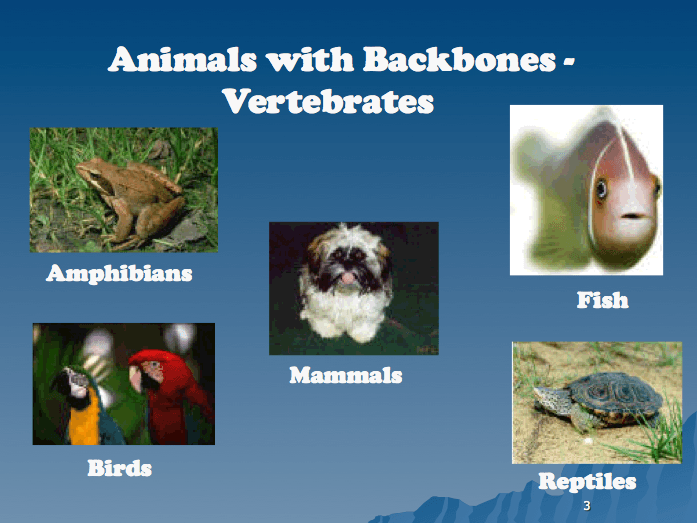
What does invertebrate mean?

a)

Animals without a backbone

b)

Animals that change their form

c)

Animals with a backbone

d)

Animals that lay eggs

36.

Which of the following is an invertebrate?

a)

Cat

b)

Snail

c)

Goldfish

d)

Humans

37.

A butterfly is a type of vertebrate.

a)

True

b)

False

38.
Why are sponges classified as animals
a)
they digest food
b)
they breathe through gills
c)
they use legs to move
d)
they have skeleton
39.

Which of these is not a major group of invertebrates?

a)

Fish

b)

Worms

c)

Mollusks

d)

Sponges

40.
A __________ is the simplest animal with a brain, nervous system, and blood in blood vessel.
a)
Sponge
b)
Worm
c)
Mollusk
d)
Cnidarian 
41.
One characteristic that invertebrates and vertebrates share is they both ___________.
a)
Are multicellular
b)
Are autotrophs
c)
Have a nerve cord
42.
What are vertebrates?
a)
Animals with a backbone
b)
Animals without a backbone
43.
There are five categories of vertebrates.  Which one is not a vertebrate?
a)
Mammals
b)
Birds
c)
Arthropods
d)
Reptiles
44.

Mammals are covered with....

a)

Sand

b)

Hair

c)

Feather

d)

Thorns

45.

What do mammals use to breathe with?

a)

Gills

b)

Skin

c)

Lungs

d)

Blood

46.

Animals that begin their life in the water and live on land are called...

a)

Birds

b)

Amphibians

c)

Mammals

d)

Reptiles

47.

What class do you belong in?

a)

Birds

b)

Mammals

c)

Reptile

d)

Amphibian

48.

How do fish breathe?

a)

Through their gills

b)

Through their skin

c)

Through their fins

d)

Through their feathers

49.
All vertebrates have an endoskeleton.
a)
true
b)
false
50.
Which group of vertebrates lay jelly like eggs?
a)
amphibian
b)
reptile
c)
bird
d)
mammal
51.
Fish are _______ blooded.
a)
cold
b)
warm
52.
Which system controls voluntary and involuntary movement?
a)
muscular
b)
skeletal
c)
immune
d)
excretory
53.
breaks down food into molecules the body can use
a)
skeletal
b)
digestive
c)
respiratory
d)
nervous
54.
Allows your body to move
a)
circulatroy
b)
nervous
c)
skeletal
d)
respiratory
55.
carries wastes products away from all cells in the body
a)
digestive
b)
circulatory
c)
respiratory
d)
nervous
56.
Which organ system includes these major organs: intestines, stomach, mouth
a)
integumentary
b)
respiratory
c)
digestive
d)
skeletal
57.
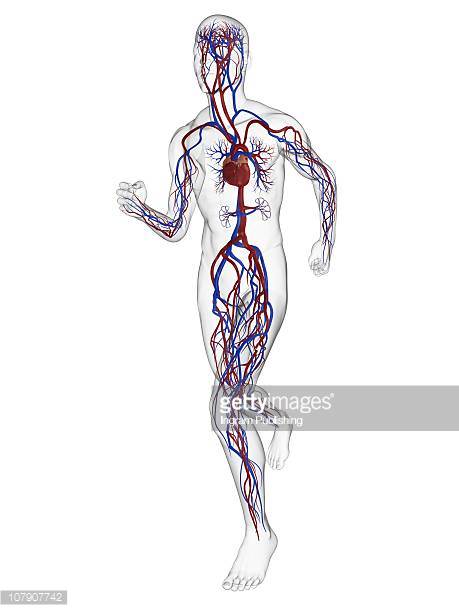
Which organ system includes these major organs: heart, blood vessels, and blood
a)
nervous
b)
digestive
c)
respiratory
d)
circulatory
58.
Which organ system includes these major organs: brain, spinal cord, and nerves
a)
nervous
b)
skeletal
c)
integumentary
d)
respiratory
59.
Which organ system includes these major organs: trachea, bronchi, and lungs
a)
circulatory
b)
skeletal
c)
digestive
d)
respiratory
60.
Which organ system includes these major organs: bones
a)
integumentary
b)
skeletal
c)
circulatory
d)
nervous
61.
Which organ system includes these major organs: hair, skin, and nails
a)
digestive
b)
circulatory
c)
integumentary
d)
skeletal
62.
Which of the following is NOT a part of the respiratory system?
a)
Windpipe
b)
Heart
c)
Lungs
d)
Nose
63.
Which of the following is NOT a part of the skeletal system?
a)
Muscles
b)
Backbone
c)
Ribcage
d)
Skull
64.
Which of the following is NOT a part of the digestive system?
a)
Gullet
b)
Small intestine
c)
Stomach
d)
Blood vessels
65.
Which system acts as a barrier against infection and UV radiation and helps regulate body temperature?
a)
integumentary
b)
muscular
c)
digestive
d)
circulatory
66.
This system fights pathogens (germs) and produces and stores white blood cells.
a)
immune
b)
muscular
c)
endocrine
d)
integumentary
67.
This system sends chemical messages (hormones) that regulate growth, development, and metabolism.
a)
endocrine
b)
nervous
c)
immune
d)
skeletal
68.
maintaining a stable internal environment
a)
diffusion
b)
osmosis
c)
cellular respiration
d)
homeostasis
69.

When vertebrates are in the early stages of development (an embryo) they all possess....

a)

gill slits and tails

b)

backbone and hands

c)

hands and feet

d)

tongue and mouth

70.

A clear fluid that helps the cornea keep its rounded shape

a)

aqueous humor

b)

blind spot

c)

cones

d)

cornea

71.

The place where all nerves from the retina join to form the optic nerve. Each eye has a _____ _____ where there are no light-sensitive cells

a)

aqueous humor

b)

blind spot

c)

cones

d)

cornea

72.

A tough, clear covering over the iris and the pupil that helps protect the eye. Light bends as it passes through the _______ The cornea begins bending light to make an image; the lens finishes the job.

a)

aqueous humor

b)

blind spot

c)

cones

d)

cornea

73.

A muscle that controls how much light enters the eye. It is suspended between the cornea and the lens. Human ________ come in many colors, including brown, blue, green, and gray.

a)

iris

b)

lens

c)

myelin

d)

optic nerve

74.

The bundle of nerve fibers that carry information from the retina to the brain.

a)

iris

b)

lens

c)

myelin

d)

optic nerve

75.

The _________ is the dark circle in the center of your iris. It’s a hole that lets light into the inner eye.

a)

pupil

b)

retina

c)

rods

d)

sclera

76.
Do reptiles have gills?
a)
Yes
b)
No
c)
Some do, some do not
77.
Which do sea turtles breathe with?
a)
Lungs
b)
Gills
c)
Spiracles
78.

What is the main organ of the circulatory system?

a)

small intestine

b)

bone

c)

lungs

d)

heart

79.

Arteries carry oxygen rich blood away from the heart.

a)

True

b)

False

80.

Veins carry oxygen poor blood back to the heart.

a)

False

b)

True

81.

The job of the heart is to . . .

a)

pump blood around the body.

b)

send food to the small intestines.

c)

break down food.

d)

give energy to the body.

82.

The skeleton has 5 major functions. Which one below is NOT one of them?

a)

moves oxygen to the body

b)

provide shape and support

c)

enable you to move

d)

protect your organs

83.

Bone has 3 characteristics:

a)

bone tissue, blood vessels, and nerves

b)

strength, growth, and development

c)

compact, spongy, and marrow

84.

A place where two bones come together is called a ...

a)

hinge

b)

ligament

c)

tendon

d)

joint

85.
If the environment gets cold, we will often shiver in order to:
a)
keep body temperature the same as the external temperature
b)
decrease body temperature
c)
increase body temperature
d)
regulate blood pressure
86.
The maintenance of an organism’s internal environment is called:
a)
compensating
b)
homeostasis
c)
balancing
d)
routine
87.
a body system that controls and coordinates all body activities through electric impulses/messages between brain, spinal cord and nerves.
a)
endocrine system 
b)
nervous system
c)
nerve
d)
neuron
88.
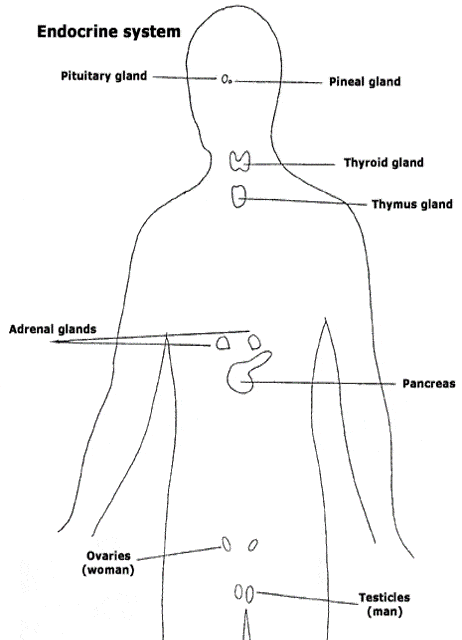
a body system that controls growth and homeostasis by secreting hormones from glands.
a)
skeletal system
b)
nervous system
c)
endocrine sytem
d)
integumentary system