
 Worksheets
Benchmark Review Quarters 1-3
Total questions: 89
Worksheet time: 1hrs 11mins
Name
Class
Date
1.
The Modern Periodic Table of Elements is arranged by
a)
atomic mass
b)
atomic number
c)
valence electrons
d)
number of isotopes
2.
The atomic number tells you what? READ THE ANSWERS CAREFULLY
a)
only the number of electrons
b)
only the number of protons
c)
only the number of neutrons
d)
the number of both electrons and protons in an atom.
3.
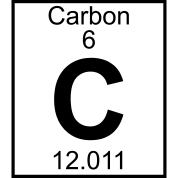
What does the 6 represent?
a)
atomic mass
b)
atomic number
c)
element name
d)
chemical symbol
4.

Water is heated and changed to steam.
a)
Chemical Change
b)
Physical Change
5.

Iron rusts.
a)
Chemical change
b)
Physical Change
6.
When placed in H20, a sodium pellet catches on fire as hydrogen gas is liberated and sodium hydroxide forms.
a)
Chemical Change
b)
Physical Change
7.
Evaporation
a)
Chemical Change
b)
Physical Change
8.

Ice Melting
a)
Chemical Change
b)
Physical Change
9.

Milk Sours
a)
Chemical Change
b)
Physical Change
10.
Sugar dissolves in water
a)
Chemical Change
b)
Physical Change
11.

Type of mixture that has the SAME COMPOSITION in every part.
a)
Homogenous
b)
Heterogeneous
12.

Type of mixture that DOESN'T HAVE the same composition in every part.
a)
Homogeneous
b)
Heterogeneous
13.

Chocolate milk is an example of a
a)
homogeneous mixture
b)
heterogeneous mixture
14.

Chicken noodle soup is an example of a
a)
homogeneous mixture
b)
heterogeneous mixture
15.
The phase of matter that has definite shape and definite volume is:
a)
solid.
b)
liquid.
c)
gas.
d)
plasma.
16.
What state of matter has the slowest moving particles?
a)
solid
b)
liquid
c)
gas
17.
Volume of a gas ____________ with increased temperature.
a)
decreases
b)
increases
c)
stays the same
18.
For example, if you increase the temperature of a gas inside a balloon, the balloon will....
[pressure is constant (k)]
[pressure is constant (k)]
a)
Expand (increase in volume)
b)
Deflate (decrease in volume)
19.
When the temperature is constant (k) inside a balloon, if you add pressure on it, the volume will .....
a)
Decrease
b)
Increase
c)
Not Change at all
d)
Particles will solidify
20.
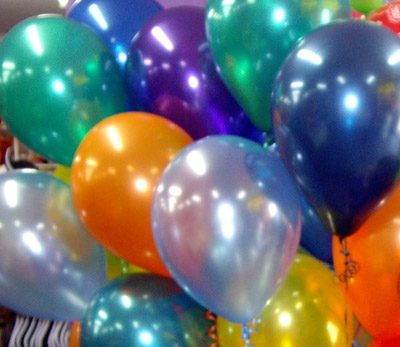
If a balloon is cooled what will happen to the volume?
a)
Volume will increase
b)
Volume will decrease
c)
Volume will not change
21.

Which process does the diagram show?
a)
freezing
b)
boiling
c)
evaporation
d)
melting
22.
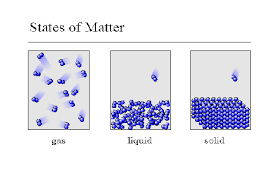
At higher temperatures
a)
particles in an object have less energy
b)
particles in an object move faster
c)
a gas contracts
23.
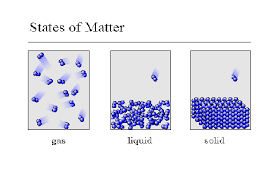
A gas
a)
has a definite shape but no definite volume
b)
has a definite volume but no definite shape
c)
has fast-moving particles
24.

a. The steam makes Mom’s kitchen window look cloudy. What is happening?
a)
evaportation
b)
solid
c)
winter
d)
condensation
25.
Particles of a liquid
a)
are tightly packed together and stay in a fixed position.
b)
have no viscosity.
c)
decrease in volume with increasing temperature.
d)
are free to move around one another but still touch.
26.
Particles (molecules) in a ______________________ have more energy than the other states of matter.
a)
gas
b)
solid
c)
liquid
27.
The state of matter that has no definite size or shape is
a)
Solid
b)
Liquid
c)
Gas
28.
Matter can not be created nor destroyed: it can only be
a)
Destroyed a little bit
b)
Invisible
c)
Transformed, changed
d)
None of the above
29.
The number to the lower side of an element is a
a)
Subscript
b)
Superscript
c)
Coefficient
d)
Charge
30.
The number in front of a compound or element is a
a)
Subscript
b)
Coefficient
c)
Superscript
d)
Charge
31.
A chemical reaction is balanced when
a)
both sides have the same elements
b)
Both sides have the same number of atoms
c)
Same subscripts
d)
Same coefficients
32.
Which of these is not a chemical reaction?
a)
Burning of wood
b)
Milk going bad
c)
Mixing vinegar and baking soda
d)
Melting of ice
33.
Is this equation balanced or unbalanced?
2Fe2O3 + 3C --> 4Fe + 3 CO2
2Fe2O3 + 3C --> 4Fe + 3 CO2
a)
balanced
b)
unbalanced
34.
Which Chemical Equation is Balanced?
a)
CH₄+O₂------CO₂+2H₂O
b)
H₂+O₂-----2H₂O₄
c)
4Al+3O₂-----2Al₂O₃
35.
The "power plant" of the cell that produces energy.
a)
Mitochondria
b)
Cytoplasm
c)
Centrioles
d)
Lysosomes
36.
The brain or "control center" of the cell.
a)
Mitochondria
b)
Cell Membrane
c)
Cytoplasm
d)
Nucleus
37.

What is the function of a chloroplast?
a)
makes proteins for animal cells
b)
allows materials in and out of the cell
c)
provides structure and support
d)
absorbs sunlight for photosynthesis
38.
In which case would a cell most likely shrink?
a)
when placed in a solution containing a high salt concentration
b)
when placed in a isotonic solution
c)
when placed in a solution containing a low pH
d)
when placed in a solution containing distilled water
39.
A student noticed that placing wilted lettuce in a bowl of cool water caused the lettuce to become more crisp and firm. What is the best explanation for his observation?
a)
Water moved into the lettuce cells by active transport.
b)
Water moved into the lettuce cells by osmosis.
c)
Salt moved into the lettuce cells by diffusion.
d)
Water moved out of the lettuce cells by osmosis.
40.
Diffusion and Osmosis are examples of...
a)
Active Transport
b)
Passive Transport
41.
Major organs of the digestive system
a)
Kidneys, nephrons
b)
Stomach, intestines, mouth
c)
Heart, blood vessels, blood
d)
Liver, kidneys, heart
42.
Major organs of the nervous system
a)
Kidneys, nephrons
b)
Stomach, intestines, mouth
c)
Heart, blood vessels, blood
d)
Brain, spinal cord, nerve
43.
Heart, blood vessels, blood
a)
Digestive system
b)
Excretory system
c)
Circulatory system
d)
Immune system
44.
This system provides the body with support, shape, and it helps to protect vital organs.
a)
nervous
b)
unrinary
c)
skeletal
d)
muscular
45.

In mitosis, the two resulting cells are
a)
different from the starting cell and identical to each other.
b)
different from the starting cell and different from each other.
c)
identical to the starting cell and different from each other.
d)
identical to the starting cell and identical to each other.
46.
After meiosis is complete, the new cells:
a)
are all identical
b)
are all different
c)
are half identical and half different
d)
are all stretched out
47.
How many daughter cells are produced from meiosis ?
a)
10
b)
6
c)
4
d)
2
48.
During which phase of the meiotic cell cycle does DNA Replication occur?
a)
Interphase
b)
Prophase
c)
Metaphase
d)
Telophase
49.

The stages of mitosis in order
a)
Metaphase, Anaphase, Prophase, Telophase
b)
Prophase, Anaphase, Metaphase, Telophase
c)
Prophase, Metaphase, Anaphase, Telophase
d)
Anaphase, Prophase, Telophase, Metaphase
50.

a)
budding
b)
sporulation
c)
vegetative propagation
d)
binary fission
51.

a)
budding
b)
binary fission
c)
sporulation
d)
regeneration
52.
All Offspring of Asexual reproduction are identical
a)
True
b)
False
53.

Which kingdoms are prokaryotic?
a)
Archaebacteria and Animalia
b)
Eubacteria and Archaebacteria
c)
Fungi and Protista
d)
Plantae and Eubacteria
54.

This domain is characterized by bacteria that can live in extreme environments, such as hot springs.
a)
Archaea
b)
Bacteria
c)
Eukarya
d)
Prokarya
55.

In which kingdom do I belong if I am unicellular, autotrophic, and eukaryotic?
a)
Archaebacteria
b)
Protista
c)
Animalia
d)
Plantae
56.
All of the following have a nucleus except...
a)
Eubacteria
b)
Animalia
c)
Plantae
d)
Protista
57.
Protists and bacteria do not belong in the same kingdom because--
a)
Protists have a nucleus; bacteria do not.
b)
Protists eat bacteria.
c)
Bacteria are not made of cells.
d)
Protists are heterotrophic; bacteria are autotrophic.
58.
Which of the following is the correct order of organization in living things from most basic (simple) to most complex?
a)
a. Organism, cell, tissue, organ, organ system
b)
a. Organ system, organ, tissue, cell, organism
c)
a. Cell, tissue, organ, organ system, organism
d)
a. Cell, organ, tissue, organ, organism, organ system
59.
A group of similar cells that come together to perform a specific function is a/an
a)
organ
b)
organism
c)
organ system
d)
tissue
60.
When a group of organs work together to perform a particular function they create a/an
a)
organ system
b)
organism
c)
tissue
d)
organ
61.

Which item on this element square is the chemical symbol?
a)
Copper
b)
29
c)
Cu
d)
63.546
62.

Which item on this element square represents the atomic number?
a)
13
b)
Al
c)
Aluminum
d)
26.981538
63.
Heterozygous is when...
a)
the alleles are the same
b)
the alleles are different
c)
the alleles are absent
d)
the alleles are present
64.
In a heterozygous genotype, the ___________ allele takes over in the phenotype.
a)
recessive
b)
dominant
c)
lower case letter
d)
both
65.

B = brown fur b = white fur
In the punnett square, what is the probability for white fur?
In the punnett square, what is the probability for white fur?
a)
0%
b)
25%
c)
50%
d)
75%
66.
Which of the following alleles is homozygous (purebred) recessive?
a)
Tt
b)
tt
c)
TT
d)
t
67.
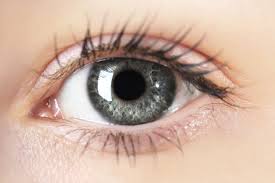
What you see, or the physical appearance.
a)
Genotype
b)
Phenotype
c)
Homozygous
d)
Heterozygous
68.

Genotype refers to the ...
a)
physical expression of the genes
b)
the possible combination of alleles in a gene
c)
whether an allele is dominant or recessive
d)
how an organism will appear
69.
Discovered the nucleus of the atom through the Gold Foil Experiment
a)
Rutherford
b)
Chadwick
c)
Thomson
d)
Dalton
70.
Created the Planetary Model of the atom
a)
Bohr
b)
Dalton
c)
Rutherford
d)
Chadwick
71.

What scientist is best known for his "Plum Pudding" model of the atom?
a)
J.J. Thomson
b)
Ernest Rutherford
c)
John Dalton
d)
Democritus
72.

What contribution did John Dalton make to atomic theory?
a)
He discovered that every atom was positively charged.
b)
He discovered that every element consisted of one type of atom that couldn't be divided.
c)
He discovered that atoms had nuclei.
d)
He discovered that atoms could be divided into smaller parts.
73.

Place the following scientists in order, from earliest to latest:
Rutherford, Dalton, Bohr, Thomson
Rutherford, Dalton, Bohr, Thomson
a)
Dalton, Rutherford, Bohr, Thomson
b)
Thomson, Dalton, Rutherford, Bohr
c)
Dalton, Thomson, Rutherford, Bohr
d)
Bohr, Dalton, Rutherford, Thomson
74.
Place the following scientists in order, from earliest to latest:
Rutherford, Dalton, Bohr, Thomson
Rutherford, Dalton, Bohr, Thomson
a)
Dalton, Rutherford, Bohr, Thomson
b)
Thomson, Dalton, Rutherford, Bohr
c)
Dalton, Thomson, Rutherford, Bohr
d)
Bohr, Dalton, Rutherford, Thomson
75.

a)
Physical Change
b)
Chemical Change
76.

a)
Physical Change
b)
Chemical Change
77.

Burning wood
a)
physical change
b)
chemical change
78.

Identify the Reactants in this equation.
a)
A
b)
B
79.
In the chemical equation H2O2(ag) → H2O(l) + O2(g), the O2 is a
a)
reactants
b)
yield
c)
products
d)
solid
80.
During osmosis
a)
water moves from high to low concentration
b)
large or oddly shaped molecules move across a cell membrane
c)
water moves when energy is used
d)
proteins are built
81.
Most elements on the periodic table are classified as ____________.
a)
Gases
b)
Metalloids
c)
Metals
d)
Nonmetals
82.

The atoms along the stair step or zig-zag line are called
a)
metals
b)
nonmetals
c)
metalloids
d)
noble gases
83.

What state of matter is X?
a)
solid
b)
liquid
c)
gas
d)
supercritical fluid
84.
What state of matter is Y?
a)
solid
b)
liquid
c)
gas
d)
supercritical fluid
85.
What state of matter is Z?
a)
solid
b)
liquid
c)
gas
d)
supercritical fluid
86.
What change occurs from F to E?
a)
sublimation
b)
deposition
c)
melting
d)
condensation
87.
Two new nuclei form and the cytoplasm splits
a)
Metaphase
b)
Telophase
c)
Anaphase
d)
Prophase
88.

What phase of mitosis is shown in the picture?
a)
Prophase
b)
Anaphase
c)
Telophase
d)
Metaphase
89.

What phase of mitosis is shown in the picture?
a)
Prophase
b)
Anaphase
c)
Telophase
d)
Metaphase
100 %

