wayground logo

Free Printable Worksheets

Font size

S
M
L
XL
Worksheets

Natural Selection and Adaptations

Total questions: 85

Worksheet time: 1hrs 12mins

Name
Class
Date
1.
An organism that hunts and feeds on another organism is a ______________________.
a)
prey
b)
producer
c)
predator
d)
decomposer
2.
An animal that is hunted as food
a)
prey
b)
predator
c)
decomposer
d)
producer
3.
An inherited trait that helps those organisms that have it to survive
a)
niche
b)
structure
c)
characteristic
d)
adaptation
4.
Coloring or another physical characteristic that help an organism blend in with its environment
a)
mimicry
b)
camouflage
c)
hibernation
d)
migration
5.
The role an organism plays in its ecosystem
a)
niche
b)
behavior
c)
structure
d)
function
6.
When an organism copies a characteristic of something else in order to better its chances for survival and reproduction
a)
hibernation
b)
camouflage
c)
mimicry
d)
migration
7.
The seasonal movement of an organism from one place to another
a)
camouflage
b)
migration
c)
hibernation
d)
function
8.
When an organism slows its life functions for a period of time to better its chances for survival during harsh conditions
a)
camouflage
b)
migration
c)
mimicry
d)
hibernation
9.
The place or environment where an organism naturally lives
a)
function
b)
habitat
c)
community
d)
ecosystem
10.
A group of organisms of the same species
a)
ecosystem
b)
community
c)
population
d)
group
11.
All the populations in a specific area or region
a)
community
b)
ecosystem
c)
population
d)
species
12.
Occurring in the night
a)
logical
b)
structural
c)
function
d)
nocturnal
13.
Survival of the Fittest and Evolution were proposed by what scientist?
a)
Charles Darwin
b)
Albert Einstein
c)
Steven Hawking
d)
Isaac Newton
14.

What word describes a trait that helps an organism survive in its environment?

a)

natural selection

b)

mutation

c)

camouflage

d)

adaptation

15.
The differences among a species, like different bird beaks, are called
a)
genes.
b)
variations.
c)
traits.
d)
theories.
16.
A change in DNA.
a)
Competition
b)
Mutation
c)
Species
d)
Fitness
17.
Organisms with the most beneficial traits will survive.  This is commonly known as ___.
a)
theory of evolution
b)
variations
c)
survival of the fittest
d)
ecosystems
18.
Mutations are a change in what?
a)
DNA
b)
tRNA
c)
genotype
d)
phenotype
19.
Occurs when a population of organisms cannot adapt quickly enough to environmental changes.
a)
Evolution
b)
Adaptation
c)
Selective Pressure
d)
Extinction  
20.
Why are advantageous traits more likely to be passed onto offspring?
a)
Because they are more likely to survive and reproduce.
b)
Because they come from dominant alleles.
c)
Because they come from recessive alleles.
d)
Because the trait is an acquired phenotype.
21.

Hollow, light weight bones is an adaptation that...

a)

is an internal structure that helps birds fly

b)

is an external structure that helps birds fly

c)

disables birds ability to fly

d)

helps birds walk

22.

Adaptation is

a)

the process that makes an organism look better

b)

the process in which weak organisms are killed off

c)

the process in which an organism becomes better adapted to its environment

d)

the process in which oxygen is transformed into glucose

23.

Breeding means

a)

Asexual reproduction that results in offspring

b)

Sexual reproduction that results in offspring

c)

Copying of genetic material in the nucleus

d)

To produce offspring with unfavorable traits

24.

The purpose of gills on a fish is to

a)

Take in nitrogen from the water

b)

Help fish avoid predators

c)

Take in hydrogen from the water

d)

Take in oxygen from the water

25.

The squirrel in the picture is using an adaptation called

a)

camouflage

b)

hibernation

c)

migration

d)

retention

26.

An example of stuctural/physical adaptation is...

a)

blood type

b)

bioluminescence

c)

camouflage

d)

migration

27.

Plants have a structure that allow them to transport water from the roots to the leaves

a)

Phloem

b)

Xylem

c)

Stem

d)

Soot

28.

A plant bulb allows

a)

the plant to store more glucose

b)

the plant to store more water

c)

Both of the above

d)

to collect more soil

29.

Which one is selective breeding

a)

genetic mutations in a rabbit that gives it more fur

b)

a cutie orange

c)

two deer mating

d)

none of the above

30.

Breeding two cows to produce more milk and meat is natural selection

a)

true

b)

false

31.
Use the dichotomous key to identify fish x
a)
trumpet fish
b)
spotted eagle ray
c)
spotted goat fish
d)
glass eye snapper
32.
Use the dichotomous key to identify fish w
a)
trumpet fish
b)
spotted eagle ray
c)
spotted goat fish
d)
glass eye snapper
33.
Use the dichotomous key to identify fish y
a)
trumpet fish
b)
spotted eagle ray
c)
spotted goat fish
d)
glass eye snapper
34.
Use the dichotomous key to identify fish z
a)
trumpet fish
b)
spotted eagle ray
c)
spotted goat fish
d)
glass eye snapper
35.
The rat snake is found in a wide array of environments. They are found in woods, along the coast, in cities, and in mountains. They eat rats, birds, mice, and squirrels. Rat snake populations in these different environments often have varied colors and markings. There are gray ones, yellow ones, black ones, and mixes of these colors, depending on where they live. Which of the following best explains the differences in colors and markings of the rat snake?
a)
Rat snakes can choose to change their coloring to match the environment theyare in to avoid predators and catch prey more easily.
b)
Rat snakes with coloring and markings that helped them blend into their uniqueenvironment avoided predators and survived to reproduce.
c)
Rat snakes began eating different types of food depending on where they live.This changed their appearance over time.
d)
The variation in the coloring and marking of rat snake populations is so that ratsnakes can recognize other rat snakes that live in the same area.
36.
How can migration enhance the survival of organisms?
a)
Migration causes adaptations to occur more frequently.
b)
Migration helps organisms to avoid predators.
c)
Migration requires organisms to exert a lot of energy.
d)
Migration makes finding necessary resources more likely.
37.
Over time, honey suckle flowers developed a sweet smell to attract pollinators. This is and example of _________
a)
selective breeding
b)
dichotomous key
c)
natural selection
d)
extinction
38.
Over time, corn plants are bred to make larger corn cobs and kernels. This is and example of _________.
a)
selective breeding
b)
dichotomous key
c)
natural selection
d)
extinction
39.
How might pockets of air in a bird's bones allow it to fly?
a)
They keep the bird very light.
b)
They produce helium for lift.
c)
They allow the birds to absorb more oxygen.
d)
They allow wind to flow through their bones.
40.
Some species of birds are very similar. Each species lives on different island. Which of the following is the best explanation for why one species has a longer beak than the others?
a)
They need a longer beak for defending itself against predators.
b)
They originated from a different type of bird than the other species.
c)
The longer beak is an adaptation to the food available in the bird’s habitat.
d)
The beak stretched to reach its food and the longer beak was passed down to its offspring.
41.
How can farmers best use selective breeding to increase apple production?
a)
By increasing the amount of water and fertilizer the trees receive.
b)
By choosing trees that are the largest in size.
c)
By choosing trees that consistently have the most apples.
d)
By limiting the number of trees growing so they have more space.
42.
This is an example of....
a)
Dieting 
b)
Evolution 
c)
Selective Breeding 
d)
Adaptation 
43.
What is a characteristic that helps an organism survive and reproduce in its environment? 
a)
Selective Breeding 
b)
Adaptation 
c)
Evolution 
d)
Fossils 
44.
What does this image represent? 
a)
Evolution 
b)
Natural Selection 
c)
Lunch 
d)
Selective Breeding 
45.
What provided information on the history of life? 
a)
Fossils 
b)
Speciation 
c)
Adaptation 
d)
Evaluation 
46.
Which is not an adaptation of a polar bear? 
a)
White fur 
b)
Large Feet 
c)
Thin Layer of fat 
d)
Strong Swimmer 
47.
The process by which organisms with favorable traits survive and reproduce at a higher rate
a)
Natural Selection 
b)
Adaptation 
c)
Evolution 
d)
Speciation 
48.
This is an example of....
a)
Evolution 
b)
Adaptation 
c)
Desert 
d)
Natural Selection 
49.
The white feathers of a snowy owl allow it to blend in with its environment during the winter months (snow). This is an example of ________________
a)
Species
b)
Environmental Change
c)
Adaptation
d)
Variation
50.

Which of these is the most likely descendant of an organism that had large canine teeth for biting, powerful muscles for running and stalking prey, and a long tail for balance?

a)

a lobster

b)

a gazelle

c)

a mallard duck

d)

a house cat

51.
Any inherited trait that gives an organism an advantage in its environment is called ___.
a)
a mutation
b)
an adaptation
c)
evolution
d)
natural selection
52.
A group of birds in an area eats many kinds of seeds. A disease kills all the plants in an area except for tall trees that produce hard seeds. Which of these traits will future generations of the birds most likely have?
a)
Webbed feet and strong wings
b)
Strong wings and strong beaks
c)
Strong beaks and webbed feet
d)
Showy feathers and Small beaks
53.
Birds in a desert climate survive on soft parts of cactus. Scientists observed that during a drought, many of the birds died. The ones that survived had a mutation which resulted in them having larger beaks and were able to crack open and eat hard seeds that would ordinarily not be used. The next generation of birds all had large beaks. How did inherited traits help some birds survive?
a)
all surviving birds migrated to new areas and are no longer present
b)
inherited traits helped birds change foods which allowed them enough food to reproduce
c)
inherited traits helped camouflage birds from predators allowing them to reproduce
d)
the inherited traits changed the environment
54.
Many animals that live in the ocean. They are often dark blue colored above and white below. Why would this color pattern be a helpful inherited trait for the ocean environment?
a)
This color allows them to blend in and avoid being seen by prey so they get food and they can reproduce
b)
This color pattern has no effect on reproduction it is only for variation during the seasons
c)
Their white underbelly helps them absorb more light and heat from the sun helping them grow and reproduce
d)
White reflects sunlight allowing the organisms to see better in the ocean
55.
Some animals are born with a gene that causes hairlessness.  Which of the following would be an example of how this is a beneficial mutation
a)
Higher rates of skin cancer in hairless animals.
b)
Animals that are hairless have better tolerance for heat
c)
Animals with no hair have more skin infections than those with hair
d)
animals with less hair are less able get food because they can't forage in cold weather
56.
Which feature of a rose helps it grow without being eaten by large animals?
a)
flowers with bright colors
b)
sharp thorns
c)
small seeds
d)
deep roots
57.
Some organisms have colorful appearances to warn their predators (animals that would try to eat them) that they are harmful or do not taste good. If other species, that are not harmful, mimic these colors how would that help them reproduce?
a)
The bright colors would help them attract more mates and allow them to reproduce
b)
Because they have similar colors they can mate with the harmful species to create hybrids
c)
Bright colors help them be more visible in the dark and most mating occurs after dark
d)
The similar markings and colors will increase their chance of predators avoiding them and allow them to survive to reproduce
58.
Why are advantageous traits more likely to be passed on to offspring?
a)
Because they are more likely to survive and reproduce.
b)
Because they come from dominant alleles.
c)
Because they come from recessive alleles.
d)
Because the trait is an acquired phenotype.
59.
Frogs and many other organisms reproduce by producing very large numbers of eggs. Why do frogs and other organism produce so many eggs or offspring?
a)
so that their babies can have friends to play with
b)
the more offspring the more likely the offspring will survive
c)
the more offspring the less likely offspring will survive 
d)
the more offspring the less competition
60.
Why are advantageous traits more likely to be passed on to offspring?
a)
Because they are more likely to survive and reproduce.
b)
Because they come from dominant alleles.
c)
Because they come from recessive alleles.
d)
Because the trait is an acquired phenotype.
61.
A population of plants live in a field. The plants lose water through their leaves. Their stems store water. What will most likely happen if the environment becomes drier?
a)
Each plant will evolve thicker stems and smaller leaves
b)
After 1 generation, most of the plants will have very thin stems
c)
Plants with larger leaves will be more likely to pass on their traits to their offspring
d)
After several generations, most of the plants will have thicker stems and smaller leaves
62.

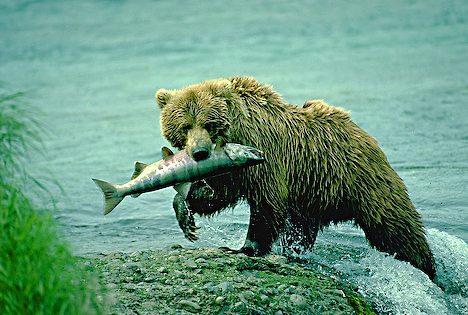
A grizzly bear survives because he is well-adapted to his environment. When he reproduces he passes on those traits to his offspring. this process is called

a)

Natural Selection

b)

Selective Breeding

c)

Random mutations

d)

Variations in a species

63.

The peppered moth's color camouflaged it on the light colored tree bark. It's color was an example of a/n

a)

Variation

b)

Dominant trait

c)

Recessive trait

d)

Adaptation

64.

The peppered moth's color camouflaged it on the light colored tree bark. It's color was an example of a/n

a)

Variation

b)

Dominant trait

c)

Recessive trait

d)

Adaptation

65.

What animal is camouflaged in this picture?

a)

Skunk

b)

Squirrel

c)

Owl

d)

Snake

66.

Where are hereditary traits stored in all organisms?

a)

In the blood

b)

In the brain

c)

In the DNA

d)

In the heart

67.

Why might it be helpful for a species to have a lot of variations?

a)

They can't be seen by predators

b)

If the environment changes, they might be better able to adapt

c)

It is helpful in asexual reproduction

d)

They don't recognize each other

68.

Which beak is probably best suited to crack open nuts?

a)

1

b)

2

c)

3

d)

4

69.

One female salmon can lay hundreds of eggs. Why doesn't the salmon population increase dramatically?

a)

Salmon reproduce asexually

b)

Most offspring do not grow up to reproduce

c)

Salmon eggs don't hatch

d)

Salmon are extinct

70.

Heredity is:

a)

Survival of the fittest

b)

The passing of genetic traits from parent to offspring

c)

Believing in false gods

d)

Unexplained

71.

The male and female black widow spider look very different. However, we know they are the same species because:

a)

They reproduce creating fertile offspring

b)

They reproduce creating infertile offspring

c)

They cannot reproduce

d)

They are not the same species

72.

Another term for Natural Selection is:

a)

Breeding

b)

Commensulism

c)

Communism

d)

Survival of the fittest

73.

Which of the following is a behavioral adapation?

a)

An opossum playing dead

b)

a turtles hard shell

c)

a squirrels fluffy tail

d)

the gills on a fish

74.

On a small island, scientists kept track of the number of wolves and moose over time. Which trend did they record?

a)

A drop in wolf population and a drop in moose population

b)

An increase in wolf population and a drop in moose population

c)

A drop in wolf population and an increase in moose population

d)

An increase in wolf population and an increase in moose population

75.

This chart shows the composition of lunar soil. Which element is third most abundant?

a)

Silicon

b)

Magensium

c)

Iron

d)

Impossible to tell

76.

According to this chart, which plant seems to grow best in full or partial sun?

a)

Geranium

b)

Impatiens

c)

Fuchsia

d)

Trillium

77.

According to this chart, which appliance is used 8 hours per day on weekdays?

a)

TV

b)

Computer

c)

Fridge

d)

Heater

78.

Which ice cream is least liked by both grades?

a)

Vanilla

b)

Strawberry

c)

Lemon

d)

Chocolate

e)

Peach

79.

According to this chart, what appliance is used second most on weekends?

a)

Lights

b)

TV

c)

Heater

d)

Other

80.

Which ice cream is most liked by second grade?

a)

Vanilla

b)

Strawberry

c)

Lemon

d)

Chocolate

e)

Peach

81.

Which tree has an average height of about 75 feet?

a)

Lodgepole Pine

b)

Western Red Cedar

c)

Sitka Spruce

d)

Douglas Fir

e)

Impossible to tell

82.

Which city has the lowest average temperature in March?

a)

Tokyo

b)

New York

c)

Berlin

d)

London

83.
How many total people took the survey?
a)
50
b)
150
c)
100
d)
200
84.
How many more students played soccer than football?
a)
3
b)
30
c)
6
d)
60
85.
According to the diagram, the cheetah belong to the same GENUS as the....
a)
Lion
b)
Skunk
c)
Cat
d)
Human