wayground logo

Free Printable Worksheets

Font size

S
M
L
XL
Worksheets

First Semester Exam Practice- Hargis 19-20

Total questions: 80

Worksheet time: 1hrs 25mins

Name
Class
Date
1.
A series of steps used by scientists to solve a problem or answer a question. 
a)
scientific method
b)
recipe
c)
data collection
d)
metric system
2.
Which is NOT a step in the scientific method?
a)
Make observation
b)
Form a theory
c)
Collect data
d)
Form a hypothesis
3.
A testable explanation to a problem that has not yet been tested. 
a)
data
b)
theory
c)
hypothesis
d)
fact
4.
Testing a hypothesis often involves a(n):
a)
answer
b)
experiment
c)
problem
d)
safety check
5.
This variable in an experiment is the one being changed by the scientist. 
a)
dependent variable
b)
independent variable
c)
data
d)
control group
6.
An experiment is performed on plants to see how different liquids affect plant growth. Each plant in the experiment is given a different liquid; water, apple juice, or milk. Each plant has the same amount of soil, sunlight, and listens to the same music. In this investigation, the independent variable is ...
a)
The type of plant
b)
The amount of sunlight
c)
The type of music
d)
The type of liquid
7.
Dependent variable means
a)
the scientist controls what to test
b)
educated guess
c)
ask a question
d)
what is being measured
8.
If you increase the amount of spinach you eat, then you will increase the iron in your blood. 
What's the dependent variable?
a)
increase the amount of iron in your blood
b)
spinach you eat
9.
_______________ is the amount of space an object takes up.
a)
mass
b)
volume
c)
weight
d)
density
10.
________________ is the amount of material (matter) in an object
a)
mass
b)
volume
c)
weight
d)
density
11.
Mass is measured in
a)
grams
b)
liters
c)
meters
d)
g/cm3
12.
The tool used to precisely measure liquid volume is the
a)
beaker
b)
flask
c)
graduated cylinder
13.
The dip that you use to measure liquid volume is called the
a)
dip
b)
meniscus
c)
patella
d)
hibiscus
14.

What is the volume of the two red beads?

a)

2.4 cm3

b)

4 cm3

c)

6 cm3

d)

2 cm3

15.
The instrument pictured is used to measure the mass of an object...
a)
flask
b)
ruler
c)
balance scale
d)
triple beam balance
16.

What is the length of the object in centimeters?

a)

3.4 cm

b)

4.3 cm

c)

3.5 cm

d)

1 1/4 inches

17.
What is the volume of the liquid in this graduated cylinder?
a)
19 mL 
b)
35 mL 
c)
24 mL 
d)
1.9 mL
18.
Jack has a rock. The rock has a mass of 14g and a volume of 2cm3. What is the density of the rock?
a)
7 mL
b)
7 g/cm3
c)
28 g/cm3
d)
1/7 g/cm3
19.
Which layer of earth is molten?
a)
inner core
b)
outer core
c)
crust
d)
lithosphere
20.
Which layer of Earth is solid and why?
a)
The inner core is solid because of movement of the outer core.
b)
The inner core is solid because of the freezing temperatures.
c)
The inner core is solid because of the extreme pressure from the other layers.
d)
The outer core is solid because of the extreme pressure from the other layers.
21.
Which layer is plastic and has the consistency of silly putty allowing movement?
a)
asthenosphere
b)
lithosphere
c)
mesosphere
d)
crust
22.

Which area of the Earth is least dense ?

a)

Outer core

b)

inner core

c)

mantle

d)

crust

23.

What is the thinnest layer of the Earth?

a)

Mantle

b)

inner core

c)

outer core

d)

crust

24.

How do scientists know the Earth has layers?

a)

Drilling into the mantle

b)

Volcanoes

c)

Seismic waves data

d)

ocean waves

25.
Which layer contains BOTH the upper mantle and the crust?
a)
lithosphere
b)
atmosphere
c)
mesosphere
d)
athensosphere
26.
The place where an earthquake originates inside the Earth's surface is called...
a)
Epicenter
b)
Hypocenter (focus)
c)
Underground
d)
Crust
27.
The place where the earthquake is felt on the Earth's surface is called...
a)
Epicenter
b)
Hypocenter (focus)
c)
Surface
d)
Crust
28.
What is the instrument used to measure earthquakes?
a)
Seismograph
b)
Seisologist
c)
Scale
29.

The most destructive type of wave is a

a)

P-wave

b)

S-wave

c)

Surface wave

d)

transverse wave

30.
What type of seismic wave travels compressionally? 
a)
P wave
b)
S wave
c)
Surface
d)
None
31.

Which wave can travel through solids, liquids, and gases?

a)

P-Waves

b)

S-Waves

c)

Surface (L) Waves

d)
32.

Which is the fastest type of seismic wave?

a)

p-waves

b)

s-waves

c)

surface waves

33.
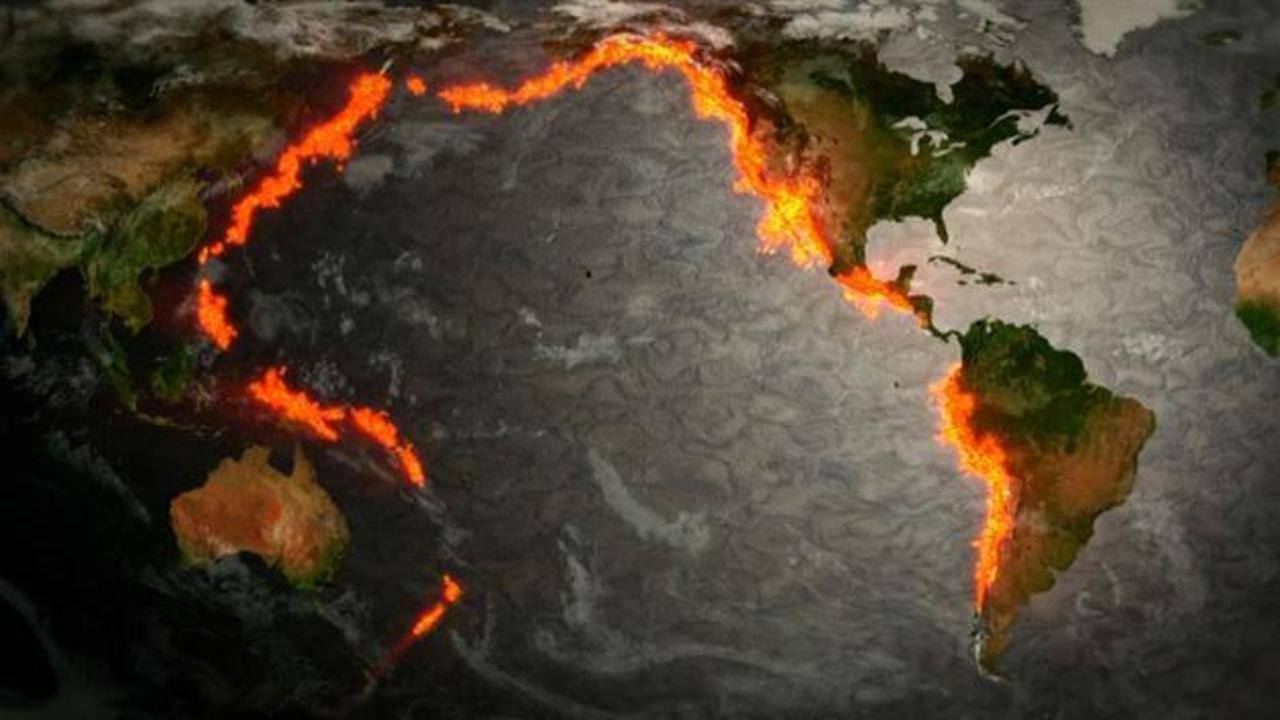
Which ocean in the world is also known as the "Ring of Fire"
a)
Atlantic
b)
Indian
c)
Arctic
d)
Pacific
34.

Which best explains the evidence for a Hot spot under Hawaii?

a)

The rocks closer to Hawaii are older

b)

The rocks closer to main island are younger

c)

The islands have the same age throughout

d)

The islands have matching fossils and mountain ranges

35.
Who is the scientist who proposed Continental Drift Theory?
a)
Albert Einstein
b)
Alfred Wegener
c)
Isaac Newton
d)
John Dalton
36.
What do you call the supercontinent landmass formed million years ago?
a)
Pangea
b)
Asia
c)
Pantallasa
d)
Eurasi
37.
What are the puzzle pieces of the Earth's surface called?
a)
Tectonic plates
b)
Puzzles
c)
Earthquakes
38.

This famous fault in California has a lot of earthquakes!

a)

New Madrid

b)

Denali Fault

c)

Ramapo Seismic Zone

d)

San Andreas Fault

39.

What type of boundary is shown in the diagram?

a)

Divergent

b)

Convergent

c)

Transform

40.

What type of boundary is shown in the diagram?

a)

Divergent

b)

Convergent

c)

Slide/Transform

41.

What type of boundary is shown in the diagram?

a)

Divergent

b)

Convergent

c)

Slide/Transform

42.

Heat transfer by convection is caused by differences in what two things:

a)

Thickness and material

b)

Weight and electricity

c)

Temperature and density

43.
The cycle that powers the ocean currents, weather, and tectonic plates it called
a)
conduction current
b)
radiation
c)
condition current
d)
convection current
44.
In convection, COOL air
a)
Rises
b)
Sinks
45.
In convection, WARM air
a)
Rises
b)
Sinks
46.
What geologic feature/event you be most likely to find at a transform boundary?
a)
Earthquakes
b)
Volcanoes
c)
Mountains
d)
Rift Valleys
47.
What geologic feature/event would you most likely to find at a divergent boundary between two pieces of oceanic crust?
a)
Rift Valley
b)
Mid-Ocean Ridge
c)
Island Arc
d)
Flat land
48.
What geologic feature/event would you most likely to find at a divergent boundary between two pieces of continental crust?
a)
Mid-Ocean Ridge
b)
Mountain
c)
Rift Valley
d)
Island Arc
49.
What geologic feature/event would you most likely to find at a convergent boundary between two pieces of continental crust?
a)
Volcano
b)
Mountain
c)
Rift
d)
Island Arc
50.
A subduction zone is formed...
a)
when one tectonic plate sinks below another
b)
at every type of convergent plate boundary
c)
at every type of divergent plate boundary
d)
at transform boundaries
51.
Fossil fuels are nonrenewable because...
a)
they are used to produce heat
b)
they take a long time to form
c)
they can be found underground
52.
Which of the following natural resources are nonrenewable?
a)
Water
b)
Animals
c)
Natural gas
d)
Wind
53.
Any useful material that is found in nature:
a)
Natural Resource
b)
Human Resource
c)
Plants
54.
Renewable resources 
a)
can be replenished.
b)
cannot be replenished.
c)
are limited.
d)
are fossil fuels.
55.

Which group includes ALL renewable resources?

a)

Coal, Trees, Water, Oil

b)

Water, Wind, Sun, Plants

c)

Minerals, Sun, Natural Gas, Water

56.

This fossil fuel has been created by the remains of plants and must be mined from deep within the Earth.

a)

oil

b)

coal

c)

natural gas

d)

solar

57.

This fossil fuel is formed from the remains of small organisms that lived in the ocean AND is a thick, black liquid

a)

natural gas

b)

coal

c)

oil

d)

steam

58.

The ADVANTAGES of Fossil Fuels include: (Choose ALL that apply)

a)

low cost

b)

produce a lot of energy

c)

cause air pollution

d)

high cost

59.

Coal is formed from

a)

rocks

b)

a factory

c)

remains of small organisms that lived many millions of years ago in our oceans

d)

plant remains along with heat and pressure

60.
How light reflects off of a mineral is called the mineral's 
a)
luster
b)
streak
c)
cleavage
d)
fracture
61.
The color of a mineral in powder form is called the mineral's 
a)
hardness
b)
specific gravity
c)
luster
d)
streak
62.
Why is coal not a mineral?
a)
It's not a solid
b)
It is man-made
c)
It is not inorganic
d)
It is made of carbon
63.
The following image shows what mineral property?
a)
Hardness
b)
Streak
c)
Cleavage
d)
Density
64.
Diamond has a hardness of ___ on Mohs Hardness Scale.
a)
1
b)
5
c)
8
d)
10
65.
Dull, silky, waxy, pearly, and earthy are terms that best describe which property of minerals?
a)
luster
b)
color
c)
streak
d)
cleavage
66.
By definition, a mineral has which of the following characteristic(s)?
a)
definite chemical composition
b)
crystal structure
c)
naturally occuring
d)
all of the above
67.
True or False: Minerals make up rocks. 
a)
True
b)
False
68.
Can a penny scratch fluorite?
a)
Yes 
b)
No 
69.
Which of these minerals is softer than glass?
a)
Topaz 
b)
Corundum 
c)
Calcite 
d)
Orthoclase 
70.
A rock formed from fragments of other rocks is a(n)
a)
Metamorphic Rock
b)
Sedimentary Rock
c)
Extrusive Rock
d)
Igneous Rock
71.
An igneous rock containing large crystals is most likely a(n)
a)
Chemical Rock
b)
Foliated Rock
c)
Extrusive Rock
d)
Intrusive Rock
72.
A metamorphic rock in which the grains line up in parallel bands is a
a)
Clastic Rock
b)
Nonclastic Rock
c)
Nonfoliated Rock
d)
Foliated Rock
73.
As lava cools and crystallizes, what type of rock will form?
a)
Sedimentary
b)
Metamorphic
c)
Extrusive Igneous
d)
Intrusive Igneous
74.
The three groups of rocks are classified by
a)
How they form
b)
Color
c)
Grain size
d)
Chemical Composition
75.
Fossils are only found in
a)
Sedimentary rocks
b)
Foliated Metamorphic rocks
c)
Igneous Rocks
d)
Nonfoliated Metamorphic rocks
76.
The process when rocks break into smaller pieces due to exposure to natural elements is called
a)
erosion
b)
weathering
c)
sediments
77.
What are the 3 major types of rocks?
a)
Igneous, Metamorphic, Sedimentary
b)
Metamorphic, Igneous, Cementation
c)
magma, lava, crystals
78.
The process by which igneous rocks are formed...
a)
heat and pressure
b)
melting and cooling
c)
weathering and erosion
79.
The process by which metamorphic rocks are formed...
a)
heat and pressure
b)
erosion and deposition
c)
melting and cooling
80.
The name rock is given when it is broken down into smaller pieces.
a)
texture
b)
weathering
c)
sediment
d)
erosion