
 Worksheets
Physics Unit Review
Total questions: 77
Worksheet time: 50mins
The combination of all forces acting on an object.
Net Force
Balanced Force
Balanced Force
When opposite forces cancel each other out. There is no change in motion. The net force equals zero.
Balanced Forces
Net Force
Unbalanced Forces
Changing position relative to another object
Distance
Motion
Reference Point
Friction is a force that acts in the ______________ direction of the way the object is trying to move.
same
perpendicular
opposite

What is the net force shown in the picture?
10 Newtons
5 Newtons
3 Newtons
2 Newtons
The LOWER the mass of an object, the more force it takes to start it, stop it, or change its direction.
True
False
Newton's 1st Law of Motion states "an object at rest stays at rest and an object in motion stays in motion until an unbalanced force acts on it." What is this called?
speed
gravity
inertia
velocity
What is the correct formula to use for the following problem:
"How much TIME will it take for a bug to travel 5 meters across the floor if it is traveling 1 meter/second?"
D=SxT
S=D/T
T=D/S
What is the correct formula to use for the following problem:
"You got to the mailbox 45 seconds after you got out of the car, which is 90 meters away. How FAST did you travel to the mailbox?"
S=D/T
T=D/S
D=SxT
Which of the following statements is associated with Newton's 3rd Law of Motion?
For every action, there is an equal and opposite reaction
Two objects must be involved to create a force
Whenever an object pushes another object, it gets pushed back in the opposite direction equally as hard.
All of the above
The following statement is an example of Newton's Third Law:
"A bird can fly because as its wings push against the air, the air pushes back against its wings."
True
False
In the formula F=ma, what is "F"?
Force
Mass
Acceleration
In the formula F=ma, what is "m"?
Force
Mass
Acceleration
In the formula F=ma, what is "a"?
Force
Mass
Acceleration
Mass is measured in ____________________________________.
kilograms (kg)
Newtons (N)
m/s2 or m/s/s or m/s^2
Force is measured in ________________________________________.
m/s2 or m/s/s or m/s^2
Newtons (N)
kilograms (kg)

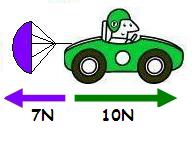
What is the net force?
3 N
3 N, right
17 N, right
3 N, left
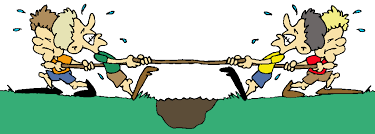


Object is...
constant speed
speeding up
slowing down
stopped

Object is...
(hint: equal distance... equal time)
constant speed
speeding up
slowing down
stopped

Object is...
constant speed
speeding up
slowing down
stopped

Object is...
(1) speeding up,
(2) constant speed,
(3) speeding up
(1) constant speed.
(2) stopped,
(3) constant speed

Object is ...
stopped
constant speed
speeding up
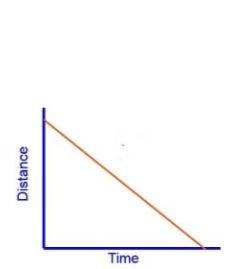
What is this line of this graph showing?
moving away from starting point at a constant speed
moving back towards the starting point at a constant speed
acceleration (getting faster)
deceleration (getting slower)


What is happening at E?
Stationary
Accelerating
Constant speed; moving away from the starting position
Constant speed; returning to start position

What is Newton's 1st law?
Law of Force and Acceleration
Law of Inertia
Law of Action-Reaction
Law of motion
Newtons 3rd Law of Motion states:
An object at rest will remain at rest unless acted upon by an outside force.
For every action, there is an equal and opposite reaction
The greater the mass of an object, the more force it will take to accelerate the object

What Newtons law does this picture represent
Newtons 1st law
Newtons 2nd law
Newtons 3rdt law
Newtons 4rth law

The formula for Force is:
Force= Magnet x Acceleration
Force= Mass x Acceleration
Force= Mass x Arsenic
Funny= Monkey x Arrive
Which is an example of Newton's 2nd law?
A ball bouncing
A fan spinning
Pushing a 10 pound box
Sneezing
A push or pull on an object is called...
Acceleration
Mass
Inertia
Force

If we put the same force on a bowling ball and a soccer ball, the soccer ball will move faster! Which law explains this?
1st
2nd
3rd

Which law explains that it would take more force to push the car than the lawnmower?
1st
2nd
3rd

Which law explains why the driver "keeps moving forwards, even though the car has stopped"?
1st
2nd
3rd

Which way would a swimmer push to move forward in the water?
To the left
Forward
Backward


The reason a ball bounces up when it hits the ground:
The ball and ground repel each other.
The ball exerts a force on the ground, and the ground exerts a force on the ball.
Forces that are exerted on an object which are equal
Unbalanced force
Balanced force
Unequal forces applied to an object.
Unbalanced force
Balanced force

A card sliding across a table.
Unbalanced force
Balanced force

A cat shoving a glass off a table
Unbalanced force
Balanced force

An airplane taking off
Unbalanced force
Balanced force
Which of the following is an example of an unbalanced force?


If the sum of the forces acting on the object is zero the forces are balanced and the object won't move.
True
False
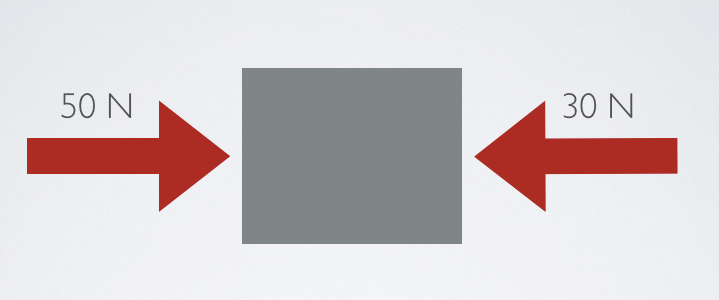
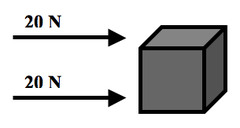


Calculate the resultant force.
40N, Left
40N, Right
0N, Balanced
75N, Right

A train travels 25 km in 5 hrs. How fast is the train going?
25 miles/hr
5 km/hr
5 m/s
50 km/hr


You are going to race your friend to a tree near the back of the playground. The tress is 24 meters away from where you stand. It will take you 4 seconds to reach the tree. What will your average speed be?
6 mph
16 m/s
60 m/s
6 m/s
Michael walked at 2 m/s for 3 minutes. How far did he walk?
360 m
6 m
18 m
5 m
What is inertia?
An object's resistance to a change in motion
An object's speed
An object's weight
Gravity
Kate travels a distance of 9 km from her house to her mom's house at 18 km/hr and runs to the store afterwards at 15 km/hr. The whole trip takes 1 hour. How far did she drive altogether?
12.5 km
9 km
24 km
18 km

How do you calculate time?
multiply distance and speed
distance divided by speed
speed divided time
divide distance and density then multiply by volume
Which of these is NOT a unit of time?
hours
minutes
seconds
metres
Arnold drives 120 km in his car at a speed of 60 km/h. How long did the journey take?
180 hours
60 hours
3 hours
2 hours
Arnold drives 120 km in his car at a speed of 60 km/h. How long did the journey take?
180 hours
60 hours
3 hours
2 hours
What should you solve for in a problem that asks how long it took an object to move from one point to another?
Distance
Time
Speed
How long will it take you to drive 160 kilometers if you drive 40 kilometers an hour? (Give number only.)
(a)

