
 Worksheets
1st nine weeks exam 23/24
Total questions: 89
Worksheet time: 2hrs 28mins
What is the difference between a conductor and an insulator?
An insulator allows electricity to flow through it easily and a conductor does not
A conductor allows electricity to flow through it easily and an insulator does not.
An insulator is magnetic and a conductor is not
A conductor is magnetic and an insulator is not
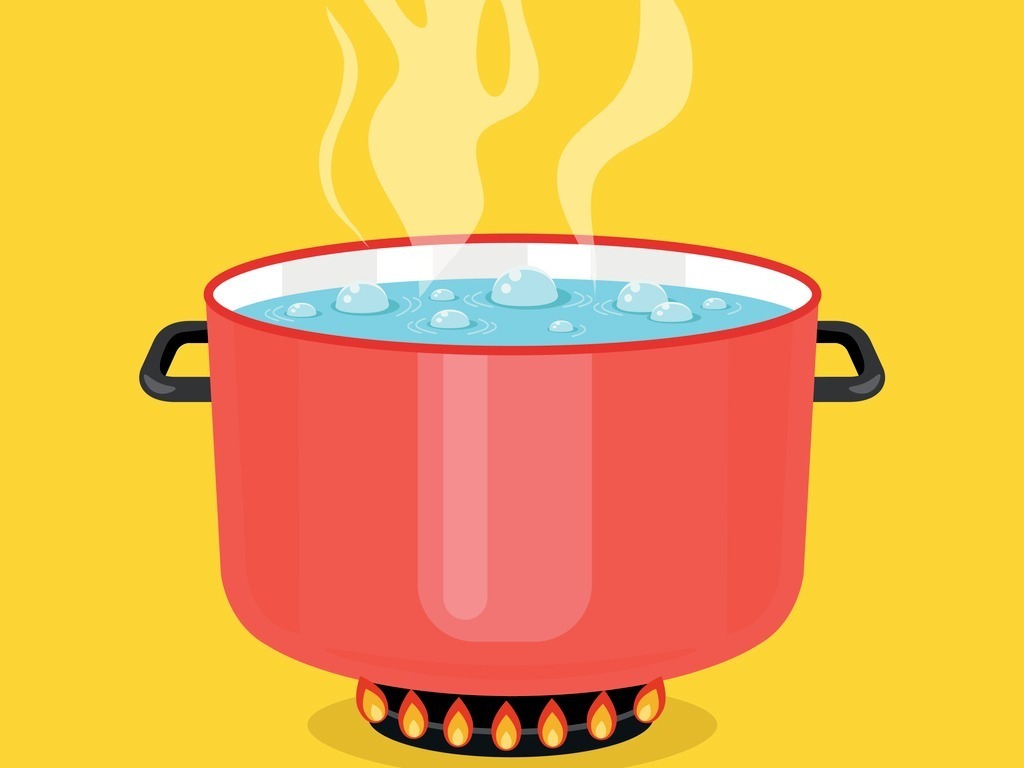
What is happening at the boiling point?
liquid to gas
solid to liquid
gas to liquid
liquid to solid
Copper and Iron are good _____________.
insulators
conductors
driver
protector
Matter can be classified by characteristics.
In science, what do we call these characteristics?
acidic and basic
physical and chemical
positive and negative

A student sees bubbles begin to form within a mixture. the student believes this is a good sign that a chemical reaction has taken place. Explain why the bubbles are good evidence of a chemical reaction.
Bubbles are cool.
Bubbles are evidence of a chemical reaction because they indicate the presence of air.
Bubbles are REALLY cool
Bubbles are evidence of a chemical reaction because they indicate that a new substance (gas) has formed.
What is PROOF that a chemical change has occured?
a new substance with different properties is created.
you can put the reactants back together
the substance changes state, solid to liquid or liquid to solid.
any characteristic of matter that you can observe without changing the identity of the substances that make it up
physical property
chemical property
periodic table
conglomerate
a characteristic of matter you observe as it reacts or changes into a different substance
physical property
chemical property
periodic table
conglomerate
When heat is released it is an
exothermic reaction
endothermic reaction
both
none
This is when heat is absorbed, it is an
Exothermic reaction
endothermic reaction
both
none


Iron is a good conductor, malleable, magnetic and usually shiny. What type of element is Iron?
Metal
Non Metal
Metalloid
Pretty
What is the approximate density of water?
1 cm
almost 1g/mL
2 g
2 g/cm3
The kinetic energies of particles in a sample of matter are increasing. This sample is most likely
a liquid that is warming.
a gas that is cooling.
a liquid that is turning into a solid.
a gas that is turning into a liquid.
An air-filled balloon shrank when moved from a warm room to a refrigerator. Which statement best explains why the balloon shrank?
The volume of air decreased as the number of particles decreased.
The mass of the air decreased as the balloon cooled.
External pressure on the balloon increased due to lower temperature.
The internal pressure of the balloon decreased due to lower kinetic energy
Which of the following changes made to a sample of liquid would increase the distance between individual molecules of the substance?
Transferring the substance to a smaller container
Decreasing the overall kinetic energy of the liquid
Adding heat energy to the substance
Changing the phase of matter from liquid to solid
What is a solvent
A liquid that will dissolve a solid solute
Another word for solution
A thing that make drinks change colour
Usually the solid about to be dissolved
The ___ is the thing being dissolved.
solute
solvent
mixture
solution
Define the term soluble.
Can dissolve in water
Cannot dissolve in water
Partially dissolves in water
______ refers to the ability of a substance to combine and form a solution
solvent
solute
solution
solubility
Cutting, crushing, melting, and boiling are all examples of what?
physical changes
chemical changes
messes
Law of Conservation of Particles
As thermal energy is added to a substance, which of the following changes is likely?
Spacing between particles will decrease.
Vibration of individual particles will increase.
Temperature of the substance will decrease.
Pressure of the substance will increase.
Which of the following changes made to a sample of liquid would increase the distance between individual molecules of the substance?
Transferring the substance to a smaller container
Decreasing the overall kinetic energy of the liquid
Adding heat energy to the substance
Changing the phase of matter from liquid to solid
Large molecules made up of small monomers are called
polymers
peptides
peptones
monomers
During an experiment, a class heated a balloon that had an initial circumference of 25 cm. The circumference increased to 27 cm. Which is the best conclusion that can be drawn?
The molecules inside the balloon lost energy to the outside.
The molecules inside the balloon gained energy from the heat.
The energy of the molecules inside the balloon remained the same.
The molecules inside the balloon were escaping outside.
An air-filled balloon shrank when moved from a warm room to a refrigerator. Which statement best explains why the balloon shrank?
The volume of air decreased as the number of particles decreased.
The mass of the air decreased as the balloon cooled.
External pressure on the balloon increased due to lower temperature.
The internal pressure of the balloon decreased due to lower kinetic energy
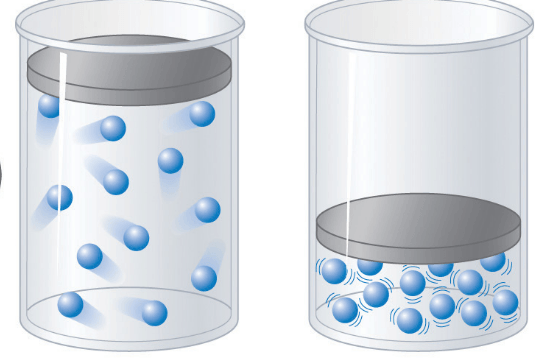
a bicycle changes color as it rusts
the temperature at which a solid changes to a liquid
solubility
boiling point
melting point
state of matter

.14 g/cm3

Claire has a liquid. It has a mass of 9g and a volume of 3mL. What is its density?
3 g/mL
.33 g/mL
27 g/mL
39 g/mL
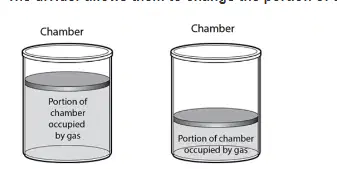
Students are able to introduce a sample of gas into a chamber with a moveable divider.
The divider allows them to change the portion of the chamber occupied by the gas.
When the volume of the gas is reduced, what change in property would be the most reasonable to expect?
The density will decrease
The temperature will decrease
The pressure will decrease
The pressure will increase.
If a hairspray can is heated, what can be expected of the pressure of the gas inside the can?
The pressure will increase
The pressure will decrease
The pressure will remain constant
The pressure will equalize
A helium balloon is taken outside on a very cold day. The balloon wrinkles and becomes a little smaller, but returns to its normal size when it is taken back inside the warm house. Why does the balloon inflate when it reenters the warm house?
The warmer temperature causes more gas to enter the balloon, and it expands.
The warmer temperature causes the gas in the balloon to contract.
The warmer temperature causes the gas in the balloon to expand.
The warmer temperature causes the gas in the balloon to turn into a solid.
Which of the following is a measure of the amount of matter in an object?
Mass
Volume
Density
Weight
Which of the following is a measure of how much mass is contained in a given volume?
Mass
Volume
Density
Weight
Which of the following is a measure of the space occupied by an object?
Mass
Volume
Density
Weight
Which subatomic particle has a POSITIVE charge?
Proton
Neutron
Electron
none of these
The two subatomic particles found in the nucleus are ____________________.
protons and electrons
protons and neutrons
neutrons and electrons
protons, neutrons, and electrons
An atom is ______________.
the smallest living organism
a subatomic particle
the smallest unit of matter
a philosopher from 420 B.C.
Which subatomic particle has a NEGATIVE charge?
Proton
Neutron
Electron
none of these
What is the atomic number?
the number of protons
the number of protons and neutrons
the number of neutrons
energy shells
Which TWO of the following subatomic particles are inside the nucleus?
protons
electrons
neutrons
There are no subatomic particles in the nucleus of an atom.
If the solar system were used as a model of an atom, what would the Sun most likely represent?
an ion
a nucleus
a neutron
an electron
What subatomic particles identify silver atoms?
neutrons
electrons
nuclei
protons
most of the mass of an atom is found in the
protons
neutrons
orbitals
nucleus


The diagram shows
element
mixture
compound


Elements
are made of two or more types of atoms chemically bonded together
are made of one type of atom
are made of two or more types of molecules combined in the same space
are always individual atoms
Compounds
are made of two or more types of atoms chemically bonded together
are made of one type of atom
are found on the periodic table
can be separated into their individual parts through physical means
Which of the following are examples of ELEMENTS?
Oxygen
Water
F2
Lemonade
Sulfur Dioxide (SO2)
Which of the following are examples of Compounds?
Salt
Salt Water
N2 + O2
C6H12O6
Co
How many elements are in the compound Fe2O3?
0
1
2
3

