wayground logo

Free Printable Worksheets

NEW

Font size

S
M
L
XL
Worksheets

Evolution

Total questions: 47

Worksheet time: 37mins

Name
Class
Date
1.
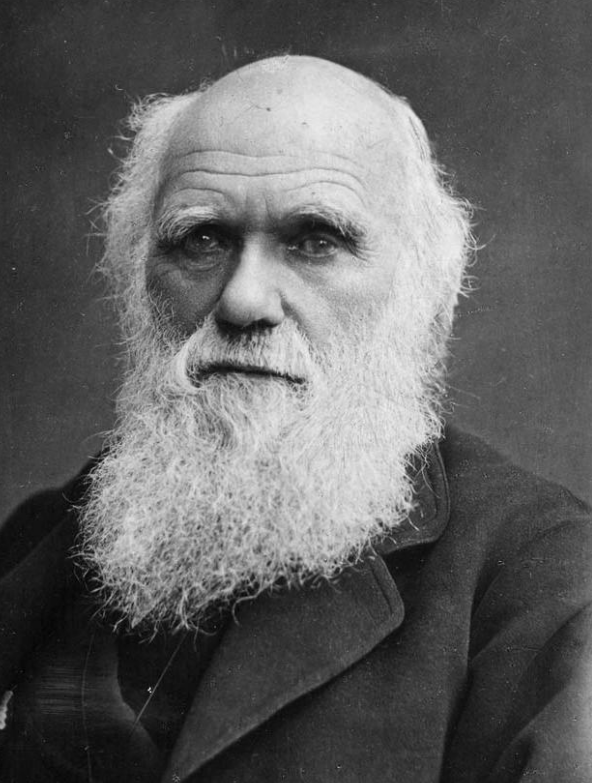
Who is the father of evolution?
a)
Darwin
b)
Mendel
c)
Newton
d)
Einstein
2.
What is another name for natural selection?
a)
survival of the smartest
b)
survival of the fastest
c)
survival of the biggest
d)
survival of the fittest
3.
What is a change in an organism that allows for it to survive in its environment?
a)
homologous
b)
vestigial
c)
variation
d)
adaptation
4.

Certain insects resemble the bark of the trees on which they live. Which statement provides a possible biological explanation for this resemblance?

a)

The insects needed camouflage so they developed protective coloration.

b)

Natural selection played a role in the development of this protective coloration.

c)

The lack of mutations resulted in the protective coloration.

d)

The trees caused mutations in the insects that resulted in protective coloration.

5.
What is an organism that has similar characteristics and can reproduce?
a)
species
b)
organism
c)
embryology
d)
vestigial 
6.
What is this an example of?
a)
diversity of species
b)
variation
c)
vestigial structures
d)
DNA studies
7.

Which statement is not part of the concept of natural selection?

a)

Individuals that possess the most favorable variations will have the best chance of reproducing.

b)

Variation occurs among individuals in a population

c)

More individuals are produced than will survive.

d)

Genes of an individual adapt to a changing environment.
8.

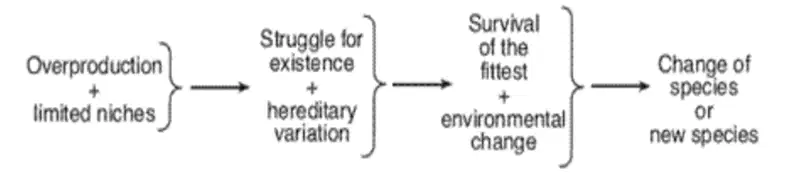
Which concept is best illustrated in the flowchart below?

a)

Natural selection

b)

genetic mutation

c)

extinction

d)

genetics

9.
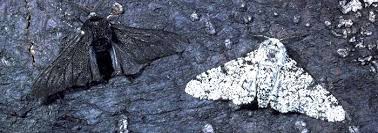
Predict which moth would increase in population
a)
light 
b)
dark
10.
When the DNA of an organism is altered it is referred to as…
a)
Mutation
b)
Gene Flow
c)
Genetic Drift
d)
Sexual Selection
11.
Darwin wrote that organisms with traits that are best suited to the environment will ________________
a)
increase in number
b)
become extinct
12.
Which of the following is NOT an example of natural selection? 
a)
People selectively breeding hamsters.
b)
Insect populations developing resistance to certain pesticides.
c)
Bacteria becoming resistant to antibiotics.
d)
Male birds of certain species developing colorful feathers to attract female mates.
13.
Which term refers to the process by which individuals that are better suited to the environment survive and reproduce therefore passing down their genes to their offspring? 
a)
Evolution 
b)
Variation 
c)
Adaptation
d)
Natural Selection 
14.
Which species’ DNA is most similar to the DNA of the toothed whale? 
a)
Hippopotamus 
b)
Baleen Whale
c)
Grazing Mammals
d)
Camels
15.
The environment around Manchester, England, changed during the Industrial Revolution.  How did this change affect peppered moths living in the area?
a)
Natural selection favored moths with dark wings because predators could not see them on the soot-colored trees.
b)
Natural selection favored moths with white wings that were easy for predators to see.
c)
Natural selection favored moths with white wings because predators could not see them on the soot-colored trees.
d)
Natural selection caused moths with white wings to become extinct.
16.
Inherited trait that helps an organism survive is a(n) __________.
a)
Fossil
b)
Adaptation
c)
Ancestor
d)
Natural selection
17.

Why do current day giraffes have long necks?

a)

  The ability to have a long neck is a gene that can be passed to future generations.

b)

The short necked giraffes all died one day.

c)

The short neck gene wasn’t able to be read by the cell.

d)

   The short necked giraffes moved to another location in the search for food.

18.
Why are advantageous traits more likely to be passed onto offspring?
a)
Because they are more likely to survive and reproduce.
b)
Because they come from dominant alleles.
c)
Because they come from recessive alleles.
d)
Because the trait is an acquired phenotype.
19.
The white feathers of a snowy owl allow it to blend in with its environment during the winter months (snow). This is an example of ________________
a)
Species
b)
Environmental Change
c)
Adaptation
d)
Variation
20.
Darwin referred to this as survival of the fittest. Over time, it results in changes in the inherited characteristics of a population because organisms with adaptations that make them fit for their environment will survive and reproduce better than those without favorable traits.
a)
Natural Selection
b)
Genetic Variation
c)
Survival of the Fittest
21.
Genetic differences between organisms of the same species
a)
Variation
b)
Adaptation
c)
Behavior
d)
Environment
22.
What is the advantage of having different shaped beaks?
a)
To look different from other species.
b)
To be able to eat the food readily available in the environment.
c)
To protect itself against predators.
d)
To protect itself against prey.
23.
The struggle for existence against other members of an organisms species is
a)
Competition
b)
Natural Selection
c)
gene flow
d)
genetic drift
24.
Which of the following is NOT a factor that affects the process of natural selection?
a)
Overpopulation
b)
Fossils
c)
Competition
d)
Variations
25.
A group of similar organisms that can mate with each other and produce fertile offspring is called a species.  
a)
True  
b)
False
26.
The difference in the physical traits of an individual from those of other individuals in a group is called a(n)
a)
change
b)
adaption
c)
species
d)
variation
27.
Organisms are the same ___________ when they can have offspring, then those have more offspring.
a)
Class
b)
Family
c)
Species
d)
Phylum
28.
Charles Darwin came up with this theory 
a)
Natural Selection
b)
Mutation
29.
What did Charles darwin think about natural selection?
a)
organisms change their traits to the trait that will help them
b)
breeding 2 similar animals get the best traits
c)
breeding 2 animals with different traits give the best results
d)
organisms with better traits for their environment will survive and reproduce
30.

What is another name for natural selection?

a)

survival of the smartest

b)

survival of the fastest

c)

survival of the biggest

d)

survival of the fittest

31.

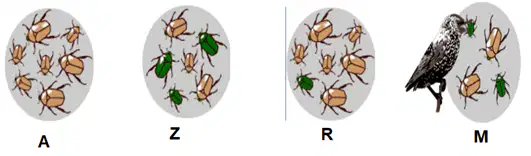
The short necked giraffes moved to another location in the search for food.

a)

A – Z – R – M

b)

Z – R – M  - A

c)

Z – M – A – R

d)

Z - M - R - A

32.
Humans, birds, whales, and lizards all have similar arm bones. What is the reason for this?
a)
The function of these bones is the same in all animals
b)
They live in similar environments
c)
They have a common ancestor
d)
All organisms resemble humans
33.
An organism's ability to survive and reproduce in its environment refers to its
a)
Fitness
b)
Variation
c)
Selection
d)
Mutation
34.

Darwin's ship was called ________

a)

HMS Bugle

b)

HMS Beetle

c)

HMS Asparagus

d)

HMS Beagle

35.

Scientists believe horses evolved over a period of 50 million years. How did they change?

a)

They became much larger

b)

Their toes eventually were replaced by a hoof

c)

Their environment changed from a forest to a grassland environment

d)

all the other answers!

36.
This is an ecological relationship in which two or more organisms depend on the same limited resource.
a)
Adaptation
b)
Competition
c)
Evolution
d)
Natural selection
37.
This is an inherited trait that helps an organism survive and reproduce in its environment.
a)
Evolution
b)
Population
c)
Environment
d)
Adaptation
38.
This is the variation of living organisms.
a)
Biological diversity
b)
Evolution
c)
Environment
d)
Natural selection
39.
These are natural differences within a species.
a)
Evolution
b)
Genetic variation
c)
Biological diversity
d)
Populations
40.
This is a process in which organisms gradually change over time.
a)
Environment
b)
Competition
c)
Evolution
d)
Fossils
41.
This is a process by which organisms inherited advantageous traits that tend to reproduce more successfully than the other organisms do. 
a)
Artificial selection
b)
Natural selection
c)
Populations
d)
Environment
42.
Who was the first naturalist to study evolution?
a)
Charles Darwin
b)
Gregor Mendal
c)
Carolus Linneaus
d)
Thomas Edison
43.
This is the trace or remains of an organism that lived long ago, most commonly preserved in sedimentary rock.
a)
Competiton
b)
Extinction
c)
Evidence
d)
Fossil
44.
Ten brown mice and ten white mice are placed in a desert environment. What will happen to the white population over time?
a)
It will increase
b)
It will decrease
c)
It will stay the same
d)
There is no way to tell
45.

How would a warming climate affect the species in an ecosystem?

a)

individuals might die off but a species cannot disappear completely

b)

species would increase in number to offset the numbers killed by the heat

c)

species that have never been seen before would suddenly appear

d)

individuals best able to survive the heat would become more likely to reproduce

46.

In a cooling environment, which species will have the best chance for survival?

a)

the one with the smartest individuals

b)

the one with the smallest body size

c)

the one with the most genetic variation

d)

the one with the largest population

47.

Occasionally a mutation produces a bird with a new characteristic. What determines whether this bird will be the beginning of a new species?

a)

The bird must dominate the other birds and reduce their ability to reproduce

b)

The bird must be able to live in the usual environment for that fish

c)

The mutation must provide some type of advantage for the bird

d)

The mutation must make the bird very different from other fish