
NEW
Font size
S
M
L
XL
 Worksheets
NCFE Grade 6 Science Review 3rd Nine weeks
Total questions: 57
Worksheet time: 29mins
Name
Class
Date
1.
The thinnest layer of the Earth is?
a)
Mantle
b)
Lithosphere
c)
Athenosphere
d)
Crust
2.
The lithosphere combines what two layers?
a)
Athenosphere & Crust
b)
Crust & Upper Mantel
c)
Mantel & Athenosphere
3.
What happens to pressure as we move from the crust to the inner core?
a)
Pressure Decreases
b)
Pressure Increases
c)
Nothing
4.
This layer of Earth is solid Iron and Nickel
a)
Outer Core
b)
Mantle
c)
Inner Core
d)
Crust
5.
This layer of Earth is the thickest part
a)
crust
b)
outer core
c)
mantle
d)
inner core
6.
What are the two types of crust
a)
continental and oceanic
b)
ocean and upper
c)
lower and upper
d)
pizza and subway
7.

Identify layer #20.
a)
mantle
b)
asthenosphere
c)
inner core
d)
outer core
8.
Scientists determine what Earth’s interior looks like by using:
a)
Volcanoes
b)
Seismic Waves
c)
Continental Drift
d)
Convection Currents
9.
Which layer of the earth has the lowest temperature?
a)
Crust
b)
Mantle
c)
Outer Core
d)
Inner Core
10.
Which layer of the earth is under the highest pressure?
a)
Crust
b)
Mantle
c)
Outer Core
d)
Inner Core
11.
Less dense materials rise to the top.
a)
True
b)
False
12.
Oceanic crust is thicker than continental crust.
a)
True
b)
False
13.
What is the correct order (starting from the surface) of Earth's layers?
a)
crust, outer core, inner core, mantle
b)
mantle, outer core, inner core, crust
c)
crust, mantle, outer core, inner core
d)
outer core, inner core, crust, mantle
14.
Which layer of Earth has the GREATEST density?
a)
crust
b)
mantle
c)
outer core
d)
inner core
15.
Which layer of Earth is LIQUID?
a)
upper mantle
b)
lower mantle
c)
outer core
d)
inner core
16.
Geologists' main evidence about the structure of Earth's interior comes from
a)
temperature measurements in deep mines
b)
observations of other planets
c)
exploration of caves
d)
rock samples and seismic waves
17.
Where does the energy from an earthquake originate?
a)
from a sudden increase in solar radiation striking Earth
b)
from the Moon’s gravitational pull during a close orbit
c)
from rocks under stress shifting deep below Earth’s surface
d)
from the weight of sediments pushing down on bedrock
18.
What major events cause islands to form in the Pacific Ocean?
a)
tsunamis
b)
severe storms
c)
volcanic eruptions
d)
erosion
19.
The movement of crustal plates results from circulating currents in material beneath the crust of Earth. Which BEST describes the material which moves the crustal plates?
a)
hot water
b)
molten rock
c)
liquid metal
d)
solid iron
20.
Which of the following is the MOST likely cause of earthquakes?
a)
shifting rock layers
b)
crashing meteorites
c)
rotation of the core
d)
magnetic force
21.
At which location does the movement of tectonic plates form isolated volcanic islands, such as Hawaii?
a)
transform boundary
b)
divergent boundary
c)
subduction zone
d)
hot spot
22.
The Hawaiian Islands are of volcanic origin. Many scientists thought that each island had an individual magma plume or hot spot that erupted and formed the islands. Other scientists speculated that these islands were the result of a single hot spot. Which of these statements BEST supports the single hot spot hypothesis?
a)
The Pacific tectonic plate is too small to have multiple hot spots.
b)
The hot spot was large enough to form all the islands at the same time.
c)
The volcanoes at hot spots have only one eruption which lasts for hundreds of years.
d)
The locations of the volcanoes match the movement of the Pacific tectonic plate over a hot spot.
23.
In an earthquake, the primary waves move through
a)
air
b)
water
c)
soil
d)
rock
24.

Which process is represented by the diagram?
a)
beach erosion
b)
trench formation
c)
glacial movement
d)
island formation
25.
Which geologic process MOST likely caused the formation of the Mount St. Helens Volcano?
a)
converging boundaries
b)
diverging boundaries
c)
transform faults
d)
rift zones
26.
Which is a fact rather than an opinion about earthquakes?
a)
Earthquakes occur along fault lines.
b)
Earthquakes are worse than hurricanes
c)
Earthquakes are bad for all local businesses.
d)
Earthquakes always cause major damage to homes.
27.
MOST of the volcanoes that make up the “Ring of Fire” were formed near
a)
hot spots
b)
subduction zones
c)
divergent boundaries
d)
normal faults
28.
Volcanoes are considered constructive because they
a)
deposit lava
b)
cause erosion
c)
trigger earthquakes
d)
release gases
29.

A strong earthquake recently occurred in Nevada. The star indicates the epicenter of the earthquake. The epicenter is located directly above the area where the energy of the earthquake was released. Which BEST identifies the other states through which the seismic waves MOST likely traveled?
a)
Idaho
b)
Idaho, Utah
c)
Idaho, Utah, Oregon
d)
Idaho, Utah, Oregon, California
30.
Which will MOST likely cause an earthquake?
a)
plates slipping along a fault
b)
a hurricane hitting a shoreline
c)
water weathering rocks on the ocean floor
d)
tidal stresses resulting from the distance between Earth and the Moon
31.
Earthquakes are vibrations of Earth’s crust. What device is used to measure the size of an earthquake?
a)
barometer
b)
Doppler Radar
c)
depth scale
d)
seismograph
32.
In what section of Earth do earthquakes happen?
a)
crust
b)
mantle
c)
inner core
d)
outer core
33.
A plant that needs well-drained soil would grow best in soil made mostly of
a)
Silt
b)
Clay
c)
Sand
d)
Humus
34.
How do the nutrients necessary for plant growth get into the soil?
a)
The soil absorbs sunlight.
b)
Water filters through the soil.
c)
Organic matter is decayed in the soil.
d)
The soil is exposed to air.
35.
The iron in iron-rich red soils may not be in a form that can be taken up by tree roots. As a result, leaves and needles may look yellow. Some trees release acids that convert iron in soil to a usable form. This change in soil chemistry is a type of which process?
a)
deposition
b)
weathering
c)
precipitation
d)
photosynthesis
36.
The texture of soil depends primarily on the
a)
mass of the soil.
b)
water in the soil.
c)
composition of the soil.
d)
vegetation growing in the soil.
37.
Which of these particles, when found in soil, contributes most to the water retention in soil?
a)
gravel
b)
sand
c)
silt
d)
clay
38.
What is the source of the organic matter needed for most fertile soils?
a)
moving water
b)
eroded sand
c)
decaying plants
d)
weathered bedrock
39.
Which property best indicates that soil contains nutrients?
a)
texture
b)
color
c)
amount of sand
d)
amount of clay
40.
If soil is permeable
a)
water cannot flow through it.
b)
water easily flows through it.
c)
it contains many minerals.
d)
it contains few minerals.
41.
What is the top layer of soil that contains decaying organic material?
a)
Bedrock
b)
Humus
c)
Sand
d)
Clay
42.
Humus is an organic material that makes up soil. Which characteristic best indicates that soil has a high humus content?
a)
the color of the sample
b)
the mass of the sample
c)
the amount of clay in the sample
d)
the amount of rock in the sample
43.
Which environment would most likely have rich, fertile soil?
a)
a desert plain
b)
a coastal beach
c)
a mountain peak
d)
a flood plain
44.
Soil formation begins with the weathering of_______.
a)
Humas
b)
Subsoil
c)
Litter
d)
Rock
45.
What effect did over plowing and cutting down trees in the Great Plains during the 1930’s?
a)
It had little effect
b)
It increased soil fertility
c)
It was a primary cause of the Dust Bowl
d)
Farmers had a great harvest
46.
The two main factors that determine the rate of weathering are the TYPE of rock and_____.
a)
Music
b)
Climate
c)
Size of rock
d)
Weight of rock
47.
The movement of rocks and weathered materials is called_________.
a)
Chemistry
b)
Physical
c)
Weathering
d)
Erosion
48.
Soil conservation includes all of the following EXCEPT_______.
a)
Desertification
b)
Contour plowing
c)
Terracing
d)
Crop rotation
49.
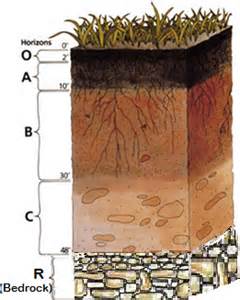
Which horizon is made up of partially weathered rocks?
a)
Horizon A
b)
Horizon B
c)
Horizon C
d)
Horizon D or R
50.
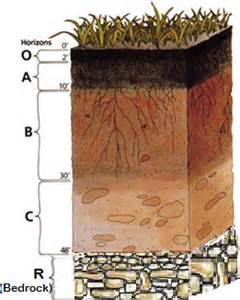
In which horizon is most of the HUMUS?
a)
Horizon A
b)
Horizon B
c)
Horizon C
d)
Horizon D or R
51.
There is an unlimited supply of fertile soil.
a)
True
b)
False
52.
Soil's one of the Earth’s most valuable resources. Everything on Earth depends on soil somehow.
a)
True
b)
False
53.

What is a soil problem all farmers face?
a)
soil hardening
b)
soil erosion
c)
soil spoiling
d)
soil pollution
54.

What soil conservation is this?
a)
Cover Crops
b)
Soil Conservation
c)
Crop Rotation
55.

What soil conservation technique is this?
a)
Crop Rotation
b)
Wind Breaks
c)
Contour Plowing
d)
No-Till Farming
56.

What is mechanical weathering?
a)
Process through which rocks are physically broken into smaller pieces.
b)
Rocks are broken down through chemical changes.
c)
Rocks are worn away from acid in plant roots.
d)
Rocks broken down by machinery.
57.

During chemical weathering, what can happen to the type of rock that has undergone chemical weathering?
a)
a new rock is produced that is larger than the original rock
b)
a new rock is produced that is the same as the original rock
c)
a new rock is produced that is different from the original rock
d)
no new rock is created - it is just smaller in size
Reset

