
 Worksheets
DPM Review
Total questions: 42
Worksheet time: 55mins
Name
Class
Date
1.
__________ is stored energy.
a)
Potential
b)
Kinetic
c)
None of the above
d)
All of the above
2.
Gravitational potential energy depends on the ________ and ________ of the object.
a)
Height and mass
b)
Friction and movement
c)
Mass and Movement
d)
Height and Friction
3.

What kind of energy is in a rock at the edge of a cliff?
a)
Potential
b)
Kinetic
4.

What kind of energy is in a moving skateboard?
a)
Potential
b)
Kinetic
5.

What kind of energy is in a person climbing a ladder?
a)
Potential
b)
Kinetic
c)
Both
6.
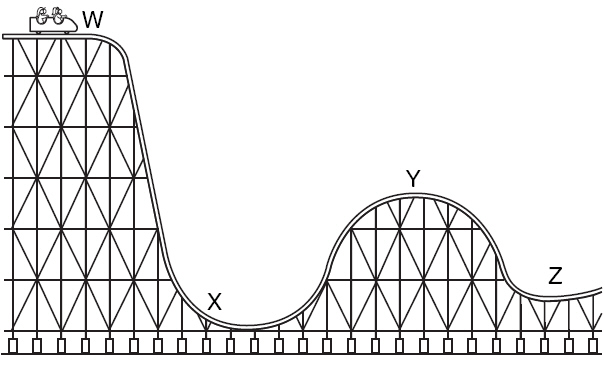
At which point is potential energy greatest?
a)
W
b)
X
c)
Y
d)
Z
7.
At which point is potential energy greatest?
a)
W
b)
X
c)
Y
d)
Z
8.
Has nucleus
a)
Prokaryote
b)
Eukaryote
c)
both
9.
Bacteria
a)
Prokaryote
b)
Eukaryote
c)
both
10.

Which type of cell?
a)
Prokaryote
b)
Eukaryote
11.

Which type of cell?
a)
Prokaryote
b)
Eukaryote
12.
Where is the DNA found in a prokaryotic cell?
a)
floating around in the cytoplasm
b)
in the nucleus
13.
Where is the DNA found in a eukaryotic cell?
a)
floating around in the cytoplasm
b)
in the nucleus
14.
What type of cell has a nucleus?
a)
eukaryotic
b)
prokaryotic
15.
What type of cell does not have a nucleus?
a)
eukaryotic
b)
prokaryotic
16.
What is true of all plants
a)
consumer
b)
decomposer
c)
producer
17.
A unusually fast zombie was chasing after Carl to eat him. What was the zombie’s speed at 6 seconds if he traveled 36 meters?
a)
6 meters/seconds
b)
6 seconds/meters
c)
.17 meters/second
d)
None of the above
18.
What forces cause a planet to orbit?
a)
gravity and orbit
b)
gravity and inertia
c)
gravity and mass
d)
gravity and weight
19.
Your mass increases on a large planet with more gravity.
a)
True
b)
False
20.
An astronaut's mass ______ in space.
a)
changes
b)
increases
c)
decreases
d)
stays the same
21.
Gravity on the moon is about 1/6 the gravity felt on the earth. This is because
a)
the moon is much less massive than the earth
b)
the earth has a molten core and the moon doesn't
c)
the moon is so much further from the sun than the earth.
d)
the moon is so far away from the earth
22.
What would happen to the planets in the solar system if the sun’s gravitational force were to suddenly disappear?
a)
They will stop moving and become static.
b)
They will stop spinning.
c)
They will fly away in straight lines.
d)
They will start moving toward the Sun
23.
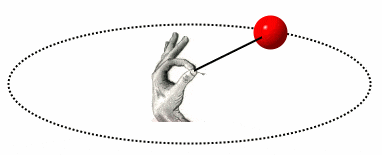
Which force in the Solar System is similar to the tension in the string?
a)
Friction
b)
Inertia
c)
Force
d)
Gravity
24.
If mass stays the same and distance increases then the gravity between two objects
a)
decreases
b)
increases
c)
stays the same
25.
This is the amount of matter in an object
a)
weight
b)
gravity
c)
mass
d)
inertia
26.
A bowling ball keeps rolling down the alley because of
a)
inertia
b)
gravity
c)
friction
d)
mass
27.
What is inertia?
a)
A force that attracts and repels objects.
b)
An object in motion that was to stay in a straight path unless it is acted upon by another force.
c)
A force that pulls objects "in" or together.
d)
A force that is measured in Newtons.
28.

what type of energy is stored in a battery?
a)
electrical
b)
chemical
c)
thermal
d)
mechanical
29.

Electrical Energy is transferred to _____ Energy.
a)
Thermal
b)
Solar
c)
Electrical
d)
None
30.
Which energy transformation occurs in a toaster?
a)
chemical to electric
b)
electric to thermal
c)
kinetic to chemical
d)
thermal to potential
31.

A battery converts what type of energy to another?
a)
sound to kinetic
b)
light to heat
c)
mechanical to electrical
d)
chemical to electrical
32.
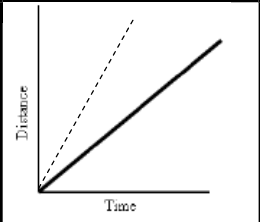
What does this graph represent?
a)
Constant Speed
b)
Acceleration
c)
Not moving
33.
What two measurements are necessary for calculating speed?
a)
Mass and time
b)
Temperature and mass
c)
Mass and distance
d)
Distance and time
34.

How long did it take this object to travel 10 m?
a)
0 s
b)
10 s
c)
15 s
d)
20 s
35.

At 60 seconds, how far had this object traveled?
a)
0 m
b)
10 m
c)
20 m
d)
40 m
36.
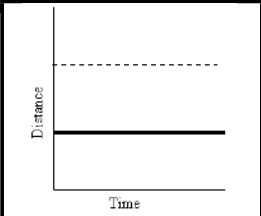
What does this graph represent?
a)
Constant speed
b)
Acceleration
c)
Not moving
37.

What does this graph represent?
a)
Constant speed
b)
Acceleration
c)
Not moving
38.

What is happening at C?
a)
Stationary
b)
Accelerating
c)
Fast steady speed; moving away from the starting position
d)
Slower steady speed; moving away from the starting position
39.

What is happening at D?
a)
Stationary
b)
Accelerating
c)
Fast steady speed; moving away from the starting position
d)
Slower steady speed; moving away from the starting position
40.
What is the formula to calculate speed?
a)
S = t/d
b)
S = d/t
c)
S = d x t
d)
S = t x d
41.

What is happening in this graph from point A to B?
a)
The object is accelerating.
b)
The object is not moving.
c)
The object is decelerating.
d)
The object is moving at a constant speed.
42.

What is happening in this graph from point B to C?
a)
The object is going down a hill.
b)
The object is returning to its starting location.
c)
The object is slowing down.
d)
The object is staying still.
100 %

