Wayground logo

Free Printable Worksheets

Font size

S
M
L
XL
Worksheets

Earth History

Total questions: 49

Worksheet time: 49mins

Name
Class
Date
1.
The age of a rock compared to the ages of other rocks.
a)
relative age
b)
half-life
c)
absolute age
d)
radioactive decay
2.

The process in which the nuclei of radioactive elements break down, releasing fast-moving particles and decay at a fixed rate

a)
relative age
b)
half-life
c)
absolute age
d)
radioactive decay
3.
The time it takes half of the atoms of a radioactive element to decay
a)
relative age
b)
half-life
c)
absolute age
d)
radioactive decay
4.
A gap in the geologic record that shows where rock layers have been lost due to erosion.
a)
extrusion
b)
unconformity
c)
intrusion
d)
law of superposition
5.
The Law of Superposition helps scientists to determine what?
a)
The absolute age of rock layers
b)
The age of fossils
c)
The relative age of rock layers
d)
the super powers of rocks
6.
According to the law of superposition, which layer is the youngest?
a)
A
b)
B
c)
C
7.
Paleozoic, Mesozoic & Cenozoic are all
a)
Epochs
b)
Eras
c)
Periods
d)
Eons
8.
Known as the age of the mammals?
a)
Mesozoic Era
b)
Holocene Epoch
c)
Cenozoic Era
d)
Cambrian
9.
The dinosaurs and reptiles were dominant in which Era?
a)
Precambrian
b)
Mesozoic
c)
Paleozoic
d)
Cenozoic
10.

Which era began with the early invertebrates, such as trilobites and brachiopods.

a)

Paleozoic

b)

Mesozoic

c)

Cenozoic

11.

early vertebrate fish began to develop in the

a)

Paleozoic era

b)

Mesozoic era

c)

Cenozoic era

12.

the first amphibians came later in the

a)

Paleozoic era

b)

Mesozoic era

c)

Cenozoic era

13.

Near the era’s end the reptiles such as amphibians became dominant.

a)

Paleozoic

b)

Mesozoic

c)

Cenozoic

14.

Flowering plants became most common.

a)

Paleozoic era

b)

Cenozoic era

c)

Mesozoic era

15.

Humans are a part of this era

a)

Paleozoic

b)

Mesozoic

c)

Cenozoic

16.

Cyanobacteria added this to the atmosphere

a)

carbon dioxide

b)

nitrogen

c)

carbon monoxide

d)

oxygen

17.

The Earth is estimated to be _____ years old

a)

4.6 million

b)

4.6 billion

c)

46 million

d)

46 billion

18.
Which era ended with the K-T extinction, probably due to an asteroid?
a)
Paleozoic
b)
Phanerozoic
c)
Cenozoic
d)
Mesozoic
19.
Pangea broke up in the 
a)
Paleozoic
b)
Mesozoic
c)
Archean
d)
Cenozoic
20.
Identify the Era:
called the "Age of Mammals"
a)
Precambrian
b)
Paleozoic
c)
Mesozoic
d)
Cenozoic
21.
Identify the Era:
Archaeopteryx lived in this era.
a)
Precambrian
b)
Paleozoic
c)
Mesozoic
d)
Cenozoic
22.
During the Cambrian Explosion that began the Paleozoic Era, the many new forms of life that evolved ____
a)
lived on land
b)
were invertebrates that lived in the sea
c)
were vertebrates covered with fur or scales
d)
were single-celled
23.
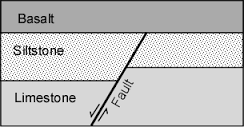
How does the law of crosscutting explain the age of a fault?
a)
The fault is younger than the rocks above it.
b)
The fault is younger than the rocks it cuts through.
c)
The fault is older than the rocks above it.
d)
The fault is older than the rocks it cuts through.
24.
What are the relative ages of the features in order from oldest to youngest?
a)
Limestone, Basalt, Fault, Siltstone
b)
Siltstone, Fault, Basalt, Limestone
c)
Limestone, Fault, Basalt, Siltstone
d)
Limestone, Siltstone, Fault, Basalt
25.
Which of the following correctly lists the layers in order from oldest to youngest?
a)
A, B, C, D, E
b)
E, B, C, D, A
c)
E, D, C, B, A
d)
C, B, A, D, E
26.
What is the difference between relative dating and absolute dating?
a)
Relative dating provides the exact age of a rock, while absolute dating provides a rough estimate of the rock’s age
b)
Relative dating can estimate a rock’s age only in relation to other objects or events, while absolute dating can provide an actual age
c)
Relative dating uses several types of radioactive decay to determine an object’s relative age, while absolute dating only uses the halflife of uranium 235
d)
Relative dating and absolute dating can only determine the rock’s age in relation to other objects or events
27.
One possible reason for the mass extinction during the Cretaceous period is due to an asteroid landing on Earth. How do you suppose an asteroid impacted the ecosystem in the area where it landed?
a)
The asteroid would cause avalanches, which buried the animals
b)
The dust from the impact would blacken the skies, preventing the plants from carrying out photosynthesis
c)
The dust from the asteroid would make all animals sterile
d)
The asteroid would carry dangerous radiation from outer space, which would wipe out the living things on Earth
28.
In the figure, "H" is ___________?
a)
an intrusion
b)
a splitting spike
c)
a contusion
d)
an inclusion
29.
Carbon dating is used on:
a)
organic samples
b)
minerals
c)
metamorphic rocks
d)
igneous rocks
30.
If a sample contains 100g of a radioactive isotope, how much will be left after 3 half lives?
a)
50g
b)
25g
c)
12.5g
d)
6g
31.
If a sample contains 60g of a radioactive isotope, how much will be left after 2 half-lives?
a)
30g
b)
15g
c)
7.5g
d)
120g
32.
A sample has 20g of an isotope with a half-life of 1000 yrs. How much is left after 2,000 yrs?
a)
10g
b)
5g
c)
2.5g
d)
.5g
33.
Why are isotopes with short half-lives not useful for dating very old rocks?
a)
because not enough of the parent isotope remains to measure accurately
b)
because not enough of the daughter product has formed to be detectable
c)
because neither the parent isotope nor the daughter product will be detectable
d)
because very old rocks would never have contained these isotopes
34.
Age of fish was during this era:
a)
Cenozoic
b)
Mesozoic
c)
Paleozoic
35.
The mostly deadly Mass Extinction (90% of species) occurs at the end of the...
a)
Paleozoic Era 
b)
Mesozoic Era
c)
Cenozoic Era
d)
Precambrian Time
36.

What was the cause of the extinction?

a)

A massive meteoroid

b)

Too much oxygen in oceans

c)

Too little oxygen in oceans

d)

A series of volcanic eruptions

37.

What of the period of the Mesozoic followed the Permian Extinction?

a)

Carboniferous

b)

Cretaceous

c)

Triassic

d)

Devonian

38.

The period of geologic time when the biodiversity of life on the planet increased dramatically was

a)

Jurassic

b)

Triassic

c)

Permian

d)

Cambrian

39.

The period when trilobites and eurypterids appeared was the

a)

Hadean

b)

Cambrian

c)

Holocene

d)

Jurassic

40.

The period of the Paleozoic when huge land plants were dominant and eventually became the coal and oil we use today.

a)

Cambrian

b)

Carboniferous

c)

Jurassic

d)

Miocene

41.

These organisms are important during Pre-Cambrian times and still exist today.

a)

Coral

b)

Petoskey Stones

c)

Hydrocarbons

d)

Stromatolites

42.

Which extinction event?

a)

K-T

b)

Permian

c)

Pleistocene

d)

Ordovician

43.

Which period of the Mesozoic?

a)

Triassic

b)

Jurassic

c)

Cretaceous

d)

Permian

44.
Which organism appeared first?
a)
Development of Fish
b)
Appearance of Humans
c)
First single-celled organisms (Cyanobacteria)
d)
Appearance of Jellyfish and Corals
45.

90% of Earth’s history occurred during which era?

a)

Precambrian

b)

Paleozoic

c)

Mesozoic

d)

Cenozoic

46.

Which of the following types of organisms benefited the most from the extinction of the dinosaurs?

a)

birds and mammals

b)

fishes and invertebrates

c)

flowering plants and ferns

d)

trilobites and cephalopods

47.
Flowering plants dominate during this era.
a)
Cenozoic 
b)
Mesozoic 
c)
cambrian
48.
One huge continent-Pangaea-forms.
a)
mesozoic
b)
cenozoic
c)
paleozoic
49.

Which of the following evolved during the Cenozoic Era

a)

grasses

b)

large grazing mammals

c)

humans

d)

all of these