
 Worksheets
ES Final Exam Review 1 (Plate Tectonics)
Total questions: 50
Worksheet time: 29mins
Name
Class
Date
1.
The tectonic plates float on the
a)
lithosphere
b)
lower mantle
c)
outer core
d)
asthenosphere
2.
The part of the earth that includes the crust and the upper mantle and is split into tectonic plates is the
a)
lithosphere
b)
crust
c)
asthenosphere
d)
mantle
3.
The thinest layer
a)
crust
b)
inner core
c)
mantle
d)
outer core
4.
This layer is completely liquid
a)
crust
b)
inner core
c)
mantle
d)
outer core
5.
This layer is completely solid due to the intense pressure it is under
a)
crust
b)
inner core
c)
mantle
d)
outer core
6.
Supporting Evidence: fossils, continent shape, landforms
a)
Continental Drift
b)
Seafloor Spreading
c)
Plate Tectonics
7.
Supporting Evidence: subduction, earthquakes, volcanoes, Mid-Atlantic Ridge, older theories
a)
Continental Drift
b)
Seafloor Spreading
c)
Plate Tectonics
8.
Supporting Evidence: discovery of Mid-Atlantic Ridge, core rock samples showing older rocks the farther that you get from the mid ocean ridge
a)
Continental Drift
b)
Seafloor Spreading
c)
Plate Tectonics
9.
The theory stating the continents were once joined in a large mass that broke apart.
a)
Continental Drift
b)
Seafloor Spreading
c)
Plate Tectonics
d)
Pangaea
10.
The process for new oceanic lithosphere forming at mid ocean ridges
a)
Continental Drift
b)
Seafloor Spreading
c)
Plate Tectonics
d)
Pangaea
11.
The theory that states that the Earth is divided into plates that float and move in slow, constant motion.
a)
Continental Drift
b)
Seafloor Spreading
c)
Plate Tectonics
d)
Tectonic Plates
12.
Ocean trenches always form at subduction zones where dense oceanic crust subducts.
a)
True
b)
False
13.
Volcanoes never form along subduction zones.
a)
True
b)
False
14.
The circular pattern of heating, rising, cooling, sinking of magma in the mantle causing tectonic plates to move.
a)
Plate Tectonics
b)
Convection Currents
c)
Pangaea
d)
Subduction
15.
The Mid-Atlantic Ridge is formed at this boundary.
a)
Divergent
b)
Convergent
c)
Normal
d)
Transform
16.
There are 3 types of crust.
a)
True
b)
False
17.
Continental crust is more dense than oceanic crust.
a)
True
b)
False
18.
Hot spots are volcanically active areas that are not near tectonic plate boundaries.
a)
True
b)
False
19.
Scientists think that convection currents flow in Earth's
a)
continents
b)
mantle
c)
lithosphere
d)
inner core.
20.

One large landmass
a)
North America
b)
Pangaea
c)
South America
d)
PanAmerica
21.

Plates sliding past each other in opposite directions
a)
Convergent
b)
Divergent
c)
Subduction
d)
Transform
22.

Which was NOT evidence of Wegener?
a)
Seafloor spreading
b)
fossils
c)
puzzle piece
d)
glacier evidence
23.

Geologists study the inside of the Earth by using____
a)
seismic waves
b)
sound waves
c)
light waves
d)
EM waves
24.
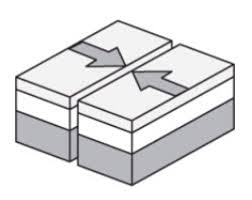
Name the boundary
a)
convergent boundary
b)
divergent boundary
c)
transform boundary
d)
sergent boundary
25.
A subduction zone is formed...
a)
when one tectonic plate sinks below another
b)
at every type of convergent plate boundary
c)
at every type of divergent plate boundary
d)
at transform boundaries
26.
What are mid-ocean ridges?
a)
A chain of underwater waterfalls
b)
A chain of underwater volcanos
c)
A chain of underwater mountains
d)
A chain of underwater rocks
27.

Who is the person credited with developing the theory of continental drift?
a)
Harry Hess
b)
Galileo
c)
Alfred Wegener
d)
Newton
28.
A collision between two pieces of continental crust at a converging boundary produces a
a)
mid ocean ridge
b)
deep ocean trench
c)
rift valley
d)
mountain range
29.
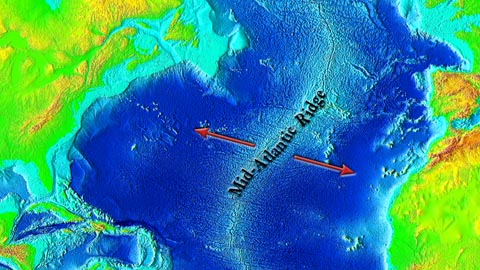
The image shows the Mid Atlantic Ridge. Which type of boundary occurs at this ridge where the ocean floor is spreading apart?
a)
convergent
b)
divergent
c)
transform fault
30.
If the focus of an earthquake occurs beneath the sea floor, as the seismic waves travel through the ocean, they create a massive and destructive
a)
epicenter
b)
tsunami
c)
focus
d)
mountain
31.
Where is the point on the Earth’s surface directly above the focus of an earthquake?
a)
Epicenter
b)
Fault
c)
Hypocenter
d)
Tremor
32.

Once magma reaches the earth's surface it is called.....
a)
Silica
b)
Rock
c)
lava
33.
What is the difference between magma and lava?
a)
Lava is inside the Earth, magma is outside.
b)
Lava is outside the Earth, magma is inside.
34.
This is the name for the chain of volcanos around the edge of the Pacific Plate.
a)
Circle of Fire
b)
Ring of Lava
c)
Ring of Fire
d)
Circle of Magma
35.

The youngest material of the ocean floor is found at mid-ocean _________.
a)
ridges
b)
trenches
c)
basins
d)
rifts
36.

The presence of the same ________ on several continents supports the idea of continental drift.
a)
rocks
b)
fossils
c)
both fossils and rocks
d)
neither fossils nor rocks
37.

The theory of _______ states that Earth’s crust and upper mantle are broken into sections that are in constant, slow motion.
a)
plate tectonics
b)
continental drift
c)
seafloor spreading
d)
divergent boundaries
38.

Many scientists think hot plastic-like rock in the mantle is forced upward toward the surface, cools, and sinks. This process is called a(n) _________.
a)
earthquake
b)
convergent boundary
c)
volcano
d)
convection current
39.

The theory of seafloor spreading was first proposed by __________.
a)
Thomas Edison
b)
Harry Hess
c)
Benjamin Franklin
d)
Alfred Wegener
40.

What is the correct order (starting from the surface) of Earth’s layers?
a)
mantle, outer core, inner core, crust
b)
crust, mantle, outer core, inner core
c)
outer core, inner core, crust, mantle
d)
crust, outer core, inner core, mantle
41.

The San Andreas Fault in California is an example of a ________.
a)
divergent boundary
b)
convergent boundary
c)
transform fault
d)
subduction zone
42.

When plates slide past one another, _________ occur.
a)
divergent boundaries
b)
convection currents
c)
subduction zones
d)
transform faults
43.
subduction zones can create
a)
Trenches
b)
volcanoes
c)
earthquakes
d)
all of the above
44.
Transform boundaries are most likely to produce what geological event?
a)
volcanoes
b)
deep sea trenches
c)
underwater mountain ranges
d)
earthquakes
45.
When an oceanic plate and a continental plate collide, which one will subduct?
a)
oceanic
b)
continental
c)
neither
46.
Geologists obtain evidence about Earth's interior by...
a)
measuring pressure at the surface
b)
studying seismic waves
c)
drilling through each layer
d)
estimation of temperature in the layers
47.
What type of boundary does not destroy or create new crust?
a)
Divergent
b)
Transform
c)
Convergent
48.
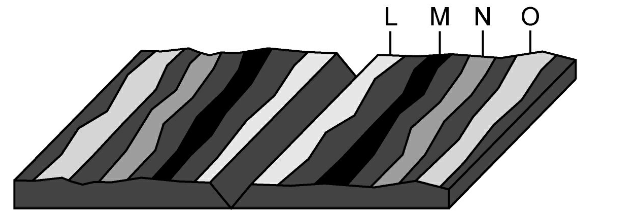
Where would the oldest rock be found?
a)
L
b)
M
c)
N
d)
O
49.
How is it possible for new crust to be formed without increasing the surface area of the Earth?
a)
Crust is destroyed at the same time it is created
b)
New crust is underwater where it sinks
c)
New crust breaks more easily than old crust
50.

Which of these events can ONLY happen on a DIVERGENT BOUNDARY?
a)
Rift Valley
b)
Mountain
c)
A peninsula
d)
An Insanely complex, long answer that you will click out of instinct.
100 %

