
 Worksheets
Forces and Scientific Method review
Total questions: 75
Worksheet time: 57mins
Name
Class
Date
1.

What is the net force?
a)
40 N left
b)
0 N Balalnced
c)
400 N right
d)
40 N right
2.

How will this object move?
a)
It won't move.
b)
It will move to the right.
c)
It will move to the left.
d)
It will move in both directions.
3.
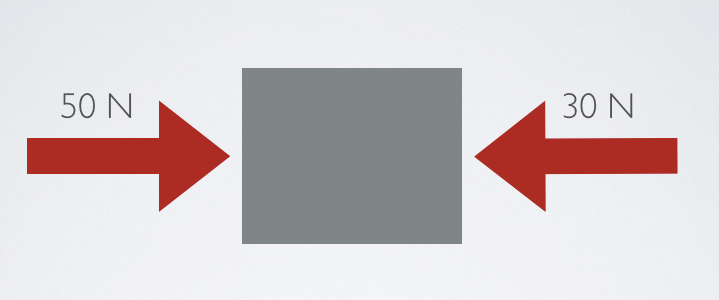
How will this object move?
a)
It won't move.
b)
It will move to the right.
c)
It will move to the left.
d)
It will move up.
4.

What is the net force?
a)
30 N left
b)
25 N right
c)
5 N left
d)
55 N right
5.
You and your dad are moving the couch from one side to another. Your dad pushes with a force of 35 N to the right and you push with a force of 25 N right. What is the net force on the couch?
a)
60 N right
b)
10 N left
c)
60 n right
d)
50 N left
6.

What is the net force?
a)
400 N Up
b)
400 N Down
c)
- 400 N Down
d)
800 N Down
7.

Forces that have a net force of zero ( the object is still).
a)
Balanced force
b)
Unbalanced force
8.
The sum of all forces acting on an object and direction
a)
Contact Force
b)
Balanced Force
c)
Unbalanced Force
d)
Net Force
9.
8 N to the left , and 4 N to the right. Find the net force. Is this balanced
a)
12 N Right No
b)
4 N Left No
c)
12 N Right Yes
d)
4 N Left Yes
10.
(T or F?) A balanced force is only an object that is not moving.
a)
True
b)
False
11.

Balanced or Unbalanced?
a)
Balanced
b)
Unbalanced
12.

Are forces balanced or unbalanced when a car is moving at a constant speed in a straight line?
a)
Balanced
b)
Unbalanced
13.
for every action there is...
a)
An equal and opposite reaction
b)
An equal and different reaction
c)
a different force
d)
two more forces
14.
The force that opposes the motion of two surfaces sliding past each other is called ___________.
a)
acceleration
b)
inertia
c)
friction
d)
unbalanced
15.
What is the unit of force?
a)
Kilogram
b)
Meter
c)
Pascal
d)
Newton
16.
What is the attraction between two objects because of their mass?
a)
Inertia
b)
Gravity
c)
Gravitational Force
d)
Weight
17.

This is a rocket.The rocket pushes the fuel down.What is the other force in this interaction pair?
a)
The fuel pulls the rocket up.
b)
The fuel pushes the rocket up.
c)
The rocket pulls the earth up.
d)
The earth pulls the rocket down.
18.

On the Picture the balloon pushes the air right and the balloon goes left. Which of Newton's Laws is this?
a)
Newton's 1st Law
b)
Newton's 2nd Law
c)
Newton's 3rd Law
19.
Which has more mass, a kilogram of feathers or a kilogram of iron?
a)
feathers
b)
iron
c)
neither
20.
A book rests on a table. The force of gravity pulls down on the book with a force of 20 newtons. What prevents the books from accelerating downward at 9.8 m/sec2
a)
The table presses back up on the book with an equal and opposite force of 20 newtons.
b)
The table presses back up on the book with a force greater than 20 newtons.
c)
The table and the book together are accelerating downwards at 9.8 m/sec2
d)
The inertia of the book holds it up
21.
Inertia is the tendency of an object to resist a change in its ___________.
a)
temperature
b)
shape
c)
size
d)
motion
22.
You push on a tree with 20 N of force. If the tree doesn't move, the tree is pushing back on you with _____of force.
a)
20N
b)
40N
c)
10N
d)
70N
23.
Which is Newtons second law
a)
Force is equal to an objects mass times its velocity
b)
an object in motion stays in motion or an object at rest stays at rest unless acted on by an outside force.
c)
law of inertia
d)
For every action there is an equal and opposite reaction
24.
If you dropped a bowling ball and a golf ball from the top of a building, which one would hit the ground first?
a)
bowling ball
b)
baseball
c)
neither
d)
both
25.
45 m/s2 is the...
a)
Mass
b)
Force
c)
Acceleration
d)
weight
26.
If you slide a hockey puck on ice, eventually it will stop because of the friction of the ice. This is an example of which Law of Motion.
a)
Newton's First Law
b)
Newton's Second Law
c)
Newton's Third Law
27.
A person not wearing a seat belt flies through a car window when someone slams on the breaks because the person’s body wants to remain in continuous motion even when the car stops.
a)
Newton's 1st Law
b)
Newton's 2nd Law
c)
Newton's 3rd Law
d)
None of them
28.
According to Newton's Third Law of Motion, when a hammer strikes and exerts a force on a nail, the nail
a)
disappears into the wood
b)
moves at a constant speed
c)
exerts an equal and opposite force back on the hammer
d)
creates a balanced force
29.

What force brings the pencil down?
a)
Applied
b)
Magnetic
c)
Normal
d)
Gravitational
30.
Which has more gravitational force acting upon it?
a)
a bus
b)
a train
c)
a car
d)
a person
31.

What force ultimately slows the roller coaster to a stop?
a)
Applied
b)
Normal
c)
Friction
d)
Magnetic
32.
Simon wanted to know if the height of a ramp affected how fast the car went down it. What part of this experiment is Simon's INDEPENDENT (Test) Variable?
a)
height of the ramp
b)
the type of car
c)
the speed of the car
d)
there isn't one
33.
Simon wanted to know if the height of a ramp affected how fast the car went down it. What part of this experiment is Simon's Dependent (Outcome) Variable?
a)
there isn't one
b)
the height of the ramp
c)
the type of car
d)
the speed of the car
34.
After Simon conducted his experiment he analyzed his data and saw some speeds that were surprising. Why would it be a good idea for Simon to ask his friends to replicate (redo) his experiment?
a)
They can test many more different variables that he did
b)
they can compare their results to Simon's to see if he was accurate
c)
So they can get better results
d)
They wouldn't do that, scientists do repeat other scientists experiments.
35.
Speed is
a)
the distance covered per unit of time
b)
the time it takes something to move a certain distance
c)
distance x time
d)
time x distance
36.
If a 10 kilogram object accelerates suddenly at 15 m/s^2, how much force was applied to the object?
a)
150 Newtons
b)
15 Newtons
c)
150 kilograms
d)
100 kilograms
37.
A push or pull exerted on an object
a)
Force
b)
Net force
c)
Momentum
d)
Speed
38.
How does friction affect speed?
a)
more friction decreases speed
b)
more friction increases speed
c)
less friction decreases speed
d)
less friction doesn't affect speed
39.
Friction is a force that acts in an ___________ direction of movement.
a)
similar
b)
opposite
c)
parallel
d)
west
40.
A type of friction that occurs when air pushes against a moving object causing it to decelerate.
a)
surface area
b)
air resistance
c)
velocity
d)
gravity
41.
Which of the following is an example of friction that is helpful?
a)
Brakes used on a bike
b)
Tires from a car on the road
c)
Tread on the bottom of your shoes
d)
All are examples that are helpful
42.

What type of friction is not moving?
a)
static
b)
sliding
c)
fluid
d)
rolling
43.
What does friction produce?
a)
light
b)
sound
c)
heat
d)
gravity
44.
Which type of friction occurs when an object rolls over or rotates on a surface?
a)
sliding
b)
static
c)
fluid
d)
rolling
45.

Wheels on a skateboard most likely experiences-
a)
Rolling Friction
b)
Sliding Friction
c)
Fluid Friction
d)
Static Friction
46.

Which of the following shows the direction of the friction force?
a)
A
b)
B
c)
C
d)
D
47.
There is more friction between _________ surfaces.
a)
smooth
b)
slippery
c)
hard
d)
rough
48.

Sally experiences-
a)
Rolling Friction
b)
Sliding Friction
c)
Fluid Friction
d)
Static Friction
49.

Swimming fish experience-
a)
Rolling Friction
b)
Sliding Friction
c)
Fluid Friction
d)
Static Friction
50.
Which of the following is NOT an example of friction?
a)
using the brakes on your bike to slow you down
b)
putting your hand out the window
c)
a satellite traveling through deep space
d)
a hockey puck going across an ice rink
51.
On which surface will a toy car travel the furthest?
a)
Carpet
b)
Polished Wood
c)
Ice
52.
Rougher surfaces have ...
a)
greater friction
b)
less friction
c)
the same level of friction
53.
If you blow up a balloon, and then release it, the balloon will fly away. This is an illustration of...
a)
Newton's first law
b)
Newton's second law
c)
Newton's third law
d)
Galileo's law of inertia
54.

If there is a big mass, it would need a stronger force to accelerate it. Which law does this describe?
a)
Newton's 1st Law
b)
Newton's 2nd Law
c)
Newton's 3rd Law
55.
What is Newton's First Law known as? The Law of
a)
Inertia
b)
Mass
c)
Gravity
56.

A student leaves a pencil on a desk and it stays there until I pick it up.
a)
1st Law
b)
2nd Law
57.
Why do scientists use the scientific method?
a)
To make sure they get credit for their discoveries.
b)
To make sure their results are valid and can be performed by other scientists.
c)
So that other scientist don't get mad at them
58.
If plants are exposed to sunlight, then they will grow taller.
What part of the scientific method is this an example of?
What part of the scientific method is this an example of?
a)
Procedure
b)
Hypothesis
c)
Question
d)
Results
59.
What step does every scientific experiment begin with?
a)
hypothesis
b)
question/problem
c)
procedures
d)
conclusion
60.
Observations made during an experiment are considered:
a)
data
b)
problems
c)
conclusions
d)
questions
61.

What is a hypothesis?
a)
an educated guess stating what you believe will be the result of your experiement
b)
a random guess
c)
a statement of the outcome of your experiment
d)
step by step directions for your experiment
62.
The independent variable is the ONE thing you _____.
a)
change on purpose
b)
control or keep constant
c)
measure
63.
The variable that is being measured or observed is called the _______________. Hint: this is the variable that is the result or effect
a)
independent variable
b)
dependent variable
c)
control variable
64.
What is a constant/control in an experiment?
a)
Things that do not change inana experiment. It's the variable that stays the same. You can have many variables stay the same.
b)
It's the variables that the scientist changes in the experiment
c)
It's the variables that are being measured in an experiment
65.
The summary at the end of an experiment that explains the results is called the ___________________
a)
conclusion
b)
procedures
c)
materials
d)
responding variable
66.

What is being changed in this experiment?
a)
ramp height
b)
the speed that the ball rolls
c)
type of ball
67.

What is being measured or the result/effect of this experiment?
a)
ramp height
b)
the speed that the ball rolls
c)
type of ball
68.

What is being kept constant?
a)
ramp height
b)
speed of the ball rolling
c)
type of ball
69.

What is being changed in this experiment?
a)
temperature of the stove
b)
how fast the water boils
c)
amount of water
70.

What is being measured or the result/effect of this experiment?
a)
how fast the water boils
b)
amount of water
c)
temperature of stove
71.
A series of steps used by scientists to solve a problem or answer a question.
a)
scientific method
b)
recipe
c)
data collection
d)
metric system
72.

Which statement is an inference about this picture?
a)
The van is tan.
b)
The van ran into KFC.
c)
The driver was hungry.
d)
Red and white are part of the KFC building.
73.
An experiment is performed on plants to see how different liquids affect plant growth. Each plant in the experiment is given a different liquid; water, apple juice, or milk. Each plant has the same amount of soil, sunlight, and listens to the same music. In this investigation, what is the dependent variable?
a)
Type of plant
b)
Water, apple juice, milk
c)
Plant growth
d)
Color of the plant's leaves
74.
When experimenting with the growth of a plant, a scientist uses three (of the same type of) plants, two different fertilizers, equal light, and equal water. What type of variable is the fertilizer?
a)
Dependent
b)
Independent
c)
Control
d)
Compound
75.
A student is planning an experiment to find out how the height from which he drops a ball affects how high the ball bounces. The dependent variable is the _____.
a)
Diameter of the ball
b)
Force acting on the ball
c)
Height that the ball bounces
d)
Height from which the ball is dropped
100 %

