wayground logo

Free Printable Worksheets

NEW

Font size

S
M
L
XL
Worksheets

8th grade Science Final Exam Review

Total questions: 73

Worksheet time: 55mins
Name
Class
Date
1.

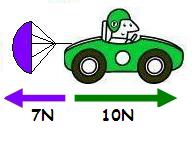
What is the net force?

a)

3 N

b)

3 N, right

c)

17 N, right

d)

3 N, left

2.

What is the unit to MEASURE force?

a)

Kilogram

b)

Meter

c)

Pounds

d)

Newton

3.

A ____________ is a push or a pull on an object.

a)

friction

b)

force

c)

magnet

d)

gravity

4.
Balanced or unbalanced?
a)
balanced
b)
unbalanced
5.
What force holds the planets in motion around the sun?
a)
Magnetic
b)
Electrical
c)
Gravitational
d)
Air Resistance
6.
What does the strength of gravity between two objects depend upon?
a)
Mass & distance
b)
Mass & weight
c)
Gravity & inertia
d)
Inertia & mass
7.
This type of force resist motion between two surfaces that are pressed together
a)
contact
b)
gravity
c)
friction
8.

How does the mass of an object affect it's motion?

a)

It has no effect

b)

The less the mass the less effect a force will have

c)

The greater the mass the greater the effect a force will have

d)

The greater the mass the less effect a force will have

9.
What law?
a)
1st
b)
2nd
c)
3rd
10.

For every action force there is a reaction force is which or newtons laws?

a)

first

b)

second

c)

third

11.
Where is the force of attraction the strongest on a magnet?
a)
at the poles
b)
in the middle
c)
above the magnet
d)
below the magnet
12.
What do the lines around this magnet represent?
a)
North Pole
b)
South Pole
c)
Magnetic Declination
d)
Magnetic Field
13.

What has the greatest effect on magnetic force?

a)

Friction

b)

Distance from magnetic poles

c)

Gravity

d)

Mass

14.

How will these charges interact?

a)

Repel

b)

Attract

c)

No interaction

15.

How will these charges interact?

a)

Repel

b)

Attract

c)

No interaction

16.

How will these charges interact?

a)

Repel

b)

Attract

c)

No interaction

17.

Repel means

a)

To pull toward each other.

b)

To push away from each other.

c)

Neither positive nor negative.

d)

Either a negative (-) or positive (+) charge.

18.

Attract means

a)

To pull toward each other.

b)

Either a negative (-) or positive (+) charge.

c)

To push away from each other.

d)

Neither positive nor negative.

19.

What is the net charge of the balloon in the picture?

a)

-1

b)

+1

c)

-2

d)

0

20.

What is the net charge of the balloon?

a)

-1

b)

+1

c)

0

d)

+2

21.

How will the two balloons interact?

a)

Attract

b)

Repel

c)

No interaction

22.

How will the two balloons interact?

a)

Attract

b)

Repel

c)

No interaction

23.

Weight is _________.

a)

the quantity of matter in an object.

b)

the measure of an object's inertia.

c)

the force exerted by gravity on an object's mass.

d)

equal to the mass of an object.

24.
The force of gravity acting on an object is the object's ______.
a)
mass
b)
matter
c)
weight 
d)
friction 
25.
The amount of matter in an object is 
a)
pressure
b)
weight
c)
mass
d)
force
26.
A person would weigh less on on the Moon than on the Earth because . . .
a)
Moon has more mass, and therefore more gravity
b)
Moon has less mass, and therefore more gravity
c)
Moon has more mass, and therefore less gravity
d)
Moon has less mass and therefore less gravity
27.
Energy due to motion is ____________ energy. 
a)
Potential 
b)
Energy
c)
Kinetic
d)
Friction
28.
The faster an object moves, the ________ kinetic energy it has. 
a)
more
b)
less
c)
none of the above
d)
all of the above 
29.
__________ is stored energy. 
a)
Potential
b)
Kinetic
c)
None of the above 
d)
All of the above 
30.
At which point is potential energy greatest?
a)
W
b)
X
c)
Y
d)
Z
31.
When a pendulum swings, at which point is kinetic energy highest?
a)
1
b)
2
c)
3
d)
4
32.
When a pendulum swings, at which point is potential energy at its greatest?
a)
1
b)
2
c)
3
d)
4
33.
On a roller coaster, where is maximum kinetic energy?
a)
At the bottom of a big hill
b)
When going around a corner
c)
When going upside down
d)
At the top of a big hill
34.
Which point has the most potential energy?
a)
G
b)
f
c)
b
d)
a
35.
Which 2 letters have the most kinetic energy
a)
W & Y
b)
X & Z
36.
At which point is potential energy greatest?
a)
W
b)
X
c)
Y
d)
Z
37.
At which point is kinetic energy greatest?
a)
W
b)
X
c)
Y
d)
Z
38.
What kind of energy is in an acorn hanging from an oak tree?
a)
Potential
b)
Kinetic
39.

The statement that "the energy within a system remains constant and cannot be created or destroyed, only transformed" best sums up _________.

a)

Something Mr. Lance likes to say.

b)

Life

c)

Law of Conservation of Energy

d)

The scientific method

e)

Newton's Third Law

40.

speed with a direction

a)

motion

b)

velocity

c)

acceleration

d)

distance

41.

Which of the following statements is correct?

a)

The car has less kinetic energy because it has more mass than the girl.

b)

The car has the most kinetic energy because it has more mass than the girl.

c)

The car and the girl have the same amount of kinetic energy because they are moving at the same speed.

d)

The girl has the most kinetic energy because she has less mass than the car.

42.

Car 1 and Car 2 have the same mass. Which of the following statements is true?

a)

Car 1 has the most kinetic energy because it is moving at a faster rate of speed.

b)

Car 2 has the least amount of kinetic energy because it is actually smaller than car one.

c)

Car 2 has the most kinetic energy because it is moving at a slower rate of speed.

d)

Car 1 has the least amount of kinetic energy because it is moving at a faster rate of speed.

43.

Which of the following is a correct statement?

a)

Both the mass and speed of an object affect the amount of kinetic energy it will have.

b)

Only the speed of an object affects the amount of kinetic energy it will have.

c)

Only the mass of an object affects the amount of kinetic energy it will have.

d)

Neither the mass nor speed of an object affects the amount of kinetic energy; only the height of the object.

44.

Objects with MORE MASS have______________

a)

lower potential energy

b)

lower number of atoms

c)

higher thermal energy

d)

higher temperature

45.

Which will have the HIGHEST thermal energy?

a)

Hot cup of tea

b)

Cold bathtub water

c)

Huge lake

d)

Warm bowl of soup

46.

Which will have the LOWEST thermal energy?

a)

Large mug of hot coffee

b)

Baby bottle with warm milk

c)

Gatorade jug of cold Gatorade

d)

Large frozen puddle

47.

Objects with MORE MASS have MORE thermal energy because

a)

there are more molecules with energy in bonds

b)

there are less atoms

c)

there is less kinetic energy in the system

d)

there is no potential energy at all

48.
An object through which electrons can easily flow is called a(n) ___________.
a)
Conductor
b)
Insulator
49.
To have a complete electric circuit, the path must be _____
a)
small
b)
closed
c)
big
d)
open
50.

Will this circuit light the bulbs?

a)

Yes, both will light up

b)

Yes, but only the one on the right

c)

Yes, but only one on the left

d)

No, neither of the bulbs will light up

51.

Is this a working circuit?

a)

Yes

b)

No

c)

I'm not sure, I would need to test it myself.

52.
If the electric circuit is CLOSED, the switch is _______. 
a)
ON
b)
OFF
53.
If the electric circuit is OPEN, the switch is ____.
a)
ON
b)
OFF
54.

What do all waves transfer?

a)

Matter

b)

Heat

c)

Electricity

d)

Energy

55.

What is the number of complete waves passing a fixed point in a given amount of time?

a)

Amplitude

b)

Intensity

c)

Wavelength

d)

Frequency

56.

What is the distance between the calm sea and the highest wave called?

a)

Wave

b)

Frequency

c)

Amplitude

d)

Magnitude

57.

What does #1 represent?

a)

Period

b)

Frequency

c)

Wavelength

d)

Amplitude

58.

What does #2 represent?

a)

Period

b)

Frequency

c)

Wavelength

d)

Amplitude

59.
Why does the pencil look broken?
a)
Light is refracting
b)
Light is reflecting
c)
Light is absorbing
d)
Light is diffusing
60.
Why does a spoon look bigger in the water than it does on the top?
a)
The light refracts as it moves from air to water
b)
The light reflects as it moves from air to water
c)
The light absorbs as it moves from air to water
d)
The light is diffused as it moves from air to water
61.
Which of the figures represents reflection?
a)
A
b)
B
c)
C
d)
D
62.

In the northern hemisphere, we are experiencing _________ when Earth is tilted towards the Sun and _________ when it is tilted away from the Sun.

a)

winter, summer

b)

spring, fall

c)

summer, spring

d)

summer, winter

63.
When does the Southern Hemisphere experience the coldest weather?
a)
When the Earth's orbit is the fastest
b)
When the South Pole is tilted toward the Sun
c)
When the South Pole is tilted away from the Sun
d)
When the northern and southern hemispheres get equal amount of sunlight
64.
When would we have a shorter amount of daylight?
a)
Earth was larger
b)
The Sun was larger
c)
Earth rotated quicker 
d)
Earth rotated slower
65.
Seasons would change significantly if this were to change...
a)
The speed of Earth's rotation
b)
the Earth's orbit changed direction
c)
The Sun's rotation changed speed
d)
the Earth's tilt were changed
66.
What is the reason why we experience seasons on Earth?
a)
Earth's distance from the Sun
b)
The speed of Earth's rotation
c)
The tilt of the Earth
d)
The sun's orbit around Earth
67.
An example of a gravitational interaction is that the Earth. . . 
a)
orbits the Sun.
b)
orbits the moon.
68.
What holds the planets in their orbits around the sun?
a)
gravity
b)
speed
c)
string
d)
air currents
69.
Which object has the most gravity?
a)
Earth
b)
moon
c)
Jupiter
d)
sun
70.
Does this graph show relative size or distance from the sun of the planets?
a)
It shows both size and distance.
b)
It does not show size or distance.
c)
It shows distance from the sun
d)
It shows relative size.
71.
Which movement creates day/night?
a)
rotation
b)
revolution
72.
Which movement creates years?
a)
rotation
b)
revolution
73.
How does the distance between two objects affect the force of gravity?
a)
The closer the two objects are the more gravitational force they have.
b)
The farther apart the two objects are the more gravitational force they have.
c)
The closer the two objects are the less gravitational force they have.