wayground logo

Free Printable Worksheets

NEW

Font size

S
M
L
XL
Worksheets

Waves Study Guide

Total questions: 75

Worksheet time: 1hrs 4mins

Name
Class
Date
1.

_____ waves NEED a medium to travel.

a)

Seismic

b)

Light

c)

Mechanical

2.

Radio Waves are an example of _________ waves.

a)

mechanical

b)

electromagnetic

c)

light

3.

The distance in between two waves.

a)

wave speed

b)

frequency

c)

wavelength

4.

Frequency is always measured in _________

a)

kilometers

b)

Hertz

c)

centimeters

5.

the number of waves that pass a certain point.

a)

wave speed

b)

frequency

6.

when a wave hits a barrier and bounces

a)

diffraction

b)

reflection

7.

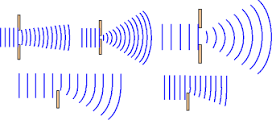
You're in your room blasting music with the door shut, your mom opens your door. Now your music is heard throughout your home. This is an example of _______

a)

interference

b)

diffraction

c)

reflection

8.

When two waves overlap each other, this behavior is known as _______.

a)

interference

b)

refraction

c)

frequency

9.

If the amplitude increases during interference, this is __________

a)

destructive interference

b)

constructive interference

10.

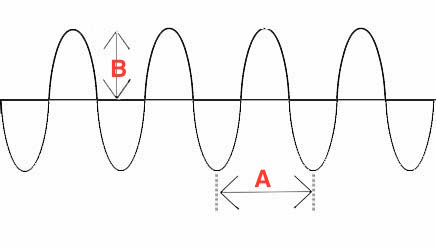
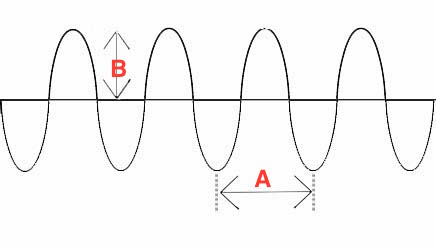
This is a high frequency wave. Which part of the wave is "B"

a)

crest/peak

b)

wavelength

c)

trough

11.

Look at this wave. "A" is which part of a wave?

a)

Crest/Peak

b)

Wave Speed

c)

Resting Point

12.

Which wave has the longest wave length?

a)

top wave

b)

bottom wave

13.

Does this wave have a high frequency or low frequency?

a)

High

b)

Low

14.
How often a wave occurs is the wave's __________________
a)
crest
b)
frequency
c)
wavelength
d)
resting point
15.
The distance between 2 corresponding parts of a wave  (example- crest to crest) is its _____________________
a)
trough
b)
frequency
c)
amplitude
d)
wavelength
16.
The frequency of a wave is measured in __________________. 
a)
inches
b)
hertz
c)
periods
d)
eras
17.
Mechanical waves are created when a source of energy causes a medium to  _________________.
a)
vibrate
b)
expand
c)
move
d)
compress
18.
Any material that a wave travels through is called a ____________________.
a)
vibration
b)
compression
c)
medium
d)
crest
19.
In what type of wave does the medium vibrate parallel to the direction of the wave?
a)
surface wave
b)
longitudinal wave
c)
transverse wave
d)
electromagnetic wave
20.
The three types of mechanical waves are transverse, surface, and _______________ waves
a)
medium
b)
water
c)
longitudinal
d)
crest
21.
In longitudinal waves, the parts where the coils are spread apart are called what?
a)
rarefactions
b)
compressions
c)
mechanicals
d)
longitudes
22.
In what type of wave does the medium move perpendicular to the movement of the wave?
a)
Transverse
b)
Longitudinal
c)
Electromagnetic
d)
Radio
23.
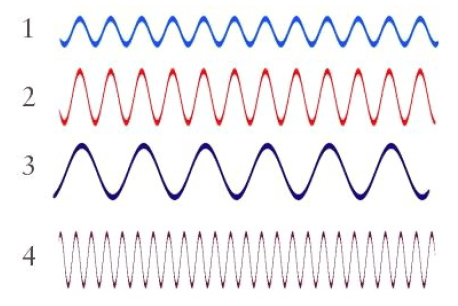
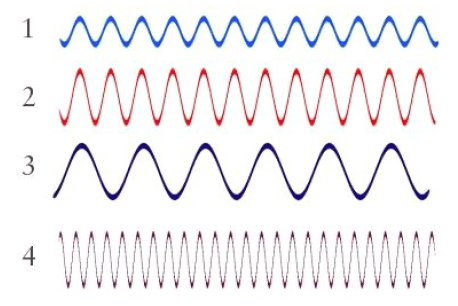
What number represents the wavelength?
a)
1
b)
2
c)
3
d)
4
24.
As the frequency of a wave increases, the __________________ decreases.
a)
amplitude
b)
resting point
c)
wavelength
d)
crest
25.
What number represents the amplitude?
a)
1
b)
2
c)
3
d)
4
26.
In a longitudinal wave, the parts where the coils are close together are called what?
a)
longitudes
b)
rarefactions
c)
compressions
d)
contractions
27.
What property of this wave is represented by the letter "A"
a)
amplitude
b)
crest
c)
trough
d)
wavelength
28.
What property of the wave is represented by the letter "B"?
a)
amplitude
b)
crest
c)
trough
d)
wavelength
29.
The number of wavelengths that pass a point each per second is:
a)
frequency
b)
period
c)
longitudinal 
d)
transverse wave 
30.
The type of waves that require medium to pass:
a)
Mechanical Waves
b)
Electromagnetic Waves
31.
When the frequency of a wave increases, what happens to the wavelength?
a)
The wavelength is not directly affected by the frequency of a wave.
b)
The wavelength increases.
c)
The wavelength decreases.
d)
More specific information is needed to form a conclusion about the wavelength.
32.
A mechanical wave cannot travel through...
a)
a vacuum(empty space).
b)
water.
c)
air. 
d)
glass.
33.
Which wave in the diagram has the greatest frequency?
a)
1
b)
2
c)
3
d)
4
34.
Which wave in the diagram has the greatest wavelength?
a)
1
b)
2
c)
3
d)
4
35.
Which of the following can sound travel through?
a)
solid
b)
liquid
c)
gas
d)
all of the above
36.
Electromagnetic waves include the following except
a)
radio waves
b)
X-rays
c)
doing the wave at a football game
d)
microwaves
37.
regular disturbances that carry energy through matter or space
a)
crest
b)
energy
c)
wave
d)
trough
38.
which material does sound travel the fastest?
a)
solid 
b)
liquid 
c)
gases
39.
When a wave strikes and object and bounces off. (example echo)
a)
medium
b)
refraction
c)
reflection
d)
interference
40.
When a wave bends as it passes through at an angle from one medium to another.(example: pencil in a glass of water-)
a)
medium
b)
refraction
c)
reflection
d)
interference
41.
When the frequency of a wave increases, what happens to the wavelength?
a)
The wavelength is not directly affected by the frequency of a wave.
b)
The wavelength increases.
c)
The wavelength decreases.
d)
More specific information is needed to form a conclusion about the wavelength.
42.

What is being transferred with a wave?

a)

medium

b)

energy

c)

matter

d)

Chicken

43.

Increasing the amplitude means you are increasing the _______________ of a wave.

a)

frequency

b)

amplitude

c)

energy

d)

wavelength

44.

Which of the following properties makes a light wave different from all mechanical waves?

a)

A light wave slows down in a vacuum.

b)

A light wave is able to transmit energy.

c)

A light wave exists as a transverse wave.

d)

A light wave can travel without a medium.

45.

Waves that need a medium are called?

a)

Electromagnetic Waves

b)

P-Waves

c)

Mechanical Waves

d)

Taco Bell

46.

What is the visible light spectrum in order?

a)

red, orange, yellow, green, blue, indigo, violet

b)

orange, blue, green, yellow, red, violet, indigo

c)

red, green blue, orange, violet, yellow, indigo

d)

McDonald's is gross

47.

The wavelength of a sound wave is 20m. The frequency is 5 Hz. What is the wave speed?

a)

4 m/s

b)

100 m/s

c)

25 m/s

d)

15 m/s

48.

What causes the refraction of a wave?

a)

the density of the medium changes the speed

b)

the amount of the medium changes the direction

c)

the color of the medium changes the speed

d)

the type of wave changes the direction

49.

When a wave bounces back, it is called?

a)

diffraction

b)

refraction

c)

transmission

d)

reflection

50.

What is the unit for frequency?

a)

Meters

b)

Hertz

c)

Decibels

d)

Meters/Second

51.

When a wave spreads out, it is called____________________?

a)

reflection

b)

refraction

c)

diffraction

d)

absorption

52.

Objects appear different in size and shape in a container of water due to ____________________________.

a)

transmission

b)

reflection

c)

absorption

d)

refraction

53.

The electromagnetic waves with the highest frequencies are called?

a)

radio waves

b)

gamma rays

c)

x-rays

d)

visible light

54.

The electromagnetic waves with the longest wavelengths are called?

a)

radio waves

b)

microwaves

c)

gamma rays

d)

x-rays

55.

When the frequency of a wave decreases, the ____________________________________ of the wave increases.

a)

wave speed

b)

amplitude

c)

wavelength

d)

Doc McStuffins

56.

How does a cell phone work?

a)

cell phones transmit and receive signals using high-frequency microwaves

b)

cell phones only receive signals from a cellular system

c)

cell phones use frequency modulation

d)

cell phones will use pulse modulation

57.

What does Amplitude Modulation mean?

a)

A method of broadcasting signals by changing the amplitude of a wave.

b)

A method of broadcasting signals by changing the frequency of a wave.

c)

A method of turning up the radio.

58.
A seismograph used to
a)
measures the weather
b)
takes a picture of the clouds
c)
used to detect and measure earthquake wave
d)
detects waves of the ocean
59.
the maximum distance that the particles of the medium carrying the wave  move away from their rest position
a)
frequency
b)
wavelength
c)
hertz
d)
amplitude
60.
Wave __________ is the number of complete waves that pass a given point in a certain amount of time.
a)
Frequency
b)
Wavelength
c)
Amplitude
d)
Compression
61.
a)
Longitdinal Wave
b)
Transverse Wave
62.
a)
Longitudinal Wave
b)
Transverse Wave
63.
a)
A is compression
b)
A is the trough
c)
A is the rarefraction
64.
a)
B is called rarefaction
b)
B is called compression
c)
B is called the crest
65.
Waves that move the medium at right angels to the direction in which the wave travel
a)
Longitudinal Waves
b)
Compressional Waves
c)
Transverse Waves
66.
The material through which a wave travel 
a)
trough
b)
medium
c)
crest
d)
vibration
67.
Defined as the ability to do work
a)
waves
b)
force
c)
motion
d)
energy
68.
A disturbance that transfers energy from place to place
a)
Energy
b)
Wave
c)
Force
d)
Motion
69.
Speed = wavelength x frequency
The speed of a wave on a rope is 50 cm/s and its wavelength is 10 cm. What is the wave's frequency?
a)
50 cm/s
b)
5 Hz
c)
10 cm
70.
The angle of incidence equals the angle of reflection
a)
Law of Conservation of reflection
b)
Law of Reflection
71.
Energy can neither be created or destroyed
a)
Law of conservation of Mass
b)
Law of conservation of Energy
72.
a)
Reflection
b)
Refraction
73.
a)
Diffraction
b)
Interference
74.
a)
Refraction
b)
Reflection
75.
a)
Constructive Interference
b)
Destructive Interference