
 Worksheets
Chemistry ATLAS Review
Total questions: 70
Worksheet time: 1hrs 21mins
An uncovered pot of soup is simmering on a stove, and there are water droplets on the wall above the back of the stove. What sequence can you infer has occurred?
melting, then boiling
freezing, then thawing
vaporization, then condensation
condensation, then vaporization

Particles move very rapidly in all directions. Particles are at great distances from one another.
solid
liquid
gas
plasma

Particles move more rapidly in a small area. Particles are still close to each other but are spread a little away from each other.
solid
liquid
gas
plasma

Particles are packed tightly together. Particles are held together by strong attractive forces (bonds). Particles vibrate in fixed positions.
solid
liquid
gas
plasma

When thermal energy is increased in a solid, what change in state is happening?
Melting
Evaporation
Freezing
Condensation
What happens to the arrangement of particles as thermal energy is removed from a substance?
The particles get farther apart.
The particles get closer together.
What happens to the movement of the particles in a substance when the thermal energy is increased?
Speed Up
Slow Down
What happens to the movement of the particles in a substance when the thermal energy is decreased?
Speed Up
Slow Down
Particles are always moving.
True
False
In which changes in state are the particles in matter moving faster and getting farther apart? There are 2 correct answer.
boiling
condensation
melting
freezing

Examine the picture. How does it represent the movement of particles in water as the temperature rises?
The particles of hot water move slower than particles of cold water.
The particles in all temperatures of water stay the same.
The particles of cold water move slower than particles of hot water.
The particles in cold and hot water are compacted together.

Where on the graph are phase changes taking place? Select all that apply
1
2
3
4
5

Use the graph below to answer this question. Which point on the graph represents the boiling point?
B
C
D
F

Use the graph below to answer this question. What state of matter would the substance be at point F?
solid
liquid
gas

What phase of matter exists in part D of the graph?
Gas
Liquid
Solid
Plasma
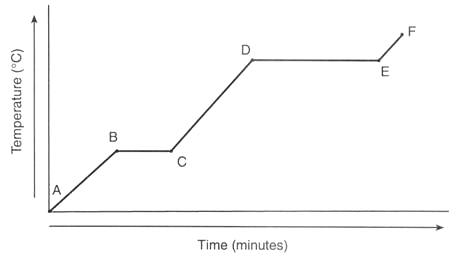
Are the particles moving faster or slower as time goes on?
Faster
Slower
What is happening to the particles in the substance between points D and E?
Melting
Freezing
Evaporating
Sublimating
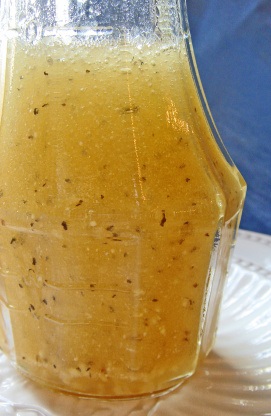

What is this?
Homogeneous Mixture
Heterogeneous MIxture

What is this?
Homogeneous Mixture
Heterogeneous Mixture

Element, mixture, or compound?
element
mixture
compound
Which statement is true when a compound is formed?
The properties of the compound are an equal mixture of the properties of the elements that make it up
The properties of the compound are the same as the properties of the elements that make it up
The properties of the compound are different than the properties of the elements that make it up
Compounds have no properties

Which classification of matter is represented in the picture?
Element
Compound
Mixture
If there is no subscript, how many atoms of that element are there?
1
2
3
0
What is the total number of atoms in this chemical formula? C8H3NaBr12
18
12
25
24
How many elements are in this chemical formula? NaHCO3
1
2
3
4
How many atoms of Iron in the following equation?
2HFe5Cl
1
10
5
20
How many atoms of Hydrogen are in this equation?
5Cl2H5
10
2
5
25
How many atoms are there TOTAL in:
H2SO4
6
5
7
3
How many molecules are in 4H2O?
6
8
2
4

Is this equation balanced?
yes
no
Not enough information

Is this equation balanced?
yes
no
Not enough information
Left side is balanced

How man atoms of carbon are there?
1
2
3
4
According to the Law of Conservation of Mass, how will the total mass of the Products compare to the total mass of the Reactants?
Reactants will be greater than Products
Products will be greater than Reactants
they will be equal
If 28 g of oxygen reacts with 14 g of hydrogen, how much water is produced?
12
28
14
42
What is the left part of a chemical equation called?
2H2 + O2 --> 2H2O
Reactants
Products
Yields
Chemical Equation
What is the right part of a chemical equation called...
2H2 + O2 --> 2H2O
Reactants
Products
Yields
Chemical Equation
Name the part in red:
H2 + O2 -> H2O
Coefficient
Product
Yield
Subscript
Is the following equation balanced?
4Fe + 3O2 --> 2Fe2O3
yes
no
Is the following reaction balanced?
NaHCO3 --> Na2CO3 + H2O + CO2
yes
no

How many grams of OXYGEN would be needed to show conservation of mass in the example below?
100 g
93 g
7 g
0 g
24 g of magnesium reacts with 38 g of fluorine to produce _____ g magnesium fluoride
62
38
24
14
How many Oxygen atoms are present in the product of the following equation: 2SO2 + 2H2O2 ----> 2H2SO4
2
3
4
8
Bob puts 200 grams of ice into a pitcher with 900 grams of water. He gets distracted and comes back later to find that the ice has melted in the water. How many grams of water does Bob now have in the pitcher?
200 g
700 g
1,100 g
Which of the following is a physical change?
Iron is oxidized to iron oxide
Aluminum metal is pounded into thin sheets
Copper reacts with a strong acid, producing smoke
Sodium metal explodes on contact with water
Which of the following is an example of a chemical change?
melting solid gold
burning hydrogen gas
dissolving sugar in water
breaking a sheet of glass
Two solutions are added together and the new solution becomes hot. This tells you that
a gas is being produced.
the solutions are not soluble.
the physical properties are the same.
a chemical change is taking place.
Jolene wants to experiment with sugar cubes. Which of the following causes a sugar cube to only change physically, not chemically?
burning the sugar cube with a match
crushing the sugar cube and dissolving it in water
dehydrating the sugar cube with sulfuric acid
chewing the sugar cube and digesting it
Marco wants to investigate the chemical properties of sodium bicarbonate (baking soda). He plans to carry out the tests below.
Test 1: Mix a teaspoon of sodium bicarbonate into a cup of warm water to see if it dissolves.
Test 2: Mix a teaspoon of sodium bicarbonate into a cup of vinegar to see if it fizzes.
Test 3: Heat a teaspoon of sodium bicarbonate in the oven to see if its melting point is less than 400 degrees Fahrenheit.
Which statement provides the best assessment of his tests?
Only Test 3 will indicate a chemical property of sodium bicarbonate. Tests 1 and 2 will show a physical property of the substance.
Only tests 1 and 2 will indicate chemical properties of sodium bicarbonate. Test 3 will show a physical property of the substance.
Only Test 2 will indicate a chemical property of sodium bicarbonate. Tests 1 and 3 will show a physical property of the substance.
Only tests 1 and 3 will indicate chemical properties of sodium bicarbonate. Test 2 will show a physical property of the substance.
What is the outcome of all chemical changes when two substances are combined?
A new substance forms with identical properties.
The two substances release an odor.
The two substances change color.
A new substance forms with different properties.
Which of the following is a common sign that a chemical change has occurred?
A chemical has turned a different color, bubbled, and/or changed temperature.
A chemical has changed to a different state of matter, such as a liquid to a solid.
A chemical has changed size.
A chemical has become a different shape.
Properties that describe how a substance looks, feels, state of matter, etc., are?
Chemical Properties
Physical Properties
Properties that describe how a substance reacts with other substances are called?
Chemical properties
Physical properties
What instrument would you use to detect an endothermic or exothermic reaction?
triple beam balance
ruler
thermometer
Ms. Guadiamos put steel wool in vinegar. It turned red, rust formed, and increased in temperature. What type of reaction occurred?
Exothermic Reaction
Endothermic Reaction
No reaction happened (No Chemical Change)

The graph above is from which type of reaction?
Endothermic reaction
Exothermic reaction

The graph above is from which type of reaction?
Endothermic reaction
Exothermic Reaction
____ reactions usually feel cold.
endothermic
exothermic

A school bus burns gasoline while delivering students to school.
exothermic
endothermic

This diagram is exothermic. Why?
In an exothermic reaction, products have LESS energy compared to the reactants
In an exothermic reaction, products have MORE energy compared to the reactants
In an exothermic reaction, reactants always have the SAME energy as the products
Photosynthesis is an example of what type of reaction?
Exothermic
Endothermic
Neutralization
Combustion
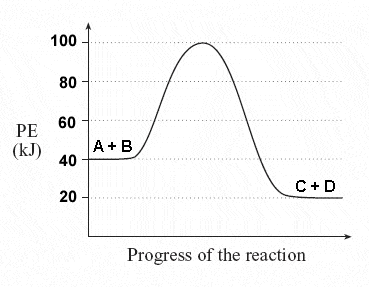
How much energy is released during this reaction?
The initial temperature was measured to be 20oC and the final temperature was 10oC. The reaction was
exothermic
endothermic
Which of the following is a sign that a chemical reaction has occurred?
Change in shape
Formation of a gas
Melting
Dissolving
Which observations prove a chemical change has occurred?
Dissolving and expected color change
Mixing and dissolving
State of matter change and boiling water bubbles
Unexpected color change and temperature change

