
 Worksheets
MS Physical Science Practice final
Total questions: 90
Worksheet time: 2hrs 40mins
Name
Class
Date
1.
The number of wavelengths that pass a point each per second is:
a)
frequency
b)
period
c)
longitudinal
d)
transverse wave
2.
The type of waves that require medium to pass:
a)
Mechanical Waves
b)
Electromagnetic Waves
3.
When the frequency of a wave increases, what happens to the wavelength?
a)
The wavelength is not directly affected by the frequency of a wave.
b)
The wavelength increases.
c)
The wavelength decreases.
d)
More specific information is needed to form a conclusion about the wavelength.
4.
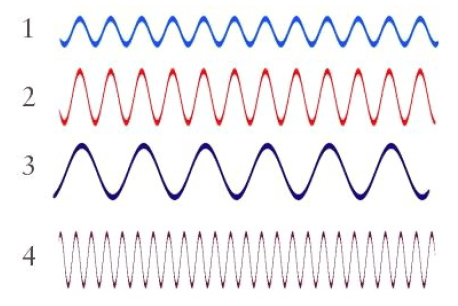
Which wave in the diagram has the greatest frequency?
a)
1
b)
2
c)
3
d)
4
5.
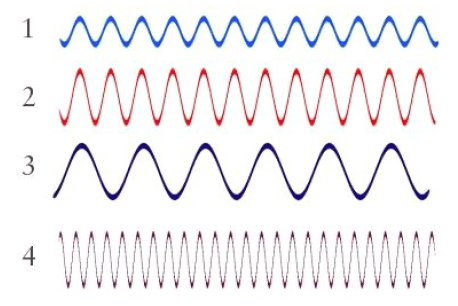
Which wave in the diagram has the greatest wavelength?
a)
1
b)
2
c)
3
d)
4
6.
Electromagnetic waves include the following except
a)
radio waves
b)
X-rays
c)
doing the wave at a football game
d)
microwaves
7.
regular disturbances that carry energy through matter or space
a)
crest
b)
energy
c)
wave
d)
trough
8.
When a wave strikes and object and bounces off. (example echo)
a)
medium
b)
refraction
c)
reflection
d)
interference
9.
When a wave bends as it passes through at an angle from one medium to another.(example: pencil in a glass of water-)
a)
medium
b)
refraction
c)
reflection
d)
interference
10.

What is represented by the letter 'x'?
a)
Crest
b)
Compression
c)
Rarefaction
d)
Wavelength
11.

What is represented by the letter 'y'?
a)
Compression
b)
Rarefaction
c)
Wavelength
d)
Amplitude
12.

Which wave has a higher frequency?
a)
A
b)
B
13.
A wave carries...?
a)
energy only
b)
matter only
c)
the matter carries the energy
d)
neither
14.
What is the measure of how many waves pass a point in a certain amount of time?
a)
frequency
b)
wavelength
c)
midpoint
d)
crest and trough
15.
Amplitude indicates the amount of ____________________ in a wave.
a)
energy
b)
compression
c)
rarefaction
d)
speed
16.

The units for frequency are measured in _____________.
a)
hertz
b)
seconds
c)
m/s
d)
m
17.
What is the metal center of an electromagnet called?
a)
The current
b)
the wire
c)
the coil
d)
the core
18.
How do you make an electromagnet stronger?
a)
Add a motor and/or lightbulbs
b)
Add more light bulbs and/or wire coils
c)
add more wire coils and/or a switch
d)
add more wire coils and/or batteries
19.
Like poles on a magnet
a)
attract
b)
repel
20.
What is a switch's function in a circuit?
a)
to make the current hotter or colder
b)
turn on and off the flow of current
c)
the pathway that current flows
d)
to add more power to the circuit
21.
Unlike poles on a magnet
a)
repel
b)
attract
22.
An electric motor changes electrical energy to _________ energy.
a)
mechanical
b)
chemical
c)
potential
d)
free
23.
How is an electromagnet different from a permanent magnet?
a)
An electromagnet’s magnetism can be turned off.
b)
An electromagnet is smaller and less powerful.
c)
An electromagnet can be built without using metal.
d)
An electromagnet does not attract objects containing iron.
24.
A coil that is magnetized only when an electric current flows through it is _____________.
a)
a battery
b)
a generator
c)
a conductor
d)
an electromagnet
25.
Which component controls the flow of electricity by opening and closing the circuit?
a)
switch
b)
d cell
c)
wire coil
d)
core
26.
What component provides the pathway to carry electricity from component to component?
a)
d cell
b)
wire
c)
switch
d)
wire coil
27.
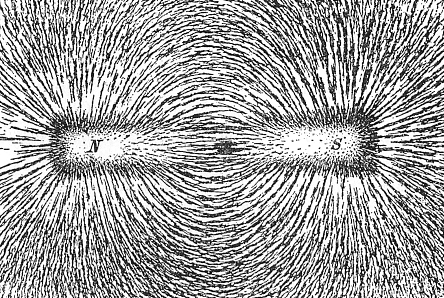
Surrounding every magnet is a __________ __________.
a)
magnetic field
b)
electrical current
c)
another magnet
d)
an enemy
28.

Why are paper clips attracted to magnets?
a)
They contain silver.
b)
They contain aluminum
c)
They contain tin.
d)
They contain iron.
29.
Surrounding every magnet is a __________ __________.
a)
magnetic field
b)
electrical current
c)
another magnet
d)
an enemy
30.

The attraction or repulsion created by spinning electric charges is called -
a)
A. electric generator
b)
B. magnetic force
c)
C. solenoid
d)
D. electromagnet
31.

The flow of electrical energy starts at the ___ side of the d-cell.
a)
negative
b)
positve
c)
complete circuit
d)
bulb
32.
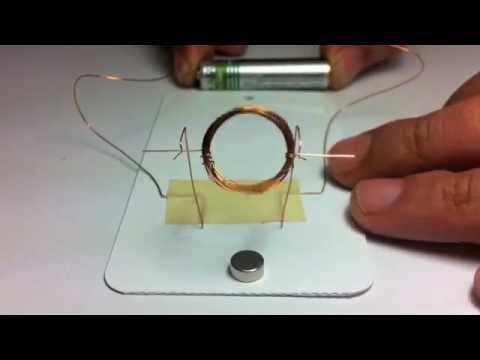
What does a motor do?
a)
Moves up and down
b)
Rotates without electricity
c)
changes motion to electricity
d)
changes electricity to motion
33.

A compass needle responds to a magnetic field, because the compass needle is a
a)
A. generator.
b)
B. motor.
c)
C. magnet.
d)
D. transformer.
34.

Where is Earth's magnetic field strongest?
a)
Along the outside lines
b)
Along the inside lines on either side
c)
Where the lines are close together at the poles
d)
In the space outside of the lines
35.

The strongest part of a magnet is...
a)
the bars.
b)
the force field.
c)
the poles.
d)
the middle.
36.

What do the lines around this magnet represent?
a)
North Pole
b)
South Pole
c)
Magnetic Declination
d)
Magnetic Field
37.

If you place the North pole of a magnet next to the South pole of another magnet, they will:
a)
Attract
b)
Repel
c)
Do nothing
d)
Shatter
38.

What will happen when these magnets are brought close together?
a)
They will attract each other.
b)
They will repel each other.
c)
Both magnets will turn to the left
d)
Both magnets will turn to the right
39.
What do the lines around this magnet represent?
a)
North Pole
b)
South Pole
c)
Magnetic Declination
d)
Magnetic Field
40.
kinetic energy
a)
the energy that an object has because it is moving
b)
the space around a magnet in which magnetic forces can act on objects
c)
one of the two opposite ends of a magnet
d)
the energy that is stored in an object or system
41.
potential energy
a)
the energy that is stored in an object or system
b)
to provide evidence that goes against a claim
c)
a set of interacting parts forming a complex whole
d)
something that can be changed and may be measured
42.

The diagram below shows a bar magnet.
Which arrow best represents the direction of the needle of a compass placed at point A?
a)
b)
c)
d)
43.

Are the magnetic field lines in the picture correct?
a)
Yes, because they point from north to south.
b)
No, because they point from north to south (they're supposed to go the other way).
c)
Yes, because the North pole is on the left in all pictures.
d)
No, because the North pole is on the left in all pictures (it's supposed to be on the right).
44.
The energy something has because it is moving
a)
kinetic energy
b)
potential energy
c)
magnetic energy
d)
force
45.
As the thermal energy of a substance increases, its particles spread out and the substance expands.
a)
True
b)
False
46.
Thermal energy and temperature are the same.
a)
True
b)
False
47.
Which of the following are kinds of heat transfer.
a)
Conduction
b)
Convection
c)
Radiation
d)
All of the above
48.
Conduction is heat transfer by -
a)
Touch
b)
Circles
c)
Waves
49.
Convection is heat transfer by-
a)
Touch an object
b)
The heating and cooling of a fluid
c)
Electromagnetic Waves
50.
Radiation is heat transfer by-
a)
Touch
b)
Circles
c)
Waves
51.
In what direction do hot liquids and gasses move?
a)
Side to Side
b)
Down
c)
Up
d)
Back and Forth
52.
In what direction to cold liquids and gasses move?
a)
Side to Side
b)
Up
c)
Down
d)
Back and Forth
53.
Hot coffee is stirred with a spoon; the spoon gets hot due to
a)
conduction
b)
convection
c)
radiation
54.
Which energy transformation below matches?
A book falling?
A book falling?
a)
chemical to sound and heat
b)
kinetic to sound and heat
c)
electrical to sound and heat
55.
Which energy transformation below matches?
Water moving over a dam to move a generator?
Water moving over a dam to move a generator?
a)
kinetic to chemical
b)
kinetic to electrical
c)
solar to electrical
56.
Which energy transformation below matches?
Green plants?
Green plants?
a)
chemical to mechanical
b)
chemical to heat
c)
solar to chemical
57.
Which energy transformation below matches?
Animals eating food?
Animals eating food?
a)
electrical to potential
b)
chemical to kinetic
c)
potential to chemical
58.
Which energy transformation below matches?
Burning coal or carbon-based fuel at a powerplant?
Burning coal or carbon-based fuel at a powerplant?
a)
chemical to heat to electrical
b)
mechanical to chemical to sound
c)
electrical to chemical to heat
59.
Which energy transformation below matches?
An electrical circuit?
An electrical circuit?
a)
chemical to heat, sound, light, mechanical
b)
solar to heat, sound, light, mechanical
c)
electrical to heat, sound, light, mechanical
60.
When you plug in an iron, electrical energy is transformed into ______ energy
a)
sound
b)
mechanical
c)
thermal (heat)
d)
radiant
61.
When a construction worker hits a hammer into plank of wood, the mechanical energy from the hit becomes _____ energy
a)
radiant
b)
electical
c)
heat and sound
d)
chemical
62.
Explain the energy transformation is a simple light electric circuit?
a)
chemical- electrical- radiant
b)
electrical- radiant- chemical
c)
Thermal- radiant- chemical
d)
radiant- chemical- electrical
63.
When electrical energy flows through a light-bulb it creates ___
a)
heat energy only
b)
heat and radiant energy
c)
radiant energy only
d)
motion energy
64.
Which materials could be used to create an electric circuit?
a)
copper wire, wooden rod, and string
b)
string, light-bulb, and battery
c)
copper wire, light-bulb, and battery
d)
rubber tube, light-bulb,and battery
65.
After using a flashlight on an overnight sleeping trip the flashlight stops working. Why?
a)
You forgot to charge the flashlight.
b)
The electrical circuit in the flashlight was broken
c)
The bulb received too much energy from the battery
d)
All of the energy from the battery was transformed into light and heat
66.
Which statement best describes matter and energy?
a)
Matter is different from energy because matter is always destroyed in a chemical reaction.
b)
Matter is similar to energy because matter is always conserved in a chemical reaction.
c)
Matter is similar to energy because matter is always created in a chemical reaction.
67.
The amount of matter in an object is
a)
pressure
b)
weight
c)
mass
d)
force
68.
A person would weigh less on on the Moon than on the Earth because . . .
a)
Moon has more mass, and therefore more gravity
b)
Moon has less mass, and therefore more gravity
c)
Moon has more mass, and therefore less gravity
d)
Moon has less mass and therefore less gravity
69.
a force that opposes motion between any surfaces that are touching
a)
velocity
b)
friction
c)
inertia
d)
position
70.
the tendency of an object to resist a change in its motion
a)
acceleration
b)
inertia
c)
mass
d)
frame of reference
71.
an objects location, x is used to represent this
a)
force
b)
position
c)
distance
d)
acceleration
72.
Inertia is the tendency of an object to resist a change in its ___________.
a)
temperature
b)
shape
c)
size
d)
motion
73.
Objects with greater _________ also have greater inertia.
a)
speed
b)
mass
c)
temperature
d)
friction
74.
The law of inertia (Newton’s First Law) applies
a)
to both moving and nonmoving objects
b)
only to moving objects
c)
only to objects that are not moving
75.
If you increase the force on an object, its acceleration
a)
decreases
b)
stays the same
c)
also increases
d)
stops
76.
If you increase the mass on an object, its acceleration
a)
decreases
b)
stays the same
c)
also increases
d)
stops
77.
Objects with greater _________ also have greater inertia.
a)
speed
b)
mass
c)
temperature
d)
friction
78.
Newton's 1st law is also called....
a)
friction
b)
inertia
c)
unbalanced forces
d)
Newtons
79.
A distance vs. time graph shows an object's
a)
frame of reference
b)
speed
c)
acceleration
d)
favorite food
80.
Change in speed over a given period of time is
a)
velocity
b)
motion
c)
speed
d)
acceleration
81.
The rate at which velocity changes is called
a)
motion
b)
average speed
c)
instantaneous speed
d)
acceleration
82.
When something has speed in a certain direction it is called ___________.
a)
motion
b)
position
c)
velocity
d)
speed
83.
_________ is another word for MOVEMENT.
a)
Speed
b)
Motion
c)
Direction
d)
Reference point
84.
Acceleration of an object happens when things ________
a)
slow down
b)
go faster
c)
change direction (turn)
d)
All of the above
85.
Energy that is transmitted by electromagnetic waves
a)
electrical energy
b)
radiant energy
c)
sound energy
d)
refraction
86.

What form of energy?
a)
Mechanical (kinetic) energy
b)
Chemical (kinetic) energy
c)
Sound (potential) energy
d)
Sound (kinetic) energy
87.

What kind of energy?
a)
Thermal (kinetic) energy
b)
Thermal (potential) energy
c)
Nuclear (kinetic) energy
d)
Mechanical (kinetic) energy
88.

Which form of energy is being released?
a)
light (potential)
b)
Light (kinetic)
c)
chemical (kinetic)
d)
Electrical (kinetic)
89.

Lightning during a thunderstorm is an example of what form of energy?
a)
Radiant (potential) energy
b)
Radiant (kinetic) energy
c)
Electrical (potential) energy
d)
Electrical (kinetic) energy
90.

This would be...
a)
Sound (kinetic) energy
b)
Sound (potential) energy
c)
Mechanical (kinetic) energy
100 %

