wayground logo

Free Printable Worksheets

Font size

S
M
L
XL
Worksheets

2018 8th Grade Final review

Total questions: 167

Worksheet time: 2hrs 56mins

Name
Class
Date
1.
What is Manifest Destiny?
a)
The belief that it was America's destiny to control and civilize all of North America
b)
The belief that their destiny was to manifest
c)
A religious term used to explain how to be saved
2.
As Americans took over more and more land, what happened to Native Americans?
a)
They agreed to give up their land.
b)
They were given their choice of where to live.
c)
They were forced to live in reservations.
d)
They voluntarily moved to Canada and Mexico.
3.
What is the name of the piece of land the U.S. gained after the Mexican-American War?
a)
Oregon Country
b)
Given Mexican Land
c)
Louisiana Purchase
d)
Mexican Cession
4.
Which of the following contributed to the westward expansion of the United States?
a)
European warships attacked the eastern seaboard, forcing citizens to move westward for safety.
b)
Most of the land east of the Mississippi River was not suitable for farming.
c)
Many Americans felt it was their right and duty to move westward.
d)
The standard of living on the Pacific Coast was very high, so many people wanted to move there.
5.
What was the name of the treaty where Mexico ceded half of its land to the United States?
a)
Treaty of Guadalupe Hidalgo
b)
Treaty of San Jacinto
c)
Treaty of Mesa Verde
d)
Treaty of Alama Gordo
6.
This was a book that was written by Harriet Beecher Stowe that showed the evils of slavery. 
a)
Harriet's Cabin
b)
Uncle Tom's Cabin
c)
Slavery 
d)
State's Rights
7.
This man led a raid at Harper's Ferry to show people they could use violence to try and end slavery. 
a)
Abraham Lincoln
b)
Jefferson Davis
c)
Robert E. Lee 
d)
John Brown
8.
The Union is the......
a)
South
b)
North
9.
The Confederacy is the.....
a)
South
b)
North
10.
Which one of  the following was NOT a cause to the Civil War?
a)
Farming
b)
Slavery
c)
State's Rights
d)
Uncle Tom's Cabin
11.
The North used what for their economy?
a)
Plantations 
b)
Factories 
c)
Slaves 
d)
Farming
12.
Secede means to.....
a)
join
b)
get rid of
c)
come together
d)
seperate
13.
Abolish means to....
a)
separate
b)
get rid of
c)
make more of
d)
bring together
14.
This was one of the main causes that led to the Civil War. The North did not want this and the South did. The  South depended on this for their economy and to make a profit. 
a)
State's Rights
b)
Uncle Tom's Cabin
c)
Slavery
d)
John Brown's Raid
15.
This person was the president of the United States during the Civil War?
a)
Jefferson Davis
b)
Ulysses S. Grant
c)
Abraham Lincoln
d)
Robert E. Lee
16.
Who was the main General of the Union?
a)
Jefferson Davis
b)
Ulysses S. Grant
c)
Robert E. Lee
d)
Stonewall Jackson
17.
Who was the main general of the Confederacy?
a)
Robert E. Lee
b)
Abraham Lincoln
c)
Jefferson Davis
d)
Ulysses S. Grant
18.
This was the first battle of the Civil War?
a)
Battle of Bull Run
b)
Battle of Chickamauga
c)
Battle of Gettysburg
d)
Battle of Fort Sumter
19.
This was the turning point of the Civil War.
a)
Battle of Gettysburg
b)
Battle of Fort Sumter
c)
Battle of Bull Run
d)
Battle of Chickamauga
20.
Sherman went from Atlanta to Savannah with his men and torched everything in his path. 
a)
Battle of Gettysburg
b)
Atlanta Campaign
c)
Sherman's March to the Sea
d)
Appomattox Courthouse
21.
This is the location where Robert E. Lee surrendered to Ulysses S. Grant to end the Civil War. 
a)
Fort Sumter
b)
Atlanta Campaign
c)
Sherman's March to the Sea
d)
Appomattox Courthouse
22.
Who won the Civil War?
a)
Union
b)
Confederacy
23.
How many years was the Civil War?
a)
2
b)
3
c)
1
d)
4
24.
What year did the Civil War begin?
a)
1860
b)
1861
c)
1862
d)
1863
25.
What year did the Civil War end?
a)
1862
b)
1861
c)
1864
d)
1865
26.
This was Lincoln's famous speech that began with the words... "4 score and 7 years ago.."
a)
Emancipation Proclamation 
b)
Lincoln-Douglas Debate
c)
Gettysburg Address
d)
Lee's Surrender
27.
Where was John Brown's Raid?
a)
Montgomery, Alabama
b)
Gettysburg, Pennsylvania
c)
Charleston, South Carolina
d)
Harper's Ferry, West Virginia
28.
Where was the Battle of Gettysburg at?
a)
Pennsylvania
b)
South Carolina
c)
Virginia
d)
Georgia
29.
When the war was over, who had the most damage and a really hard time to go back home to?
a)
Union
b)
Confederacy 
30.
Was the Underground Railroad actually underground?
a)
No, it was only called that because they had to keep secret.
b)
No, it ran on tracks above ground from south to north.
c)
Yes, the railroad was totally underground.
d)
Yes, and it ran for miles on end!
31.
People who helped slaves, took the chance of being arrested and jailed if they were caught. 
a)
True
b)
False
32.
What was the Underground Railroad?
a)
A place where slaves were sold
b)
It was a railroad that was underground and carried slaves to freedom.
c)
A network slaves used to get to freedom.
d)
A smooth form of transportation.
33.
Who was Harriet Tubman?  
a)
She led many slaves to the Underground Railroad.  
b)
She started the Underground Railroad.  
c)
She died being a slave in 1913.  
d)
A woman born in Africa.
34.
The main goal of the Underground Railroad was to escape to:
a)
Ohio
b)
Canada
c)
The Northwest Territories
d)
New York
35.
Why was the Underground Railroad important?
a)
It carried many products from the North to the South.
b)
It led to the end of slavery.
c)
It was the route used by slaves escaping from the South
d)
It carried settlers west.
36.
People who campaigned to end slavery were called ____.
a)
conformists
b)
rebels
c)
abolitionists
d)
yankees
37.
Frederick Douglass was a slave.
a)
True
b)
False
38.
What were slaves legally considered?
a)
People
b)
Property
c)
Citizens
d)
Children
39.
How did cotton relate to slavery?
a)
The desire to grow more cotton led to increased slavery
b)
It did not relate to slavery
c)
All slaves were required to grow cotton
d)
Cotton was traded for slaves in Africa
40.
You hear the hound dogs sniffing out your trail, how will you hide your tracks?
a)
Cover your footprints
b)
Take off your shoes
c)
Go to the river
d)
Hide under a log
41.
What was the best time of day to travel along the Underground Railroad?
a)
In the morning
b)
At lunchtime
c)
In the evening
d)
At night
42.
Whose economy depended on slave labor?
a)
neither the North or the South
b)
North
c)
both the North and the South
d)
South
43.
Sectional issues divided the United States for many years after War of 1812. What was one of the major issues that divided the nation?
a)
whether or not to pass the Northwest Ordinance
b)
whether or not new states should be represented in Congress
c)
whether or not to allow slavery in new territories
d)
whether or not to annex Canada to the United States
44.
The runaways had to reach Canada to be free because of the
a)
Fugitive Slave Law
b)
Society of Friends
c)
Middle Passage 
d)
Philadelphia Vigilance Comittee
45.
To break away from a group
a)
state's rights
b)
slavery
c)
Gettysburg
d)
secede
46.
President of the U.S. during the Civil War who issued the Emancipation Proclamation which freed slaves in the states that seceded.
a)
George Washington
b)
Thomas Jefferson
c)
Ulysses S. Grant
d)
Abraham Lincoln
47.
This gave slaves their freedom.
a)
The Compromise of 1850
b)
The Gettysburg Address 
c)
The Battle of Antietam 
d)
The Emancipation Proclomation
48.
Network of safe houses that aided runaway slaves
a)
Fugitive Slave Act
b)
Underground Railroad
c)
Temperance
d)
Safe Houses
49.
More factories, population, and a better navy
a)
Southern advantages
b)
Northern advantages
c)
Reasons for  Southern victory
d)
Cause of the battle of Gettysburg
50.
What was a major advantage of the South during the Civil War?
a)
heavy industrial development
b)
a network of railway lines to transport supplies and troops
c)
superior military leadership
d)
an alliance with Britain and France
51.
During Reconstruction the South was under Military rule
a)
True
b)
False
52.
What amendment abolished slavery?
a)
13th
b)
14th
c)
15th
d)
16th
53.
The 13th Amendment of the United States Constitution...
a)
guarantees African Americans free speech
b)
Outlawed slavery in the United States
c)
gave African Americans the right to vote
d)
rejoined the South and the North
54.
The 14th Amendment of the United States Constitution...
a)
Gave African Americans citizenship
b)
Gave African Americans the right to vote
c)
Freed the slaves
d)
Gave landowners the right to sharecrop
55.
The 15th Amendment of the United States Constitution...
a)
Gave African Americans the right to own businesses
b)
Freed the Slaves
c)
Gave African Americans the right to vote
d)
Forced African Americans back into slavery
56.
Who assassinated President Abraham Lincoln?
a)
Nathan Bedford Forrest
b)
John Wilkes Booth
c)
Henry Clay
d)
John Breckinridge
57.
Which of the following was not a part of the Freedman's Bureau?
a)
Helped reconnecting slaves with their families
b)
Helped create African American Colleges
c)
Helped feed slaves
d)
Forced African Americans to become sharecroppers
58.
What group in Congress felt that Lincoln's plan was too lenient?
a)
Deciduous Democrats
b)
Radical Republicans
c)
Wistful Whigs
d)
Fancy Federalists
59.
What problem did many farmers have under the sharecropping system?        
a)
They were forced to grow cash crops instead of food.
b)
 They often were trapped in a cycle or circle of debt.
c)
 Many sharecroppers were forced to buy goods on credit. 
d)
   All choices are true.
60.
Northerners who went south after the Civil War to make large profits from the destruction in the south were called
a)
Scalawags
b)
Ku Klux Klan
c)
Carpetbaggers
d)
Sharecroppers
61.
Laws passed by southern states soon after the Compromise of 1877.  These laws legalized segregation whites and blacks to use separate facilities. 
a)
Jim Crow Laws
b)
Black Codes
c)
Freedman's Bureau
d)
Reconstruction
62.
These were laws that made it illegal for African Americans to live or work in certain areas and allowed whites to arrest African Americans who were not working.  Once arrested they would be forced to work for white landowners. 
a)
Freedman's Bureau
b)
Reconstruction
c)
Black Codes
d)
Jim Crow Laws
63.
The process of rebuilding the South after the Civil War. 
a)
Reconstruction
b)
Freedman's Bureau
c)
Black Codes
d)
Jim Crow Laws
64.
Made African Americans citizens.
a)
13th Amendment
b)
14th Amendment
c)
15th Amendment
d)
19th Amendment
65.
Guaranteed all men the right to vote no matter their race.
a)
13th Amendment
b)
14th Amendment
c)
15th Amendment
d)
19th Amendment
66.
Abolished slavery throughout the United States.
a)
13th Amendment
b)
14th Amendment
c)
15th Amendment
d)
19th Amendment
67.
The organization put in place after the Civil War to provide food, clothing, health care and education in the South was known as:
a)
The Civil Rights Committee
b)
The Freedmen's Bureau
c)
The Welfare Committee
d)
The Salvation Army
68.
Groups like the Ku Klux Klan that formed during Reconstruction helped freed slaves and worked to protect their rights.
a)
True
b)
False
69.
All of the following resulted from the end of Reconstruction EXCEPT:
a)
Ku Klux Klan is founded
b)
Jim Crow laws were passed to segregate blacks from whites and place other limits on their rights. 
c)
Sharecropping becomes the dominant economy in the South
d)
Blacks continued to enjoy increased freedoms and equality
70.
Frederick Douglass wanted _______.
a)
to help slave children.
b)
money. 
c)
to be a land owner. 
d)
justice for slaves.
71.
Frederick Douglass was a known abolitionist. What is an abolitionist? 
a)
a person who wanted to end slavery.
b)
a person who wanted to help endangered animals.
c)
a person who fought for women's rights.
d)
a presidential candidate.
72.
Frederick Douglass was friends with this U.S. president.
a)
Barack Obama
b)
George W. Bush
c)
George Washington
d)
Abraham Lincoln
73.
What was the Underground Railroad?
a)
A secret network of people and hiding places to help slaves escape to freedom.
b)
Rights protected by people. 
c)
Not being controlled by someone. 
d)
Forced to work without pay.
74.
What is a strong feeling or opinion formed unfairly or without knowing all of the facts?
a)
civil rights
b)
prejudice
c)
freedom
d)
expression
75.
What is slavery?
a)
A happy system where one person willingly lets another person own them. 
b)
A cruel system in which someone legally owns or controls another person.
c)
A system that is ok.
d)
A monarchy with a king and queen.
76.
What is a conductor of the Underground Railroad?
a)
A person who checks tickets on board a train. 
b)
A person who helped people escape to freedom using the Underground Railroad.
c)
A person who sells tickets before you board the train.
d)
A person who checks your tickets when you are on board a boat. 
77.
Frederick Douglass was enslaved. What does enslaved mean?
a)
Free to work and keep his earnings.
b)
Forced to work and keep his earnings. 
c)
Free to work and forced to give up pay.
d)
Forced to work and to give up pay. 
78.
Which of the following was NOT associated with early factory working conditions?
a)
Low wages
b)
Safe working conditions
c)
Dangerous working conditions
d)
Widespread pollution
79.
A place where people and machines join together to mass produce goods.
a)
Cartel
b)
Corporation
c)
Factory
d)
Urbanization
80.
Mass production led to:
a)
Products being more superior in quality
b)
goods became less expensive
c)
laborers received higher wages
d)
industries moved to rural areas
81.
Before the Industrial Revolution all products were created by
a)
Factories
b)
Hand
c)
Slaves
d)
Royalty
82.
What is the movement from rural to urban areas called?
a)
Moving
b)
colonization
c)
inflation
d)
urbanization
83.
Why did people move to the cities during the Industrial revolution?
a)
Jobs in factories
b)
Jobs on the farm
c)
Family
d)
Friends
84.
This machine allowed factories to be built anywhere, powered by coal.
a)
flying shuttle
b)
steam engine
c)
spinning jenny
d)
cotton gin
85.
Which statement is true?
a)
Children were not allowed to work in the mines during the Industrial Revolution
b)
Work conditions were closely regulated
c)
There were no labor laws that prevented children from working
d)
Children were allowed to work but they were treated fairly. 
86.
What did the Meat Inspection Act accomplish?
a)
Banned the use of assembly lines
b)
Allowed the government to have unlimited power
c)
Cleaned up food producing factories
d)
Advocated for minority groups
87.
Which Muckraker exposed problems with the meat-packing industry in the book 'The Jungle'?
a)
Jacob Riis
b)
Ida B. Wells
c)
Upton Sinclair
d)
Ida Tarbell
88.
Muckrakers were
a)
progressive reformers who sought legal changes to problems
b)
politicians who passed laws cleaning up the "muck" in society
c)
governors who wanted to get rid of monopolies
d)
journalists who wrote about the problems in society
89.
Which of the following was NOT a famous muckraker during the early 1900's?
a)
Jacob Riis
b)
Upton Sinclair
c)
Teddy Roosevelt
d)
Ida Tarbell
90.
Who wrote the “History of the Standard Oil Company,” in 1902 and showed how Rockefeller’s rise was based on unfair business practices? 
a)
Ida B. Wells 
b)
Ida Tarbell 
c)
Jacob Riis
d)
Upton Sinclair
91.
What was a result of The Jungle by Upton Sinclair?
a)
Interstate Commerce Act
b)
Pure Food and Drug Act
c)
Sherman Anti Trust Act
d)
none of the above
92.
What was a result of Ida Tarbell's work?
a)
The Pure Food and Drug Act was passed.
b)
People discovered the conditions of the poor in urban areas.
c)
Rockefeller's Standard Oil Company was prosecuted under the Sherman Anti-trust Act
d)
none of the above
93.
Photographed conditions of the urban poor in “How the Other Half Lives.” Examined the conditions of the poor in America’s cities. 
a)
Upton Sinclair 
b)
Lincoln Steffens 
c)
Jacob Riis 
d)
Frank Norris 
94.
Group of works who collective bargain to get higher pay, more rights and better working conditions
a)
Soviet Union
b)
Labor Union
c)
Commune 
d)
Trade Federation
95.
What industry was paralyzed by the Pullman Strike of 1894?
a)
Clothing
b)
Steel
c)
Railroads
d)
It was spread across several industries
96.
What does AFL stand for?
a)
American Fun Labor
b)
American Finance of Labor
c)
American Freedom of Labor
d)
American Federation of Labor
97.
_______ is when workers refuse to work in order to force an employer to meet their demands.
a)
labor unions
b)
party
c)
strike
d)
sweatshop
98.
Women worked the same hours as men and were also paid the same.
a)
true
b)
false
99.
Knights of Labor, American Federation of Labor, and the Congress of Industrial Organization were examples of....
a)
Organized Crime
b)
Terrorist organizations
c)
Labor unions
100.
What was the main cause of the Pullman Strike?
a)
Cut wages 
b)
Pullman wouldn't tell the workers the Wifi password
c)
Raised rent prices
d)
Pullman wouldn't pay for electricity in worker's homes
101.
In which of the following places did 146 female workers die in a fire?
a)
Carnegie Steels Homestead Plant
b)
the Triangle Shirtwaist Factory
c)
Haymarket Square
d)
the Pullman factory
102.
Most strikes by unions in the late 1800's were unsuccessful mainly because
a)
unions were unconstitutional
b)
strikes had never been used before to settle labor issues
c)
government supported business instead of workers
d)
strikers failed to use militant tactics
103.
Formation of national labor unions in the late 1800's was mainly because of
a)
passage of laws that supported workers
b)
laws restricting immigration
c)
poor working conditions and low wages
d)
economic depression that led to high unemployment
104.
The Homestead Strike was a protest 
a)
in Colorado demanding safer working conditions. 
b)
Chicago demanding an eight-hour workday.
c)
against the Pullman Palace Car Company’s unsafe working conditions
d)
against the Carnegie Steel Company’s plan to cut jobs.
105.
Collective bargaining is the 
a)
practice used by employers to hire groups of laborers.
b)
practice used by employers to get the cheapest labor possible.
c)
idea that laborers working in groups are more productive in the workplace.
d)
idea that laborers acting together have greater success in negotiating with management.
106.
Which of the following is a strategy used by unions to force employers to meet labor demands?
a)
Injunctions 
b)
Lock outs 
c)
Scabs 
d)
Strikes 
107.

In 1850, where did most American immigrants migrate from?

a)

Ireland

b)

Mexico

c)

England

d)

China

108.

A person who leaves his or her country due to a well-founded fear of persecution.

a)

Immigrant

b)

Refugee

c)

Asylum seeker

d)

Internally displaced person

109.
What is a main reason immigrants came to the US in the late 1800s and early 1900s?
a)
Did NOT want religious freedom
b)
Hoped for economic opportunity (to make money)
c)
Wanted LESS diversity
d)
Wanted to live more simply
110.
What challenges did immigrants face in the US?
a)
They caught diseases
b)
Had trouble learning the language/faced prejudice
c)
Uncomfortable in the large homes in the US
d)
Difficult to study for the citizenship test
111.
How did prejudice create problems for some immigrants?
a)
Major companies wanted to hire them
b)
People laughed at their accents
c)
Were not allowed jobs because of their race/ethnicity
d)
Immigrant children were not allowed to attend school
112.
Where were most immigrants from?
a)
Italy
b)
Slavic Countries
c)
Mexico, Cuba, Puerto Rico
d)
Europe
113.
This person challenged the Jim Crow Laws.
a)
Homer Plessy
b)
Jim Crow
c)
Ferguson
d)
Ms. Greene
114.
Immigrants from Europe came here first.  They were taken by ferry boat here.
a)
Angel Island
b)
Ellis Island
115.
This means variety.
a)
diversity
b)
prejudice
c)
Laws
116.
The Statue of Liberty represented all of these EXCEPT what to immigrants?
a)
Freedom
b)
Excitement for a new life
c)
Opportunity to be successful
d)
Fear for a worse life
117.
Immigrants were checked for dangerous diseases because...
a)
They didn't want them to bring them into the US
b)
They were discriminating against immigrants
c)
They had prejudice and did it just to be mean
118.
The Statue of Liberty was…. 
a)
A gift from England, the first thing immigrants to N.Y. saw
b)
A gift from France, where all immigrants were processed
c)
A gift from France, the first sign of America that many immigrants saw
d)
A gift from Germany to indicate the United States friendship with them
119.
Where did most immigrants live? 
a)
Most lived in farming communities
b)
Most lived in the suburbs
c)
Most lived in big cities
d)
Most lived around lakes
120.
Where did immigrants in the West work?
a)
Factories, Industries
b)
Ranches
c)
Farms, Railroad, Mines
d)
Schools, Offices, Businesses
121.
This immigration inspection site was located on the East Coast and opened in 1892.
a)
Angel Island
b)
The Statue of Liberty
c)
Ellis Island
d)
New York City
122.
What was the first thing immigrants saw when they arrived in the U.S.?
a)
Angel Island
b)
Statue of Liberty
c)
Empire State Building
d)
Central Park
123.
Imperialism is __________.
a)
when a powerful nation uses its resources to help a weaker nation
b)
when a weaker nation invites a powerful nation to help it industrialize
c)
when a powerful nation takes control of the economy and government of a weaker nation
d)
when weak nations join together to fight a strong nation
124.
Social Darwinism:
a)
was used by Anti-Imperialists to promote imperialism
b)
was used to argue some races and nations are naturally superior to others
c)
was used to defend a policy of neutrality and isolationism
d)
was promoted by Frederick Jackson Turner
125.
Cornerstone of American foreign policy that told European powers to stay out of the affairs of the Western Hemisphere. 
a)
Roosevelt Corollary
b)
Adams Doctrine
c)
Truman Doctrine
d)
Monroe Doctrine 
126.
Why did Americans in Hawaii want to be annexed by the United States?  
a)
Queen Liluokalani was persecuting American sugar growers. 
b)
Annexation had trade advantages for the American sugar growers in Hawaii. 
c)
Laws forced Americans to return land to the Hawaiian government. 
d)
 All are true.
127.
Why did United States business interests favor overseas expansion in the late 1800's? 
a)
to establish a commonwealth of colonies 
b)
to establish military bases around the world
c)
to acquire new markets and sources of raw materials 
d)
to spread democratic ideals to other areas of the world
128.
Which of the following definitions best defines imperialism? 
a)
Imperialism is the establishing of colonies in foreign lands to economically benefit the “mother” country.
b)
 Imperialism is the taking over of western lands due to feelings of nationalism and racism. 
c)
Imperialism is a feeling of great loyalty and love for one’s country.
d)
Imperialism is the passage of laws designed to protect the rights of citizens of the “mother” country while they transact business in foreign colonies.
129.
Areas where the imperial power protected local rulers who had to accept advice from imp. power.
a)
Dollar Diplomacy
b)
protectorate
c)
sphere of influence
d)
Yellow Journalsim
130.
This word means pride in one's country; it was a cause of WWI.
a)
Militarism
b)
Alliances
c)
Nationalism
d)
Imperialism
131.
This word means strengthening a country's military; it's a cause of World War I.
a)
Nationalism
b)
Militarism
c)
Alliances
d)
Imperialism
132.
This word means seeking other colonies; it was a cause of World War I.
a)
Militarism
b)
Imperialism
c)
Alliances
d)
Nationalism
133.
This word means support for different sides during war; there were the Allied and Central powers during WWI.
a)
Nationalism
b)
Imperialism
c)
Alliances
d)
Militarism
134.
Germany used their U-boats to sink ships of the Allied powers; this British passenger liner was destroyed in 1917.
a)
Lusitania
b)
USS Maine
135.
Who won WWI?
a)
Allied powers
b)
Central Powers
136.
What was signed in 1919 to end WWI?
a)
Treaty of Versailles
b)

Treaty of Paris

c)
Treaty of World Wars
137.
Germany had to pay $33 billion dollars in _______________.
a)
land
b)
military
c)
reparations
138.
Germany also lost millions of square miles of ______.
a)
money
b)
land
c)
colonies
139.
Germany also had to ______ their military.
a)
disarm
b)
disband
c)
give up
140.
Germany also had to take ______ for the war.
a)
a hit
b)
blame
c)
one for the team
141.
WWI sets the stage for the rise of what German leader?
a)
FDR
b)
Adolf Hitler
c)
Winston Churchill
142.
What does "neutral" mean?
a)
taking sides
b)
not taking sides
143.
A secret telegram from Germany to Mexico was the:
a)
Tooleriod Telegram
b)
Zimmerman Telegram
c)
Lusitania Telegram
144.
What was the purpose of the Zimmerman Telegram?
a)
Germany wanted Mexico to join the war and fight against the US.
b)
Germany wanted Mexico to stay out of the war.
145.
Which choice is a reason the US joined World War I?
a)
Economic and Political ties to Russia
b)
Sinking of the Titanic
c)
The Zimmerman Telegram
d)
Inability to remain angry
146.
The Zimmerman Telegram
a)
Officially announced the entry of the USA into WWI
b)
Was a message sent by the British requesting help from the USA
c)
Asked Mexico to attack the USA in return for land
d)
Warned passengers of the Lusitania that the ship would be sunk
147.
Which Constitutional Amendment finally allowed American women to vote in 1920?
a)
15th Amendment
b)
19th Amendment
c)
16th Amendment
d)
18th Amendment
148.
In 1848, women first gathered here to begin their official fight for Suffrage.
a)
Seneca Falls, New York
b)
Salem, Ohio
c)
Albany, New York
d)
Worcester, Massachusetts
149.
What American Suffragist was arrested for picketing the White House on behalf of Suffrage?
a)
Carrie Chapman Catt
b)
Susan B. Anthony
c)
Alice Paul
d)
Betty Friedan
150.
What is "Suffrage"?
a)
Right to freedom
b)
Right to vote
c)
Right to citizenship
d)
Right to Temperence
151.

Suffrage is the right to vote

a)

true

b)

false

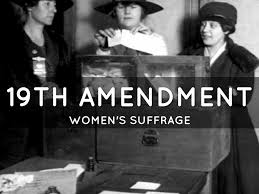
152.

Which amendment gave women the right to vote?

a)

17

b)

18

c)

19

d)

20

153.
Which amendment guarantees women the right to vote?
a)
1st Amendment
b)
4th Amendment
c)
19th Amendment
d)
12th Amendment
154.
Which amendment guaranteed the right to vote for black men?
a)
13th Amendment
b)
14th Amendment
c)
15th Amendment
d)
16th Amendment
155.
Which Amendment gave women the right to vote?
a)
16th
b)
17th
c)
18th
d)
19th
156.
What was the impact of the Harlem Renaissance? 
a)
promoted the growth of New York cities
b)
promoted culture identity of African Americans 
c)
it fought discrimination in southern cities
d)
it established programs such as the NAACP
157.
What allowed Henry Ford's Model T to be sold for less than half the cost of other cars?
a)
the use of the assembly line
b)
the use of cheaper materials
c)
by not following safety procedures
d)
the fact that no two cars were exactly alike
158.
Which of the following is a pull factor of the Great Migration? 
a)
racical discrimination
b)
lynching in southern cities
c)
new opportunity and chance of equality in northern cities
d)
mass poverty in northern cities
159.
Which of the following is a push factor in the Great Migration? 
a)
racial disrimination and lynching in southern cities
b)
job opportunity in northern cities
c)
better equality opportunities in the north 
d)
none of the above
160.
The Harlem Renaissance can best be described as:
a)
The time period in which African Americans joined the war effort during World War I
b)
A time period when African Americans came to the city to look for jobs
c)
A time period in which African Americans fought against the discrimination in New York City
d)
A time period where African Americans celebrated their culture and roots through music, art, and literature
161.
The Harlem Renaissance provided a voice to the African American culture.  Which of the following was a theme from this time period. 
a)
celebration of culture and life
b)
desire for independence and political freedoms
c)
pains and joys of the African American
d)
all of the above
162.

How did race relations in the South change after Reconstruction?

a)

Laws were created to increase African Americans' rights.

b)

Poll Taxes were decreased to ensure voting practices.

c)

Laws were created to limit African Americans' rights.

163.

The photograph above was an example of —

a)

Reconstruction

b)

Freeman's Bureau legislation

c)

Jim Crow Laws

164.

What effect did the Harlem Renaissance have on white Americans?

a)

It made them aware of the cultural contributions of African Americans.

b)

It encouraged them to end unfair discriminatory practices.

c)

It inspired Progressive leaders to take up the cause of civil rights.

d)

It led them to participate in non-violent protests and demonstrations.

165.

Which type of discrimination is portrayed in this Jacob Lawrence painting from his Great Migration series?

a)

White people received the higher paying jobs in the North and Midwest.

b)

African Americans experienced segregation in public facilities.

c)

There were few job opportunities for African Americans in the North.

166.

The poem above was published in 1926. Which statement best supports the author's view of African Americans in the United States?

a)

The author accepts the discrimination of African Americans.

b)

The author believes the treatment of African Americans will worsen in the future.

c)

The author is hopeful that conditions will improve for African Americans in the future.

167.

Which statement BEST explains one result of the Harlem Renaissance?

a)

African American artists helped foster a new sense of unity and cultural pride.

b)

Artists spread political and social ideals of nationalism to the public.

c)

Artists and musicians began to include themes of discontent about foreign policy.