wayground logo

Free Printable Worksheets

Font size

S
M
L
XL
Worksheets

Bio Comp Ultra Mega Review Quizizz

Total questions: 259

Worksheet time: 3hrs 2mins

Name
Class
Date
1.
What is the study of life?
a)
geology
b)
scientology
c)
biology
d)
cinematography
2.
Any living thing made of one or more cells is a(n) ___________
a)
organism
b)
cell
c)
nucleus
d)
biotic factor
3.
Which is not a characteristic of all living things?
a)
get and use energy
b)
grow and develop
c)
adapt
d)
multiple cells
4.
What does an apple, bacteria, and a bear all have in common?
a)
eyes
b)
have cells
c)
found in the body
d)
grow everywhere in the world
5.
Which particle has a positive charge?
a)
electron
b)
orbital
c)
proton
d)
neutron
6.
Choose the particle that has no charge.
a)
nucleus
b)
neutron
c)
proton
d)
electron
7.
What are valence electrons?
a)
electrons on the first orbital always
b)
nucleus
c)
the outermost shell
d)
the number of electrons on the outermost orbital
8.
Which particles make up the nucleus of an atom?
a)
protons and neutrons
b)
electrons and protons
c)
electrons, protons, and neutrons
d)
electrons and neutrons
9.
An element with a mass number of 11 and an atomic number of 5 has how many neutrons?
a)
11
b)
5
c)
6
d)
16
10.
Proteins are made of monomers called ___________
a)
Nucleotides
b)
Monosaccharides
c)
Amino Acids
d)
Glycerol and fatty acids
11.
DNA and RNA are examples of 
a)
Carbohydrates
b)
Lipids
c)
Proteins
d)
Nucleic Acids
12.
Waxes, oils and fats are examples of
a)
Carbohydrates
b)
Lipids
c)
Proteins
d)
Nucleic Acids
13.
Which macromolecule is shown?
 View Figure 1 (if not visible)
a)
lipid
b)
protein
c)
nucleic acid
d)
carbohydrate
14.
Which macromolecule is shown?
 View Figure 2 (if not visible)
a)
lipid
b)
protein
c)
nucleic acid
d)
carbohydrate
15.
Which macromolecule is shown?
 View Figure 4 (if not visible)
a)
lipid
b)
protein
c)
nucleic acid
d)
carbohydrate
16.
surrounds the cell; regulates what enters/leaves cell; maintains homeostasis
a)
vacuole
b)
cell wall
c)
cell membrane
d)
lysosome
17.
control the cell's activities; contains the cell's DNA
a)
mitochondria
b)
cell membrane
c)
nucleus
d)
golgi body
18.
breaks down glucose to release energy for the cell
a)
nucleus
b)
lysosomes
c)
mitochondria
d)
vacuole
19.
What is the main difference between prokaryotic and eukaryotic cells?
a)
Prokaryotic cells have a nucleus and Eukaryotic cells do not
b)
Prokaryotic cells are unicellular and Eukaryotic cells are multicellular.
c)
Prokaryotic cells do not have a nucleus, Eukaryotic cells do have a nucleus.
d)
Prokaryotic cells are plant cells and Eukaryotic cells are animal cells.
20.
Which statement is NOT part of the Cell Theory?
a)
Only animals are made of cells.
b)
Cells are the basic unit of structure and function in all living things.
c)
All living things are made of cells.
d)
New cells come from existing cells.
21.
Using this image, what organelle is D?
a)
Endoplasmic Reticulum
b)
Flagella
c)
Rough ER
d)
Smooth ER
22.
Using this image, what organelle is C?
a)
Cell Wall
b)
Mitochondria
c)
Large Cell Vacuole
d)
Chloroplast
23.
Using this image, what organelle is A?
a)
Cell Wall
b)
Large Central Vacuole
c)
Mitochondria
d)
Chloroplast
24.
What is the difference between rough and smooth ER?
a)
There is no difference.
b)
Plants have rough ER, animals have smooth ER.
c)
What type of injuries the Doctors treat.
d)
Rough has ribosomes, smooth does not.
25.
A phospholipid has 2 parts. What are they called? 
a)
Hydrophilic Head, Hydrophobic Tail 
b)
Hydrophobic Head, Hydrophilic Tail 
26.
"Water Fearing" 
a)
Hydrophobic
b)
Hydrophilic 
c)
Hydroelectric 
d)
Hydroloric
27.
Something is ___________ ____________
when some molecules can cross the membrane while others cannot. 
a)
Selectively (or Semi) Permeable 
b)
Totally Transparent
c)
Liquid Licorice 
d)
Heavily Patrolled 
28.
The picture is an example of _________________.
a)
osmosis
b)
isotonic
c)
diffusion
d)
active transport
29.
A cell will __________________ in a hypotonic solution.
a)
swell and perhaps burst (lyse)
b)
shrink
c)
the size of the cell will not change
d)
the size of the cell will change from large to small and from small to large
30.
A cell will _____________________ in a hypertonic solution.
a)
swell
b)
shrink
c)
will not change
d)
will explode
31.
What type of transport requires energy? 
a)
Active Transport
b)
Facilitated Diffusion
c)
Simple Diffusion
d)
Passive Transport
32.
What type of solution is this cell in?
a)
Isotonic
b)
Hypertonic
c)
Hypotonic
d)
diffused
33.
Most plants appear green because chlorophyll
a)
absorbs green light.
b)
absorbs violet light.
c)
reflects green light.
d)
does not absorb violet light.
34.
The reactants of photosynthesis are
a)
sugar and water.
b)
sugar and oxygen.
c)
carbon dioxide and water.
d)
carbon dioxide and oxygen.
35.
What are the products of photosynthesis?
a)
Carbon dioxide and water
b)
Carbon dioxide and oxygen
c)
Glucose and oxygen
d)
Glucose and water
36.
Which gas is removed from the atmosphere during photosynthesis?
a)
hydrogen
b)
oxygen
c)
nitrogen
d)
carbon dioxide
37.
Where do the light-dependent reactions occur? 
a)
thylakoid membrane
b)
stroma
c)
mesophyll
d)
mitochondria
38.
Which of the following is NOT a product of the light-dependent reactions?
a)
ATP
b)
NADPH
c)
Oxygen
d)
Glucose
39.
Use the diagram to answer the question. Which chemical is an electron carrier molecule?
a)
H2O
b)
carbon dioxide
c)
NADP+
d)
oxygen
40.
Glycolysis is a __________ process.
a)
aerobic
b)
anaerobic
c)
aerobic and anaerobic
d)
neither aerobic nor anaerobic
41.
How many ATP are gained through glycolysis?
a)
0
b)
2
c)
4
d)
30-38
42.
Which of these molecules stores the most energy?
a)
NADH
b)
NAD+
c)
ADP
d)
ATP
43.
Which of these correctly lists the reactants of cellular respiration?
a)
glucose and oxygen
b)
carbon dioxide and water
c)
ATP and carbon dioxide
d)
water and glucose
44.
How many ATP molecules can a glucose molecule produce during aerobic respiration in Eukaryotes?
a)
2
b)
4
c)
38
d)
36
45.
What is an autotroph?
a)
an organism that can make their own food. 
b)
an organism that cannot make their own food
c)
Herbivore
d)
Omnivore
46.
What are the products of anaerobic respiration?
a)
Glucose and oxygen
b)
Carbon dioxide and water
c)
Lactic acid
d)
Carbon monoxide
47.
Where does the Krebs Cycle take place?
a)
mitochondria
b)
chloroplast
c)
cytoplasm
d)
nucleus
48.
What are the three stages that make up cellular respiration?
a)
light reactions, calvin cycle and electron transport
b)
glycolysis, kreb's cycle and Calvin cycle
c)
Glycolysis, Kreb's cycle and electron transport
d)
Light Reactions, Calvin Cycle and Glycolysis
49.
Before cells can divide, what must be copied?
a)
mitochondria
b)
cytoplasm
c)
DNA
d)
Cell Wall
50.
Humans have ________ pairs of chromosomes.
a)
21
b)
23
c)
46
d)
None of the above
51.
Uncontrollable cell growth is known as _____
a)
obesity
b)
cancer
c)
diabetes
d)
hepatitis
52.
The ___________ holds the replicated sister chromatids together.
a)
centriole
b)
chromosomes
c)
centromere
d)
cycles
53.
In the G1 stage of the cell cycle, the cell
a)
Grows
b)
Matures
c)
Carries on normal activities
d)
All of the above
54.
In the S stage of interphase_______________
a)
the cell grows
b)
the nucleus divides
c)
the cell membrane divides
d)
the DNA is replicated
55.
In the G2 stage of cell division, ______________ are made.
a)
organelles
b)
structures for cell division
c)
proteins
d)
all of the above
56.
When a plant cell goes through cell division,  _____________.
a)
the 2 new nuclei are separated by the cell membrane pinching off.
b)
4 new cells are formed
c)
a cell plate forms, dividing the 2 new nuclei
d)
None of the above
57.
A human cell has 46 chromosomes before mitotic division.  How many chromosomes will the daughter cells after mitosis.
a)
12
b)
23
c)
46
d)
92
58.
The stages of mitosis in order
a)
Metaphase, Anaphase, Prophase, Telophase
b)
Prophase, Anaphase, Metaphase, Telophase
c)
Prophase, Metaphase, Anaphase, Telophase
d)
Anaphase, Prophase, Telophase, Metaphase
59.
Asexual reproduction will result in
a)
Identical offspring to the parent
b)
Twins
c)
Meiosis
d)
Non-identical offspring to the parent
60.
The purpose of meiosis is to form ________ cells.
a)
body
b)
sex
c)
somatic
d)
brain
61.
Why do we need meiosis?
a)
To double the number of chromosomes going into sex cells
b)
To halve the number of chromosomes going into sex cells
c)
To triple the number of chromosomes going into sex cells
d)
To not change the number of chromosomes going into sex cells
62.
Meiosis makes sperm and egg cells. In humans, sperm and egg cells each have _____ chromosomes. Therefore a fertilized human egg cell (sperm and egg cell combined) would create a cell with _____ chromosomes.
a)
23, 46
b)
46, 23
c)
2, 4
d)
50, 100
63.
What is it called when a sperm and egg meet?
a)
meiosis
b)
fertilization
c)
cell division
d)
mitosis
64.
A cell with only half the normal number of chromosomes is called a ___________ cell.
a)
haploid
b)
prokaryotic
c)
heterotrophic
d)
eubacterial
65.
What did Erwin Chargaff conclude from his experiments?
a)
Nitrogen bases are held together by peptide bonds
b)
A and T, C and G always occur in equal amounts
c)
Proteins are the carriers of genetic information
d)
C and G rarely occur in eukaryotic organisms
66.
Which of the following pairs identifies the PURINE nitrogen bases?
a)
Cytosine and Thymine
b)
Adenine and Thymine
c)
Adenine and Guanine
d)
Cytosine and Guanine
67.
Which of the following pairs identifies the PYRIMIDINE nitrogen bases?
a)
Cytosine and Thymine
b)
Adenine and Thymine
c)
Adenine and Guanine
d)
Cytosine and Guanine
68.
What makes up the rails, or backbone, of a DNA molecule?
a)
Alternating sugars and nitrogen bases
b)
Nitrogen base pairs
c)
A sugar, a phosphate, and a nitrogen base
d)
Alternating sugars and phosphates
69.
A sugar, a phosphate, and a nitrogen base make up a ___ subunit.
a)
Amino acid
b)
Nucleotide
c)
Protein
d)
Pyrimidine
70.
The enzyme that constructs the new strand of DNA during replication is known as...
a)
DNA Helicase
b)
DNA Polymerase
c)
DNA Ligase
d)
RNA Polymerase
71.
Which enzyme is responsible for unwinding and unzipping the DNA during replication AND transcription?
a)
DNA Helicase
b)
DNA Polymerase
c)
DNA Ligase
d)
RNA Polymerase
72.
During replication, what would be the complementary DNA sequence to: TTA GCC TAG
a)
AAT CGG ATC
b)
CCG ATT CGA
c)
GGC TAA GCT
d)
AAT CGG TAC
73.
According to the semi-conservative model, the original strand serves as a template for the construction of the new strand during DNA replication.
a)
True
b)
False
74.
Replication takes place in many locations of the lagging strand of DNA.  This creates ___ which are pieced together by DNA ligase.
a)
RNA Sections
b)
DNA Polymerase
c)
Okazaki Fragments
d)
Replication Forks
75.
Which process is used to make mRNA from the DNA in the nucleus?
a)
transcription
b)
translation
c)
replication 
76.
Which RNA bases would pair with TACGAA in transcription
a)
AUGCUU
b)
ATGCTT
c)
GCATCC
d)
GCAUCC
77.
Where does transcription take place?
a)
nucleus
b)
cytoplasm
c)
ribosome
78.
One difference between DNA and RNA is that....
a)
Only RNA has the base Uracil
b)
only RNA contains the base Thymine
c)
only RNA contains the base Cytocine
d)
only RNA contained the base Guanine
79.
A triplet of mRNA is called a
a)
codon
b)
anticodon
c)
amino acid
d)
peptide bond
80.
_______ is made during transcription and ________ is made during translation.
a)
mRNA / a protein
b)
a protein / mRNA
c)
Ribosome / Nucleus
d)
mRNA / tRNA
81.
The bonds that hold the two strands of DNA together come from...
a)
the attraction of phosphate groups 
b)
strong bonds between  bases and sugars
c)
carbon to carbon bonds in the sugar
d)
weak hydrogen bonds between the bases
82.
Which enzyme is responsible for making RNA?
a)
DNA polymerase
b)
RNA enzymase
c)
RNA polymerase
d)
RNA proliferase
83.

Which two mutations could cause a frameshift?

a)

Point mutations and deletions

b)

Insertions and point mutations

c)

Insertions and deletions

d)

Substitutions and deletions

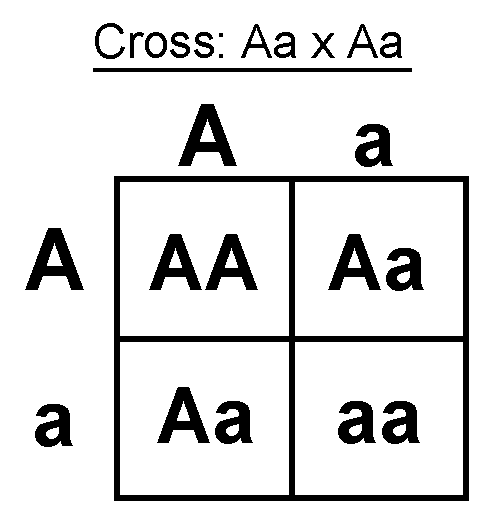
84.
Each one of the boxes on the Punnett Square represents what probability of an offsprings' genotype?
a)
25%
b)
1%
c)
10%
d)
0%
85.
Aa, DD, bB, yy are all examples of
a)
genotypes
b)
phenotypes
86.
AA and Aa always show up as
a)
dominant
b)
recessive
87.
Which of the following genotypes is heterozygous?
a)
Bb
b)
BB
c)
bb
d)
B
88.
In a flowering plant species, red flower color (R) is dominant over white flower color (r). What is the genotype of any red-flowering plant resulting from this species?
a)
rr
b)
R
c)
RR
d)
RR or Rr
89.
What you see, or the physical appearance.
a)
Genotype
b)
Phenotype
c)
Homozygous
d)
Heterozygous
90.
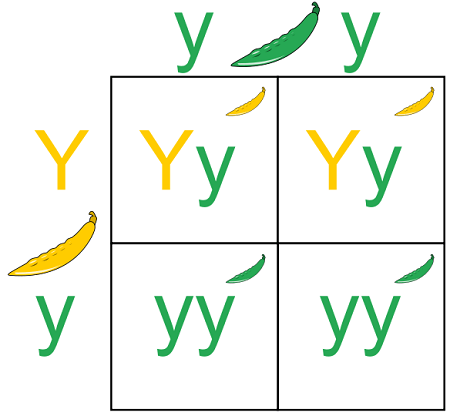
Which choice best represents the genotype of this cross?
a)
1 Yy: 2 yy: 0 YY
b)
2 Yy: 2 yy: 0 YY
c)
3 Yy: 1 yy: 0 YY
d)
1 Yy: 3 yy: 0 YY
91.
What is the phenotype of the offspring? (A-Brown hair; a-blond hair) 
a)
50 % Brown Hair and 50% Blond Hair 
b)
25 % Brown Hair and 75% Blond Hair 
c)
75 % Brown Hair and 25% Blond Hair 
d)
0% Brown Hair and 100% Blond Hair 
92.
This type of inheritance pattern is a MIXTURE of both traits.
a)
incomplete dominance
b)
co-dominance
c)
complete dominance
93.
This is an example of ___________.
a)
 Incomplete Dominance
b)
 Codominance
94.
If you cross a red snapdragon with a white snapdragon, only pink snapdragons will be produced.  What type of inheritance pattern does this follow?
a)
Complete Dominance
b)
Incomplete Dominance
c)
Co-Dominance
d)
Sex-linked
95.
Hemophilia is a recessive x-linked disorder.
Which genotype represents a female who is a carrier for hemophilia?
a)
XHXh
b)
XhXh
c)
XHXH
d)
XhY
96.
Hemophilia is a recessive x-linked disorder.
Which genotype represents a male with hemophilia?
a)
XHXh
b)
XhXh
c)
XHY
d)
XhY
97.
Colorblindness is a recessive x-linked disorder.
Which genotype represents a male with normal vision?
a)
XNXN
b)
XnXn
c)
XNY
d)
XnY
98.
Colorblindness is a recessive x-linked disorder.
Which genotype represents a female who is colorblind?
a)
XNXn
b)
XnXn
c)
XNXN
d)
XnY
99.
Duchenne muscular dystrophy is a recessive x-linked disorder.
According to the Punnett square, what percentage of male offspring will have the disorder?
a)
0%
b)
25%
c)
50%
d)
100%
100.
Restriction Enzymes . . . 
a)
cut DNA at precise locations
b)
help bacteria to pick up DNA
c)
move DNA through a gel
d)
copy DNA
101.
Some restriction enzymes produce "sticky ends". Sticky ends are . . . 
a)
single-stranded DNA "overhangs" that can bind to complementary DNA
b)
smooth cuts that are sticky due to the "goo" left behind by the enzyme
c)
The two wires (black and red) on a gel box
d)
The surface of the LB agar plates so that bacteria can grow
102.

DNA pieces can then be separated and compared using a process called

a)

gel electrophoresis

b)

DNA Puzzle Pieces

c)

RFLPs

d)

Agrose Gel

103.

As DNA fragments move through during gel electrophoresis, their varying lengths propel them through an agarose gel at different speeds

a)

True

b)

False

104.

This laboratory procedure is known as

a)

CLONING

b)

gel electrophoresis

c)

chromatography

d)

use of a dichotomous key

105.

A student performed a gel electrophoresis experiment. The results are represented in the diagram

below. Compared to the fragments at the top of the gel, the fragments at the lower end are

a)

larger, and move slower

b)

larger, and move faster

c)

smaller, and move faster

d)

smaller, and move slower

106.
Which two bear species are most closely related?
a)
Bear 1 and Bear 2
b)
Bear 1 and Bear 3
c)
Bear 2 and Bear 3
d)
There’s no way to tell
107.
Why do the fragments of DNA in gel electrophoresis travel away from the negative electrode?
a)
DNA is negatively charged
b)
DNA is positively charged
c)
the agarose gel in negatively charged
d)
the agarose gel is positively charged
108.
In gel electrophoresis, the largest DNA fragment will appear
a)
closest to the starting wells
b)
farthest from the starting wells
c)
three quarters away from the starting wells
d)
it depends on how many fragments there are
109.

#6

a)

semicircular canals

b)

cochlea

c)

tympanum

d)

round window

110.

#2

a)

tympanic cavity

b)

malleus

c)

cochlea

d)

incus

111.

#3

a)

cochlea

b)

tympanum

c)

malleus

d)

incus

112.

#7

a)

tympanum

b)

ear canal

c)

Eustachian tube

d)

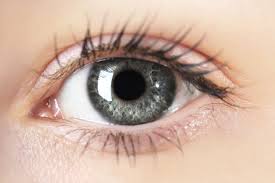
cochlea

113.

I

a)

pupil

b)

aqueous humor

c)

lens

d)

fovea

114.

E

a)

cornea

b)

fovea

c)

retina

d)

pupil

115.

D

a)

optic nerve

b)

vitreous humor

c)

cornea

d)

retina

116.

F

a)

cornea

b)

pupil

c)

iris

d)

incus

117.

G

a)

pupil

b)

fovea

c)

iris

d)

cornea

118.
A(n) _____ is a virus that enters a bacterial cell.
a)
endospore
b)
decomposer
c)
plasmid
d)
bacteriophage
119.
Why do doctors suggest people get a flu vaccine every year?
a)
Flu viruses replicate more rapidly over time
b)
Flu viruses can mutate from year to year
c)
Vaccines are absorbed by the body after a year
d)
Vaccines get stronger over time
120.
What is a way to become immune to a disease without first having the disease?
a)
antibiotics
b)
Anti-retroviral drugs
c)
Vaccinations
d)
Exposure Therapies
121.
Which can be treated with antibiotics?
a)
Virus
b)
Bacteria
c)
Mutagen
d)
Parasite
122.
Viruses 
a)
have many cells
b)
are misfolded proteins
c)
are a protein coat around genetic material
d)
endospores
123.
Antibiotics work against most
a)
Bacteria
b)
Bacteria & Viruses
c)
Vaccines
d)
Viruses
124.
Which of the following illness is caused by pathogens?
a)
Bruise
b)
Blood Clot
c)
Diabetes
d)
Influenza
125.
What do antibodies attach to on the pathogen?
a)
Anti inflammatory
b)
Antigens
c)
Antiseptic
d)
Antibodies
126.
Vaccines stimulate the body to produce...
a)
autoimmune diseases
b)
helper t-cells
c)
fever
d)
antibodies
127.

What is the function of antibodies within the immune system?

a)

Antibodies kill off any antigen that enters the body.

b)

Antibodies are only made when you are given a vaccination for specific antigens.

c)

Antibodies bind to specific antigens to flag for destruction.

d)

Antibodies are part of an external defense mechanism.

128.

What happens after the second time you are exposed to a pathogen?

a)

The body will not be able to fight off the pathogen quickly, because it knows how to get into the body easier.

b)

The body's immune system will react the same was as it did during the first exposure.

c)

The body can only be exposed to a pathogen a second time if you do not have a vaccine.

d)

The body will know how to fight off the pathogen quickly, because memory cells have been created after the first encounter.

129.

How do T cells differ from B cells?

a)

T cells fight pathogens by killing pathogens directly, while B cells fight pathogens by making antibodies.

b)

T cells only make memory cells, and B cells only make antigens

c)

T cells fight pathogens by making antibodies, while B cells fight pathogens by killing pathogens directly.

d)

T cells can only fight off pathogens the body has encountered once, and B cells can fight off any pathogen the body comes across.

130.
Two major branches of the nervous system
a)
central and peripheral
b)
peripheral and motor
c)
motor and sensory
d)
central and motor
131.
Neurons send signals in the brain and body via...
a)
neurotransmitters only
b)
electrical impulses only
c)
wifi
d)
neurotransmitters AND electrical signals
132.
This portion of a neuron allows the electrical signal to move very quickly
a)
Dendrites
b)
myelin sheath
c)
nucleus
d)
axon terminals
133.
Motor neurons are involved with
a)
all 5 senses
b)
all movement
c)
involuntary movement only
d)
voluntary movement only
134.
An example of involuntary movement would be:
a)
heart beating
b)
walking
c)
talking
d)
wiggling toes
135.
This involuntary response is also known as "fight or flight"
a)
Sympathetic
b)
Parasympathetic
c)
Slow
d)
Sensory
136.
This involuntary response occurs AFTER a period high stress and causes body to calm down
a)
Sympathetic
b)
Parasympathetic
c)
Slow
d)
Sensory
137.
Concentration, language production, and decision making are features of the ___ lobe in the brain.
a)
Temporal
b)
Frontal
c)
Occipital
d)
Brain stem
138.
Sensory information is processed in the ____ lobe of the brain 
a)
frontal
b)
occipital
c)
parietal
d)
temporal
139.
This lobe of the brain is responsible for processing your sight
a)
Occipital
b)
Frontal
c)
Brain stem
d)
Temporal
140.
This portion of the brain helps you coordinate your body movements.
a)
Cerebellum
b)
Frontal lobe
c)
brain stem
d)
Amygdala
141.
These parts of the brain are MOST important for maintaining homeostasis.
a)
cerebellum and frontal lobe
b)
hypothalamus and brain stem
c)
brain stem only
d)
cerebellum and hypothalamus
142.
This part of the brain regulates the temperature of the body.
a)
Amygdala
b)
frontal lobe
c)
Hypothalamus
d)
temporal lobe
143.
The gland labeled 4 in the diagram is?
a)
the thymus gland
b)
the thyroid gland
c)
the parathyroid glands
d)
the adrenal glands
144.
Hormones are either steroid hormones (fat based hormones) or amino acid hormones (water soluble hormones). Which of the following statements is correct?
a)
melatonin and calcitonin are steroid hormones
b)
Estrogen, progesterone and testosterone are steroid hormones
c)
insulin and glucagon are steroid hormones
d)
testosterone and parathyroid hormone are amino acid hormones
145.
The anterior pituitary produces the following hormone(s)
a)
oxytocin for uterine contraction and ADH (anti-diuretic hormone) for re-absorption of water by kidneys
b)
melatonin which controls wake/sleep cycles and calcitonin which stores calcium in bones
c)
prolactin which promotes milk production and growth hormone which promotes growth and development of bone and muscle
d)
parathyroid hormone which targets bone destroying cells (osteoclasts) to release stored calcium 
146.
targets the brain and make people sleepy when its dark
a)
melanin
b)
melanoma
c)
melatonin
d)
melons
147.
stores calcium in bones when calcium levels are high
a)
parathyroid hormone
b)
calcitonin
c)
calciumonus
d)
T3 and T4
148.
produces epinephrine and nor-epinephrine which promote the fight or flight response
a)
pancreas
b)
testes
c)
adrenal glands
d)
pineal gland
149.
together these two hormones produced by the pancreas control blood sugar levels
a)
epinephrine and nor-epinephrine
b)
T3 and T4
c)
estrogen and progesterone
d)
insulin and glucagon
150.
this hormone causes an increase in bone density, deepening of the voice, and increased production of body and facial hair
a)
estrogen
b)
insulin
c)
testosterone
d)
progesterone
151.
a disease by which people cannot control sugar levels in the blood
a)
hypertension
b)
sleep apnea
c)
diabetes
d)
hyperthyroidism
152.
these hormones promote secondary sex characteristics in females
a)
testosterone and GH
b)
epinephrine and nor-epinephrine
c)
estrogen and progesterone
d)
prolactin and oxytocin
153.
Which diagram (1 or 2) depicts how a steroid hormone works and why?
a)
diagram 1 because steroid hormones can pass through the lipid bilayer of cells and bond with internal receptors to promote a reaction in cells
b)
diagram 2 because steroid hormones bond to receptors on the surface of target cells because they cannot enter cells to promote a reaction
154.
The bone marrow makes
_______________________ cells.
a)
blood
b)
cancer
c)
large
d)
normal
155.
The common name for the clavicle is
_________________________.
a)
shoulder
b)
sternum
c)
collar bone
d)
neck
156.
Toes and fingers are called
_______________________.
a)
bones
b)
carpals
c)
tendons
d)
phalanges
157.
Your hip bone is also known as your
____________________
a)
pelvis
b)
waist
c)
femur
d)
radius
158.
Common name for the patella is
____________________
a)
thigh
b)
knee cap
c)
fingers
d)
shin
159.
Also known as the shin bone
a)
Femur
b)
Tibia
c)
Fibula
d)
Metatarsals
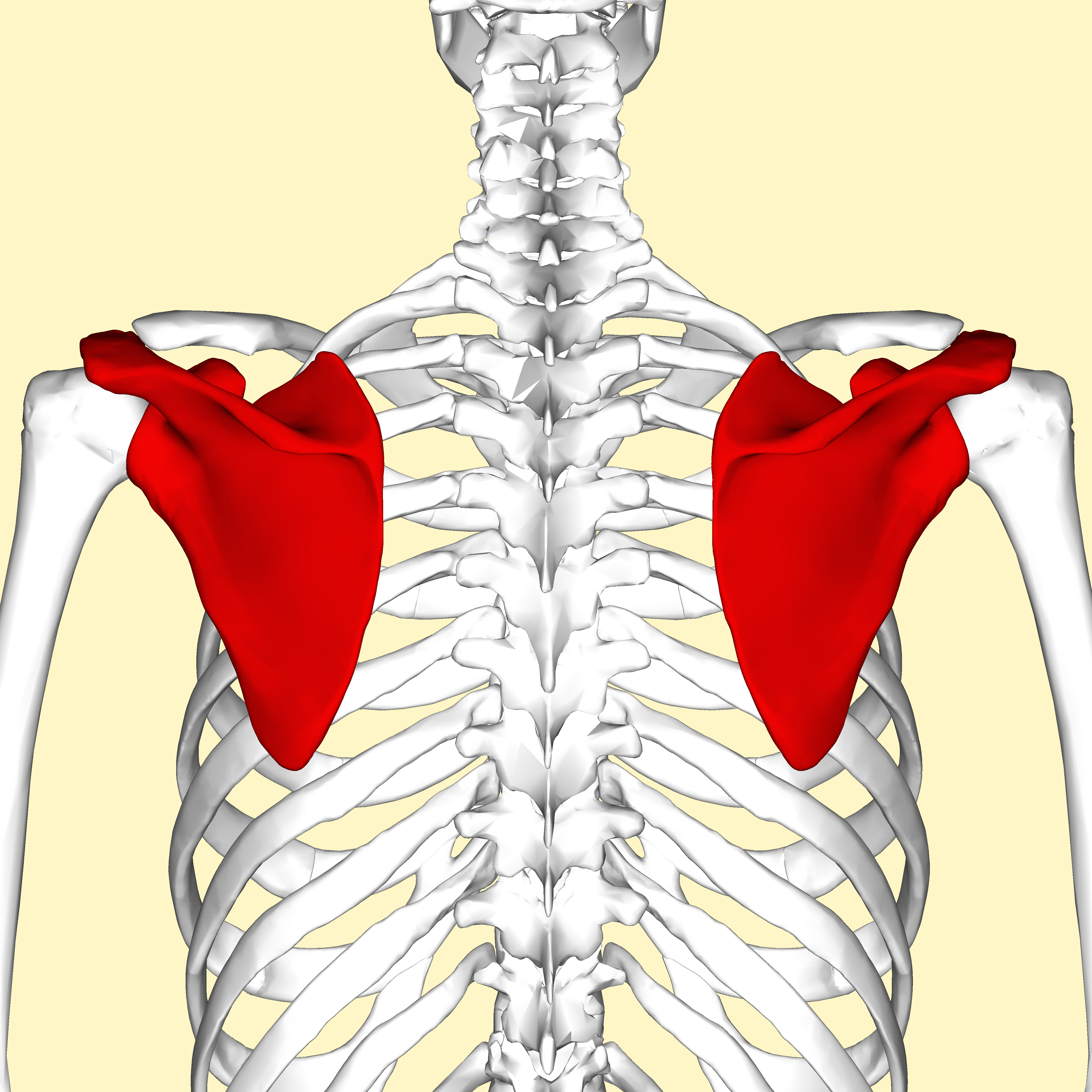
160.
What bones is represented in the  picture?
a)
Clavicle
b)
Scapula
c)
Sternum
d)
Carpals
161.
The bones in your back are made up of what?
a)
fingers
b)
phalanges
c)
vertebrate
d)
toes
162.
What is the name for the connector that attaches muscle to bone?
a)
ligament
b)
tendon
c)
patella
d)
string
163.
What is the name for the connector that attaches bone to bone?
a)
ligament
b)
tendon
c)
patella
d)
string
164.

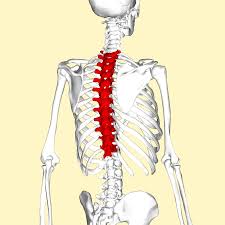
What bone is highlighted?

a)

Skull (Cranium)

b)

Mandible

c)

Scapula

d)

Clavicle

165.

What bone is highlighted?

a)

Radius

b)

Ulna

c)

Humerus

d)

Carpals

166.

What bone is highlighted?

a)

Radius

b)

Ulna

c)

Humerus

d)

Carpals

167.

From wrist to fingertip, what is the order of bones?

a)

Carpals, metacarpals, phalanges

b)

Phalanges, metacarpals, carpals

c)

Carpals, phalanges, metacarpals

d)

Metacarpals, carpals, phalanges

168.
What are the 3 types of muscle tissue?
a)
Thigh, Calf, & Shoulder
b)
Traps, Forearm, & Abs
c)
Hamstring, Biceps, & Triceps
d)
Smooth Muscle, Cardiac Muscle, & Skeletal Muscle
169.
Which muscle type is found in your stomach, bladder, and intestines?
a)
Skeletal
b)
Smooth
c)
Cardiac
d)
Straight
170.
Which muscles are involuntary?
a)
skeletal
b)
cardiac
c)
smooth
d)
smooth and cardiac
171.
The functional unit of the muscle cell is the: 
a)
Sarcomere
b)
Osteon
c)
Myofilament
d)
Muscle fiber
172.
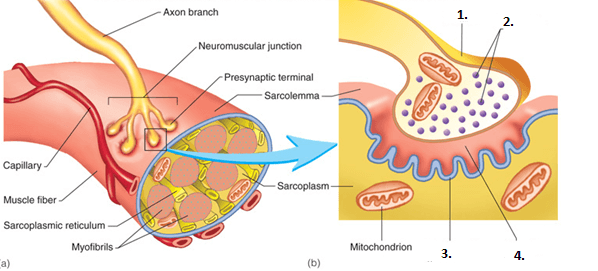
The gap between a neuron and a muscle cell: (#4 in the diagram)
a)
synaptic cleft
b)
sarcolemma
c)
vesicle
d)
Ca2+ ion
173.
a)
Quadriceps
b)
Satorius
c)
Hamstring
d)
Gastronecmius
174.
a)
Abdominal
b)
External Oblique
c)
Erectors
d)
Satorius
175.
a)
Tricep
b)
Deltoid
c)
Hamstring
d)
Bicep
176.
a)
Trapezius
b)
Gluteals
c)
Deltoid
d)
Hamstring
177.
a)
Hamstrin
b)
Quadricep
c)
Tibialis Anterior
d)
Gastrocenmius
178.
a)
Pectoral
b)
Tricep
c)
Bicep
d)
Deltoid
179.
a)
Hamstring
b)
Quadriceps
c)
Gastronecmius
d)
Satorius
180.
a)
Latissimius Dorsi
b)
Trapezius
c)
Triceps
d)
Erectors
181.
a)
Biceps
b)
Triceps
c)
Occuli
d)
Trapezius
182.
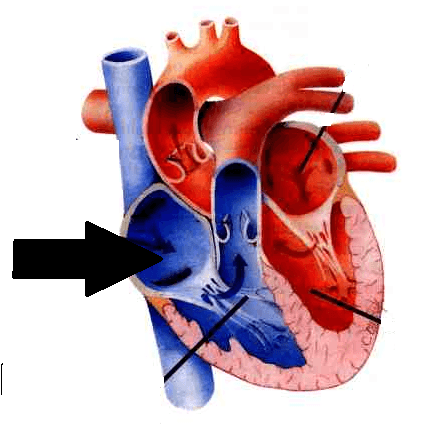
Identify
a)
Left atrium
b)
Right atrium
c)
Left ventricle
d)
Right ventricle
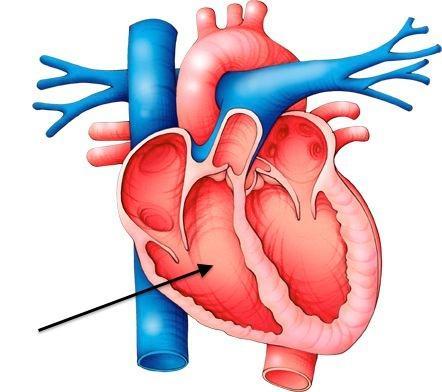
183.
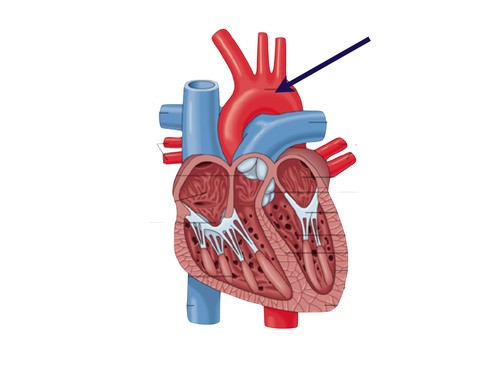
Identify
a)
Pulmonary veins
b)
Pulmonary artery
c)
Aorta
d)
Vena cava
184.
Identify
a)
Left atrium
b)
Right atrium
c)
Left ventricle
d)
Right ventricle
185.
This chamber of the heart RECEIVES blood returning from the body
a)
Right Atrium
b)
Right Ventricle
c)
Left Atrium
d)
Left Ventricle
186.
The aorta is the largest artery in the body. The blood leaving the aorta is full of?
a)
Oxygen 
b)
Carbon Dioxide 
c)
White blood Cells 
d)
Potassium 
187.
Thin-walled vessels that allow for the exchange of O2 , CO2, nutrients and wastes between blood cells or air sacs in the lungs
a)
Arteries
b)
Veins
c)
Capillaries
188.
A flap of tissue that prevents blood from flowing backward
a)
Aorta
b)
Atrium
c)
Septum
d)
Valve
189.
Carry blood away from heart; mostly oxygen-rich
a)
Arteries
b)
Veins
c)
Capillaries
190.
What is pulmonary circulation?
a)
Blood travelling to and from the lungs
b)
Blood travelling to and from the body
c)
A blood clot in the lungs
d)
The vessel that brings blood to the lungs
191.
Blood circulation from the heart to the rest of the body is called
a)
Full body
b)
Systemic
c)
pulmonary
d)
heart to lung
192.
What is an upper, thin-walled chamber through which blood is pumped to the ventricles?
a)
Valves 
b)
Veins 
c)
Ventricles
d)
Atrium
193.
What is a lower, thick-walled chamber that receives blood from the Atrium?
a)
Ventricle
b)
Valve
c)
Aorta
d)
Pericardium
194.
What do Red-Blood cells do?
a)
Carry oxygen from the lungs to the body cells and  transport carbon dioxide from the cells back to the lungs
b)
keeps blood flowing in one direction to the heart and prevent blood from flowing backwards
c)
Collects  blood from the capillaries and drain it into the veins
d)
Bring nutriients to the cells and carries away waste materials.
195.

When you breathe, your lungs take in ___ and remove ___.

a)

air/oxygen

b)

oxygen/carbon dioxide

c)

carbon dioxide/waste

d)

waste/air

196.
The two main branches from the trachea (one to each lung)
a)
bronchi
b)
alveoli
c)
capillaries
d)
bronchioles
197.
The air sacs that are covered with capillaries that separate gases we need from gases we don't need.
a)
bronchi
b)
lungs
c)
oxygen
d)
alveoli
198.
What is tube that is also known as your wind pipe?
a)
esophogus
b)
bronchi
c)
trachea
d)
alveoli
199.
What does the Larynx hold ?
a)
The larynx holds the whole sub system 
b)
The larynx is part of the plant cells. 
c)
The larynx holds the vocal chords. 
d)
The larynx is part of animal tissues. 
200.
What is the name of the muscle below the lungs that helps with breathing?
a)
trachea
b)
alveoli
c)
diaphragm
d)
bronchi
201.
Given the following structures:
1. larynx
2. nasal cavity
3. pharynx
4. trachea
Which of the following is the correct order that air would flow during inhalation. 
a)
1,2,3,4
b)
2,3,1,4
c)
2,1,3,4
d)
4,2,3,1 
202.
What is the small flap of tissue called that covers the air-only passage when we swallow?
a)
Bronchioles
b)
Larynx
c)
Alveoli
d)
Epiglottis
203.
The chewing and grinding of food into smaller pieces is an example of...
a)
Mechanical Digestion
b)
Chemical Digestion
204.
Bile is made by which digestive organ?
a)
Gallbladder
b)
Stomach
c)
Rectum
d)
Liver
205.
Nutrients from digested food are absorbed in which digestive organ?
a)
Small Intestine
b)
Stomach
c)
Large Intestine
d)
Gallbladder
206.
Which of the following is NOT part of the digestive tract?  (Hint:  Identify the secondary organ.)
a)
Mouth
b)
Esophagus
c)
Small Intestine
d)
Liver
207.
Number 3 is pointing to the...
a)
Small intestine
b)
Rectum
c)
Large intestine
d)
Stomach
208.
Number 2 is pointing to the...
a)
Esophagus
b)
Stomach
c)
Small intestine
d)
Anus
209.
Which organ pushes food down to the stomach?
a)
Mouth
b)
Esophagus
c)
Rectum
d)
Large intestine
210.
Bile is stored in which secondary digestive organ?
a)
Stomach
b)
Liver
c)
Gallbladder
d)
Pancreas
211.
Enzymes (chemicals) in your saliva help break down food while chewing.  This is...
a)
Mechanical digestion
b)
Chemical digestion
212.
What is the correct order of digestion?
a)
Mouth - pharynx - stomach - esophagus - L.I. - S.I. - anus - rectum
b)
Pharynx - mouth - esophagus - stomach - gall bladder - S.I. - rectum - anus - L.I.
c)
Mouth - pharynx - pancreas - stomach - rectum - gall bladder - S.I. - rectum - anus
d)
Mouth - pharynx - esophagus - stomach - S.I. - L.I. - rectum - anus
213.
The nephron loop, or loop of Henle, is indicated by ________.
a)
Label J
b)
Label I
c)
Label K
d)
Label M
214.
The glomerular capsule (Bowman's capsule) is indicated by ________.
a)
Label A
b)
Label G
c)
Label F
d)
Label C
215.
The glomerulus is indicated by ________.
a)
Label O
b)
Label I
c)
Label F
d)
Label M
216.
The tube connecting each kidney to the urinary bladder is the ________.
a)
ureter
b)
urethra
c)
calyx
d)
ductus (vas) deferens
217.
Starting from the glomerular capsule, the correct order of the renal tubule regions is ________.
a)
proximal convoluted tubule, nephron loop (loop of Henle), distal convoluted tubule
b)
distal convoluted tubule, proximal convoluted tubule, nephron loop (loop of Henle)
c)
nephron loop (loop of Henle), proximal convoluted tubule, distal convoluted tubule
d)
proximal convoluted tubule, distal convoluted tubule, nephron loop (loop of Henle)
218.
Which one of the following is NOT a substance typically reabsorbed by the tubules under normal healthy conditions?
a)
urea
b)
water
c)
glucose
d)
amino acids
219.
Urine is transported from the urinary bladder to the outside of the body by the ________.
a)
urethra
b)
ureter
c)
trigone
d)
collecting duct
220.
Which serves as a temporary storage of sperm cells before they are released   in the urethra?
a)
Testes
b)
Epididymis
c)
Prostate gland
d)
Cowper's gland
221.
Which produces egg cells and female hormones?
a)
cervix
b)
fallopian tube
c)
vagina
d)
ovaries
222.
What do you call the process in which the ovary releases a mature egg cell?
a)
penile erection
b)
ejaculation
c)
ovulation
d)
nocturnal emission
223.
What do you call the union of egg and sperm cell?
a)
penile erection
b)
ejaculation
c)
fertilization
d)
ovulation
224.
Where does fertilization usually take place?
a)
ovary
b)
fallopian tube
c)
cervix
d)
vagina
225.
a)
Testes
b)
Prostate gland
c)
Bladder
d)
Seminal gland
226.
a)
Vagina
b)
Uterus
c)
Cervix
d)
Ovaries
227.

The urethra belongs to which reproductive system?

a)

Male

b)

Female

c)

Both

228.
Once a sperm matures, it travels through this tube
a)
Vas deferens
b)
Fallopian tube
c)
Ovaries
d)
Epididymis
229.

All of the following are characteristics of plants except:

a)

Autotrophic

b)

Prokaryotic

c)

They have chloroplasts

d)

Cell wall made of cellulose

e)

They have a large, central vacuole

230.

Which of the following is not a function of the roots?

a)

Absorb water and minerals

b)

Photosynthesis

c)

Anchor the plant

d)

Can store food

231.

These structures are surrounded by guard cells that allow carbon dioxide to enter and oxygen & water to leave.

a)

Stomata

b)

Roots

c)

Vacuole

d)

Chloroplast

232.

Which part produces pollen?

a)

3

b)

4

c)

6

d)

7

233.

Which part produces ovules?

a)

3

b)

4

c)

5

d)

7

234.

Which part is number 3?

a)

stigma

b)

anther

c)

filament

d)

style

235.

Which part is number 8?

a)

Stamen

b)

Stigma

c)

Pistil

d)

Anther

236.

__________________________ is the process of transporting the male gamete from the male flower parts to the female flower parts.

a)

Asexual reproduction

b)

Pollination

c)

Photosynthesis

d)

Vasculation

237.

After fertilization, what does the ovary develop into?

a)

Seed

b)

Fruit

c)

Bud

d)

Flower

238.
What is the term for each step in the transfer of energy and matter within a biological community?
a)
energy path
b)
food web
c)
trophic level
d)
food pyramid
239.
Autotrophs make up the _______ level in all ecosystems.
a)
First
b)
Second
c)
Third
d)
Fourth
240.
What does a food web represent?
a)
All connections of energy flow throughout all organisms in a habitat.
b)
The specific ways that mutualism is carried out.
c)
A single pathway or energy flow between organisms. 
d)
How carnivores get their food. 
241.
The amount of energy that usually transfers from one trophic level to the next...
a)
10%
b)
20%
c)
80%
d)
50%
242.
The nonliving aspects of an ecosystem.
a)
Abiotic factors
b)
Biotic factors
243.
The living portions of the ecosystem.
a)
Biotic factors
b)
Abiotic factors
244.
A collection of organisms that belong to different populations but all live in the same area and interact with one another.
a)
Population
b)
Ecosystem
c)
Community
d)
Ecosphere
245.
A collection of organisms that make up a community as well as all of the nonliving aspects of the environment.
a)
Population
b)
Community
c)
Habitat
d)
Ecosystem
246.
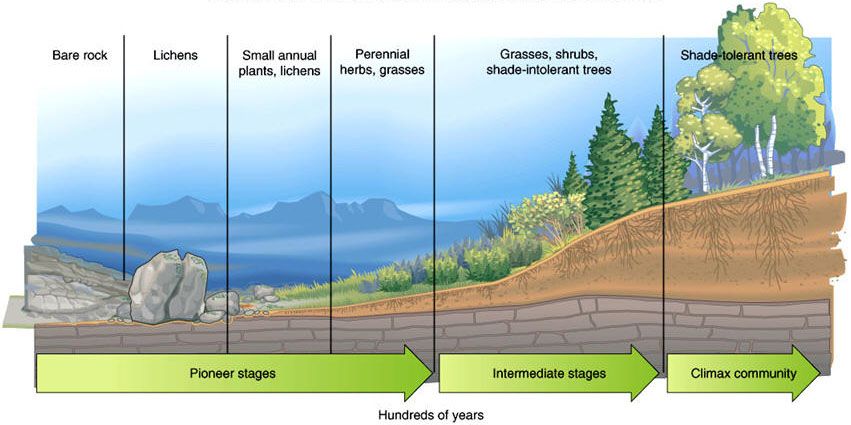
The picture shows what type of succession?
a)
primary
b)
secondary
c)
tertiary
d)
quadanary
247.
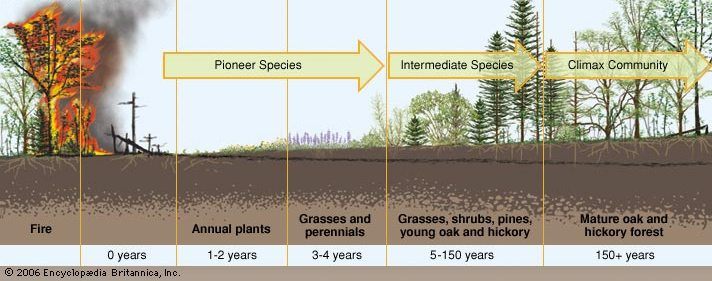
The picture shows what type of succession?
a)
primary
b)
secondary
c)
tertiary
d)
quadanary
248.
What is the name given to lichen or algae after a primary succession?
a)
pioneer species
b)
volunteer species
c)
founder species
d)
conqueror species
249.
Reaches a climax community quicker because soil is already present
a)
primary succession 
b)
secondary succession
c)
both types of succession
250.
What is another name for natural selection?
a)
survival of the smartest
b)
survival of the fastest
c)
survival of the biggest
d)
survival of the fittest
251.
What is a change in an organism that allows for it to survive in its environment?
a)
homologous
b)
vestigial
c)
variation
d)
adaptation
252.
What is the study of organisms at the early stages of development?
a)
DNA studies
b)
embryology 
c)
extinction
d)
fossil record
253.
What is an organism that has similar characteristics and can reproduce?
a)
species
b)
organism
c)
embryology
d)
vestigial 
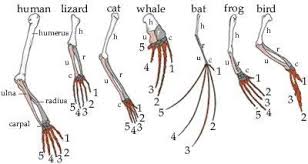
254.
What is this an example of?
a)
vestigial structures
b)
embryology
c)
homologous structures
d)
fossil record
255.
The cause of artificial selection is…
a)
The environment
b)
Humans
c)
Mutation
d)
Gene Flow
256.
Darwin wrote that organisms with traits that are best suited to the environment will ________________
a)
increase in number
b)
become extinct
257.
Which term refers to the process by which individuals that are better suited to the environment survive and reproduce therefore passing down their genes to their offspring? 
a)
Evolution 
b)
Variation 
c)
Adaptation
d)
Natural Selection 
258.
What increases genetic variation when animals move  from one population to another
a)
genetic drift
b)
sexual selection
c)
bottleneck effect
d)
gene flow
259.
What is speciation?
a)
combining of tow species to form one with different traits
b)
isolation that affects mating behaviors
c)
timing of mating that prevents normal sexual selection
d)
divergence of two or more species from an existing one