
Font size
S
M
L
XL
 Worksheets
Earth science review
Total questions: 75
Worksheet time: 2hrs 36mins
Name
Class
Date
1.
Ocean tides are
a)
non-cyclic and not predictable
b)
non-cyclic but predictable
c)
cyclic and predictable
d)
cyclic but not predictable
2.
If I am located at 40 degrees North latitude, what is the altitude of Polaris?
a)
0 degrees
b)
40 degrees
c)
50 degrees
d)
90 degrees
3.
As one travels from the equator to the North Pole, what happens to the altitude of Polaris?
a)
it decrease
b)
it increases
c)
it doesn't change
4.
If you travel WEST, time
a)
is less
b)
will increase
5.
For every change of 15 degrees longitude, time changes
a)
1 hour
b)
2 hours
c)
3 hours
d)
4 hours
6.
The closer the isolines, the steeper the gradient.
a)
True
b)
False
7.

What is the contour interval for this map?
a)
200 m
b)
200 mi
c)
100 m
d)
100 mi
8.
Where is the steepest slope?
a)
North side
b)
South side
c)
East side
d)
West side
9.
What's the highest possible elevation?
a)
800 meters
b)
900 meters
c)
899 meters
d)
999 meters
10.
Which direction is the stream flowing?
a)
SE
b)
SW
c)
NE
d)
NW
11.
Earth is tilted
a)
15 degrees
b)
40 degrees
c)
23.5 degrees
d)
90 degrees
12.
We rotate
a)
clockwise, West to East
b)
clockwise, East to West
c)
counterclockwise, West to East
d)
counterclockwise, East to West
13.
We revolve
a)
clockwise, West to East
b)
clockwise, East to West
c)
counterclockwise, West to East
d)
counterclockwise, East to West
14.
Summer solstice
a)
3/21
b)
6/21
c)
9/23
d)
12/21
15.
Winter solstice
a)
3/21
b)
6/21
c)
9/23
d)
12/21
16.
Spring Equinox
a)
3/21
b)
6/21
c)
9/23
d)
12/21
17.
Fall Equinox
a)
3/21
b)
6/21
c)
9/23
d)
12/21
18.
If Earth was not tilted
a)
we would only have 1 season
b)
we would only have 2 seasons
c)
we would have 4 seasons but they would be more extreme
19.
If Earth was tilted 15 degrees
a)
nothing would change
b)
summers would be cooler and winters would be warmer
c)
summers would be warmer and winters would be cooler
20.
If Earth was tilted 50 degrees
a)
nothing would change
b)
summers would be cooler and winters would be warmer
c)
summers would be warmer and winters would be cooler
21.

Summer
a)
A
b)
B
c)
C
d)
D
22.
As Earth goes from A to C, the length of our noon time shadows
a)
increases
b)
decreases
c)
remains the same
23.
Sunrise direction in Summer
a)
due East
b)
North of East
c)
South of East
24.
Sunset direction in Summer
a)
due West
b)
North of West
c)
South of West
25.
Sunrise direction in Winter
a)
due East
b)
North of East
c)
South of East
26.
Sunset direction in Winter
a)
due West
b)
North of West
c)
South of West
27.
Direction we need to look to see the Sun at noon
a)
north
b)
south
c)
east
d)
west
28.
Coriolis Effect and Focault Pendulum prove
a)
Earth revolves
b)
Earth rotates
29.
The Sun's apparent diameter is greatest during
a)
winter
b)
spring
c)
summer
d)
fall
30.
We know the universe is expanding because of
a)
blue shift
b)
red shift
31.
Geocentric means
a)
Sun is in the center
b)
Earth is in the center
32.

Where is this located?
a)
equator
b)
somewhere in the Northern Hemisphere
c)
somewhere in the Southern Hemisphere
d)
At one of the Poles
33.

Where is this located?
a)
equator
b)
somewhere in the Northern Hemisphere
c)
somewhere in the Southern Hemisphere
d)
At one of the Poles
34.

The purple path represents
a)
the winter solstice
b)
an equinox
c)
the summer solstice
35.
The red path represents
a)
the winter solstice
b)
an equinox
c)
the summer solstice
36.
Each season, the angle of insolation changes by
a)
15 degrees
b)
23.5 degrees
37.

What is the best evidence that one of
these layers of rock was formed under an ocean?
a)
the thickness of the layer
b)
the type of fossils in the layer
c)
the number of caves in the layer
d)
the height above sea level of the layer
38.

The diagram represents a cross-section of a cliff. It shows
several rock layers containing fossils.
Which of the following layers of rock is most likely the youngest?
Which of the following layers of rock is most likely the youngest?
a)
the layer containing trilobites
b)
the layer containing fishes
c)
the layer containing amphibians
d)
the layer containing dinosaurs
39.

How many hours (h) will it take for the apparent position of the Sun to change from point A to point B?
a)
1 h
b)
2 h
c)
3 h
d)
4 h
40.

In order for process A to occur, liquid water must
a)
gain 334 Joules per gram
b)
gain 2260 Joules per gram
c)
lose 334 Joules per gram
d)
lose 2260 Joules per gram
41.

The block diagram represents two parallel mountain ranges. Which two geologic processes most likely created this landscape region?
a)
volcanism, followed by metamorphism
b)
faulting, followed by deposition
c)
folding, followed by erosion
d)
glaciation, followed by rifting
42.

The greatest amount of transpiration and evaporation will occur most likely when the air temperature is
a)
low and the humidity is low
b)
low and the humidity is high
c)
high and the humidity is low
d)
high and the humidity is high
43.

The map shows a stream. Letters A, B, C, and D represent locations on the stream surface. Arrows represent the direction of stream flow. Which two locations have the greatest stream velocities?
a)
A and B
b)
B and C
c)
C and D
d)
D and A
44.
Volcanic ash is a good geologic time marker because the ash
a)
is deposited rapidly over a large area
b)
spreads evenly in all compass directions
c)
is easily weathered and eroded
d)
remains in the atmosphere for millions of years
45.
Compared to terrestrial planets, Jovian planets have
a)
smaller equatorial diameters and shorter periods of revolution
b)
smaller equatorial diameters and longer periods of revolution
c)
larger equatorial diameters and shorter periods of revolution
d)
larger equatorial diameters and longer periods of revolution
46.
Clouds most likely form as a result of
a)
moist air rising, compressing, and warming
b)
moist air rising, expanding, and cooling
c)
dry air rising, compressing, and warming
d)
dry air rising, expanding, and cooling
47.
Which mineral can be tested using the acid test? (Hint: Use your ESRT)
a)
Halite
b)
Calcite
c)
Gypsum
d)
Quartz
48.
According to your ESRT, what are the two most abundant elements in the Earth's Crust?
a)
Silicon
b)
Hydrogen
c)
Calcium
d)
Oxygen
49.
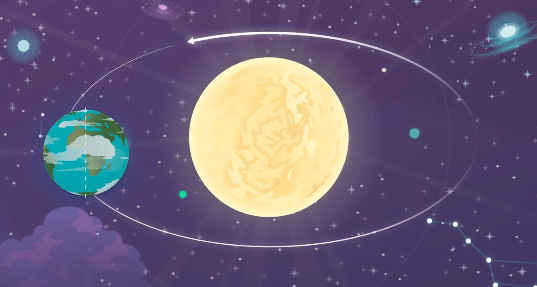
How long does it take for the Earth to make one full orbit around the Sun?
a)
one day
b)
one week
c)
one month
d)
one year
50.
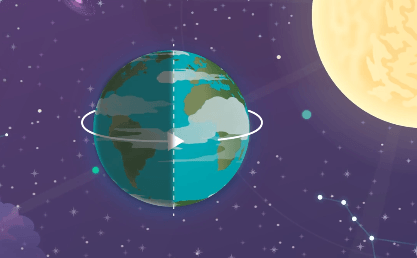
The Earth is rotating on its axis, creating _____
a)
the 12 months
b)
the years
c)
the seasons
d)
day and night
51.

As the Earth travels around the Sun, it creates a pattern that makes _____
a)
the months
b)
the years
c)
the seasons
d)
day and night
52.
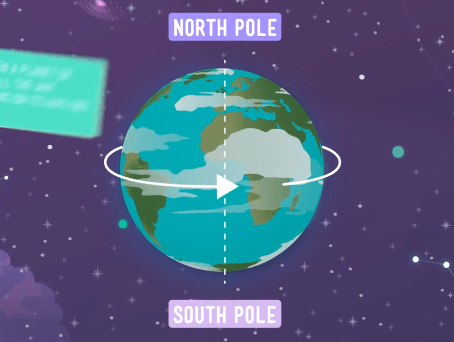
The spinning movement of the Earth about its axis is called the Earth's _____
a)
revolution
b)
rotation
c)
precession
d)
orbit
53.
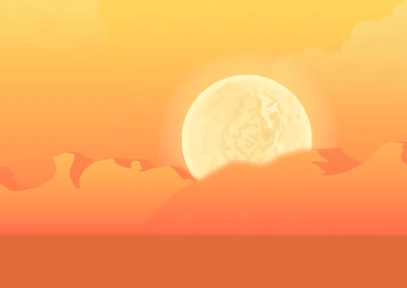
What looks to be the motion of the Sun in the sky is really caused by the motion of _____
a)
the Earth
b)
the stars
c)
the planets
d)
the Earth's axis
54.
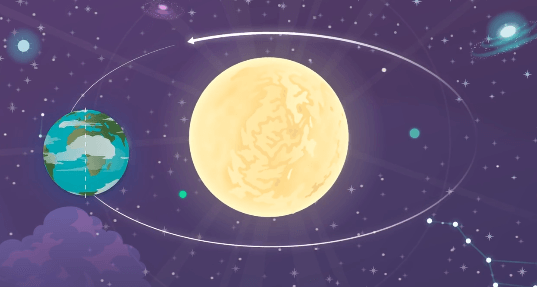
The movement of the Earth around the Sun is called its _____
a)
revolution
b)
rotation
c)
precession
d)
gyration
55.

When the part of the world that you're living in is leaning towards the Sun, its _____
a)
winter
b)
spring
c)
summer
d)
fall
56.

The invisible line that passes through the North Pole and the South Pole is called Earth's ____
a)
axis
b)
equator
c)
ecliptic
d)
prime meridian
57.
Rotation of the earth is what causes
a)
The seasons
b)
Day and night
c)
The tides
d)
A full moon
58.
Rotation of the earth takes
a)
One day
b)
One year
c)
One summer
d)
One winter
59.
Revolution of the earth takes
a)
One day
b)
One year
c)
One summer
d)
One winter
60.
The earth's rate of rotation is...
a)
1 degree per day
b)
15 degrees per hour
c)
15 degrees per day
d)
365 days per year
61.

When is the Sun directly overhead at noon in New York State?
a)
never
b)
September 21/March 21
c)
June 21
d)
Dec 21
62.

What does this symbol on a weather map indicate?
a)
High pressure system
b)
Low pressure system
c)
Cold front
d)
Warm front
63.
What kind of weather is usually associated with a high pressure system?
a)
Sunny weather
b)
Precipitation (rain, snow, etc.)
64.
Which weather tool measures air pressure?
a)
thermometer
b)
barometer
c)
anemometer
d)
psychrometer
65.
This weather tool measures wind speed and direction
a)
thermometer
b)
barometer
c)
anemometer
d)
psychrometer
66.
Which weather tool measures temperature?
a)
thermometer
b)
barometer
c)
psychrometer
d)
anememeter
67.
Hot air (RISES / FALLS) __________.
a)
RISES
b)
FALLS
68.
Which condition usually means cloudy, stormy weather?
a)
high pressure
b)
low pressure
69.
A gap in the geologic record that shows where rock layers have been lost due to erosion.
a)
extrusion
b)
unconformity
c)
intrusion
d)
law of superposition
70.
How does the law of crosscutting explain the age of a fault?
a)
The fault is younger than the rocks above it.
b)
The fault is younger than the rocks it cuts through.
c)
The fault is older than the rocks above it.
d)
The fault is older than the rocks it cuts through.
71.
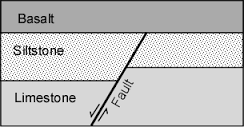
What are the relative ages of the features in order from oldest to youngest?
a)
Limestone, Basalt, Fault, Siltstone
b)
Siltstone, Fault, Basalt, Limestone
c)
Limestone, Fault, Basalt, Siltstone
d)
Limestone, Siltstone, Fault, Basalt
72.
What is the half life of carbon-14?
a)
10,000 years
b)
5,730 years
c)
2,135 years
d)
1,025 years
73.
What does uranium-238 decay into?
a)
carbon-14
b)
lead-206
c)
argon-40
d)
nitrogen-14
74.
Which statement is not true?
a)
Older rock layers will be found under younger rock layers.
b)
Rock layers are always younger than the igneous intrusions that cut through them.
c)
Nonconformities are sedimentary rocks that lie on top of metamorphic or igneous rock layers
d)
Faults, intrusions, folding, and tilting are examples of disturbances.
75.
What does finding marine shells in the woods of Pennsylvania tell scientists?
a)
Marine species once lived on land.
b)
The area of Pennsylvania was once underwater.
c)
The fossils had most likely been transported from a marine environment to Pennsylvania.
d)
Marine organisms have adapted to survive on land.
Reset

