
 Worksheets
Final Review Part 3
Total questions: 50
Worksheet time: 40mins
Name
Class
Date
1.
Fossils are usually found in
a)
igneous rock
b)
extrusions
c)
intrusions
d)
sedimentary rock
2.
Which statement is true about the fossil record?
a)
It is a record of all living things
b)
It shows how our climate has remained the same over time
c)
It provides evidence for history of life on Earth
d)
It does not support the theory of evolution
3.

A fossil is ____.
a)
a dead rotten animal
b)
the remains of things that lived a long, long time ago
c)
a plant that dried up
4.
Relative dating of rock layers tells us that the deeper we dig, _______.
a)
the younger the rocks get
b)
the smellier the rocks get
c)
the harder the rocks get
d)
the older the rocks get
5.
How old do Paleontologists believe the Earth is?
a)
2015 years old
b)
3.6 billion years old
c)
4.6 billion years old
d)
4.6 million years old
6.

According to the law of superposition, which layer is the youngest?
a)
A
b)
B
c)
C
7.

Look at the diagram, what layer did animal E first show up in?
a)
Layers #4
b)
Layers #5
c)
Layers #6
d)
Layers #8
8.
The atmosphere is composed of
a)
mostly oxygen
b)
all hydrogen
c)
a mixture of gases
d)
H20
9.
Low air pressure moves towards high air pressure.
a)
true
b)
false
10.
High pressure creates sunny, clear skies.
a)
True
b)
False
11.
Low pressure areas would likely have
a)
cloudy weather
b)
clear weather
c)
sunny weather
d)
storms
12.
As altitude increases, pressure __________.
a)
increases
b)
decreases
c)
stays the same
d)
rises
13.
Which water cycle stage creates clouds?
a)
Transpiration
b)
Evaporation
c)
Condensation
d)
Runoff
14.
What type of weather is associated with a cold front?
a)
Thunderstorms
b)
Clear skies
c)
Warmer temperatures and tornadoes
d)
Cool temperatures and thunderstorms, rain
15.
What weather would you find at a stationary front?
a)
Many days of wet weather
b)
Dry, warm temperatures
c)
A mix of dry and wet days
d)
Mild weather
16.
Cold air traveling south from Canada is:
a)
continental tropical
b)
continental polar
c)
maritime tropical
d)
maritime polar
17.
Warm air moving upwards from the Gulf of Mexico is:
a)
continental tropical
b)
continental polar
c)
maritime tropical
d)
maritime polar
18.
In an atmospheric convection current, cool air ____ and warm air ____.
a)
sinks, sinks
b)
rises, sinks
c)
sinks, rises
d)
rises, rises
19.

Feeling the heat from a fire is an example of which type of atmospheric heating?
a)
Radiation
b)
Convection
c)
Conduction
d)
Greenhouse effect
20.

What tool is used to measure air pressure?
a)
thermometer
b)
anemometer
c)
psychrometer
d)
barometer
21.

This picture represents the symbol for a __________________________Front.
a)
Warm
b)
Occluded
c)
Cold
d)
Stationary
22.

This Symbol is associated with a _____________________Front.
a)
Warm
b)
Occluded
c)
Cold
d)
Stationary
23.

The picture represents the symbol for a _______________________Front.
a)
Cold
b)
Warm
c)
Occluded
d)
Stationary
24.

In which direction is this front moving:
a)
west
b)
northwest
c)
southeast
d)
south
25.
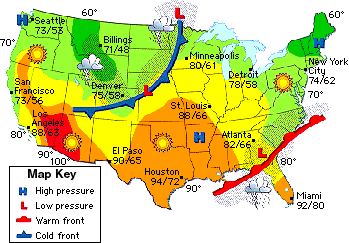
A high pressure system is located north of New York City. What type of weather will be experienced there?
a)
clear, sunny skies
b)
cloudy and rainy
26.

Which city is experiencing thunderstorms?
a)
Denver
b)
New York
c)
Miami
d)
Boise
27.
When a pot is touching a stove that is on, what heat transfer is happening?
a)
I don't know??????
b)
Radiation
c)
Conduction
d)
Convection
28.
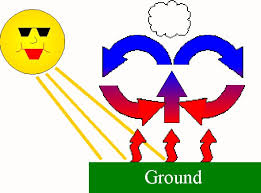
Warm air rises and the cool air sinks demonstrates this type of heat transfer.
a)
conduction
b)
convection
c)
radiation
d)
Insolation
29.
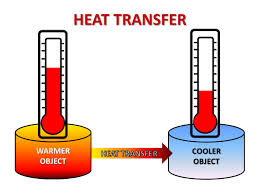
Heat transfers from an area of ____temperature to an area of ___ temperature.
a)
high to low
b)
low to high
c)
high to high
d)
It can travel high to low and low to high.
30.
The Earth's axis is tilted _____ degrees.
a)
23.5
b)
25.3
c)
30.2
d)
24
31.

At position A, which hemisphere would have summer?
a)
Northern hemisphere
b)
Southern hemisphere
32.
The term equinox means....
a)
equal amount of day light and equal amount of night
b)
Equal amount of winter and summer
c)
Equal amounts of hot dogs for everyone
d)
The longest day of the year
33.
What do June 21 and December 21 have in common?
a)
equinox dates
b)
the moon is full
c)
solstice dates
d)
the cold fronts blow in
34.
What is the longest day of the year?
a)
winter solstice
b)
summer solstice
c)
fall equinox
d)
spring equinox
35.
Why do we experience the changing of the season on the earth?
a)
distance from the sun
b)
rotation of the earth
c)
change in solar output
d)
tilt of the earth's axix
36.

Which season is taking place in the Northern Hemisphere in Position 1?
a)
Winter
b)
Spring
c)
Summer
d)
Fall
37.
What does the rotation of the earth cause us to experience?
a)
seasons
b)
year
c)
day & night
d)
eclipse
38.
How long does it take the earth to revolve once around the sun?
a)
12 hours
b)
24 hours
c)
30 days
d)
365.25 days
39.

How long is a day on earth?
a)
22 hours
b)
365 days
c)
12 hours
d)
24 hours
40.

The earth orbits around the _________
a)
sun
b)
moon
c)
other planets
d)
solar system
41.

When the visible (lit) portion of the moon is increasing, the moon is:
a)
waning
b)
full
c)
waxing
d)
new
42.

When the Earth is between the moon and sun, it is most likely a:
a)
new moon
b)
full moon
c)
waxing crescent
d)
waxing gibbous
43.
Changes in the moon's appearance are
a)
phases
b)
eclipses
c)
stages
d)
cycle
44.
What causes the moon's phases
a)
Where you are standing on Earth
b)
the amt of sunlight reflected onto the moon from the sun
c)
The tilt of Earth
d)
how fast the moon is moving
45.

The Moon orbits Earth in a ________________ direction
a)
clockwise
b)
counterclockwise
c)
upwards
d)
downwards
46.
Define New Moon
a)
None of moon is visible from Earth
b)
All of moon visible from Earth
c)
Moon is 1/2 visible from Earth
d)
Moon is more than Half Visible from Earth
47.

Name the moon phase
a)
Waxing Gibbous
b)
Waxing Crescent
c)
Waning Crescent
d)
Waning Gibbous
48.

Name the phase of the moon for letter f
a)
Waning Gibbous
b)
Waxing Gibbous
c)
Waning Crescent
d)
Waxing Crescent
49.

People buy more drinks on ____ than any other day.
a)
Monday
b)
Tuesday
c)
Thursday
d)
Friday
50.

Which event on this timeline happened FIRST?
a)
Last use of hieroglyphic writing
b)
Rosetta Stone is carved
c)
Settlers in Nile Valley
d)
Development of hieroglyphic writing
100 %

