

wayground logo

Free Printable Worksheets

Font size

S
M
L
XL
Worksheets

Summer 2018 School Mr. Phillips

Total questions: 142

Worksheet time: 2hrs 50mins
Name
Class
Date
1.
An increase in the price of aspirin is likely to be paired with a(n) ___________________ in the demand for Tylenol because the two goods are __________________.
a)
increase; complements
b)
increase; substitutes 
c)
 decrease; complements 
d)
 decrease; substitutes
2.
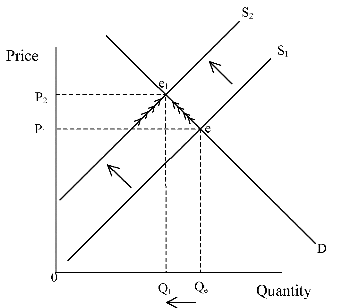
Assume the image is showing the market for apples.  Which of the headlines could indicate the pictured shift is occurring in the market?
a)
Pesticides on apples linked to mouth cancer.
b)
Storms destroy apple orchards.
c)
An apple a day really does keep the doctor away.
d)
New genetic strain leads to apple trees that produce twice as many apples.
3.
When the supply of a product or service goes up and the demand stays the same the Price will typically do what? 
a)
rise
b)
fall
c)
stay the same
d)
Consumer
4.
Factors that cause the supply or demand to change are called?
a)
equilibrium
b)
shifter
c)
demand
d)
producer
5.
The cost of borrowing money is referred to as 
a)
Interest 
b)
Annual Percentage Rate 
c)
Credit 
d)
Credit Line 
6.
The amount charged if your payment is received after the billing due date.
a)
late payment fee
b)
overdue fee
c)
withdrawal fee
d)
loser fee
7.
The maximum amount you are allowed to carry as a balance on the card
a)
interest
b)
ARP
c)
credit limit
d)
all of these
8.
Which one is considered a danger of using a credit card
a)
no cash needed
b)
leads to overspending
c)
convenient
d)
earns rewards
9.
What is credit?
a)
Free money
b)
Borrowed money
c)
Standard of living
d)
A term that causes tears
10.
What is a credit score?
a)
A credit score is a three-digit numerical rating that reflects how likely you are to fail at paying your debts
b)
A five-digit numerical rating that reflects how likely you are to repay your debt. 
c)
A three-digit numerical rating that reflects how likely you are to repay your debt. 
d)
A credit score is a five-digit numerical rating that reflects how likely you are to fail at paying your debts
11.
What financial habits determine your credit score?
a)
Payment History & Amount you owe 
b)
Length of credit history & Amount of new credit applied for recently
c)
Types of credit open
d)
All of these are correct
12.
What are the three major Credit Reporting Agencies (CRAs)?  
a)
Equifax
b)
TransUnion
c)
Experian
d)
All of these are correct
13.
The maximum amount you are allowed to carry as a balance on the card
a)
interest
b)
ARP
c)
credit limit
d)
all of these
14.
One of the 5 C's of credit that shows a person's willingness to pay is
a)
capital
b)
collateral
c)
character
d)
capacity
15.
A FICO Credit Score of 300 would be considered:
a)
Excellent
b)
Good
c)
Poor
d)
Very Bad
16.
A FICO Credit Score of 725 would be considered:
a)
Excellent
b)
Good
c)
Poor
d)
Very Bad
17.
Your credit score is determined by several things.
The timely manner in which you did or did not repay debt is called:
a)
Payment history
b)
Outstanding Debt
c)
Credit history
d)
Pursuit of new credit
18.
Using a debit card affects your credit score.
a)
True
b)
False
19.
An unsecured loan is backed by collateral.
a)
True
b)
False
20.
What is term for the person who will sign a loan document with you to help you obtain credit?
a)
Capital
b)
Nice Person
c)
Cosigner
d)
Equitor
21.
Which loan type is more common?
a)
Single Payment
b)
Installment
c)
No payment
d)
Character
22.

__________ is money paid regularly at a particular rate for the use of money lent, or for delaying the repayment of a debt.

a)

Credit

b)

Credit Score

c)

Interest

d)

Annual Fee

23.

__________ is extra time allowed for meeting with a requirement, satisfaction of an obligation, or implementation of an agreement.

a)

Grace Period

b)

Secured Credit Card

c)

Loan Extension

d)

Overdraft Protection

24.
6.  An agency that collects financial information and keeps files on individual consumers
a)
credit bureau
b)
credit rating
c)
finance charges
d)
creditors
25.
______________ is the amount of money you pay to use someone else's money.
a)
Interest
b)
Credit
c)
Principal
d)
Term
26.
Type of loan used specifically for purchasing a home is a __________
a)
Mortgage
b)
Student Loan
c)
Equity Line of Credit
d)
Credit Card
27.
________________ occurs when someone uses your personal information without your permission
a)
Identity theft
b)
Personal theft
c)
Kidnapping
d)
Information theft
28.
With this type of loan the interest rate will remain the same for the life of the loan
a)
Adjustable rate
b)
Balloon rate
c)
Never changing rate
d)
Fixed rate
29.
What you give up to obtain something else is called ______________
a)
Trade-in cost
b)
Give-up cost
c)
Opportunity cost
d)
Substantial cost
30.
The amount of time your are obligated to make payments on a loan is the 
a)
Interest rate
b)
Term
c)
Principal
d)
Annual percentage rate
31.
The four C's of credit are:  Credit, Character, Capacity and Collateral
a)
True
b)
False
32.
The fee incurred when you exceed our credit limit on your credit card is the __________
a)
Annual fee
b)
Cash-advance fee
c)
Service fee
d)
Over the limit fee
33.
Which of the following is an ADVANTAGE of credit?
a)
No need for carrying cash
b)
Annual Fees
c)
Interest Rates
34.
When should you use a credit card?
a)
For large purchases!
b)
When I'm hungry
c)
Only for small purchases
d)
Never.
35.
Your honesty and willingness to pay your debts is known as....
a)
character
b)
capacity
c)
capital
d)
the 3 cs of credit
36.
Credit can lead to overbuying in some instances.
a)
True
b)
False
37.
A record of your transactions completed during a billing period and mailed to a debtor is called a ________________.
a)
Receipt
b)
Credit memorandum
c)
Statement of Account
d)
Credit Check
38.
The APR is a disclosure statement required by law.
a)
True
b)
False
39.
Which law requires that you be told the cost of a credit purchase in writing prior to signing/agreeing to the credit agreement?
a)
Fair Credit Reporting Act
b)
Fair Billing Act
c)
Truth in Lending Law
d)
Equal Credit Opportunity Act
40.
Law that requires prompt correction of billing errors after they have been reported to a creditor.
a)
Fair Credit Reporting Act
b)
Fair Billing Act
c)
Truth in Lending Law
41.
Security for a loan is called ______________.
a)
Debtor
b)
Collateral
c)
Finance Charge
d)
Net worth
42.
A type of loan in which you agree to pay an amount each month to cover purchases of gas or electricity (utilities) provided.
a)
revolving charge account
b)
budget account
c)
service account
d)
regular charge account
43.
Your ability to pay debts when they are due is called capacity.
a)
True
b)
False
44.
A _______________ is money given as a partial payment to secure a loan.
a)
credit limit
b)
foreclosure
c)
down payment
d)
cash advance
45.
Loan given with no collateral required.
a)
revolving loan
b)
installment loan
c)
signature loan
d)
open
46.

An excellent credit score would be ____________.

a)

900-1000

b)

750-850

c)

600-750

d)

less than 650

47.

A ___________ payment is the smallest payment you can make on a revolving credit account and keep the account in good standing.

a)

balloon

b)

down payment

c)

monthly

d)

minimum

48.
A loan which the borrower must repay the amount in a specified number of equal payments.
a)
Closed-end credit
b)
Open-end credit
c)
Credit Card
d)
Debit Card
49.
Short‐term loan that provides immediate cash by securing a borrower’s written check or receiving authorization for automatic withdrawal from the borrower’s depository institution account.
a)
Payday Loan
b)
Pawn Loan
c)
Rent-to-own Loan
d)
Title Loan
50.
Short‐term cash advance secured by a taxpayer’s expected tax refund.
a)
Refund Anticipation Loan
b)
Pawn Loan
c)
Rent-to-own Loan
d)
Title Loan
51.
Transferring debt from one credit card to another
a)
Balance Transfer
b)
EFT
c)
Annual Fee
d)
Introductory RAte
52.
People under the age of 21 can never receive a credit card.
a)
True
b)
False
53.
What if I have bad credit?
a)
High interest rates on loans
b)
You can easily be approved for a loan
c)
You have a high credit score
d)
You may have to live with Mr. Trump.  
54.
What can be found on your credit report?
a)
FICO score
b)
Girlfriend's name
c)
Cash amount in your bank account
d)
Number of traffic tickets 
55.
Length of credit history is listed on your credit report
a)
True
b)
False
56.
My credit history does not affect my chances for renting my first apartment.
a)
True
b)
False
57.
Routinely paying my bills late could negatively affect my credit history.
a)
True
b)
False
58.
I should review my credit report for errors.
a)
True
b)
False
59.
If my credit card allows me to charge up to $1000, I should charge the maximum amount to build my credit history.
a)
True
b)
False
60.
Telephone and utility companies may use information in your credit report to decide whether to provide services to you.
a)
True
b)
False
61.
The original money that a person borrows on credit:
a)
principal
b)
interest
c)
debt
d)
credit
62.
Any fee representing the cost of credit, or the cost of borrowing:
a)
credit
b)
finance charge
c)
APR
d)
term
63.
A fee charged by a lender on entering into a loan agreement to cover the cost of processing the loan
a)
origination fee
b)
interest
c)
finance charge
d)
none of these
64.
A patient may have met the required amount and insurance will begin to cover, but they will only cover a specific percentage of the expense such as an 80/20.
a)
Medicare
b)
co-insurance
c)
co-payment
d)
deductible
65.
Before insurance begins to cover a patient, the ___ must be paid first, the the insurance will begin to pay.
a)
Medicaid
b)
HMO
c)
PPO
d)
deductible
66.
Before leaving the health care facility, a patient is usually responsible for a specific amount of money known as a ___ for whatever services they received, regardless of the total cost and/or insurance coverage.
a)
co-payment
b)
co-insurance
c)
deductible
d)
premium
67.
If injured on the job, __ insurance will cover treatment and reimburse lost wages.
a)
Medicare
b)
co-payment
c)
deductible
d)
workmens' compensation
68.
___ is a federal program for individuals over the age of 65, disabled for at least 2 years or ESRD.
a)
Medicare
b)
Medicaid
c)
HMO
d)
PPO
69.

The out of pocket cost to the insured when a loss occurs is called...

a)

Premium

b)

Deductible

70.

Which of the following wouldn't save you money on your auto insurance premium?

a)

Decrease your deductible

b)

Reduce or eliminate optional insurance on an older vehicle

c)

Maintain a good credit history

d)

Bundle your insurance with other policies

71.

Under current law, until what age can a child stay on their parents' health insurance?

a)

18

b)

21

c)

26

d)

29

72.

The FDIC insured deposit limit is

a)

$150,000

b)

$200,000

c)

$250,000

d)

$300,000

73.

What information is typically listed on an insurance policy?

a)

Name of person or property being insured

b)

Actual Cash Value of the property being insured

c)

Deductible amounts

d)

The policy period

74.

Which insurance coverage is required by law?

a)

Homeowners insurance

b)

Auto insurance

c)

FDIC

d)

Disability insurance

75.
Amount you must pay before you begin receiving any benefits from your insurance company.
a)
Out of Pocket Expense
b)
Premium
c)
Liability
d)
Deductible
76.
The possibility of a loss is called
a)
Risk
b)
Liability
c)
Insurance
d)
Hazard
77.
Insurance coverage to protect you from damage to your car other than by collision or vehicle overturning
a)
Floater
b)
Collision
c)
Comprehensive
d)
Liability
78.
Jerry just got a very expensive piece of art for his dining room. Which statement would it be most appropriate for Jerry to make to his insurance agent
a)
“I think I need a personal property floater.” 
b)
 “I think I should get speculative risk insurance"
c)
 “I will deduct the cost of the jewelry from my premium.”  
d)
“I realize that if this jewelry is stolen it will be considered vicarious liability.” 
79.
Marco owns a restaurant. One of Marco's chefs just got injured by slipping on a greasy floor. What type of insurance might protect Marco in this situation?
a)
Life insurance
b)
Medicare
c)
Liability insurance
d)
Diversification insurance
80.
Generally, the higher the deductible on an insurance policy, the
a)
higher the copay.
b)
worse the insurance
c)
higher the premium
d)
lower the premium
81.
A person buys a homeowner’s insurance policy with a $250 deductible, which means the person will 
a)
a. have to pay a quarterly premium of $250.
b)
 b. have to pay the first $250 which will be deducted from the claim settlement paid by the insurance company. 
c)
c. only receive payment from the insurance company of $250 for any single article damaged.
d)
 d. not be responsible for the first $250 of the claimed damages.
82.
In insurance, a premium is
a)
The reoccuring price someone must pay to keep the health insurance
b)
The cost paid out of pocket before the insurance company will begin paying anything
c)
Using your insurance to help pay for something
d)
none of the above
83.
For the past five years, a person has had a $20,000 whole life insurance policy that has a cash value clause. The person decides to surrender the policy. At the time of surrender, the person will receive
a)
one-fifth of the $20,000 face value.
b)
$20,000 less the premiums paid.
c)
a calculated amount of money which includes the premiums paid as well as the interest on that money.
d)
a calculated amount of money that must be converted to a term life insurance policy.
84.
You have a $2,000 loss. Your insurance company pays you $1,500 on the claim for the loss. The $500 the insurance did not pay is a result of your policy having a:
a)
Co-insurance clause
b)
Deductible
c)
Hazard clause
d)
Premium
85.
Why is term life insurance usually the least expensive type of life insurance?
a)
The policy only pays a death benefit
b)
The policy builds a cash value
c)
The policy provides coverage for a lifetime
d)
The policy is available to all consumers
86.
Lucy has no insurance. The situation(s) should she consider insuring against first are:
a)
Death so her financial obligations are paid
b)
Losses resulting from an illness, accident, or disability
c)
Property losses and auto accidents
d)
Auto collision, and burglary
87.
Which of the following insurance covers vehicles?
a)
Mortgage
b)
Racing
c)
Automobile
d)
Life
88.
Insurance is frequently described as a method of "sharing the risk" because the:
a)
Risk of loss is shared with the insurance company sales person
b)
Insured shares the risk of loss with all the other policy holders
c)
Insured can share the risk by spreading the cost over a number of years
d)
Risk of loss is shared with the government
89.
The purpose of Insurance is NOT to:
a)
Diversify an investment portfolio
b)
Share risk with other policy holders and the insurance company
c)
Protect assets
d)
Protect against potential losses
90.
Gwen receives a bill from her auto insurance company, and she sends a check to the company to make sure her policy is not canceled. The cost of her policy is called the:
a)
Co-insurance clause
b)
Premium
c)
Deductible
d)
Exclusion
91.
The only type of life insurance that does not develop a cash value is:
a)
Term life insurance
b)
Whole life insurance
c)
Universal life insurance
d)
Variable universal life insurance
92.
Which statement does NOT accurately describe a characteristic of cash value for whole life insurance?
a)
Cash value grows gradually over time
b)
If the policy is canceled, you may be entitled to some or all of the accrued cash value
c)
Policy that accumulates cash value is less expensive than a policy that does not accumulate cash value
d)
When an insured person dies, the beneficiary will receive the death benefit but the insurance company keeps the cash value
93.
Mr. Akon's wife died. The money he received as the beneficiary on her life insurance is called the:
a)
Cash value
b)
Death benefit or face value
c)
Separate value
d)
Premium or annuity value
94.
Sally's health insurance policy requires her to pay the first $500 of medical costs each year before the company will pay any of her medical bills. This policy provision is the:
a)
Co-insurance clause
b)
Premium
c)
Annual deductible
d)
Major medical benefit
95.
A person buys a homeowner's insurance policy with a $250 deductible, which means the person will
a)
A.  have to pay a quarterly premium of $250.
b)
B.  have to pay the first $250 which will be deducted from the claim settlement paid by the insurance company.
c)
C.  only receive payment from the insurance company of $250 for any single article damaged.
d)
D.  not be responsible for the first $250 of the claimed damages.
96.
The purpose of Insurance is NOT to:  
a)
A.  Diversify an investment portfolio
b)
B.  Share risk with other policy holders and the insurance company
c)
C.  Protect assets
d)
D.  Protect against potential losses  
97.
When a self-employed person decides to purchase disability insurance it is generally to
a)
A.  lessen the possibility of becoming injured.
b)
B.  protect against the financial effects of not being able to work.
c)
C.  Separate value
d)
D.  Premium or annuity value      
98.
Which type of savings account is not insured by the Federal Deposit Insurance Corporation?
a)
Mutual Funds
b)
Savings Account
99.
When a self-employed person decides to purchase disability insurance it is generally to protect against the financial effects of not being able to work.
a)
financial effects of not being able to work.
b)
possibility of customers defaulting on their loans.
100.
________ is a tax used to fund the Social Security system
a)
Income Tax
b)
FICA Tax
101.
Most Consumer Credit Counseling Services (CCCS):
a)
Charge a fee for setting up and administering a debt repayment plan
b)
Provide their debt repayment services free of charge
102.
Determined to be Legal Tender by a government
a)
fiat money
b)
currency
c)
money
d)
gold
103.
Central Bank of the U.S.; regulates Monetary Policy
a)
US Treasury
b)
Federal Reserve
c)
IRS
d)
US Mint
104.
When you purchase stocks, you are purchasing....
a)
treasury bills
b)
markets
c)
bonds
d)
securities
105.
A savings account that offers the competitive rate of interest (real rate) in exchange for larger-than-normal deposits
a)
money market
b)
savings
c)
checking
d)
certificate of deposit
106.
A retirement savings plan that is funded by employee contributions and (often) matching contributions from the employer.
a)
IRA
b)
Pension plan
c)
Roth IRA
d)
401K
107.
A global electronic marketplace for buying and selling securities, as well as the benchmark index for U.S. technology stocks
a)
NYSE
b)
Dow
c)
NASDAQ
d)
none of these
108.
A distribution of a portion of a company's earnings, decided by the board of directors, to a class of its shareholders.
a)
interest
b)
dividend
c)
profit
d)
none of these
109.
Extra liability insurance coverage that goes beyond the limits of the insured's home, auto or watercraft insurance.
a)
auto insurance
b)
split limits
c)
umbrella insurance
d)
none of these
110.
Insurance coverage that would cover claims unrelated to an accident (you hit a deer, bad weather damages your car, your car is stolen, etc)
a)
liability
b)
comprehensive
c)
collision
d)
uninsured motorist
111.
Total liquidation of all assets for business or individuals
a)
Chapter 7
b)
Chapter 9
c)
Chapter 11
d)
Chapter 13
112.
The ________ is designed to make sure you have all of the information you need to make a healthy decision about borrowing money.
a)
Predatory Lending
b)
Truth In Lending Act
113.
Spreading one's assets across several types of saving and investment products to manage risk is called: 
a)
Allocation
b)
Pooling
c)
Diversification
d)
Budgeting
114.
If a person makes a deposit of $10,000 or more into a bank account, the bank must notify the
a)
US Treasury Department.
b)
Federal Deposit Insurance Corporation. (FDIC).
c)
State Banking Commission.
d)
Federal Reserve Board.
115.
A bank Certificate of Deposit is a:
a)
Savings instrument that requires a deposit for a period of time during which the saver can withdraw money from the plan at any time without a penalty
b)
Savings instrument that requires a deposit for a period of time during which there is a penalty for withdrawals
c)
Cash deposit in a savings account that earns interest
d)
Certificate for deposits that are issued for half the face value
116.
A type of electronic funds transfer (EFT) is:
a)
A transaction made with a check
b)
A deposit made with a bank teller
c)
Not widely used by consumers
d)
An ATM transaction
117.
One of the benefits of holding an investment for over a year rather than selling it in less than a year is that the
a)
capital gains on the investment will be taxed at a lower rate.
b)
fees will not be charged by brokers for selling the investment.
c)
money earned on the investment will be considered tax-free.
d)
profits on the investment can be averaged over the length of time the investment is held.
118.
Money set aside to grow is typically called:
a)
a budget
b)
discretionary income
c)
net income
d)
savings or investments
119.
Julian is a single and recent college graduate who just got his first full-time job. Which of the following should be his first financial goal?
a)
buying a house
b)
buying a life insurance policy
c)
establishing a fund for emergencies
d)
creating a stock portfolio
120.
A term that best describes your gross pay after taxes are deducted is:
a)
take-home pay
b)
net worth
c)
assets
d)
total revenues
121.
If a person makes a deposit of $10,000 or more into a bank account, the bank must notify the
a)
A.  US Treasury Department.
b)
B.  Federal Deposit Insurance Corporation. (FDIC).
c)
C.  State Banking Commission.
d)
D.  Federal Reserve Board.
122.
When James received his paycheck, he planned to cash it at a check cashing store.  You advise him to cash it at his own bank if possible. Why?
a)
A.  They typically require a two day waiting period before giving cash
b)
B.  They typically charge high fees
c)
C.  There is likely to be a ceiling on the size of the check he can cash
d)
D.  They generally require a co-signor  
123.
Which financial product typically pays the highest rate of interest?
a)
A.  Savings account
b)
B.  Money market account
c)
C.  Certificate of deposit
d)
D.  Common stock  
124.
The best reason for depositing money in a bank or credit union savings account instead of keeping your money "under the mattress" is that:
a)
A.  Money deposited in savings accounts are F.D.I.C. insured
b)
B.  Most savings accounts earn a guaranteed rate of interest
c)
C.  Most savings accounts come with a free credit card
d)
D.  Money in a savings account can be accessed any time during the day or night
125.
A person who is financially literate...
a)
Has high debt and low savings
b)
Understands the basics of how to manage money
c)
Always chooses stocks that increase in value
d)
Always achieve all of their financial goals
126.
Purchases made with your debit card are usually...
a)
Deducted immediately from your checking account
b)
Deducted from your credit card balance
c)
Added to your credit card balance
d)
Put on your credit card bill as a cash advance
127.
Buying stock on margin means...
a)
You get stocks for free
b)
You get twice as many stocks 
c)
A brokerage firm lends you money to buy stocks
d)
A brokerage firm owns your stocks
128.
Interest earned on United States Series EE Savings Bonds is...
a)
exempt from state and local taxes
b)
Paid in a lump sum when the bond reaches face value
c)
Equal to the money paid to purchase it
d)
Deducted at the time of the bond's purchase
129.
What is the largest equities market in the world?
a)
AMEX
b)
NASDAQ
c)
NYSE
d)
OTC Market
130.
A blue-chip stock can be described as...
a)
Preferred stock
b)
Stock with a good reputation
c)
Speculative stock
d)
Stock that pays interest
131.
If a person makes a deposit of $10,000 or more, the bank must notify the...
a)
US Treasury Department
b)
Federal Reserve
c)
SEC
d)
FDIC
132.
To determine the time value of depositing $100 in a savings account, you need to know the interest rate and...
a)
your total income
b)
the rate of inflation
c)
whether the account is FDIC protected
d)
whether the bank offers overdraft protection
133.
Annual percentage rate (APR) is...
a)
The true cost of credit that must be disclosed on a loan agreement
b)
Always expressed in dollars
c)
Required by the Securities and Exchange Commission
d)
Required by the Comptroller of the Currency
134.
When you purchase stocks, you are purchasing....
a)
treasury bills
b)
markets
c)
bonds
d)
securities
135.

Which is an example of a diverse portfolio?

a)

100% bonds

b)

33% stocks in Washington, DC, 33% stocks in New York, 34% stocks in Los Angeles

c)

20% stocks in technology companies, 40% stocks in commodities companies, 30% stocks in a building company, and 10% stock in restaurants

d)

50% stocks, 20% bonds, 20% mutual funds, 10% real estate

136.

What is the most famous and largest stock exchange?

a)

Wells Fargo

b)

The Dow Jones

c)

the New York Stock exchange

d)

NASDAQ

137.

___________________ is when prices increase over time, but salaries do not.

a)

a bull market

b)

budgeting

c)

inflation

d)

the stock market

138.
The Federal Reserve uses ______________  ____________ to regulate the nation's money supply. ____________  ________________ is directed at expanding or contracting the supply of money and credit in the U.S. economy. (same answer used twice)
a)
monetary policy
b)
fiscal policy
139.
In order to track large deposits, the federal government requires that deposits of $_________________ or more be reported to the _________________  ________________. Some concerns may be that a person might be trying to avoid paying taxes on game winnings or perhaps illegal gains.
a)
$5,000 /  The Treasury Department
b)
$10,000   / The Treasury Department
c)
$15,000  / The IRS
d)
$10,000   /  The IRS
140.
Choose the best suggestion for building and maintaining a good credit score.
a)
Have money in savings and protect against identity theft.
b)
Keep debt low and pay bills on time.
c)
Make safe investments and set clear financial goals.
d)
Comparison shop and follow a budget.
141.
________ is a tax used to fund the Social Security system
a)
Income Tax
b)
FICA Tax
142.

What does PYF stand for?

a)

Prepare your Future

b)

Pay Your Friends

c)

Pay Yourself First

d)

Pay Your Finances
