wayground logo

Free Printable Worksheets

Font size

S
M
L
XL
Worksheets

Unit1 ReTake: History/Theories, Research/Experiments,Personality

Total questions: 101

Worksheet time: 2hrs 33mins

Name
Class
Date
1.
Contemporary psychology is defined as the
a)
science of mental phenomena.
b)
science of conscious and unconscious activity.
c)
science of behavior.
d)
science of behavior and mental processes.
2.

The biopsychosocial approach emphasizes the importance of

a)

different levels of analysis in exploring behavior and mental processes.

b)

basic research over pure research.

c)

pure research over basic research.

d)

having a single academic perspective to guide research.

3.

The training of a person to analyze the content of their own thoughts and to practice self-reflective observation of one's own sensations and feelings according to Wundt is called

a)

clinical psychology.

b)

introspection.

c)

spaced practice.

d)

humanism.

4.
Which approach to psychology focuses on how we encode, process, store, and retrieve information?
a)
biological
b)
cognitive
c)
evolutionary
d)
psychodynamic
5.
Many humans across cultures share similar taboos, ideas or behaviors that are unacceptable. The perspective of evolutionary psychology would most likely explain this by saying: 
a)
Taboos develop because of behaviors that have caused harm or diminished reproductive success across past generations. 
b)
Taboos develop because of social norms created by institutions. 
c)
Children learn from a young age what is and is not acceptable from parents and other adults. 
d)
Humans share a common morality that creates an aversion to certain behaviors. 
6.
Who would have been most likely to ignore mental processes and to define psychology as “the scientific study of observable behavior”?
a)
Edward Titchner
b)
Jean Piaget
c)
John B. Watson
d)
William James
7.
Who had the first psychology laboratory in Leipzig, Germany?
a)
William James
b)
Edward Titchner
c)
Wilhelm Wundt
d)
G. Stanley Hall
8.

Who is considered a Humanistic Psychologist?

a)

Freud

b)

Skinner

c)

Ivan Pavlov

d)

Maslow

9.

Who studied unconscious and conscious behavior?

a)

Sigmund Freud

b)

B.F. Skinner

c)

Ivan Pavlov

d)

John B. Watson

10.

Read the following description and select the defense mechanism it describes:

When you use this defense mechanism, you are likely to be extra nice to someone that you do not really like.

a)

Reaction Formation

b)

Repression

c)

Regression

d)

Rationalization

11.
Read the following description and select the defense mechanism it describes:

When you use this defense mechanism, you may kick your dog because you are angry at your parents. 
a)
Projection
b)
Repression
c)
Displacement
d)
Rationalization
12.
Read the following description and select the defense mechanism it describes:

When you use this defense mechanism, you might not admit to yourself that you are failing a class even though your last three tests were “F’s”.  
a)
Projection
b)
Denial
c)
Displacement
d)
Rationalization
13.

Freud said that this personality trait worked on the Reality Principle.

a)

Id

b)

Ego

c)

Superego

14.

During this stage of development, the child learns the difference between boys and girls.

a)

Oral

b)

Anal

c)

Genital

d)

Phallic

15.
During this stage of development, the child cares only about making friends with the same sex.
a)
Oral
b)
Anal
c)
Genital
d)
Latency
16.

In Freudian theory, the part of a person's mind that acts as a self-critical conscience, reflecting standards learned from parents and teachers (Morality Principle):

a)

id

b)

ego

c)

superego

17.

In Freudian theory, the part of the psyche associated with instinctual, repressed, or antisocial desires, usually sexual or aggressive (Pleasure Principle):

a)

id

b)

ego

c)

superego

18.
According to Sigmund Freud, the sexual energy which is the driving force of all behavior:
a)
ego
b)
superego
c)
libido
d)
drive energy
19.
I wrote the Principles of Psychology in 1890 and established functionalism, the first school of psychology in the U.S.
a)
Abraham Maslow
b)
William James
c)
Sigmund Freud
20.

Developed the concept of the collective unconscious and archetypes. Once was a friend of Sigmund Freud's.

a)

William James

b)

Karen Horney

c)

Carl Jung

d)

Abraham Maslow

21.

He was a humanistic psychologist who developed a “hierarchy of needs” that stressed the importance of

positive growth and self-actualization.

a)

Albert Bandura

b)

Jean Piaget

c)

Abraham Maslow

d)

Ivan Pavlov

22.

He is from the school of

psychology known as

behaviorism. Along with Skinner, redefined psychology as the scientific study of observable behavior.

a)

John Watson

b)

Alfred Binet

c)

Carl Rogers

d)

Erik Erikson

23.
In the early 1960s, the cognitive revolution in psychology involved a renewal of interest in the scientific study of 
a)
 mental processes. 
b)
unconscious motives.
c)
learned behaviors.
d)
evolutionary influences.
24.
Humanistic psychologists focused on the importance of 
a)
childhood memories.
b)
unconscious thoughts. 
c)
healthy growth potential.
d)
punishment and reinforcement.
25.

This theory of psychology does not recognize free will when it comes to making decisions and believe we are mechanically controlled by our environment and are conditioned to act in certain ways via prior experience and either rewards/punishments:

a)

psychoanalytic

b)

humanist

c)

cognitive

d)

behaviorist

26.

Which historical "school" of psychology, developed by Wundt and his student, Titchener, focused on fundamental components of the conscious experience?

a)

humanism

b)

behaviorism

c)

structuralism

d)

functionalism

27.

William James' historical "school" of psychology associated with understanding the purpose of behavior/conscious thought was

a)

functionalism

b)

behaviorism

c)

neodynamism

d)

psychoanalysis

28.

Which perspective would focus on the extent to which different styles of parenting are encouraged among various ethnic communities?

a)

cognitive

b)

psychodynamic

c)

social-cultural

d)

biological

29.
Perspective that focuses on the role unconscious forces play on behavior
a)
psychoanalytic
b)
behavioral
c)
cognitive
d)
sociocultural
30.
Professor Crisman believes that most women prefer tall and physically strong partners because this preference enhanced the survival of our ancestors' genes. This viewpoint best illustrates the ________ perspective.
a)
social-cultural
b)
behavioral
c)
cognitive
d)
evolutionary
31.
Mr. Lopez believes that severe depression results primarily from an imbalanced diet and abnormal brain chemistry. Mr. Lopez favors a ________ perspective on depression.
a)
biological
b)
psychodynamic
c)
behavioral 
d)
cognitve
32.
Arguments as to whether psychological differences between men and women result from biological or social influences most clearly involve a debate over the issue of
a)
evolution versus natural selection.
b)
continuous versus non-continuous.
c)
structuralism versus functionalism.
d)
nature versus nurture.
33.
each time a study is repeated, the results are consistent.
a)
validity
b)
reliability
c)
sample
34.
Factors that cause differences between the experimental group and control group other than the independent variable. 
a)
control group
b)
population
c)
confounding variables
35.

The factor the researcher manipulates in a controlled experiment

a)

dependent variable

b)

independent variable

c)

confounding variable

36.
The subgroup of the population that participates in the study
a)
sample
b)
assignment
c)
group
37.
A phenomenon that occurs when a researcher's expectations or preferences about the outcome of a study influence the results. 
a)
placebo
b)
case study
c)
experimenter bias
38.
Division of the sample into groups so that every individual has an equal chance of being put in any group or condition.
a)
single blind
b)
double blind
c)
random assignment
d)
random sampling
39.
A psychological or physical treatment given to the control group that resembles the treatment given to the experimental group, but that contains no active ingredient. 
a)
independent variable
b)
placebo
c)
dependent variable
40.
A description of the specific procedure used to determine the presence of a variable.  Created so that the experiment can be replicated by others.
a)
operational definition
b)
independent variable
c)
controlled group
41.
Research design in which neither the experimenter nor the participants know who is in the experimental group and who is in control group.
a)
single blind study
b)
case study
c)
double blind study
42.
The extent to which an instrument measure what it is supposed to measure.
a)
reliability
b)
validity
c)
standardized
43.
Measures the average difference between each score and the mean of the data set.
a)
median
b)
range
c)
standard deviation
44.
Suggested rules for acting responsible and morally when conducting research.
a)
ethics
b)
guidelines
c)
rules
45.
Correlational research where one  specific group of people or person is studied in detail through interviews, file reviews, etc.  Not generalizable. 
a)
case study
b)
naturalistic evaluation
c)
experiment
46.
A response to the belief that the independent variable will have an effect on the subjects when they haven't been given the independent variable. 
a)
placebo effect
b)
case study
c)
experiment
47.
The comparison group, the subgroup of the sample that is similar to the experimental group in every way except for the presence of the independent variable. 
a)
experimental group
b)
control group
c)
population
48.
The behavior or mental process that is measured in an experiment (the effect)
a)
dependent variable
b)
independent variable
c)
random sample
49.

Obtain large samples of abilities, beliefs or behaviors through written or interview questions.

a)

case study

b)

naturalistic observation

c)

survey

50.
What must a researcher do to fulfill the ethical principle of informed consent?
a)
Keep information about participants confidential
b)
Allow participants to choose whether to take part
c)
Provide participants with a pre-experimental explanation of the study
d)
Protect participants from potential harm
51.
Which ethical principle requires that at the end of the study participants be told about the true purpose of the research?
a)
Institutional Review Board Approval
b)
Informed Consent
c)
Confidentiality
d)
Debriefing
52.
When a distribution of scores is skewed, which of the following is the most representative measure of central tendency?
a)
Inference
b)
Standard Deviation
c)
Mean
d)
Median
53.

"Monday Morning Quarterbacks" rarely act surprised about the outcome of the weekend football games. This tendency to believe they knew how the game would turn out is best explained by which psychological principle?

a)

Overconfidence

b)

Hindsight Bias

c)

Intuition

d)

Illusory Correlation

54.
Which of the following is a positive correlation?
a)
As study time decreases, students achieve lower grades
b)
As levels of self-esteem decline, levels of depression increase
c)
Gas mileage decreases as vehicle weight increases
d)
People who exercise regularly are less likely to be obese
55.
Which of the following is a potential problem for a case study?
a)
They provide too much detail and the researcher is likely to lose track of the most important facts.
b)
They are generally  too expensive to economical
c)
They may be misleading because they don't fairly represent other cases
d)
The dependent variable is difficult to operationally define in a case study
56.
A mistaken belief that two factors or events are related when they are not is called
a)

the rule of falsifiability.
b)
pseudoscience.
c)

an illusory correlation
d)

paranormal phenomena
57.
Our tendency to believe we know more than we do illustrates
a)
naturalistic observation.
b)
illusory correlation.
c)
overconfidence.
d)
the standard deviation.
58.
Hypotheses are best described as
a)
confirmations
b)
replications
c)
assumptions
d)
predictions
59.
Which research method would be most appropriate for investigating the relationship between the religious beliefs of Americans and their attitudes toward abortion?
a)
survey
b)
naturalistic observation
c)
case study
d)
experiment
60.
A correlation coefficient is a measure of the
a)
average squared deviation of scores from a sample mean.
b)
statistical significance of a difference between two sample means.
c)
direction and strength of the relationship between two variables.
d)
difference between the highest and lowest scores in a distribution.
61.
To graphically represent the correlation between two variables, researchers often construct a
a)
pie chart
b)
bar graph
c)
scatterplot
d)
skewed distribution
62.

The anonymity that participants promised so that they feel comfortable answering questions honestly?

a)

Written consent

b)

Debriefing

c)

Confidence

d)

Confidentiality

63.
The symmetric, bell shaped curve that represents the pattern in which many human characteristics are dispersed in the population is known as
a)
scatter plot
b)
normal distribution
c)
frequency polygon
d)
histogram
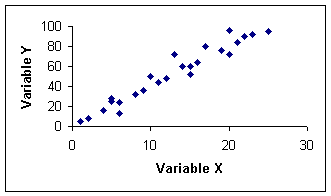
64.
What type of association does this graph have?
a)
Strong positive
b)
Strong negative
c)
none
d)
Weak negative
65.
All of the following choices are valid correlation coefficient or r-values except:
a)
0.05
b)
-1.999
c)
-1.0
d)
0.23
66.
Dr. Schulte wants to investigate if aggressive behavior in children is increased if they view violent videos.  In this instance, the dependent variable is
a)
violent videos
b)
aggressive behavior
c)
a placebo
d)
the control condition
67.
Operational definitions are used for which of the following reasons?
a)
They enable other researchers to replicate studies by precisely describing the variables and how they are used.
b)
They exclude mental processes from being studied, as they are no longer considered part of the scientific study of psychology.
c)
They determine which test of statistical significance will be used to analyze the results of the experiment
d)
They determine whether the experiment is better suited for a laboratory or a field setting
68.
For the following data set, find the MEAN:
5, 7, 3, 5, 1, 9
a)
2
b)
5
c)
7
d)
11
69.
The difference between the highest and lowest scores in a distribution is called the 
a)
mean
b)
median
c)
mode
d)
range
70.
The most frequently occurring number in a distribution.
a)
Mean
b)
Mode
c)
Median
d)
Range
71.
The standard deviation
a)
indicates the average difference between each score in a group and the mean for that group of scores
b)
reveals the degree of skew for a a group of scores 
c)
is sensitive to scores at the extremes of a distribution of scores
d)
is used to determine whether a data set is positively or negatively skewed
72.
At Donald's Donuts the number of donut holes in a bag can vary. Help Donald find the mode.
12,10,10,10,13,12,11,13,10
a)
13
b)
12
c)
11
d)
10
73.
Roger bowled 7 games last weekend. His scores are: 155, 165, 138, 172, 127, 193, 142. What is the range of Roger's scores?
a)
193
b)
127
c)
60
d)
66
74.
Find the mode of these numbers:
4,4,6,6,2,2,6,2,4,2
a)
2
b)
4
c)
6
d)
2.4
75.
Find the median of these numbers:
4,2,7,4,3
a)
2
b)
5
c)
7
d)
4
76.
To find the ______ you put all numbers in order from least to greatest and then take the largest number minus the smallest number.
a)
Mean
b)
Median
c)
Mode
d)
Range
77.
people that define themselves as aspects of groups, to give priority to in-group goals, to focus on context more than the content in making attributions and in communicating, to pay less attention to internal than to external processes as determinants of social behavior,
a)
individualism
b)
collectivism
78.
shown a series of black and white pictures similar to the one below. The person showing you the pictures asks you to create a story by answering four questions about each picture:
1. What's happening now?
2. What led up to it?
3. What are the characters in the story thinking and feeling?
4. How will the story end?
a)
Thematic Apperception Test
b)
Rorschach Inkblot test
79.
The most widely used projective test, a set of 10 inkblots, seeks to identify people's inner feelings by analyzing their interpretations of the blots
a)
Thematic Apperception Test
b)
Rorschach Inkblot test
80.

interaction of behavior, cognitions, and environment make up you.

a)

Collectivistic

b)

Regression

c)

Reciprocal Determinism

d)

Locus of Control

81.

belief that one can succeed, so you ensure you do

a)

Self esteem

b)

Self efficacy

c)

self concept

82.
the ego's protective methods of reducing anxiety by unconsciously distorting reality
a)
Ego
b)
Defense Mechanisms
c)
psychodynamic
83.
type of statistical procedure that is conducted to identify clusters or groups of related items (called factors) on a test
a)
fixation
b)
factor analysis
c)
false consensus effect
84.
overestimation of how much other people share our beliefs and behaviors
a)
free association
b)
Ignorance of one incompetence phenomenon
c)
inferiority complex
d)
false consensus effect
85.

Therapist reads aloud a list of words; you respond w/o hesitation no filter.

a)

Ink Blot

b)

MMPI

c)

Transference

d)

Free Association

86.

replace a less acceptable reasoning with a more acceptable one (don’t get into your college – justify it was a sucky college anyway)

a)

Regression

b)

Displacement

c)

Rationalization

d)

Sublimination

87.

According to the "Big 5" of Personality Traits, people who score high in ____ tend to be sympathetic, trusting, cooperative, and modest.

a)

neuroticism

b)

extraversion

c)

conscientiousness

d)

agreeableness

88.

According to the "Big 5" of Personality Traits, people who score high in ____ are characterized as anxious, hostile, self-conscious, insecure, and vulnerable.

a)

neuroticism

b)

extraversion

c)

conscientiousness

d)

openness to experience

89.
Charles has an anger problem, so he joins athletics so he can have a positive outlet for his anger.
a)
regression
b)
sublimation
c)
rationalization
d)
compensation
90.
The idea that a male child desires his mother and fears his father illustrates the
a)
genital complex
b)
latency complex
c)
Oedipal complex
d)
Electra complex
91.
Ned is generally uptight and very neat.  Freud would say Ned is
a)
orally fixated
b)
fixated at the anal stage
c)
fixated at the phallic stage
d)
fixated at the genital stage
92.
Alan is failing his math class.  He blames the teacher and the fact that he has to work at night.  Alan
a)
Has high self efficacy
b)
Has external locus of control
c)
Has internal locus of control
d)
is engaging in sublimation
93.
The best personality inventory for assessing mental illness symptoms as well as traits.
a)
TAT
b)
Rorschach
c)
Myers-Briggs
d)
MMPI
94.

What is the most important stage in the hierarchy of needs according to Maslow?

a)

Self-Esteem

b)

Love and Belonging

c)

Self-Actualization

d)

Safety and Security

95.

According to the "Big 5" of Personality Traits, people who score high in ____ are characterized as outgoing, sociable, upbeat, friendly, and assertive.

a)

neuroticism

b)

extraversion

c)

concientousness

d)

openness to experience

96.

Hereditary/Inborn aspects of personality, including sensitivity, moods, irritability, and adaptability

a)

Personality Type

b)

Self-Concept

c)

Temperament

d)

Character

97.
theory dates back to Hippocrates and has of a 5 factor model of personality by Allport, Cattell
a)
psychoanalytic theory
b)
social learning theory
c)
sociocultural theory
d)
trait theory
98.
The cognitive view of psychology 
a)
subscribes to the idea that thoughts and actions arise from the way we interpret experiences
b)
has a special interest in how the operation of your brain influences personality
c)
has a special interest in mental health and disorders
d)
bananas, B-a-n-a-n-a-s
99.
Professor Hernandez approaches questions about human behavior from a perspective that emphasizes unconscious processes within the individual, such as inner forces or conflicts. It is most likely that she accepts which of the following psychological approaches?
a)
social-cognitive learning
b)
 learning
c)
cognitive approach
d)
psychodynamic approach
100.
Which school of psychology would most likely have written a book titled The Whole is More than the Parts?
a)
Cognitive
b)
Gestalt
c)
Evolutionary
d)
Behavioral
101.

Which psychological perspective would be most interested in studying our brain structures & chemistry, genetics, glands, etc.?

a)

Biological/Neuroscience

b)

Structuralism

c)

Functionalism

d)

Humanistic