wayground logo

Free Printable Worksheets

NEW

Font size

S
M
L
XL
Worksheets

Scientific Processes

Total questions: 63

Worksheet time: 53mins

Name
Class
Date
1.
If you are not sure what to do during a lab activity:
a)
guess
b)
change lab partners
c)
ask a teacher
d)
just sit quietly and do nothing
2.
Disrupting other students in the laboratory with horseplay in the lab is:
a)
helpful.
b)
allowed
c)
dangerous.
d)
the quickest way to do a job.
3.
You should report accidents to the teacher __.
a)
after the class is over
b)
immediately 
c)
the following day
d)
never
4.

Bob and Lizzy are working in the lab. They are goofing off and break a glass test tube. Which rule did they break?

a)

Know the location of the safety equipment.

b)

Do not eat or drink in the lab.

c)

Read instructions.

d)

No Horseplay

5.
10.5 cm = ______m
a)
.105
b)
10
c)
105
105
d)
1,000
6.
1 Km = ______m
a)
1
b)
10
c)
100
d)
1,000
7.
34 cm = ? mm
a)
340
b)
3400
c)
0.34
d)
3400
8.
4 m = ? cm
a)
4367
b)
245
c)
400
d)
4000
9.
The base unit for volume is the
a)
second
b)
gram
c)
meter
d)
liter
10.
The base unit for length is the
a)
second
b)
gram
c)
meter
d)
liter
11.
The base unit for mass is the
a)
meter
b)
gram
c)
kilogram
d)
liter
12.
What is the abbreviation for centimeter?
a)
c
b)
cm
c)
m
d)
km
13.
The metric system is based on multiples of:
a)
100
b)
20
c)
10
d)
1
14.
What does the abbreviation km stand for?
a)
kilo
b)
kilometer
c)
kilogram
d)
meter
15.
1000 grams = _____ kilograms
a)
0.0001
b)
1,000,000
c)
10
d)
1
16.
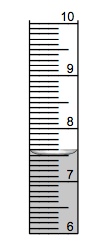
What is the volume of the liquid in this graduated cylinder?
a)
8.5 mL 
b)
7.5 mL 
c)
8 mL 
d)
.1 mL
17.
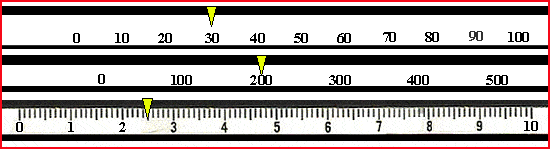
What is the mass on the triple beam balance? 
a)
232.5
b)
237.0
c)
750.
18.
What is the mass on the triple beam balance? 
a)
206.0
b)
260.0
c)
200.6
19.

Mr. Franklin filled a bucket with water to clean the floor. What would be the best unit of measure for the water in the bucket?

a)

liters

b)

milliliters

c)

grams

d)

centimeters

20.
5 L = ____ mL
a)
500
b)
5,000
c)
50
d)
5
21.
1000 mg = _____g
a)
0.001
b)
1
c)
1,000,000
d)
100
22.
To go from kilograms to grams, move the decimal point to the__
a)
left
b)
right
23.
The Metric System is also known as the International System, SI.
a)
True
b)
False
24.
Is 20 g greater than, less than, or equal to 2 kg?
a)
greater than
b)
less than
c)
equal to
25.
648 g = ____ mg
a)
6,480
b)
64,800
c)
648,000
d)
64.8
26.
This variable in an experiment is the one being deliberately changed by the scientist. 
a)
dependent variable
b)
independent variable
c)
data
d)
control group
27.
There are two types of data. Which type of data involves numbers that are obtained by counting or measuring?
a)
quantitative
b)
qualitative
28.
The summary at the end of an experiment that explains the results. 
a)
conclusion
b)
procedures
c)
materials
d)
responding variable
29.
There are two types of data. Which type of data involves descriptions/photographs/illustrations that cannot be counted or measured?
a)
qualitative
b)
quantitative
30.
A series of steps used by scientists to solve a problem or answer a question. 
a)
scientific method
b)
recipe
c)
data collection
d)
metric system
31.

In a experiment, how many variables should be changed or tested?

a)

one

b)

none

c)

two or more

d)

how ever many makes sense.

32.
Which statement is an inference about this picture?
a)
The van is tan.
b)
The  van ran into KFC. 
c)
The driver was hungry. 
d)
Red and white are part of the KFC building. 
33.
Measuring the number of times a person breathes after exercise involves ____ data. 
a)
quantitative
b)
qualitative
34.
Jane Goodall video recorded chimpanzees hunting pigs, this type of data is called ___
a)
qualitative
b)
quantitative
c)
field study
d)
observation
35.
Mr. S. sets up an experiment to see how the mass of a ball affects the distance it rolls off a ramp.  Identify the independent variable.
a)
distance traveled by the ball
b)
height of the ramp
c)
mass of the ball
d)
weight of the ball
36.
A student is planning an experiment to find out how the height from which he drops a ball affects how high the ball bounces. The dependent variable is the _____.
a)
Diameter of the ball
b)
Force acting on the ball
c)
Height that the ball bounces
d)
Height from which the ball is dropped
37.
An experiment is performed on plants to see how different liquids affect plant growth. Each plant in the experiment is given a different liquid; water, apple juice, or milk. Each plant has the same amount of soil, sunlight, and listens to the same music. In this investigation, what is the dependent variable?
a)
Type of plant
b)
Water, apple juice, milk
c)
Plant growth
d)
Color of the plant's leaves
38.

If I study for my scientific method quiz, then I will have a better test score. What is the responding variable?

a)

Scientific Method

b)

Studying

c)

Independent variable

d)

Test score

39.
What is a hypothesis?
a)
A hypothesis is the right answer to an experiment.
b)
A hypothesis is the wrong answer to an experiment.
c)
A hypothesis is an educated guess.
d)
I don't know.
40.
What step does every scientific experiment begin with?
a)
hypothesis
b)
question/problem
c)
procedures
d)
conclusion
41.
This part of the experiment serves as a basis of comparison; the one variable being tested has been omitted. 
a)
experimental group
b)
control group
c)
data
d)
variables
42.
Why do we want to test only one independent variable at a time?
a)
Because it is hard to setup a data table with more than one variable
b)
To better identify what is causing the changes
c)
It is what has always been done
d)
It's easier to perform the experiment
43.
Should experiments be repeated over and over to see if the results are the same each time?
a)
yes
b)
no
44.
The name of the information that you get from your experiment (you organize it into charts and graphs).
a)
observations
conclusion
b)
data
c)
variables
d)
hypothesis
45.
Dependent variable means
a)
the scientist controls what to test
b)
educated guess
c)
ask a question
d)
what is being measured
46.

What is an observation?

a)

A scientific statement based on ideas

b)

Using your senses to notice what is going on around you

c)

To be unaware of your surroundings

d)

The question that you want an answer to.

47.
Information gathered using your 5 senses.
a)
Observation
b)
Inference
48.
The girl is folding her arms.
a)
Observation
b)
Inference
49.
They are robbing a bank.
a)
Observation
b)
Inference
50.
The girl does not want to eat her vegetables.
a)
Observation
b)
Inference
51.
There are bars  on the windows.
a)
Observation
b)
Inference
52.
The man in the headlock is a fireman.
a)
Observation
b)
Inference
53.

Any factor that can change in an experiment is known as a

a)

hypothesis

b)

variable

c)

inference

d)

observation

54.

The factors in an experiment that must remain the same for both the experimental and control groups are called

a)

constants

b)

independent variables

c)

dependent variables

55.

How do you determine the volume of a block of wood?

a)

water displacement

b)

use a triple beam balance

c)

multiply length x width x height

56.
A scientists is testing the effect of a chemical on apple growth. he sprays the orchard with the chemical. The second orchard does not receive the chemical being tested. What is the IV?
a)
The second orchard
b)
The # of apples
c)
the tree
d)
the chemical
57.

What are the SI base units?

a)

inches, feet, miles

b)

ounces, pints, gallons

c)

meter, liter, gram, seconds

d)

a bushel and a peck

58.

Which is the most accurate tool for measuring volume?

a)

beaker

b)

flask

c)

graduated cylinder

d)

triple beam balance

59.

Which is typically the first step in an investigation?

a)

Question

b)

Hypothesis

c)

Experiment

d)

Conclusion

60.

Which group in an experiment is not tested?

a)

experimental

b)

control

c)

variable

d)

data

61.

Josh wrote down the temperature every day last week during football practice. He collected

a)

quantitative data

b)

qualitative data

c)

variables

d)

inferences

62.

What is this tool and what does it measure?

a)

triple beam balance, weight

b)

scale, mass

c)

triple beam balance, mass

d)

scale, length

63.

Which is the best hypothesis?

a)

I will study and do great on this test!

b)

I think that I will make an A on the test.

c)

If I study hard, then I will do well.

d)

If I take the Quizizz 3 times, then I will score over a 90% on the test because I will know the material.