wayground logo

Free Printable Worksheets

NEW

Font size

S
M
L
XL
Worksheets

Chapter 2 test review

Total questions: 54

Worksheet time: 1hrs 11mins

Name
Class
Date
1.

What is the length of this screw?

a)

5.01 cm

b)

5.10 cm

c)

5.2 cm

d)

5.1 cm

2.

What mass does the balance display?

a)

27.70 grams

b)

27.7 grams

c)

277 grams

d)

207 grams

3.

What is the reading on the measuring cylinder shown?

a)

8.000 mL

b)

8.50 mL

c)

8.00 mL

d)

8.0 mL

4.

When measuring the length of this red line with the metric ruler provided, the first decimal place that is uncertain is:

a)

tenths of a centimeter

b)

thousandths of a centimeter

c)

hundredths of a centimeter

d)

meters

5.
How would you write 4.3756 x 10in standard form?
a)
437,560,000
b)
0.00043756
c)
43,756
d)
4,3756
6.
How would you write 0.0005 in scientific notation?
a)
50 x 105
b)
5 x 10⁴
c)
5 x 10³
d)
.5 x 103
7.
When writing a number in scientific notation, the first number must be greater than 1, but less than 10.
a)
False
b)
True
8.
How do you write
8.317 x 10⁶
in standard form?
a)
8, 371, 000
b)
83, 170, 000
c)
837, 100
d)
8, 317, 000
9.
Express the following in scientific notation:
.000045
a)
4.5 x 10⁻⁵
b)
45 x 10-6
c)
4.5 x10⁵
d)
45 x 106
10.
Express the following in scientific notation:
10,030,400,000
a)
1.00304 x 10⁹
b)
1.00304 x 10¹⁰
c)
1.00403 x 10¹⁰
d)
1.00304 x10⁻¹⁰
11.

Which of the following numbers has 4 sig figs?

a)

0.089

b)

5000

c)

0.009540

d)

7.1001

12.

Round the following number to 3 decimal places:


9.123456789

a)

9.12

b)

9.123

c)

9.1235

d)

none of the options

13.

Round the following to 2 sig figs:


8.75

a)

8.8

b)

8.7

c)

8.5

d)

8

14.

Which of the following describes a circumstance when a zero IS NOT significant

a)

When it is at the end of a number, and that number contains a decimal point.

b)

When it is in between nonzeros

c)

When it begins the number

15.
Multiply:
(9.4 x 10⁶)(3.2 x 10⁵)
a)
30.08 x 10¹¹
b)
3.8 x 101
c)
3.008 x 10¹²
d)
2.9375 x 101
16.
Multiply:
(3.4 x 10⁵)(1.2 x 10⁻³)
a)
4.08 x 10⁻⁸
b)
4.8 x 10²
c)
4.08 x 10²
d)
4.08 x 10⁻¹⁵
17.
Solve: 
(6 × 10⁶) ÷ (2 × 103)
a)
12 x 103
b)
3 x 10⁹
c)
1.2 x 10⁴
d)
3 x 10³
18.
Evaluate and write answer in scientific notation.
(9 x 10¹⁸) ÷ (3 x 10¹⁶)
a)
3 x 10²
b)
6 x 10²
c)
27 x 1034
d)
3 x 1034
19.
Divide:
(6.9 × 107) ÷ (2.3 × 10-3)
a)
3 x 10¹⁰
b)
3 x 10⁴
c)
3 x 10⁻⁴
d)
3 x 10-11
20.

How many significant figures are in the following number: 1020 m

a)

1

b)

2

c)

3

d)

4

21.

How many significant figures are in the following number: 0.0045 g

a)

2

b)

3

c)

4

d)

5

22.

How many significant figures are in the following number: 1.00050

a)

2

b)

3

c)

5

d)

6

23.

How many significant figures are in the following number: 5000 mL

a)

1

b)

2

c)

3

d)

4

24.

What is the volume of the graduated cylinder?

a)

44 mL

b)

45 mL

c)

44.8 mL

d)

44.80 mL

25.
How many sig figs in the number 101?
a)
1
b)
2
c)
3
d)
Only Ronald McDonald knows for sure.
26.
How many sig figs in the number 100?
a)
1
b)
2
c)
3
d)
As many as you want there to be.
27.
Calculate 1.23 m x 0.89 m and give your answer with the appropriate number of significant figures.
a)
1.0 m2
b)
1.1 m2
c)
1.0947 m2
d)
1.09 m2
28.
24.4 / 2.2
a)
11.1
b)
11.09
c)
11
d)
11.091
29.
Calculate 12.34 + 1.234 + 0.1234
a)
13.6974
b)
13.697
c)
13.70
d)
13.7
30.
Calculate 5.50 cm + 5.50 cm
a)
11 cm
b)
11.0 cm
c)
11.00 cm
d)
11.000 cm
31.
What is the correct SI unit for mass?
a)
Kilograms
b)
newtons
c)
pounds
d)
grams
32.
The SI unit for temperature is __?__.
a)
degree fahrenheit  (° F)
b)
degree celsius  (° C)
c)
kelvin  (K)
d)
degree centigrade  (°C)
33.

The SI unit for time is the __?__.

a)

hours (h)

b)

liter (L)

c)

gram (g)

d)

second (s)

34.

What SI unit is used to measure length?

a)

meters

b)

liters

c)

centimeters

d)

kilograms

35.
What prefix is represented by the following symbol:  k
a)
hecto
b)
kilo
c)
deci
d)
deka
36.

What prefix is represented by the following symbol: m

a)

hecto

b)

kilo

c)

milli

d)

mega

37.
Convert 12 km to m
a)
120 m
b)
1,200 m
c)
12,000 m
d)
120,000 m
38.
Convert 5720 cm to km
a)
0.0572 km
b)
0.572 km
c)
5.72 km
d)
57.2 km
39.
The amount of space an object takes up or the amount of space something contains
a)
volume
b)
weight
c)
mass
d)
force
40.
Grams (g), Kilograms (kg), Milligrams (mg)
a)
metric (SI) Units for mass
b)
metric (SI) Units for force
c)
metric (SI) Units for volume
d)
metrics (SI) Units length
41.
Metric (SI) Unit for liquid volume
a)
millimeters, meters, centimeters
b)
grams, kilograms, milligrams
c)
milliliters, liters
d)
Newtons
42.
How many cm are in 1 km?
a)
100000 cm
b)
1 cm
c)
10000 cm
d)
100 cm
43.
285 kg = ____ g
a)
285,000
b)
285
c)
2,850
d)
28,500
44.
Convert 0.25 m to mm
a)
25
b)
2.5
c)
250
d)
0.025
45.
8.3 kg = ______g
a)
.083g
b)
830g
c)
83g
d)
8,300g
46.
How many cg are in a g?
a)
10
b)
100
c)
1000
d)
1 000 000
47.
How many dL are in a L?
a)
10
b)
100
c)
1000
d)
1 000 000
48.
Convert the following SI Units:  3.2 km to meters
a)
32
b)
320
c)
3200
d)
32000
49.
It is a measure of how close measurements come to each other when they are made in the same way
a)
Accuracy
b)
Precision
c)
Error
d)
Extrapolation
50.
An irregularly-shaped sample of aluminum (Al) is put on a balance and found to have a mass of 43.6 g.  The student decides to use the water-displacement method to find the volume.  The initial volume reading is  25.5 mL and, after the Al sample is added, the water level has risen to 41.7 mL.  Find the density of the Al sample in g/cm3.  (Remember:  1 mL = 1 cm3.)
a)
1.7 g/mL
b)
1.05 g/mL
c)
0.65 g/mL
d)
2.7 g/mL
51.
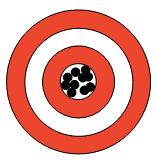
This bullseye demonstrates...
a)
High Accuracy & High Precision
b)
High Accuracy & Low Precision
c)
Low Accuracy & High Precision
d)
Low Accuracy & Low Precision
52.
When a measurement is repeatable and consistent it is said to have...
a)
High precision
b)
Low precision
c)
High accuracy
d)
Low accuracy
53.
A set of data are all close to each other, but they are not close to the actual value.  This set of data can be described as...
a)
accurate
b)
precise
c)
both precise and accurate
54.
?
a)
High Accuracy & High Precision
b)
High Accuracy & Low Precision
c)
Low Accuracy & High Precision
d)
Low Accuracy & Low Precision