Wayground logo

Free Printable Worksheets

Font size

S
M
L
XL
Worksheets

AP Macro Fundamental Economics

Total questions: 40

Worksheet time: 28mins

Name
Class
Date
1.
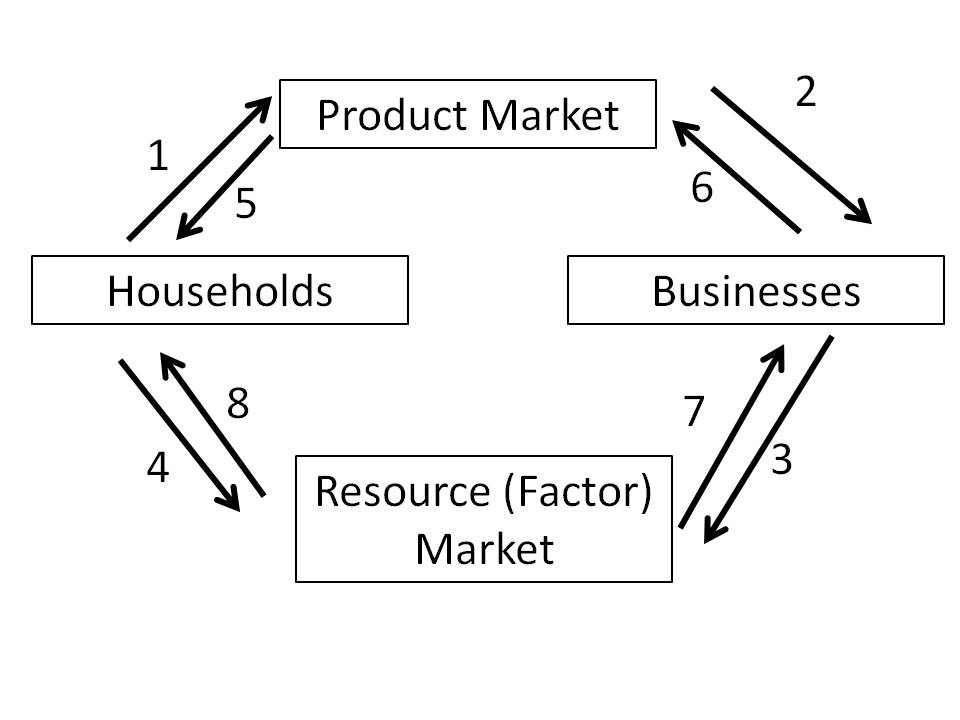
Which statement is true about the circular flow diagram?
a)
A  Households are demanders in the product market and suppliers in the factor market
b)
A  Business are demanders in the product market and suppliers in the factor market.
c)
A  Households are demanders in the factor market and suppliers in the product market.
d)
 A  Businesses and households are not components of the circular flow diagram.
2.
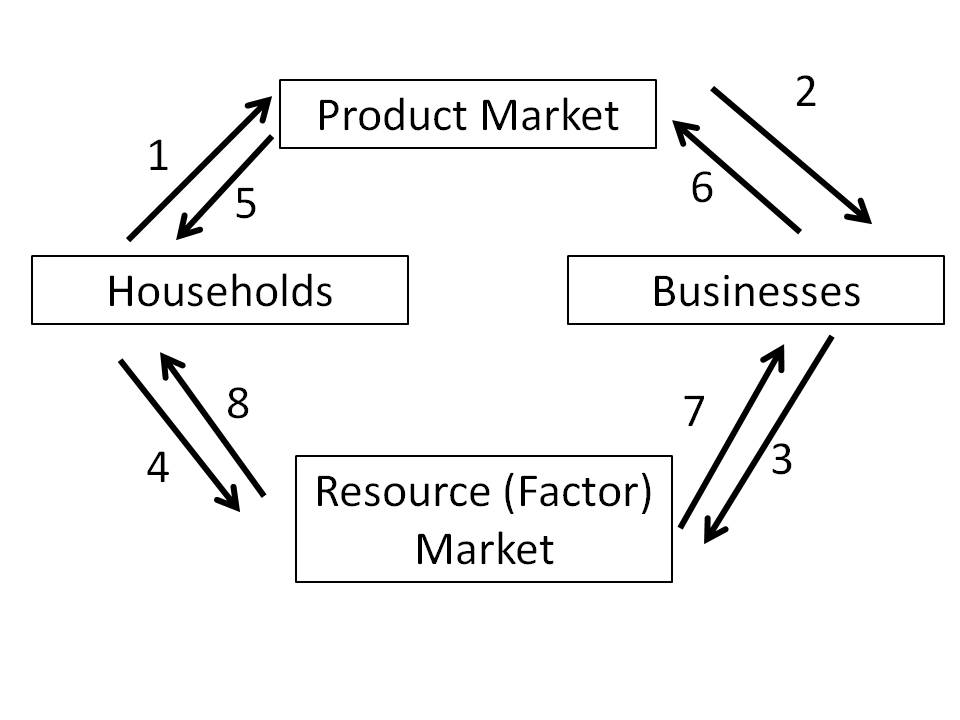
Which arrows on this diagram would represent the transaction between Joe who rents his office to Homework Inc., a company that provides tutoring services?
a)
2,3
b)
4,7
c)
1,2
d)
5,6
3.
Arrows 4 and 7 on this circular flow diagram demonstrate
a)
prices
b)
taxes
c)
goods and services flow
d)
money flow
4.
The arrows 1 to 2 in this diagram represent which aspect of the economy?
a)
goods and services flow
b)
money flow
c)
taxes
d)
factors of production
5.
Place where buyers and sellers meet to exchange goods and services for money
a)
Market
b)
Factor of production
c)
Money
d)
Interdependent
6.
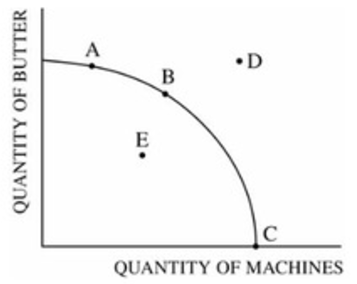
The diagram shows the production possibilities curve for Country Y. Which of the following statements is true?
a)
If Country Y is producing at point C, it is using all its resources efficiently
b)
The opportunity cost of producing more machines is constant
c)
Country Y cannot produce at point E
d)
The most efficient point of production is point D
7.
The simplified production possibilities curves for country A and B are shown. Which one of the following statements is correct?
a)
Country A has the comparative advantage in both goods
b)
Country A has the comparative advantage in chairs & Country B has the comparative advantage in shirts
c)
Country B has the absolute advantage in shirts only
d)
Country A has the comparative advantage in shirts & Country B has the comparative advantage in chairs
8.
Two alternative production possibility frontiers for apples and wheat are shown in the figures. As more wheat is produced, how will the opportunity cost of producing wheat, as represented in Figures 1 and 2, be affected? 
a)
Figure 1: Decrease / Figure 2: Increase
b)
Figure 1: Increase / Figure 2: Decrease
c)
Figure 1: No Change / Figure 2: Increase
d)
Figure 1: No Change / Figure 2: Decrease
9.
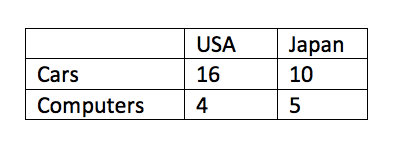
Based on the table provided, which one of the following statements is correct?
a)
Japan has the absolute advantage in producing cars
b)
Japan has the comparative advantage in producing cars
c)
The United States has the absolute advantage in producing both cars and computers
d)
The opportunity cost of producing a car in Japan is 1/2 a computer
10.
Which of the following constitute the fundamental questions every economic system must answer?
a)
I, III, V only
b)
I, II, and IV only
c)
I, II, and V only
d)
II, IV, and V only
11.
The four types of economic systems are: 
a)
Traditional, Command, Mixed, & Market
b)
Traditional, Command, Combined, & Market
c)
Communism, Capitalism, Free Market, and Macroeconomics
d)
Microeconomics, Macroeconomics, Individual, and Traditional.
12.
Which of the following is an economic system in which the government and people are used to decide how to use scarce resources?
a)
Market economy
b)
Command economy
c)
Traditional economy
d)
Mixed economy
13.
What type of economy do most countries in the world have?
a)
Market economy
b)
Command economy
c)
Traditional economy
d)
Mixed economy
14.
Which of the following is an economic system in which economic decisions are made according to social roles & culture?
a)
Market economy
b)
Command economy
c)
Traditional
Traditional economy
d)
Mixed
Mixed economy
15.
In the economy of the Bushmen of the Kalahari Desert the people follow the examples of their ancestors.  This is what kind of economy? 
a)
Traditional 
b)
Market 
c)
Command 
d)
Centrally planned 
16.
The Country of North Korea has a dictator that makes all of the economic decisions. What type of economy is this?
a)
Traditional 
b)
Market 
c)
Command 
d)
Centrally Planned 
17.

The economic problem is that

a)

resources are limited and wants are limited.

b)

resources are unlimited and wants are limited.

c)

resources are limited and wants are unlimited.

d)

resources are unlimited and wants are unlimited.

18.

The opportunity cost of Australian households moving away from coal-powered energy to solar-powered energy includes (i) the loss of jobs in the coal industry, (ii) a cleaner environment, (iii) reduced coal production.

a)

(i), (ii) and (iii)

b)

(ii) and (iii)

c)

(iii) only

d)

(i) and (iii)

19.

A firm operating at 'X' produces 70 whips and 60 saddles. It changes production to 'Y' producing 20 whips and 90 saddles. The opportunity cost of this production change is

a)

20 whips

b)

30 saddles

c)

50 whips

d)

60 saddles

20.

The production possibility curve shows

a)

alternative combinations of two goods that an economy is capable of producing.

b)

the actual levels of production of two goods that the economy is achieving.

c)

alternative combinations of productive resources that can be used to produce two goods.

d)

the total value of two goods produced in one time period.

21.
The US can produce 200 airplanes or 400 trucks. Japan can produce 300 trucks or 100 airplanes. 
Which country has the comparative advantage in producing trucks and what is their opportunity cost? 
a)
Japan, 1/3 airplane per truck
b)
US, 1/2 airplane per truck
c)
US, 2 airplanes per truck
d)
Japan, 3 airplanes per truck
22.
I decided to attend a specialty high school that offered experience in fixing cars so I could be an auto mechanic when I get older.  I’ve wanted to be one since I was a little kid.
a)
security
b)
equity
c)
stability
d)
freedom
23.
Economics is the study of how people seek to satisfy their needs and wants by making choices.
a)
True
b)
False
24.
Something that causes a consumer to purchase a good or service is called:
a)
Promotion
b)
Incentive
c)
Sale
d)
The right decision
25.
This is the reason we have to make choices.
a)
Scarcity
b)
Shortages
c)
Opportunity Costs
d)
Trade offs
26.
What is the difference between a shortage and scarcity? 
a)
A shortage is temporary but scarcity always exists 
b)
A shortage results from rising prices; scarcity results from falling prices 
c)
A shortage is lack of all goods and services; scarcity concerns a single item 
d)
There is no real difference between a shortage and scarcity
27.
Which of the following shifts a PPC outward
a)
influx of immigrants
b)
increase in unemployment
c)
increase in resource costs
d)
increase in technology
28.
When a point lies inside of the PPF it can be said that
a)
Resources are under employed
b)
Resources are fully utilize
c)
Production is beyond the resource potential
d)
Opportunity cost of production is constant
29.
Division of labor is a characteristic of 
a)
home craft businesses
b)
assembly line production
c)
classroom education
d)
entrepreneurship
30.
In the time period covered by the production possibilities curve, the company decides to make 4 gallons of red paint. How many gallons of blue paint can the company make with the available time and resources?
a)
2
b)
3
c)
6
d)
8
31.

Which factor is most commonly associated with highly skilled jobs?

a)

Price floors

b)

capital goods

c)

opportunity costs

d)

technological abilities

32.

What does a production possibilities curve show?

a)

demand for two goods

b)

the cost of producing to two goods

c)

the trade-off faced by producers of two different goods

d)

the amount of resources used to produce two goods

33.

How will producers use a production possibilities curve?

a)

to determine opportunity of producing two goods

b)

to determine the profit that can be made by producing two goods

c)

to determine the number of inputs that are required to produce two goods

d)

to determine the number of employees needed to produce two goods

34.

The main role of the government in a command economic system is

a)

promoting business entrepreneurship

b)

encouraging private markets

c)

adopting import quotas to enforce

d)

allocating raw materials for production use

35.

Which of these best explains when rational decisions occur in economics

a)

when marginal costs are small

b)

when marginal benefits decrease over time

c)

when marginal benefits are greater than or equal to marginal costs

d)

when marginal costs increase and marginal benefits remain constant

36.

What is always associated with an economic decision?

a)

an opportunity cost

b)

a tariff rate

c)

monetary cost

d)

exchange rate

37.

Allen is working a summer job to earn money for college in the fall. Which two activities will most help him reach his goal?

a)

saving money

b)

getting a loan

c)

reducing spending

d)

managing time

e)

increasing expenses

38.

Country X has a lower opportunity cost of producing apples than Country Y. Based on the information provided what is the most reasonable conclusion about these countries?

a)

Country Y should specialize in producing apples

b)

Country X should specialize in producing apples

c)

Country Y has an absolute advantage over Country X in producing apples

d)

Country X has an absolute advantage over Country Y in producing apples

39.

Why do investments in human capital lead to a higher standard of living?

a)

Greater productivity leads to a higher income

b)

Higher debt leads to more income redistribution

c)

More specialization leads to greater price stability

d)

Increased government spending leads to more competition

40.

Country X and Country Y can produce either beef or wheat but not both. Country X produces beef and trades it with Country Y for wheat. What economic situation exists to allow both countries to enjoy both products?

a)

trade embargo

b)

balance of trade

c)

absolute advantage

d)

comparative advantage